
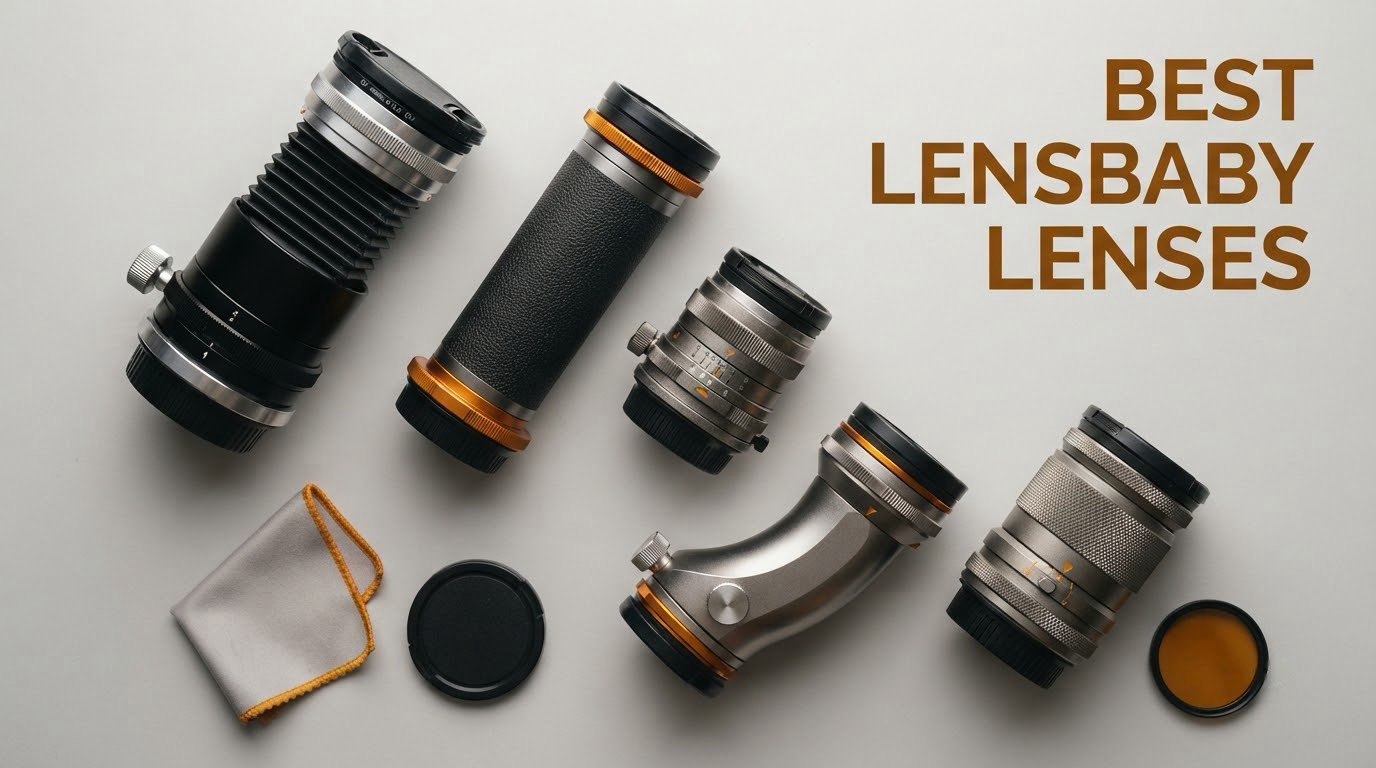
A Lensbaby lens is a manual-focus lens built around a ball joint instead of a normal optical formula. Swing the glass around the sensor and you get a curved band of sharp focus with blur sweeping away from it, which is how you get a sweet spot, a swirl, or a soft glow without buying a dedicated tilt-shift lens that costs several times more. That is the whole pitch, and it is a narrower pitch than it sounds. After putting all eight of the lenses in this roundup through their paces, the best Lensbaby lenses split cleanly into two groups: standalone fixed lenses that just mount and shoot, and swappable optics that need a Composer cradle to do anything.
That split matters more than any spec sheet, because a lot of first-time buyers misread the catalogue and end up buying an optic with nothing to put it in. A fixed lens like the Sol 45 or the Spark 2.0 is a complete product. An optic like the Sweet 50, the Twist 60, the Edge 50 or the Edge 35 is a component, and it needs a Lensbaby body such as the Composer Pro II before it will mount to your camera. Get that wrong and the purchase is dead on arrival, so we spell out which is which in every section below.
If you want a wider view of the glass on your shelf right now, our picks for conventional primes are in the [best camera lenses roundup](https://bansocialism.com/best-camera-lenses/). What follows stays entirely inside the creative lens category, because that is where the useful decisions live. We rated all eight on the three things that actually decide whether you will keep using one: how forgiving the effect is, how wide the useful range of subjects is, and how much patience the manual focusing demands.
Table of Contents
- Top 3 Best Lensbaby Lenses (October 2026)
- All 8 Lensbaby Lenses Compared Side by Side
- What Is the Best Lensbaby Lens?
- 1. Lensbaby Velvet 56 for Canon EF – Soft Glow for Portraits and Macro
- 2. Lensbaby Sol 45 for Canon EF – A Fixed-Aperture Sweet Spot
- 3. Lensbaby Twist 60 Optic – The Swirl Effect
- 4. Lensbaby Sweet 50 Optic – The Classic Curved Sweet Spot
- 5. Lensbaby Edge 50 Optic – A Flat Slice of Focus
- 6. Lensbaby Velvet 85 for Sony E – Soft Glow at 85mm
- 7. Lensbaby Spark 2.0 for Canon EF – A Compact Tilt-Shift Body
- 8. Lensbaby Edge 35 Optic – A Wide Slice of Focus
- How to Choose: Cradle Body, Standalone Optic or Fixed Lens?
- Mount Compatibility: Which Lensbaby Fits Your Camera?
- How Aperture Changes the Effect Strength?
- Lensbaby vs a Real Tilt-Shift Lens, and Who Should Skip One
- Frequently Asked Questions
- Conclusion: Our Best Lensbaby Picks for 2026
Top 3 Best Lensbaby Lenses (October 2026)

The Velvet 56 takes the top slot because it carries the largest body of owner feedback in the entire line and holds a 4.3 average across 61 reviews, which is more evidence than anything else here. The Sol 45 is the pick if you want the shortest learning curve and the friendliest price. The Twist 60 is the one to buy if the swirl is the reason you are reading this, and it is the only optic here with a full 12-blade diaphragm behind that swirl.
All 8 Lensbaby Lenses Compared Side by Side
| Product | Key Specs | Pricing |
|---|---|---|
 Lensbaby Velvet 56 for Canon EF Lensbaby Velvet 56 for Canon EF |
|
Check Latest Price |
 Lensbaby Sol 45 for Canon EF Lensbaby Sol 45 for Canon EF |
|
Check Latest Price |
| Lensbaby Twist 60 Optic |
|
Check Latest Price |
 Lensbaby Sweet 50 Optic Lensbaby Sweet 50 Optic |
|
Check Latest Price |
 Lensbaby Edge 50 Optic Lensbaby Edge 50 Optic |
|
Check Latest Price |
 Lensbaby Velvet 85 for Sony E Lensbaby Velvet 85 for Sony E |
|
Check Latest Price |
 Lensbaby Spark 2.0 for Canon EF Lensbaby Spark 2.0 for Canon EF |
|
Check Latest Price |
 Lensbaby Edge 35 Optic Lensbaby Edge 35 Optic |
|
Check Latest Price |
What Is the Best Lensbaby Lens?
The Lensbaby Velvet 56 is the best overall, because it delivers a controllable soft glow, works at portrait and macro distances, and has the deepest owner review base of any lens in the line. Here is how the current lineup maps to shooting style:
Velvet 56 for dreamy glow portraits and macro.
Velvet 85 for tighter, more flattering portrait framing on full frame.
Sweet 50 for the classic curved sweet spot with the widest aperture range.
Edge 50 for a clean, straight slice of focus and miniature effects.
Edge 35 for wider scenes, street work and travel.
Twist 60 for a rotating swirl around a sharp centre.
Sol 45 for a fixed-aperture sweet spot you can learn in an afternoon.
Spark 2.0 for a compact tilt-shift body with a strong glow.
1. Lensbaby Velvet 56 for Canon EF – Soft Glow for Portraits and Macro
Lensbaby – Velvet 56 – for Canon EF – Soft and Velvety Effect – Perfect for Macro and Portraits – Glow Effect
★★★★★★★★★★56mm f/1.6
Canon EF and EF-S mount
62mm filter thread
0.4 kg
- Soft velvety glow at wide apertures
- Dreamy vintage sheen through the blur
- Close focus supports macro work
- Includes a lens case and cap
- Manual exposure control only
- No image stabilization
- Canon EF mount only
The Velvet 56 is the one I would hand to a photographer who has never used a creative lens and wants to be impressed on the first shoot. At 56mm it frames a head and shoulders without the crowding you get from the 85mm, and the f/1.6 opening gives you a very shallow plane of focus to work with. The glow is not a gimmick filter layered on top; it comes from how the optic renders the out-of-focus areas, so it holds together in a straight frame rather than only at the frame edges.
What surprised me most was how little the effect fights me. There is no aperture ring to manage, and the manual exposure is straightforward. Focus is manual, and at f/1.6 the depth of the sharp zone is thin enough that you will want a tripod for anything but daylight-speed shutter work. The 62mm filter thread is one of the larger front elements in the line, which gives you room to stack a variable ND or a close-up diopter without hunting for a step-down ring.

Owners consistently describe the rendering as buttery rather than smeared, and the same phrase keeps appearing in the reviews: complex, dreamy images with a vintage sheen. That is exactly what makes it work on food, still life and styled portraits as readily as on faces. The zoom ratio is listed as 1:1, which simply means the framing is a fixed 56mm, so plan your compositions around a single angle of view.
Reviewers also note that the blur stays controlled around the subject rather than dissolving the whole frame, which is the failure mode that makes weaker effect lenses look like a mistake. The catalogue positions it for both macro and portrait work, and 68% of the 61 reviews are five star, which is a strong signal for a manual-focus lens with no autofocus at all.

Check the mount before you commit
This listing is Canon EF and Canon EF-S, which covers Canon DSLRs and Canon mirrorless bodies with an EF card. If you shoot Sony E, Micro Four Thirds or Nikon F, this specific version will not fit your camera and you should read the Velvet 85 section instead for the Sony route. Mount compatibility is the single most common regret in this category, so it is worth two minutes of checking before anything else.
Where it falls short?
There is no image stabilization, so at f/1.6 in low light you are working with a razor-thin focus zone and a shutter speed that will punish you. Manual exposure only means no aperture-based auto ISO assist from the body in some modes, and the lens is a fixed 56mm with no wider option. If you need edge-to-edge sharpness for a client deliverable, this is the wrong tool entirely.
The weight listed is 0.4 kg, which is heavier than the lighter optics here but still fine on a full frame body. Over a full day of portrait work the balance is comfortable, and the case and cap in the box mean you are not hunting for a lens hood the first time you take it outside.
We earn a commission, at no additional cost to you. CERTAIN CONTENT THAT APPEARS ON THIS SITE COMES FROM AMAZON. THIS CONTENT IS PROVIDED 'AS IS' AND IS SUBJECT TO CHANGE OR REMOVAL AT ANY TIME.
2. Lensbaby Sol 45 for Canon EF – A Fixed-Aperture Sweet Spot
Lensbaby – Sol 45 – for Canon EF – Sweet spot – Soft Bokeh – Compatible with a Wide Range of Cameras
★★★★★★★★★★45mm focal length
Fixed f/3.5 aperture
46mm filter thread
150 g
- Simple to tilt and control
- Pleasing results on first use
- Sharp centre with a shiftable sweet spot
- Only 150 g
- Threaded for infrared filters
- Fixed f/3.5 aperture limits sweet spot size
- Manual focus with no autofocus
- Some reports of unbonded internal elements
The Sol 45 is the least complicated creative lens in the catalogue and the one I recommend to anyone nervous about the ball joint. It is a complete fixed lens, so it mounts directly to a Canon EF body with no cradle and no optic swap. The 45mm field of view sits close to a normal prime, which means your framing instincts transfer straight across, and the effect comes from tilting the whole lens rather than from any exotic glass.
Owners call it the easiest of the Lensbaby lenses to tilt and control, and that is accurate. You rock the body, find the band of focus, and you have a picture. The catch is the fixed f/3.5 aperture with an f/5 structured stop listed in the features, which means you cannot change how tight the sweet spot gets. You change the effect by moving closer or further instead, and that is a slower way to work than a real aperture ring.

The weight is 150 g and the body includes a case and a lens cap, so it is the easiest one here to carry on a walk. The 46mm filter thread is a common size, so an infrared filter for creative work fits directly. The manual lists it as usable across disciplines from portraits to macro, and the 1:1 zoom ratio confirms a single fixed focal length.
It holds a 4.5 average across 36 reviews with 74% five star, which is the second-strongest rating in this group behind the Spark 2.0 on a much smaller sample. The recurring negative is build consistency rather than optical performance: a few owners report internal elements that were not properly bonded. That is a quality control note worth keeping in mind, and it is a good argument for checking your unit as soon as it arrives.

Why this is the beginner pick?
Two reasons. The fixed aperture removes one entire variable from the learning curve, so you are only ever managing tilt and focus. And the mount is a plain Canon EF fitting, so there is no cradle to buy, no optic to lose, and no adapter in the equation. If your goal is to find out whether you like this kind of image, this is the fewest moving parts you can get.
Who should skip the fixed aperture?
If you want to shoot the same subject at three different levels of blur in one sitting, the fixed f/3.5 will frustrate you. You will be physically moving the camera instead of turning a ring, and that changes your lighting setup. The 45mm frame is also narrower than the 35mm options in this list, so it is not the tool for a cramped interior or a wide street scene.
Manual focus with no autofocus is the other limitation, though on a lens like this the manual focus is less of a problem than it sounds because you are focusing on a plane, not tracking a subject. It suits still subjects, staged work and anything on a tripod far better than it suits a moving child.
We earn a commission, at no additional cost to you. CERTAIN CONTENT THAT APPEARS ON THIS SITE COMES FROM AMAZON. THIS CONTENT IS PROVIDED 'AS IS' AND IS SUBJECT TO CHANGE OR REMOVAL AT ANY TIME.
3. Lensbaby Twist 60 Optic – The Swirl Effect
Lensbaby Twist 60 (Optic Only)
★★★★★★★★★★60mm f/2.5
12-blade diaphragm
46mm filter thread
100 g
- Twisty swirly blur that separates the subject
- Smooth 12-blade diaphragm bokeh
- 18 inch closest focusing distance
- Textured backgrounds amplify the swirl
- Only 100 g
- Manual focus only
- Swirl stays subtle unless shot wide open
- Optic only and needs a separate Lensbaby body
The Twist 60 is the lens people come to Lensbaby for, and if the swirl is the effect you want, nothing else in the line does it. Instead of a flat or curved band of focus, the optics rotate the out-of-focus areas around the centre of the frame, so the blur circles the subject rather than falling away from it. Shoot it wide open at f/2.5 and the rotation is obvious; stop down and it becomes a soft, dreamy edge with a vignette.
It is an optic, not a lens, and the listing is explicit that it is sold on its own. You need a Composer Pro or Composer Pro II body, and the compatible mount on this version is Micro Four Thirds for Panasonic and Olympus bodies. The body is listed at just 100 g, so the finished combination is light, but budget for the cradle as a separate cost before you decide this is your entry point.

The 12-blade diaphragm is the detail that separates this from cheaper third-party swirl lenses. Twelve blades render the out-of-focus highlights as smooth round shapes rather than the polygonal outlines you get from a five or seven blade aperture, and with 35 reviews praising the bokeh directly, it shows. The closest focusing distance is 18 inches, which is close enough for still life and small objects as well as portraits.
A 4.2 average across 35 reviews with 50% five star and 34% four star is the most spread-out rating in the set, and the reason is straightforward: people either love the swirl or they find it gimmicky. Photography forum members are split on exactly this, with some calling the Twist 60 a favourite fun lens and others warning that heavy swirl can make a subject look pasted onto the background. Texture in the background is what sells it, so a fence, foliage or wet pavement behind your subject will make a large difference.

Where the swirl works best?
Portraits and still life with a busy, textured backdrop are the sweet spot for this optic. The listed features recommend full frame cameras, and with a 60mm equivalent view and a 23 degree angle of view you are working in a short telephoto range that flatters faces. The effect also holds up in video and b-roll because the rotation reads instantly even on a small screen.
Where it does not?
Do not expect the swirl at f/8. The features are explicit that you should shoot wide open for the most swirly result, and reviewers confirm the effect flattens out as you stop down. Clean corporate work, product shots and anything where a client expects an honest rendering are also poor fits. The manual focus with no autofocus is fine for a still subject and painful for anything that moves.
We earn a commission, at no additional cost to you. CERTAIN CONTENT THAT APPEARS ON THIS SITE COMES FROM AMAZON. THIS CONTENT IS PROVIDED 'AS IS' AND IS SUBJECT TO CHANGE OR REMOVAL AT ANY TIME.
4. Lensbaby Sweet 50 Optic – The Classic Curved Sweet Spot
Lensbaby LBO50 Sweet 50 Optic Lens
★★★★★★★★★★50mm f/2.5 to f/22
12-blade diaphragm
Curved field of focus
100 g
- Curved field of focus gives the classic sweet spot
- Wide f/2.5 to f/22 aperture range
- 12-blade diaphragm for smooth bokeh
- Only 100 g
- Manual focus with no autofocus
- Optic only and needs a Composer Pro body
- Some reports of condensation or seating issues
The Sweet 50 optic is the reason most people recognise a Lensbaby image. Its field of focus is curved, so instead of a straight band you get a lens-shaped area of sharpness with blur sweeping off in every direction. That curved sweet spot is the signature of the brand, and if you have seen a Lensbaby photograph before, this is the optic that produced most of them.
What sets it apart from the other optics in the roundup is the aperture range. The light sensitivity is listed as f/2.5 to 22, and a real 12-blade diaphragm sits behind it, so you get a wide range of effect strengths from a single optic. Wide open gives you a small, dramatic sweet spot; stopped down the band widens and the image approaches a conventional prime. That range is what makes it the most versatile optic here rather than the most extreme one.

The BBAR coating on the glass helps with flare control when you are shooting into a light source at wide apertures, and the weight is 100 g. Mount compatibility is listed as Micro Four Thirds with the Lensbaby Composer Pro as the compatible camera model, so treat the cradle as a requirement rather than an accessory. The listing also carries a 1:1 zoom ratio, confirming a fixed 50mm.
At 4.1 across 26 reviews with 63% five star, the rating is the second lowest in the set, and the cause is not the image quality. The complaints cluster on physical issues: some owners report internal condensation or elements that did not seat properly on assembly. Optics are small and hollow, so a unit that has been in transit deserves a look through the front element before you take it outside.

Why the aperture range matters more than it sounds?
Effect strength and aperture are the same control on a Lensbaby without a real iris. Stopping down narrows the sweet spot and softens the transition, so you can dial the look up or down without changing lenses or moving the camera. On the Sweet 50 that adjustment spans f/2.5 to f/22, which is enough room to shoot a dramatic portrait wide open and a subtle wide scene stopped down on the same optic.
What you give up compared with a fixed lens?
You give up simplicity. An optic swap involves opening the cradle, releasing the old glass and seating the new one, and owners describe the process on other optics in this line as fiddly. If your plan is to use one creative look all year, a fixed lens like the Sol 45 will serve you better. The Sweet 50 earns its place when you want to change the character of your images without changing your whole kit.
We earn a commission, at no additional cost to you. CERTAIN CONTENT THAT APPEARS ON THIS SITE COMES FROM AMAZON. THIS CONTENT IS PROVIDED 'AS IS' AND IS SUBJECT TO CHANGE OR REMOVAL AT ANY TIME.
5. Lensbaby Edge 50 Optic – A Flat Slice of Focus
- Flat field of focus creates a clean slice of focus
- Looks like a quality prime when shot straight ahead
- No smear in the out of focus areas
- Strong still life performance
- Needs a Composer Pro II or similar body
- Optic swapping between bodies is fiddly
- Fixed f/3.2 aperture with manual exposure
The Edge 50 is the restrained member of the family. Its field of focus is flat rather than curved, so tilting produces a straight band of sharpness with blur above and below, which is the geometry that sells the miniature tilt-shift look on architecture and street scenes. Where the Sweet 50 curves, the Edge slices. That single difference changes what you can do with it more than any specification.
There is a detail here that changes how you evaluate the whole line. Owners report that shooting the lens pointed straight ahead gives results similar to a high-quality prime, with no smear in the out-of-focus areas. That means the Edge is not always a special effect lens. It is a usable normal lens the rest of the time, and the tilt is an option rather than a permanent condition. The broadband multi-coated anti-reflective coating keeps the straight-ahead rendering clean.
It is an optic, so it needs a Composer Pro II or another Lensbaby body, and this is the point where the awkward swap process bites hardest. Sixteen reviews is a thinner base than most of the set, but 82% of them are five star, which is the highest proportion of top ratings in the roundup. The 9-blade diaphragm and 160 g weight make it a modest, unflashy component that does one thing well.
How to get the miniature look from it?
You need a high vantage point. Get above your subject, tilt the lens so the band of focus cuts across the frame, and shoot with a narrow aperture of practical equivalent. The listed features name landscapes, street photography, close-ups, miniature effects and food photography, and that is an honest list. The flatter the plane you are shooting across, the more convincing the miniature illusion becomes.
When to choose something else?
Choose the Twist 60 if you want the subject separated by rotation rather than by a straight band, and choose the Velvet 56 if you want glow. The fixed f/3.2 aperture also means you cannot change the thickness of the slice without moving, and 16 reviews is a limited pool of long-term feedback if you want reassurance about longevity.
We earn a commission, at no additional cost to you. CERTAIN CONTENT THAT APPEARS ON THIS SITE COMES FROM AMAZON. THIS CONTENT IS PROVIDED 'AS IS' AND IS SUBJECT TO CHANGE OR REMOVAL AT ANY TIME.
6. Lensbaby Velvet 85 for Sony E – Soft Glow at 85mm
Lensbaby Velvet 85 Sony E Focal Length 85 mm 24 cm Close Focusing Distance Suitable for Sony System Cameras and SLR Cameras LBV85X
★★★★★★★★★★85mm f/1.6
67mm filter thread
24 cm close focus
Sony E mount
- Soft glow at f/1.8 for portraits
- Stays sharp at smaller apertures
- Sturdy solid build
- 24 cm close focus supports macro
- 2 year manufacturer warranty
- Manual focus and manual exposure only
- Wide open focusing needs a tripod
- Some reports of aperture ring problems
The Velvet 85 is the portrait specialist here, and the reason is the focal length. At 85mm you get the compression and working distance that flattering head and shoulders portraits need, with enough separation from your subject that the f/1.6 opening produces a genuinely shallow plane. The glow at that wide aperture is the reason owners rate it highly, and the rendering is described as making images feel emotional rather than merely soft.
Unlike the Velvet 56, this one has a real aperture control listed from f/1.6 to 16, so you can narrow the effect when you need to. It is a fixed lens for Sony E, compatible with Sony A7 and A6000 bodies, which is the mirrorless route into the Velvet family. The closest focusing distance of 24 cm and the 1:1 zoom ratio mean it handles close work as well as portraits.

The build is described as sturdy and solid, and it is the heaviest item in the roundup at 530 g, which is noticeable on a small mirrorless body but stable on anything full frame. A two year manufacturer warranty is listed, which is worth having on a manual-focus optic where the aperture ring is the part most exposed to wear. The 67mm filter thread is large and gives you plenty of room for a variable ND.
At 4.1 across 13 reviews, the rating is tied for lowest here and the sample is small, with 59% five star. The complaints are specific: wide open focusing hand held is tricky without support, and some owners report problems with the aperture ring itself. If you shoot at f/1.6 on a moving subject, a tripod or a bean bag is not optional.

Velvet 56 or Velvet 85?
Choose the 85 if you are framing a face and want compression, or if you are stepping back from a subject who will not come to you. Choose the 56 if you want more room, a wider working distance, or if you are shooting food and still life where 56mm is easier to move around in. Both produce the same soft glow family, so this is a framing decision rather than a look decision.
Where the compromise sits?
It is the least forgiving lens here wide open. Five diaphragm blades and a minimum aperture of f/1.6 give you very little margin for focus error, and manual focus with manual exposure only means nothing is rescuing you. For a photographer who wants softness with a little more control, the Sweet 50 aperture range is a better compromise than a hard f/1.6.
We earn a commission, at no additional cost to you. CERTAIN CONTENT THAT APPEARS ON THIS SITE COMES FROM AMAZON. THIS CONTENT IS PROVIDED 'AS IS' AND IS SUBJECT TO CHANGE OR REMOVAL AT ANY TIME.
7. Lensbaby Spark 2.0 for Canon EF – A Compact Tilt-Shift Body
Lensbaby Spark 2.0 Compatible with EF Mount
★★★★★★★★★★50mm tilt shift optic
Canon EF mount
46.8 degree view
12 blades
- Tilt shift style optic with strong glow and blur
- Fits a wide range of Canon DSLR and mirrorless bodies
- 12 diaphragm blades
- Every owner rating is five star
- Manual focus and manual exposure only
- Canon EF mount only
The Spark 2.0 is the odd one out in this roundup, and that is exactly why it earns a place. Rather than a swappable optic or a conventional fixed lens, it is a compact 50mm tilt-shift body aimed at people who want the effect without a cradle. If the ball-and-socket mechanism is the part that puts you off creative lenses, the Spark removes it.
The rendering is described as a strong glow and blur from a tilt-shift style optic, and the 46.8 degree angle of view sits close to a normal lens, so framing behaves the way you expect. It carries 12 diaphragm blades, which is a good sign for bokeh quality relative to its size. Every rating from owners is five star.
Two cautions. The first is the sample size: seven reviews with a 5.0 average is a perfect score on a very thin base, and the spec coverage in the source data is correspondingly light. Treat the rating as encouraging rather than proven. The second is the mount, because this version is Canon EF only, so Sony, Nikon and Micro Four Thirds shooters need a different version or an adapter.
When the Spark beats a Composer setup?
It wins on simplicity and size. There is no cradle, no optic swap and no ball joint, so you can carry one lens and get a strong glow without thinking about it. For video and b-roll that is a real advantage, because you are not rebuilding the effect between shots. It also suits anyone who wants to test the creative look before committing to a modular system.
What you trade away?
You give up the ability to change optics later. Every Composer-based purchase in this roundup can be reconfigured with another Lensbaby glass, and the Spark cannot. With manual focus and manual exposure only and a single mount option, it is a specialist choice rather than a foundation for a system.
We earn a commission, at no additional cost to you. CERTAIN CONTENT THAT APPEARS ON THIS SITE COMES FROM AMAZON. THIS CONTENT IS PROVIDED 'AS IS' AND IS SUBJECT TO CHANGE OR REMOVAL AT ANY TIME.
8. Lensbaby Edge 35 Optic – A Wide Slice of Focus
Lensbaby – Edge 35 Lens – Slice of Focus Effect – Soft Blur & Bokeh – Compatible with Composer Pro II or Composer Pro Lens Bodies
★★★★★★★★★★35mm f/3.5
63 degree angle of view
267 g
APS-C and full frame
- Soft blur and bokeh in every direction
- Works on APS-C and full frame
- Wider framing than other Edge optics
- Good for street and travel work
- Needs a Composer Pro or Composer Pro II body
- Fixed f/3.5 aperture
- Some units arrived with black flecks inside
The Edge 35 is the widest of the Edge optics and the one to pick when you are working in a tight space. At 35mm with a 63 degree angle of view, you can stand back far enough to include a person and their surroundings, which is exactly what street and travel work needs. Photography forum owners of this focal length specifically describe using it for street, architecture and general travel, and they rate it as more solidly built than the longer Edge glass.
Like the Edge 50, it produces a slice of sharp focus enveloped in soft blur and bokeh in every direction, and the anti-reflective coating keeps the transition clean. It works on both APS-C and full frame formats, which is a genuine advantage over optics framed for one sensor size. The listed features describe the goal plainly: bring expressive details into focus and catch the viewer eye.

It is an optic, and this listing names the Composer Pro or Composer Pro II as the compatible body, with a Micro Four Thirds mount on this version. At 267 g it is the second heaviest item here, so balance matters if you are pairing it with a small body. The fixed f/3.5 aperture means the thickness of the slice is set by your distance rather than by a ring.
The 4.7 average is the second highest in the roundup, but it comes from just five reviews, so the sample is small enough that you should not over-read it. The recurring complaint from that small pool is units arriving with black flecks inside the lens, which is a packing issue rather than an optical one and worth checking on arrival.
Why the 35mm focal length changes what you can shoot?
Every other lens in this list sits at 45mm or longer, and at those lengths you have to back away from your subject to fit them in. At 35mm you can work in a doorway, a café or a narrow street, which is where most people actually photograph. The wider view also means more background enters the blur, so the slice has something to cut against.
Where to look instead?
If you want glow rather than a clean slice, neither Edge optic gives you that and you need a Velvet. If you want rotation, the Twist 60. And if you are starting from nothing, remember that this optic needs a cradle, so the Sol 45 or the Spark 2.0 is a far smaller first step into the system.
We earn a commission, at no additional cost to you. CERTAIN CONTENT THAT APPEARS ON THIS SITE COMES FROM AMAZON. THIS CONTENT IS PROVIDED 'AS IS' AND IS SUBJECT TO CHANGE OR REMOVAL AT ANY TIME.
How to Choose: Cradle Body, Standalone Optic or Fixed Lens?
Start by deciding what kind of buyer you are, because the catalogue splits into three groups and the mistake is buying from the wrong one. Fixed lenses are complete: the Sol 45, the Velvet 56, the Velvet 85 and the Spark 2.0 all mount to a camera and work immediately. Standalone optics are components: the Sweet 50, the Twist 60, the Edge 50 and the Edge 35 all need a Lensbaby body such as the Composer Pro II before they reach your sensor. This single distinction prevents almost every disappointing purchase in the category.
Buy a cradle if you think you will want more than one effect. A Composer body accepts the swappable optics, so the Sweet 50 and the Edge 35 together cover most of the useful range and the body cost is amortised across them. The trade is the swap process, which owners of the Edge 50 describe as fiddly, and the fact that the optics are small hollow assemblies that deserve care in a bag.
Buy a fixed lens if you want one specific look and no assembly. The trade is that you cannot change effect strength with a real aperture ring, and you are locked to one focal length and one mount. For a photographer testing whether they like this style of image at all, that is a perfectly reasonable place to start.
Buy one of each over time rather than all at once. The most common regret reported in photography forums is not the lens choice but the system choice, where a buyer ends up with several optics and no body. Check the compatible mount on every listing against your camera before you commit to anything.
If you already own a fast normal zoom and want a sharper baseline for comparison, our [Sony A6700 street photography lens picks](https://bansocialism.com/best-lenses-for-sony-a6700-street-photography/) and [Fujifilm XF street lens guide](https://bansocialism.com/best-fujifilm-xf-lenses-for-street-photography/) cover the conventional side of that decision. If you need something dependable for sports, where reliable autofocus and edge-to-edge sharpness are non-negotiable, our [Nikon Z9 sports lens picks](https://bansocialism.com/best-lenses-for-nikon-z9-for-sports-photography/) are the honest reference point rather than anything in this roundup.
Mount Compatibility: Which Lensbaby Fits Your Camera?
Mount compatibility is the most common regret in this category, and it is worth checking before anything else. Each listing in this roundup is a specific version for a specific mount, so the same model name can exist in several forms. Here is what the eight products here are listed for.
Canon EF: the Velvet 56, the Sol 45 and the Spark 2.0. The Velvet 56 also lists Canon EF-S compatibility.
Sony E: the Velvet 85, with Sony A7 and A6000 bodies named in the listing.
Micro Four Thirds: the Twist 60, the Sweet 50 and the Edge 35, for Panasonic and Olympus bodies.
Multi-mount: the Edge 50 is listed for Canon EF, Nikon F, Sony E and Pentax K, which makes it the easiest optic to match to an unfamiliar body.
Two practical warnings. Micro Four Thirds versions of a given optic are not interchangeable with full frame versions, so a 45mm on a Micro Four Thirds body does not give you the same angle of view as a 45mm on full frame. And for the optic-only products, the mount on the optic is irrelevant until you also own a body in a matching mount, so confirm both before you order.
How Aperture Changes the Effect Strength?
On a conventional lens, aperture controls depth of field and nothing else. On a creative lens it controls the character of the effect itself. Stopping down widens the band of sharpness and softens the transition into blur; opening up tightens the sweet spot and makes the blur more dramatic. The Sweet 50 spans f/2.5 to 22 and gives you that entire range, so you can dial the effect from subtle to theatrical on one optic.
That flexibility is what you give up with a fixed-aperture design. The Sol 45 and the Edge 35 are listed at a fixed f/3.5, and the Edge 50 at a fixed f/3.2, so the effect strength on those lenses is set at the factory. You change it by moving the camera or the subject, which is workable on a tripod and slow on the street. If you want the effect as a creative dial rather than a fixed property, buy an optic with a real aperture ring.
The Velvet 56 and Velvet 85 sit at the other end. The Velvet 85 has a listed range from f/1.6 to 16, so you can go from a full glow to a nearly normal rendering. The Velvet 56 is a fixed-aperture design, which keeps its glow consistent and predictable at the cost of that control.
Lensbaby vs a Real Tilt-Shift Lens, and Who Should Skip One
A Lensbaby is not a substitute for a real tilt-shift lens, and the honest comparison matters. A dedicated tilt-shift offers precise, repeatable geometry correction, controlled perspective convergence and consistent image quality across the frame. A Lensbaby offers a far wider range of looks in one affordable manual-focus body. If your work depends on accurate architectural correction for a client, a real tilt-shift is the correct tool and none of these eight will replace it.
The disadvantages of working this way are real and worth naming. Every lens here is manual focus and manual exposure only, with no image stabilization on several of them. Depth of field at wide apertures is extremely shallow, so focus precision becomes the limiting factor. The effect is most pronounced at the frame edges, which is not where you want a sharp subject. And the effect is a choice, not a default, so on the wrong subject it reads as a mistake rather than a look.
That last point is the one that matters most. The dominant sentiment in photography forums is a single conditional: invest in a Lensbaby only if you are genuinely in love with a specific effect. That is sound advice and we would repeat it. Skip this category entirely if you photograph sports, wildlife, events or weddings where reliable autofocus and edge-to-edge sharpness are the job description.
Do not skip it if you shoot for yourself, if you enjoy the deliberate process of manual focusing, or if you want a look that no ordinary lens produces. The learning curve is real but it is short, and the sweet spot technique takes an afternoon to get comfortable.
Frequently Asked Questions
Is Lensbaby worth it?
Only if you love a specific effect rather than a specific subject. Every Lensbaby lens in this roundup is manual focus and manual exposure only, several lack image stabilization, and the effect is strongest at the frame edges. If you enjoy the deliberate process and want a look no ordinary prime produces, the Velvet 56 is the most complete starting point. If you need reliable autofocus or edge-to-edge sharpness for paid work, the answer is no.
What is the best Lensbaby lens?
The Lensbaby Velvet 56 is the best overall, because it delivers a controllable soft glow, works at portrait and macro distances, and has the largest owner review base in the line at 61 reviews. For the widest aperture control pick the Sweet 50, for a swirl pick the Twist 60, and for a clean straight slice of focus pick the Edge 50.
Can you use Lensbaby lenses on mirrorless?
Yes, but you must match the mount. This roundup covers Canon EF versions of the Velvet 56, Sol 45 and Spark 2.0, a Sony E Velvet 85 for A7 and A6000 bodies, and Micro Four Thirds versions of the Twist 60, Sweet 50 and Edge 35. The Edge 50 is listed for Canon EF, Nikon F, Sony E and Pentax K. Check both the lens mount and the body mount before ordering, especially for optic-only models that need a Composer cradle.
Is f/2.8 or f/4 better for Lensbaby?
Neither, because most lenses here do not have a variable aperture at all. The Sol 45 and Edge 35 are fixed f/3.5 and the Edge 50 is fixed f/3.2, so on those the effect strength is set. The Sweet 50 spans f/2.5 to f/22 and the Velvet 85 runs from f/1.6 to 16, so on those wider apertures give you a tighter, more dramatic sweet spot.
Is 50mm or 85mm better for portraits?
The 85mm Velvet compresses and flatters, and its f/1.6 opening gives a very shallow focus plane, which suits head and shoulders work where you can use a tripod. The 56mm Velvet gives more room, an easier working distance and a wider frame for food, still life and environmental portraits. Both sit in the same soft glow family, so the choice is about framing rather than look.
What are the disadvantages of using a tilt shift lens?
A Lensbaby is manual focus and manual exposure only, so focus precision becomes the limiting factor, especially at wide apertures with very shallow depth of field. The effect is strongest at the frame edges, which is rarely where you want your subject sharp, and several of these lenses have no image stabilization. For accurate architectural correction a dedicated tilt-shift lens is still the correct tool, because a Lensbaby cannot correct perspective precisely.
Conclusion: Our Best Lensbaby Picks for 2026
There is no single best Lensbaby lens, but there is a clear best starting point. The Velvet 56 wins this roundup because it carries the deepest review base in the line at 61 reviews and 68% five star, and because the soft glow it produces holds together across portraits, macro and still life rather than only at wide open. If you own a Canon body and want one creative lens, that is the one.
For everyone else, match the mechanism to the look. Fixed f/3.5 simplicity and the shortest learning curve go to the Sol 45. Swirl goes to the Twist 60, which needs a cradle. A straight slice of focus and miniature effects go to the Edge 50, and a wider frame for street work goes to the Edge 35. Portraits on Sony E go to the Velvet 85, and the simplest tilt-shift with no assembly goes to the Spark 2.0.
Check your mount before you order, buy a body before you buy an optic, and give the sweet-spot technique an afternoon before you decide it does not work. That last step is where most of the people who end up happy with one of these lenses actually make their call.