
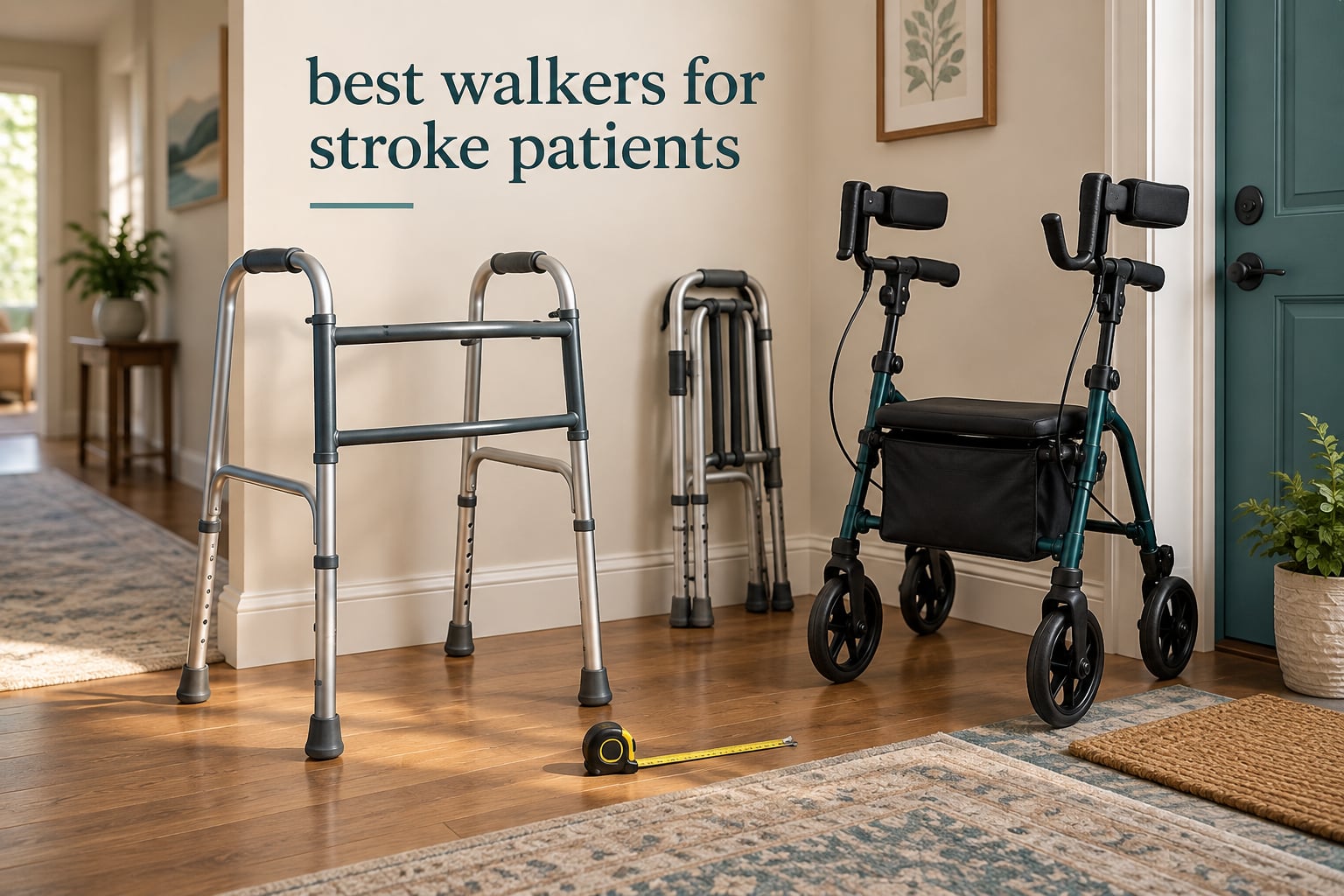
The best walker for a stroke patient is a hemi walker (side walker) if they have one-sided weakness and can only use one arm, or a front-wheeled or upright rolling walker if they have functional use of both arms and both legs. Which one is right comes down to the weakness pattern, grip strength and core control, not the brand.
That single sentence is the answer most families need, and most caregivers arrive at it days after a hospital discharge with a discharge date, a prescription note and almost no time to research. I have spent weeks reading the product listings, spec sheets and owner reviews behind every pick below, and the pattern in the reviews is consistent: the wrong walker type does not just disappoint, it actively wastes the small amount of energy a new stroke survivor has for walking.
Medical note: this guide is informational and is not a substitute for an assessment by a doctor, physical therapist or occupational therapist. Nobody should buy or start using a mobility aid for someone with new weakness, unexplained falls or rapid decline without a clinical review first. Where a therapist is involved, bring this page to the appointment and treat the picks below as options to discuss, not prescriptions.
One thing the research literature keeps making clear, in work going back to papers like the PubMed-indexed review Moving Stroke Rehabilitation Research Evidence into Practice (Eng and colleagues), is the gap between what evidence recommends and what actually reaches families at the bedside. A walker is a support tool. It does not restore function on its own, and no device on this page should be presented as a treatment.
The other thing worth saying early: the person buying is almost never the person using. Search behaviour for this topic is dominated by spouses, adult children and home health aides, often at 11pm the night before a discharge. I have written the recommendations with that buyer in mind.
For broader reads while you decide, our guides to upright walkers and hemi walkers go deeper on the two most stroke-specific categories below.
Table of Contents
- Top 3 Best Walkers For Stroke Patients (October 2026)
- All 8 Walkers at a Glance in 2026
- Which Walker Type Matches Which Weakness Pattern?
- 1. Helavo Upright Walker with Seat – Best Overall Upright Rollator
- 2. ELENKER Upright Rollator Walker – Best Value Upright Walker
- 3. Vive Mobility Upright Walker with Seat – Best for Supported Rest Breaks
- 4. Goplus Foldable Platform Walker – Best Convertible Walker
- 5. Medline Upright Forearm Walker – Best for Lightweight Folding
- 6. Days Hemi Walker – Best Hemi Walker for One-Handed Control
- 7. Vive Hemi Walker for Seniors – Best Hemi Walker for Narrow Doorways
- 8. Inspired by Drive Nimbo Posterior Walker – Best for Therapy Gait Training
- How to Choose a Walker After a Stroke?
- Will Medicare or Insurance Cover a Walker?
- Frequently Asked Questions
- Is it beneficial to use a walker after a stroke?
- What is the best stand-up walker for stroke patients?
- Which is safer, a rollator or a standard walker?
- What kind of walker will Medicare pay for?
- Do stroke patients need a walker or a cane?
- Can you use a walker with one arm?
- What weight capacity walker do I need after a stroke?
- Conclusion
Top 3 Best Walkers For Stroke Patients (October 2026)
These three cover the widest range of recovery profiles in the roundup. The Helavo leads on outdoor capability and the highest review volume among the upright models, the ELENKER is the strongest volume-per-review option, and the Goplus is the only pick that converts into a standard walker when arm support is no longer needed.

Helavo Upright Walker with Seat
- Upright rollator with padded forearm support
- 10-inch puncture-proof rubber front wheels
- Cushioned seat with adjustable padded backrest
- Hand brakes with parking brake

ELENKER Upright Rollator Walker
- Back stays erect
- armrests 38-47 inches
- 10-inch front and 8-inch rear wheels with 360-degree swivel
- Breathable mesh seat with backrest
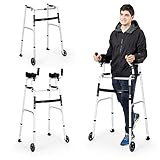
Goplus Foldable Platform Walker
- Removable padded armrests convert to a standard walker
- Only 9 pounds
- 5-inch wheels with unidirectional pulleys
- 7-level height and 4-level arm rest adjustment
All 8 Walkers at a Glance in 2026
Every pick below is listed with the walker type first, because the type decides whether the device suits the patient at all. Ratings and review counts are copied directly from the product listings.
| Product | Key Specs | Pricing |
|---|---|---|
| Helavo Upright Walker with Seat |
|
Check Latest Price |
| ELENKER Upright Rollator Walker |
|
Check Latest Price |
 Vive Mobility Upright Walker with Seat Vive Mobility Upright Walker with Seat |
|
Check Latest Price |
| Goplus Foldable Platform Walker |
|
Check Latest Price |
 Medline Upright Forearm Walker Medline Upright Forearm Walker |
|
Check Latest Price |
 Days Hemi Walker Days Hemi Walker |
|
Check Latest Price |
 Vive Hemi Walker for Seniors Vive Hemi Walker for Seniors |
|
Check Latest Price |
 Inspired by Drive Nimbo Posterior Walker Inspired by Drive Nimbo Posterior Walker |
|
Check Latest Price |
Which Walker Type Matches Which Weakness Pattern?
Four walker types cover almost every stroke recovery scenario, and each one exists for a mechanical reason. Matching the type to the weakness pattern matters more than any brand decision you will make afterwards.
Hemi walkers (side walkers) are for one-sided weakness or hemiplegia, where one arm and hand cannot grip a frame. Best for: patients with hemiparesis who can stand and walk but can only use one side. Why it works: the open side means the patient steps into the middle of the frame rather than standing behind it, and the four-legged base gives a wider, more stable base of support than a cane without needing two hands. Top options: the Days Hemi Walker and the Vive Hemi Walker for Seniors.
Front-wheeled two-wheel walkers are for patients with good two-handed grip who need reliable support. Best for: bilateral weakness with usable arms who tire when lifting a standard four-legged frame. Why it works: the two front wheels are pushed forward rather than lifted, so the user only has to slide the frame, not raise it. Top options: the Goplus platform walker and the Medline upright forearm walker.
Upright or forearm rollators are for later recovery stages. Best for: patients with good leg control and core stability who cannot bear weight through weak wrists or hands. Why it works: the load transfers to the forearms on padded cuffs, the back stays upright, and a seat plus brakes turn it into a rest stop. Top options: the Helavo and the ELENKER upright rollators.
Posterior gait trainers are therapy devices. Best for: patients still being trained to walk in a clinical setting, or children in physical therapy. Why it works: the open rear lets a therapist push from behind, which encourages trunk extension and upright posture. Top options: the Inspired by Drive Nimbo.
Two clinical distinctions matter more than any of the others. Hemiplegia means paralysis on one side; hemiparesis means weakness, not full paralysis. Many people describe a loved one as having had a stroke and assume it means paralysis, when in practice it is far more often weakness, which opens up options a nurse would not suggest otherwise.
The second is core control. A walker with a seat and brakes is only safe if the user can sit down without toppling forward, and can brake with the hand that is actually working. Unilateral neglect, where a stroke survivor does not register one side of space, changes the supervision question entirely and is worth raising with a therapist before purchase.
On the question of whether a walker is even beneficial after a stroke, the honest answer is yes but conditionally. A walker lets a patient walk more often and more safely than they otherwise could, and more walking is generally good during recovery. It is a support tool rather than a treatment, and it does nothing for the underlying impairment.
One caregiver thread on Reddit’s r/stroke community, from a relative whose partner had an ischemic stroke, captured the motivation better than any spec sheet: “We went for a walk in a walker around the unit and she took right off. She is speaking better now and much much less face drooping.” The thread title asks whether walking is safe at 36 hours post-stroke. That decision belongs to the treating team, not to a shopping guide, and the fact that families are asking it at all tells you how much of this purchase is really about confidence.
1. Helavo Upright Walker with Seat – Best Overall Upright Rollator
Helavo Upright Walker with Seat, Foldable Stand Up Walker with Rubber Tires
★★★★★★★★★★Upright rollator
300 lb capacity
10-inch rubber front wheels
22.7-pound aluminum frame
- Padded armrests take load off shoulders and back
- Large 10-inch puncture-proof front wheels handle outdoor surfaces
- Adjustable padded backrest and cushioned seat work as a rest stop
- Parking brake locks the rear wheels while seated
- Cup holder and cane holder keep hands free
- Heaviest class here at about 22.7 pounds
- bulky 26.4-inch footprint is awkward in tight rooms
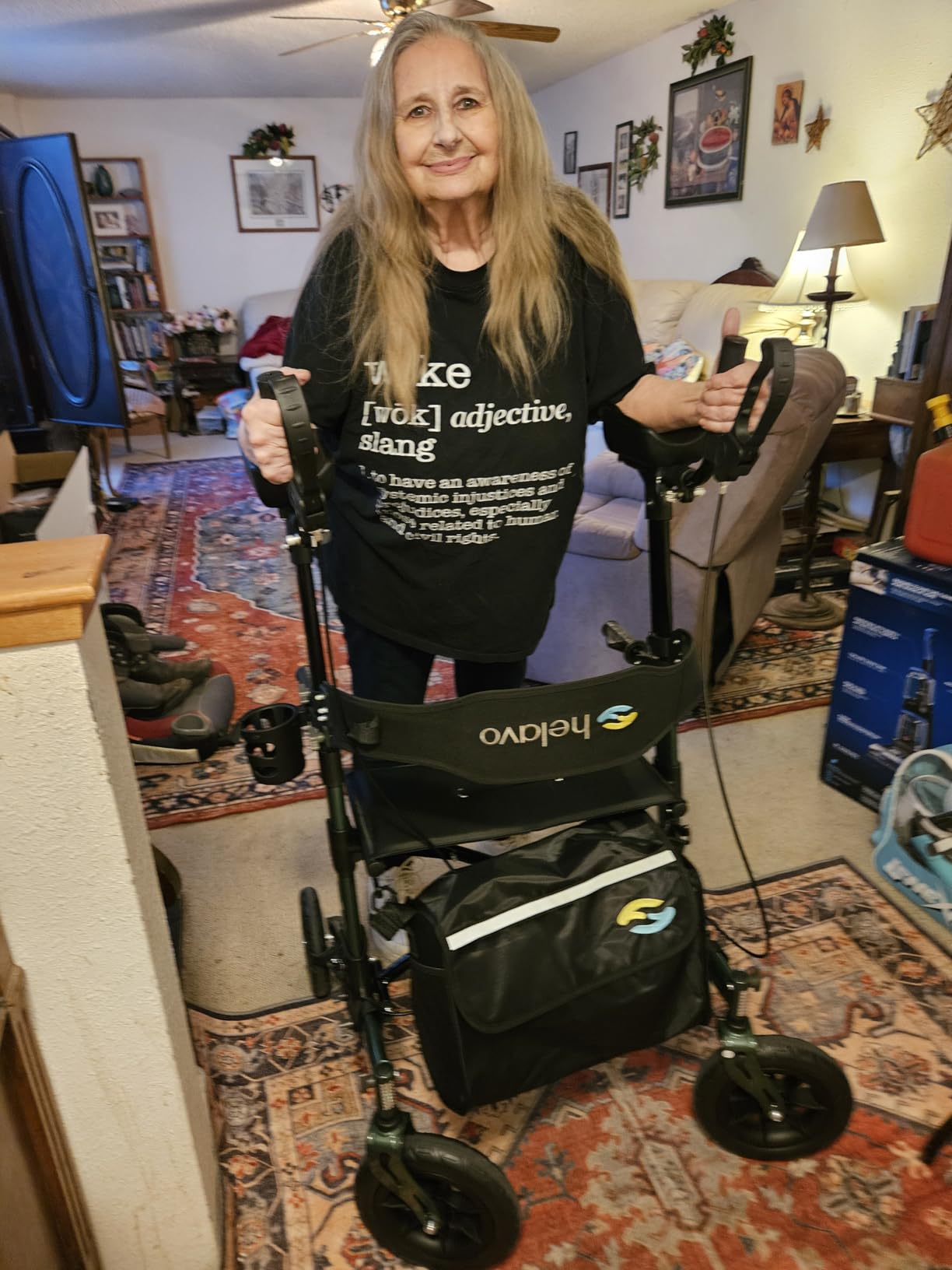
The Helavo is the pick I keep coming back to because it solves the specific problem that ends up disabling other walkers: getting outdoors at all. Those 10-inch puncture-proof rubber front wheels are the whole argument. Most upright rollators in this category run 8-inch wheels, and owners of those models consistently report the difference on gravel, grass and uneven paths.
What matters clinically here is the armrest geometry. The padded armrests and height-adjustable ergonomic handles are designed to let someone stand and walk straight rather than folded forward over a handlebar, which is the posture most four-legged walkers push you into. Reviewers recovering from stroke, managing chronic pain and walking with partial weight-bearing status all describe the posture change as the noticeable improvement.
My reservation is the weight, and it is a real one. At roughly 22.7 pounds for a 26.4 by 26.4 inch frame, this is not something a 70-year-old spouse is loading into a trunk alone, and for a caregiver-heavy household that changes the calculus. If the walker is going to live in a garage and be used for a loop of the block, this is the right trade. If it is being shuttled to a therapy appointment twice a week, the weight will be felt.
The second reservation is the footprint. Twenty-six inches square will not go where a hemi walker goes. Users in small apartments, or anyone whose route involves a 30-inch doorway, will feel it.
Reviewers also flag that Helavo offers a two-year standard warranty extendable to three, plus replacement parts and 24/7 support, which is better after-sales cover than several competing listings offer. Buyers credit the 10-inch rubber tires as the most-cited strength and the seat and adjustable backrest as the most useful comfort feature. The common complaint, consistently, is simply the weight when loading the car.

Tool-free assembly comes with a video walkthrough, and the warranty extends to three years with a two-year standard, plus 24/7 support and replacement parts. The cushioning is the reason this model shows up most often in owner photos, and the backrest adjustment means it can be used as a rest stop between short walks rather than only while standing. The common thread in the reviews is that the 10-inch tires and the seat are what people keep mentioning, and the weight is what they keep working around.
I would put this at the top of the list for a patient who is in the later phase of recovery, walking indoors independently but losing confidence on uneven ground, and who has the trunk control to sit down and brake without help. Pair that with the standalone review of the best upright walkers if you want to see it compared against models built for indoor-only use.
For whom it suits
A stroke survivor in later-stage recovery with good core stability, enough forearm strength to rest weight on padded armrests, and a need to walk outdoors on paths that are not smooth. If the person tires quickly and the walk is mostly indoors between a bedroom and a bathroom, a lighter platform walker will serve better.
The frame is a good match when a caregiver can manage the lifting, because the ride quality over uneven ground is the thing that cannot be replicated by a lighter indoor-only frame.
For whom it does not suit
Anyone who cannot reliably brake, cannot sit down without help, or whose home has doorways and corridors narrower than 28 inches. Also a poor fit for a household where a single family member is doing all the lifting and cannot comfortably manage 23 pounds.
If the household has no outdoor route at all, the wheel size advantage that puts this walker at the top of the list is not something you will ever use.
We earn a commission, at no additional cost to you. CERTAIN CONTENT THAT APPEARS ON THIS SITE COMES FROM AMAZON. THIS CONTENT IS PROVIDED 'AS IS' AND IS SUBJECT TO CHANGE OR REMOVAL AT ANY TIME.
2. ELENKER Upright Rollator Walker – Best Value Upright Walker
ELENKER Upright Walker, Stand Up Folding Rollator Walker Back Erect Rolling Mobility Walking Aid with Seat, Padded Armrests for Seniors and Adults, White
★★★★★★★★★★Upright rollator
Armrests adjust 38-47 inches
Solid PVC frame
24 pounds
- Most reviewed walker in the roundup with 2254 reviews
- An angled central support bar discourages forward tipping
- Armrests lock the rear wheels so the seat is stable
- Folds into a typical car back seat
- Owners rate it sturdier than the price suggests
- About 24 pounds is difficult for a user to load alone
- Fixed armrest width suits some bodies better than others
- Padded armrests reported to crack after months of use
With more than 2,200 reviews behind it, the ELENKER is the model with the deepest evidence base in this roundup, and in a category where a PubMed-indexed rehabilitation paper is competing for the same attention, that volume of real-world use is worth something. Reviewers recovering from stroke, managing partial weight-bearing status and living with chronic pain repeatedly describe it as a step up from two canes or a standard aluminium walker.
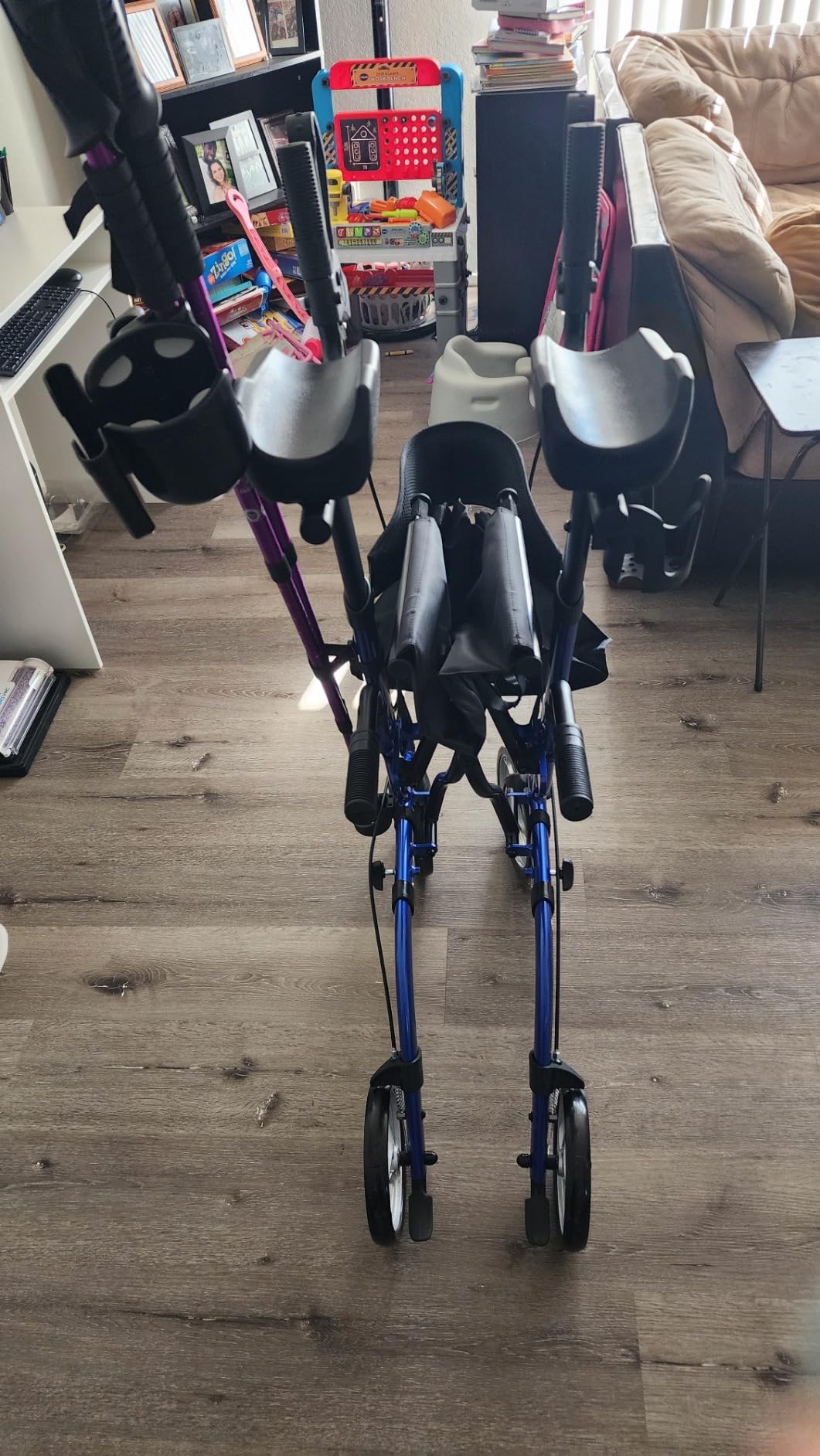
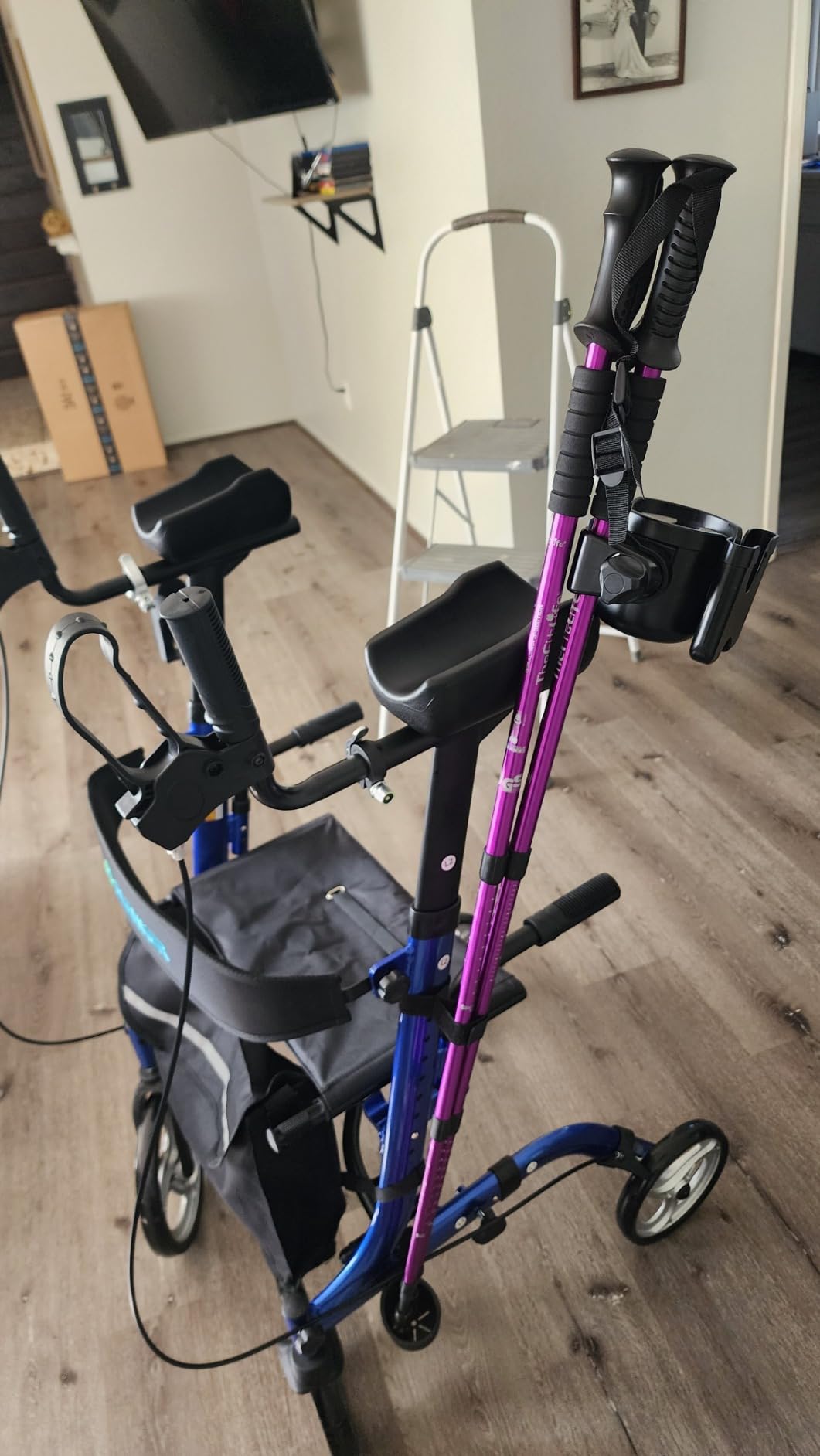
The angled central support bar is the detail owners single out most. It braces the forearm line against forward tipping over cracks and bumps, which is precisely the failure mode of a lighter upright rollator on a bad path. The padded armrests adjust from 38 to 47 inches off the ground, and the brakes lock the rear wheels by pushing forward so the mesh seat is stable for sitting.
Wheel specification is 10-inch fronts and 8-inch rears on a solid PVC frame, with 360-degree swivel at the front. The seat is 18 by 10 by 21 inches of breathable mesh with a durable backrest, and the frame folds without tools for storage, with a detachable storage bag and a cane holder included.
At roughly 24 pounds across a 28 by 26 by 53 inch frame, it is the heaviest upright rollator here. Buyers who rated it 3 stars or below almost always mention the weight, fixed armrest spacing, or a padded armrest that cracked after a period of use. A few buyers also noted that some units advertise nine height holes and ship with eight, which is worth checking on arrival.
It is also worth knowing that several reviewers said the company’s direct customer service is weaker than Amazon’s, so going through the listing channel is the safer route if something arrives damaged or incomplete. Assembly is tool-free, and the frame folds down to a size most families find fits in a back seat.
What made this the value pick rather than the top pick is simple: at 24 pounds with a fixed armrest width, it is the least forgiving of the upright models for a smaller user or a caregiver doing the lifting. For a user of average build with two working hands, the sheer volume of reviews behind it is the strongest argument in this roundup.
For whom it suits
A user of average height and build, with two-handed grip and reasonable trunk control, who will mostly walk on pavement and paths and who wants the most battle-tested upright rollator available. Good for a household with a seat and brakes used frequently during long outings.
The review volume is itself a reason to lean this way: a long history of owner reports makes the small failure modes predictable rather than surprising.
For whom it does not suit
Smaller users, anyone with limited lifting capacity in the household, and anyone confined to a very small home. A cracked armrest after six months of daily use is the most common long-term failure report here.
Check the number of height holes against the listing photo on arrival, since a handful of owners reported a mismatch between what is advertised and what ships.
We earn a commission, at no additional cost to you. CERTAIN CONTENT THAT APPEARS ON THIS SITE COMES FROM AMAZON. THIS CONTENT IS PROVIDED 'AS IS' AND IS SUBJECT TO CHANGE OR REMOVAL AT ANY TIME.
3. Vive Mobility Upright Walker with Seat – Best for Supported Rest Breaks
Vive Mobility Upright Walker with Seat – Stand Up Rollator, Arm Rests
★★★★★★★★★★Upright rollator
300 lb capacity
8-inch flat-free wheels
Handle height 45 to 52 inches
- Forearm pads slide forward and back to fit different arm lengths
- Loop brakes lock the wheels for stable seating
- 17.5-inch seat is wider than most in this category
- 20-pound frame is lighter than most upright rollators
- Detachable shoulder bag
- 8-inch wheels struggle on rough outdoor ground
- 20 pounds is still heavy to load unaided
- 32-inch width is awkward through narrow doorways
This one carries a 4.1-star average across more than 1,100 reviews, and the review profile is honest about where that lands. What it does well is specific and real; what it does not do is outdoor terrain. At 8 inches, the flat-free wheels are the smallest in the upright category here, and buyers say exactly that when they describe gravel or uneven paths.
Where it earns its place is the seat and the seat width. At 17.5 inches, it is the widest seat among these picks, and for a stroke survivor who cannot walk far without stopping, a seat that is genuinely comfortable is not a luxury. Fatigue after a stroke is often what ends a walk early, so a rest point that works matters more than wheel size in a lot of households.
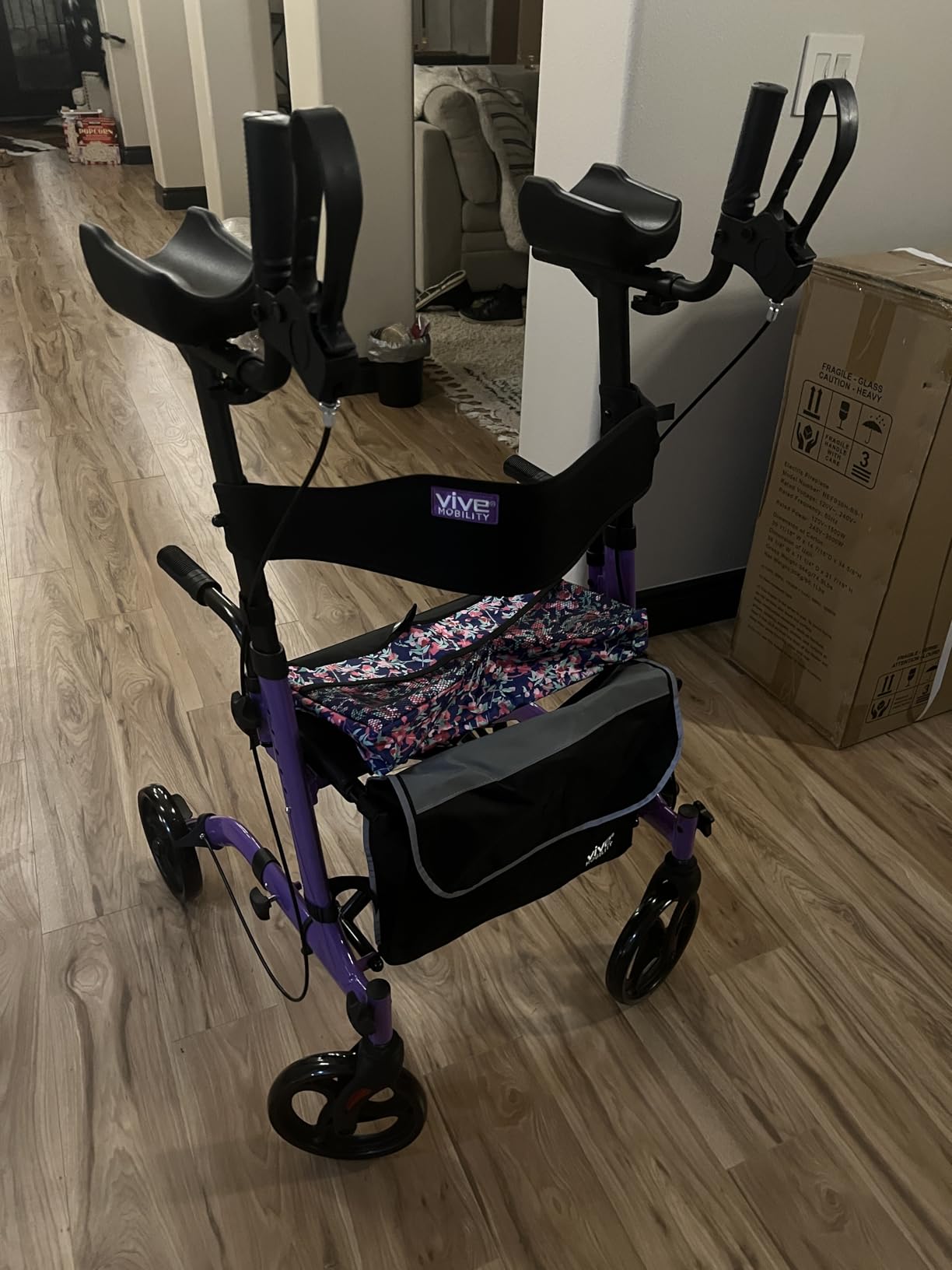
The forearm pads adjust forward and back rather than only up and down, which accommodates different arm lengths better than a single-axis adjustment. The manufacturer’s stated user height range is 5 foot 2 inches to 6 foot 4 inches, with handle height adjusting from 45 to 52 inches, and contoured armrests distribute pressure. Loop brakes lock the wheels for stable seating, and a detachable shoulder bag keeps essentials close.
At 20 pounds and 32 by 25 by 52 inches, it is a little lighter and a little narrower than the ELENKER, though still a wide frame. It carries a one-year guarantee, which is the shortest in the roundup, and folds for transport in a trunk or back seat.
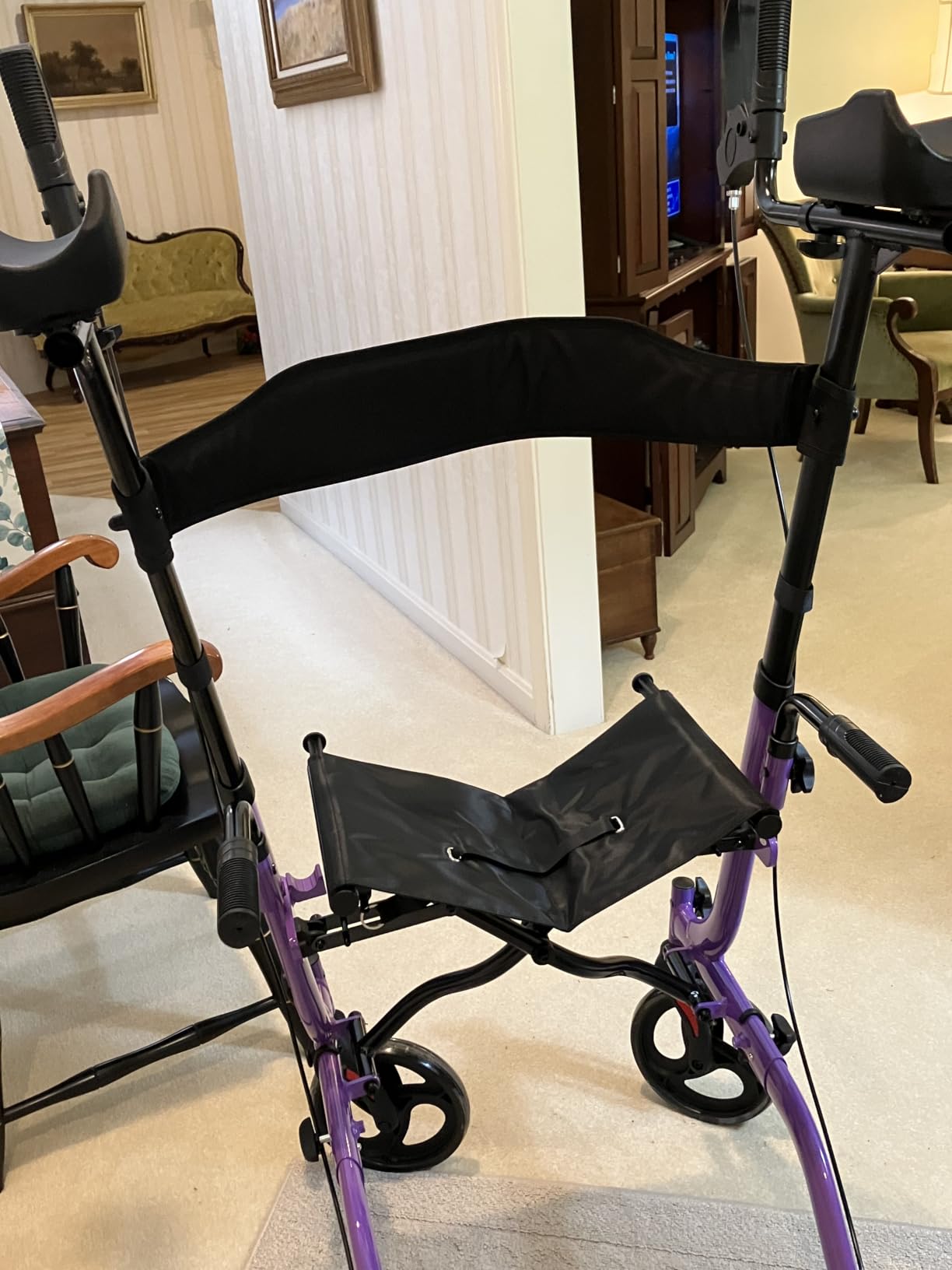
My read is that this is a fair indoor-and-paved-surface rollator rather than a flawed one. Buyers generally consider it solid value against higher-priced upright rollators, and the positive comments cluster on posture support, the adjustable forearm pads, and the seat-and-brake combination.
Do check the listed user height range against the actual person before buying. A 32-inch frame that will not pass a narrow doorway is a common and avoidable disappointment, and the widest seat here only helps if the user can reach and lock the brakes on the working hand.
For whom it suits
A user within the 5 foot 2 to 6 foot 4 stated height range who walks mostly indoors and on smooth pavements, needs frequent rest breaks, and needs a seat wide enough to sit down in without negotiating. Good value for the feature set.
The sliding forearm pads are the detail therapists and owners mention most, because they let a therapist set arm support for a specific arm length rather than a generic range.
For whom it does not suit
Anyone who regularly walks on gravel, grass or uneven ground, and anyone in a home with narrow doorways. The 4.1-star average reflects those limits honestly rather than hiding them.
If a multi-year warranty matters to the household, note that the one-year guarantee here is the shortest of the eight picks.
We earn a commission, at no additional cost to you. CERTAIN CONTENT THAT APPEARS ON THIS SITE COMES FROM AMAZON. THIS CONTENT IS PROVIDED 'AS IS' AND IS SUBJECT TO CHANGE OR REMOVAL AT ANY TIME.
4. Goplus Foldable Platform Walker – Best Convertible Walker
Goplus Walkers for Seniors, Foldable Standard Walker with 5’’ Wheels and Removable Padded Armrests 220lbs, Lightweight Walking Mobility Aid, Folding Platform Walker for Elderly, Handicap, Disabled
★★★★★★★★★★Platform walker with removable armrests
220 lb capacity
9-pound frame
5-inch wheels
- Removable armrests convert it to an ordinary two-wheeled walker
- Only 9 pounds so a caregiver can lift it easily
- One-hand button folding and compact storage
- 7 height and 4 arm-rest levels fit a wide range of body sizes
- Two modes
- interactive and fixed
- 5-inch wheels roll poorly on uneven surfaces
- 220 lb capacity is below most walkers here
- Armrest welds reported to crack after six to eight months
The Goplus is the most interesting purchase in this roundup for a specific reason: it is two walkers. Take the padded armrests off and it becomes an ordinary two-wheeled walker. That matters in stroke recovery because the need for forearm support usually fades before the need for balance support does, and a household that buys one convertible frame avoids buying twice.
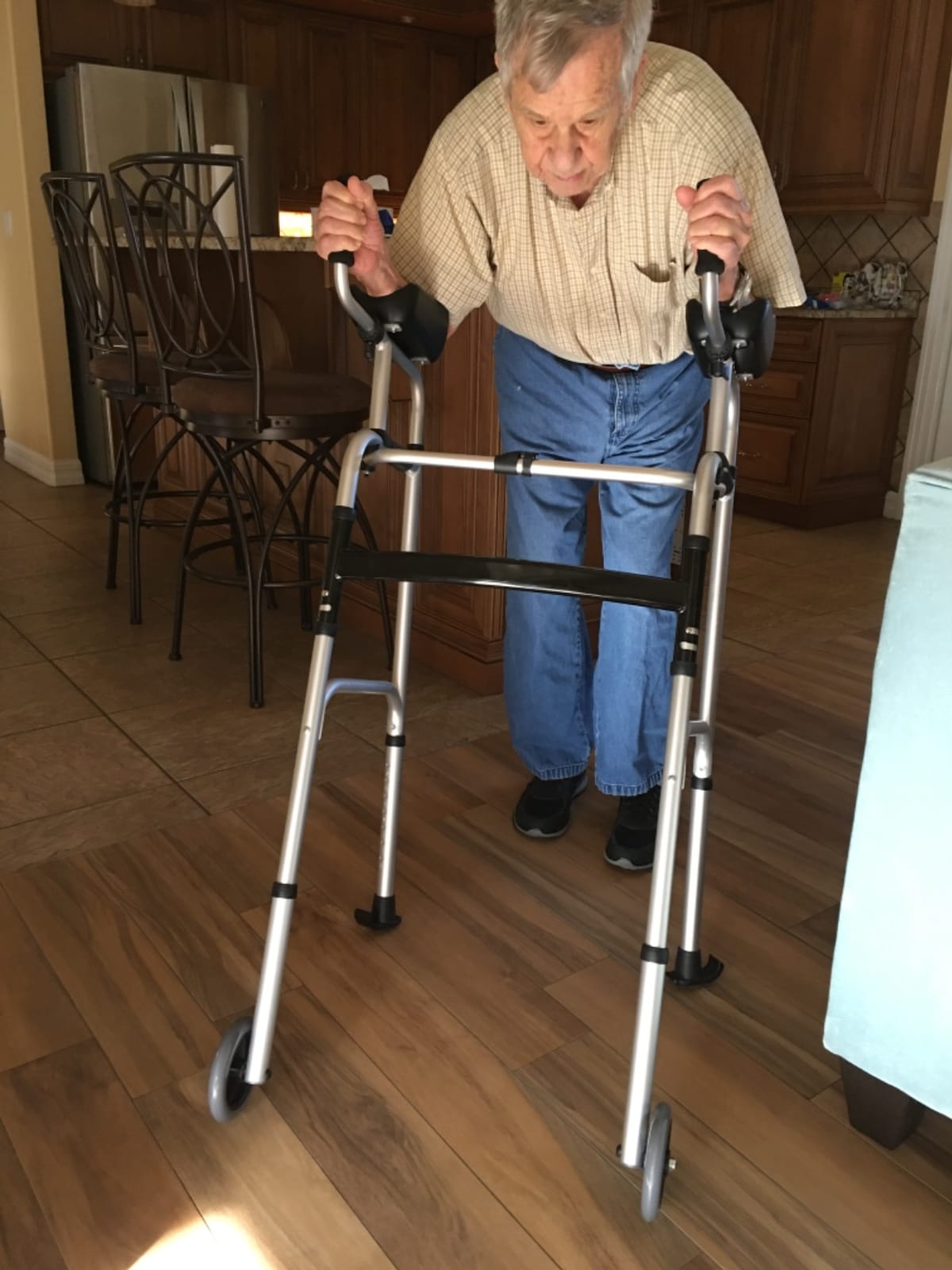
Physical therapists, according to the review pattern, reach for platform walkers when a patient cannot bear weight through the wrists. The double-arm support lets the user stand upright and take pressure off the shoulders, wrists and elbows, and owners credit the upright stance with helping their recovery progress. Soft PU armrests and sponge handles are described as skin-friendly over long sessions.
It weighs 9 pounds, which is the second-lightest frame here, and it folds with a one-click mechanism that works with one hand. There are 7 levels of height adjustment on the support feet and 4 levels of arm-rest adjustment, built on thick aluminium alloy tubes in an H-shaped design that resists shaking. The listing carries FDA certification, and the frame is rated to 220 pounds.
That 220-pound rating is the catch, and it is the first thing to check. It is below the 300 pounds that five of the other seven picks here carry, which matters for any larger user. The 5-inch unidirectional pulleys also do not roll smoothly on every surface, and the manufacturer itself warns not to screw the wheels on too tightly or they will seize.
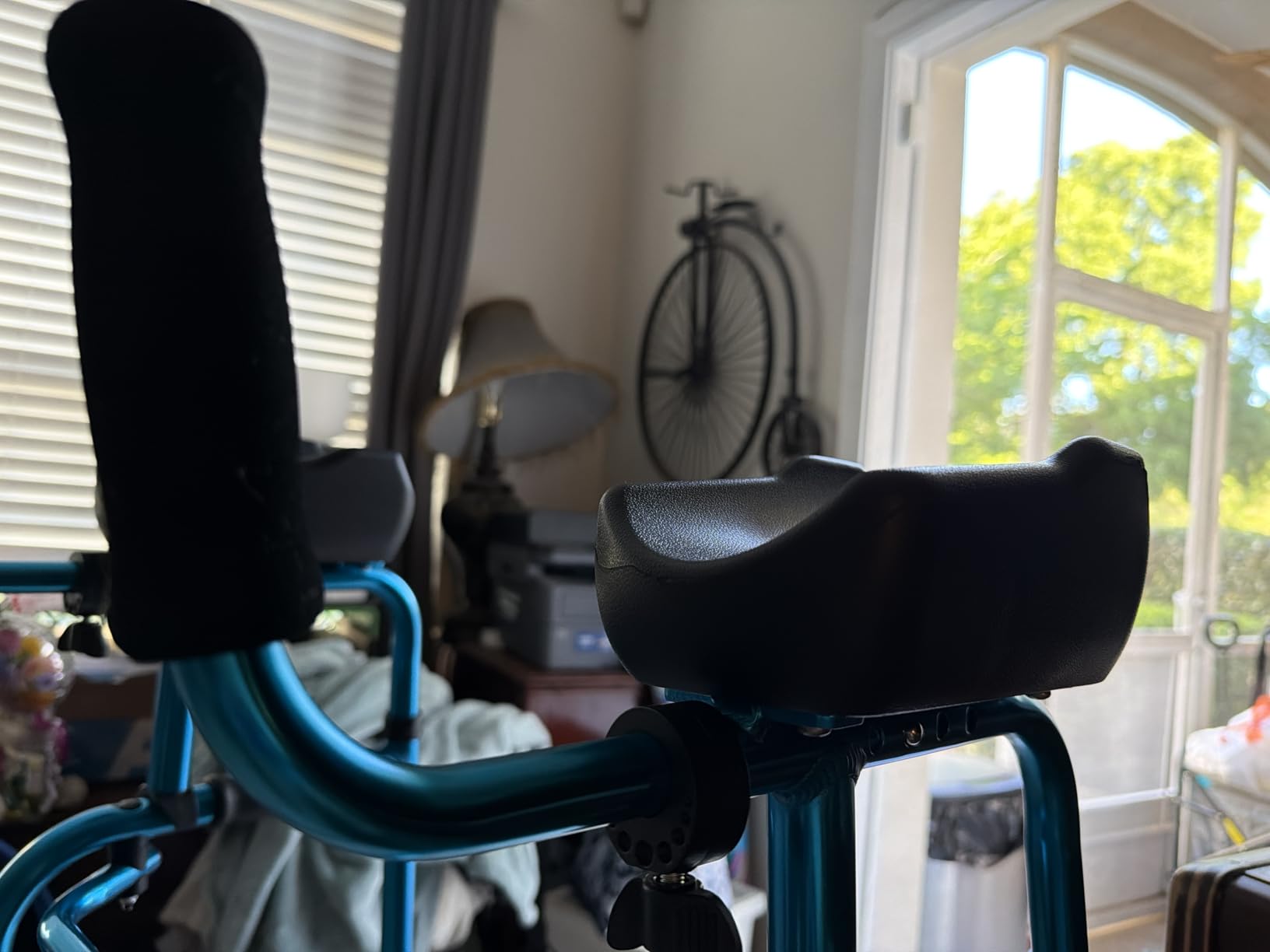
The most serious complaint in the reviews is a welded armrest that cracked after roughly six to eight months, which left the walker unusable in its intended platform configuration. Slider feet can also mark hard floors, and some owners fit tennis balls to the feet as a workaround. The two-wheel base is less stable than a four-wheel rollator on uneven ground.
It runs in two modes, interactive and fixed, and can double as a toilet handrail, which makes it useful in a small bathroom where a second frame will not fit. For anyone comparing this against other platform walkers, our knee walker roundup covers the alternative braced category.
For whom it suits
A user who cannot push through their wrists, who is under 220 pounds, who will use the walker indoors, and whose household wants one frame that can be reconfigured as recovery progresses. The 9-pound weight also makes it the easiest here for a single caregiver to manage.
It is also the sensible choice when a second device will not fit in a small bathroom, because the frame doubles as a toilet handrail.
For whom it does not suit
Anyone over 220 pounds, anyone walking outdoors on uneven ground, and anyone whose therapist expects daily heavy use, given the armrest weld reports. Confirm the armrest welds on arrival.
For long daily sessions, the weld failure reports are the reason to consider a heavier platform frame instead of the lightest one.
We earn a commission, at no additional cost to you. CERTAIN CONTENT THAT APPEARS ON THIS SITE COMES FROM AMAZON. THIS CONTENT IS PROVIDED 'AS IS' AND IS SUBJECT TO CHANGE OR REMOVAL AT ANY TIME.
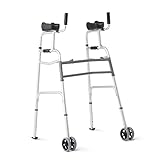
5. Medline Upright Forearm Walker – Best for Lightweight Folding
Medline Upright Walker with 5” Dual Wheels, Forearm Walker with Armrests, Height Adjustable, 300lb Weight Capacity, Height Adjustable 46-53″, 31″ Wide
★★★★★★★★★★Upright forearm walker
300 lb capacity
11-pound aluminum frame
Height 46 to 53 inches
- Removable soft armrests convert it to a traditional walker
- 11-pound frame supports up to 300 pounds
- Two-button folding needs no tools
- Length-adjustable arm handles from 11.5 to 13.5 inches
- Walker glides move smoothly over carpet and hard floors
- 5-inch dual wheels suit smooth indoor surfaces only
- 31-inch width struggles through narrow doorways
- Armrest width is fixed and not adjustable
Eleven pounds supporting 300 pounds is the best weight-to-capacity ratio among the upright and platform frames here, and if a caregiver is doing the lifting, that single fact carries a lot of weight. The removable soft armrests are the second point: take them off and it converts into a traditional walker, the same convertible logic as the Goplus, on a frame that supports 50 pounds more.
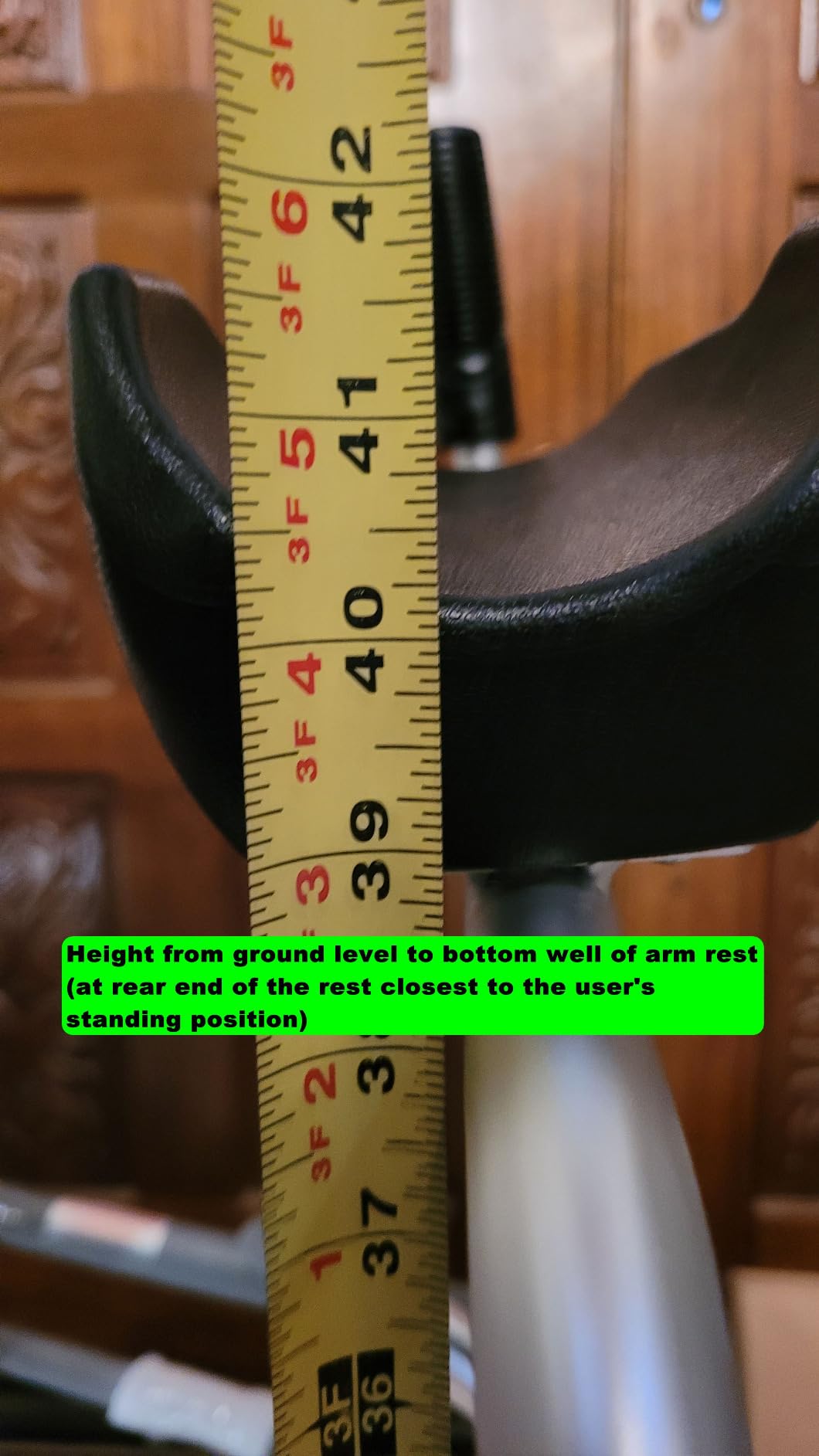
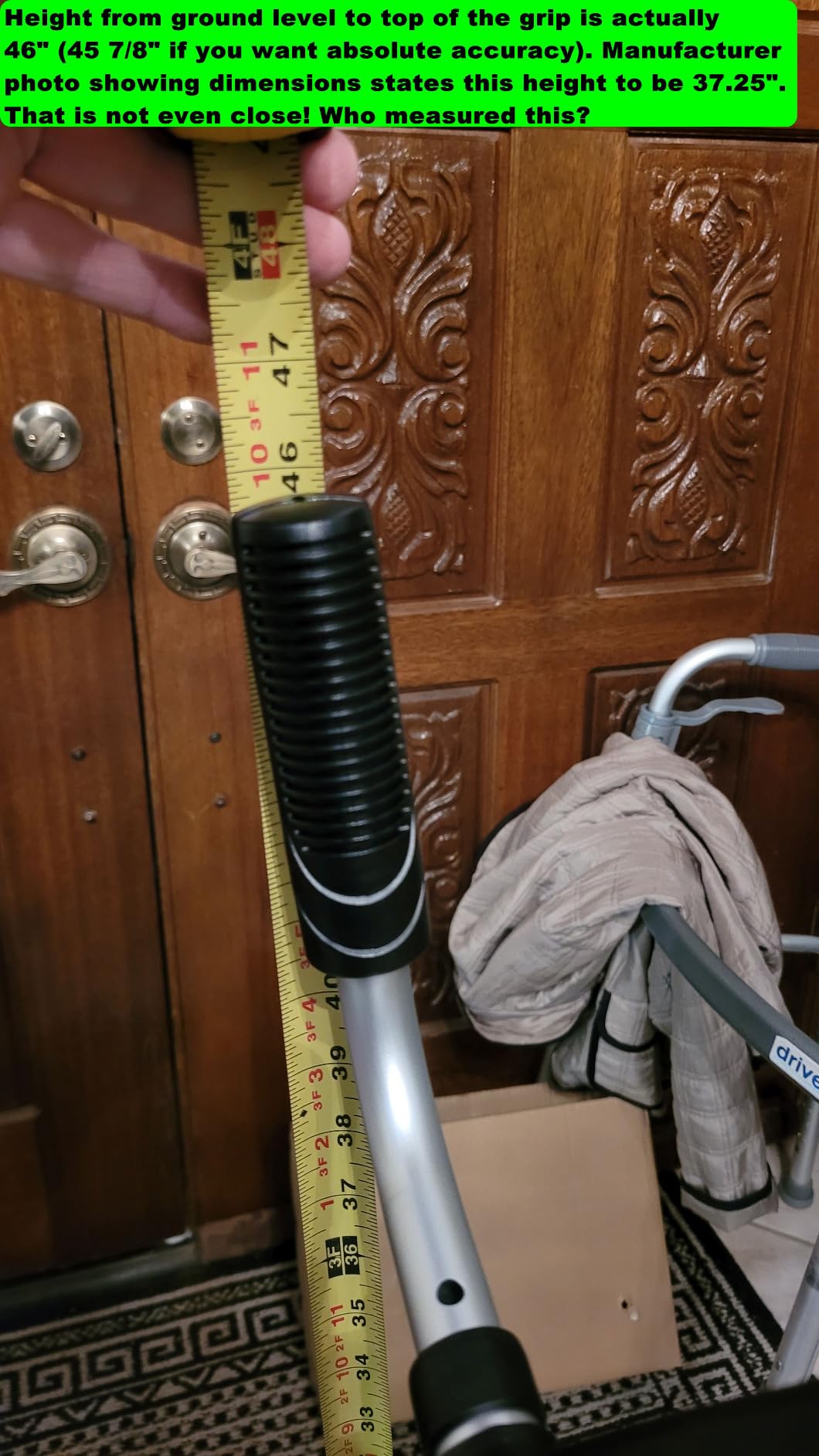
Adjustment is thorough. Height-adjustable push-button legs combined with length-adjustable arm handles running from 11.5 to 13.5 inches let a physical therapist set a posture that is genuinely natural rather than approximately right, and the manufacturer describes that as the main advantage over a traditional walker. Overall height runs from 46 to 53 inches.
Folding is a two-button mechanism with no tools, and the frame assembles quickly with no tools either. Walker glides on the legs are reported to move smoothly over carpet and hard floors, which is where a four-legged walker with plain rubber tips tends to catch.
Against that, the frame is 31 inches wide. Buyers and reviewers flag this repeatedly, and it is a genuine problem in a house with standard interior doorways. The 5-inch dual wheels are for smooth indoor surfaces rather than outdoor paths, and the armrest width is fixed, so it does not adapt to different body sizes the way an adjustable model would.
This is a straightforward, budget-priced upright walker sold largely through healthcare suppliers rather than by direct marketing, and it carries a 4.0 star average across 174 reviews, the second-lowest here. Buyers focus on the removable armrests, which let one product serve both upright and standard walking needs, and on the light aluminium frame.
One oddity: the listing carries a material field reading 100% wool, which is a catalogue data artifact and has nothing to do with the product. If you are comparing spec sheets across listings, ignore it. Our folding walker guide covers the lighter four-legged end of this market.
For whom it suits
A user under 300 pounds, with a strong enough working hand to grip a handle, who needs forearm support now and standard-walker support later. Especially good where a caregiver must load the frame into a car regularly.
Users on carpet or hard floors get a real benefit from the walker glides, which is where plain rubber tips tend to catch.
For whom it does not suit
Anyone walking outdoors, and anyone in a home where the doorways are narrower than 33 inches. The fixed armrest width also makes it a harder fit for very small and very large users.
With the smallest review base here, buyers who want a long history of owner feedback have less to go on than with the ELENKER or the Vive Mobility rollator.
We earn a commission, at no additional cost to you. CERTAIN CONTENT THAT APPEARS ON THIS SITE COMES FROM AMAZON. THIS CONTENT IS PROVIDED 'AS IS' AND IS SUBJECT TO CHANGE OR REMOVAL AT ANY TIME.
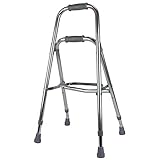
6. Days Hemi Walker – Best Hemi Walker for One-Handed Control
Days Hemi Walker – Mobility Aid for Elderly, Handicapped, Disabled Users – One Arm or Hand Support, Folding, Aluminum, Height Adjustable – Weight Capacity Up to 300 Pounds
★★★★★★★★★★Hemi walker
300 lb capacity
3.5 pounds
Each leg adjusts independently
- Independent leg height adjustment handles uneven ground
- Lightest frame in the roundup at 3.5 pounds
- Dual grips assist sit-to-stand
- Owners report sturdier than clinic-supplied walkers
- Narrow enough for tight indoor spaces
- Fixed rubber tips
- so no long distances or outdoor terrain
- Grip and joint wear develops with heavy daily use
If the patient has one-sided weakness, this is the category that matters, and the Days is the version most physical therapists appear to recommend. Owners repeatedly report that the hemi walker was suggested by a physical therapist during stroke or post-surgical rehab, and they credit it with helping a loved one relearn to walk.
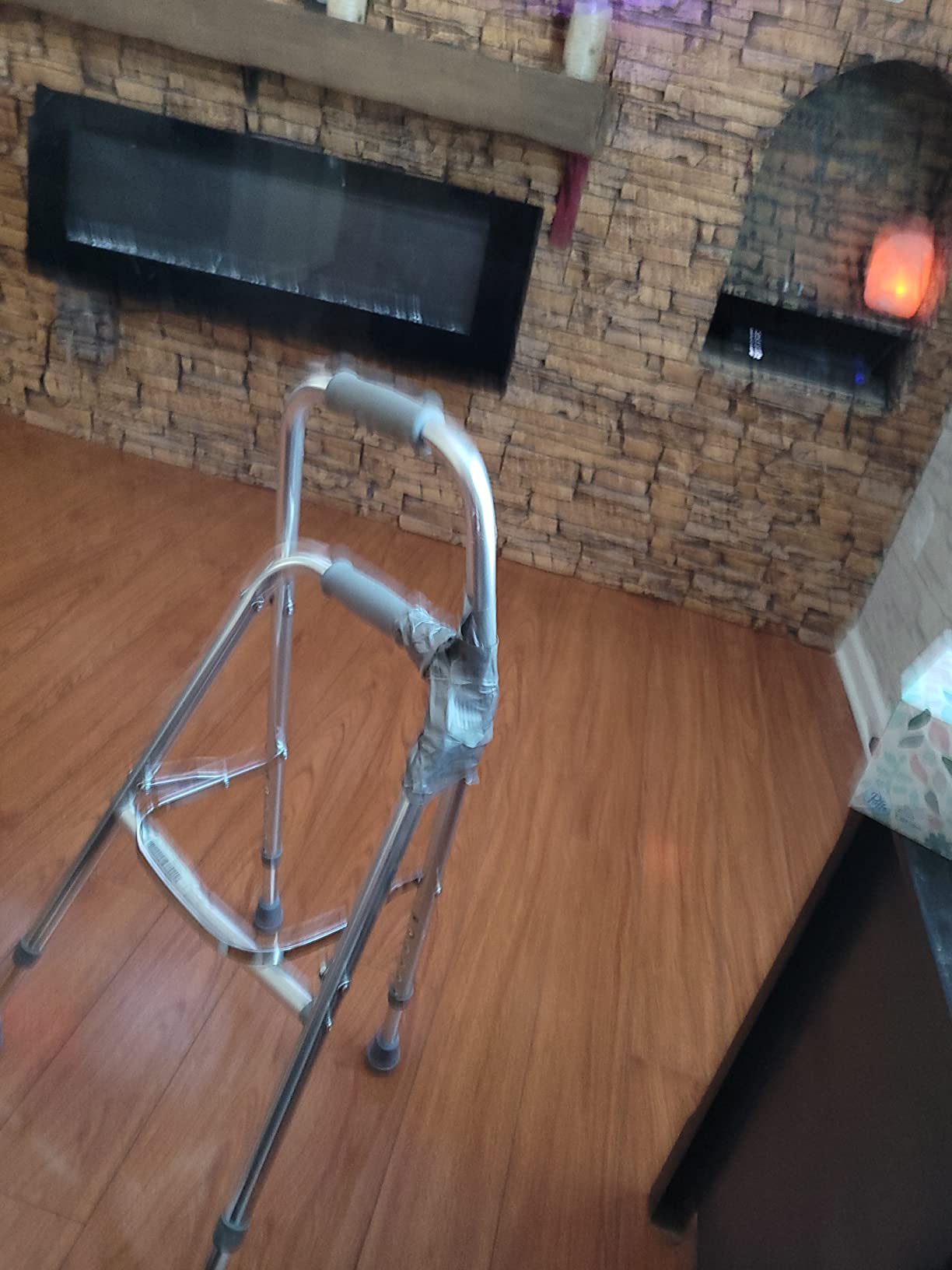
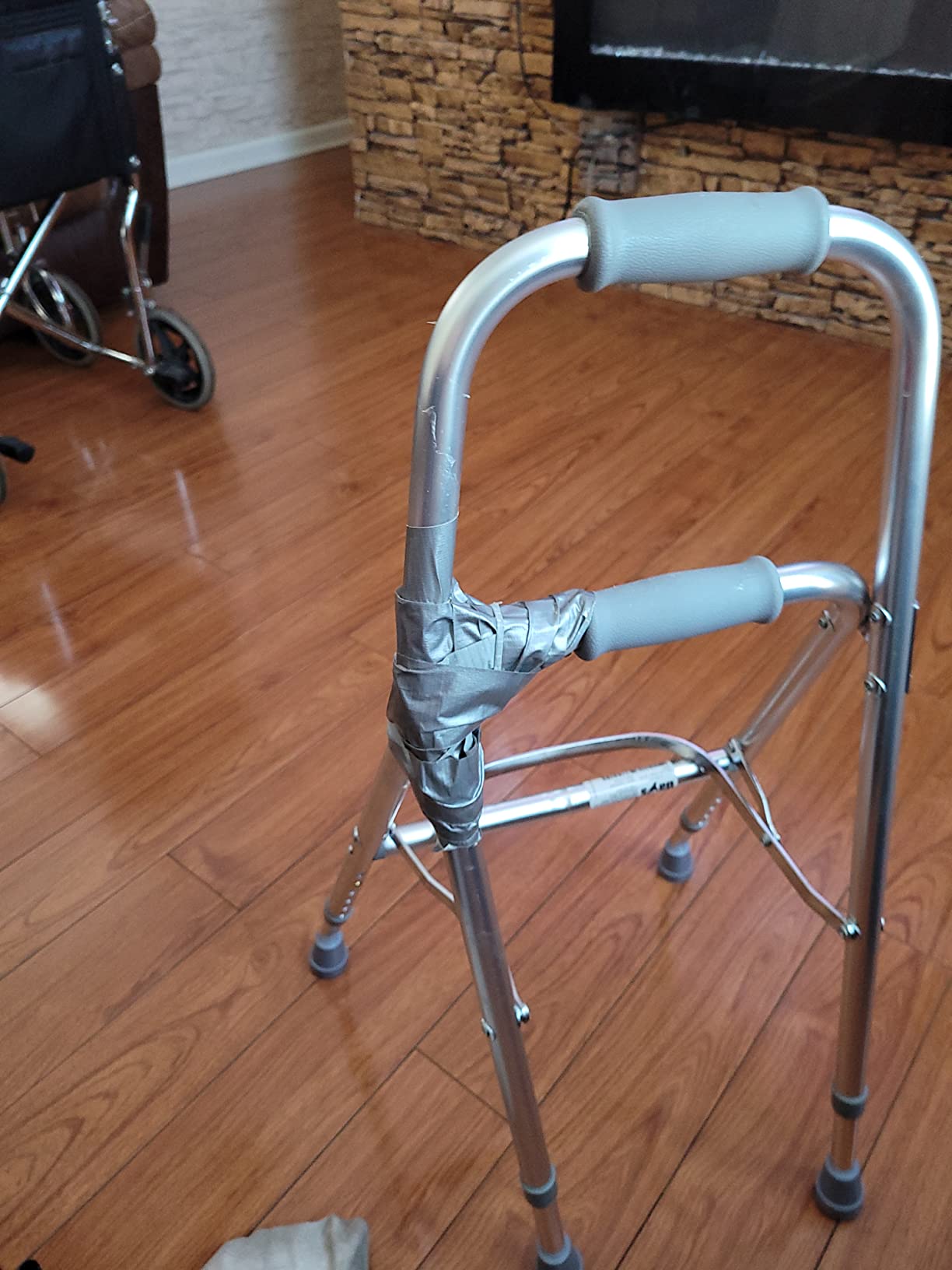
Mechanically, the reason a hemi walker beats a cane for one-sided weakness is the base of support. The patient stands inside the frame rather than behind it, so the four legs sit under and around the body, and a cane puts the support on one narrow line. Add the aluminium frame rated to 300 pounds and the whole thing weighs 3.5 pounds, the lightest in this roundup, which means it can be moved with one hand.
The feature owners praise beyond the weight is independent leg adjustment. Each of the four legs adjusts on its own, which means the walker can be set level on uneven ground, including stairs, where a fixed-base frame rocks. Dual grips give the user something to push down on when rising from a chair or a toilet, and the frame folds for transport to appointments.
The compromise is that all four legs are fixed rubber tips. There are no wheels at all, so this is an indoor device by design. The same review pattern notes that grip and joint wear can develop faster than expected under heavy daily use, which is worth checking periodically on a frame this light.
Package dimensions are 31.9 by 17.2 by 3.8 inches, and it has been on sale for many years, so the fit and parts are well established. The one thing to verify in person is that the user can actually operate it with the strong hand, because the single-handed motion is unfamiliar in the first few minutes and the one critical review in the narrower hemi category describes it as awkward at first.
A cane is a reasonable first step for a patient with mild one-sided weakness who walks short distances indoors with supervision. Once the person needs a frame for balance rather than just reassurance, the jump to a hemi walker is the one that pays off.
For whom it suits
A patient with one-sided weakness or hemiparesis who can bear weight on both legs but only has one usable arm, and who mostly walks indoors on level surfaces. The 300-pound rating and 3.5-pound weight make it the broadest fit in the hemi category.
If floors in the home are uneven or include a step or two, the independent leg adjustment is the feature that prevents the frame from rocking.
For whom it does not suit
Anyone who needs to walk distance or cross uneven outdoor ground, since there are no wheels. Also a poor match for a patient with enough arm weakness that even one-handed operation is not reliable, which is a therapist question, not a shopping one.
On a frame this light, check the grips and joints periodically under heavy daily use, because wear shows up quickly.
We earn a commission, at no additional cost to you. CERTAIN CONTENT THAT APPEARS ON THIS SITE COMES FROM AMAZON. THIS CONTENT IS PROVIDED 'AS IS' AND IS SUBJECT TO CHANGE OR REMOVAL AT ANY TIME.
7. Vive Hemi Walker for Seniors – Best Hemi Walker for Narrow Doorways
Vive Hemi Walker for Seniors – Narrow for Small & Tight Spaces, Ultra
★★★★★★★★★★Hemi walker
18-inch wide frame
300 lb capacity
About 4 pounds
- 18-inch frame is one of the most compact hemi walkers
- About 4 pounds so it lifts one-handed
- Arrives pre-assembled with no setup
- Height adjustable in 1-inch increments
- Doubles as a stand-assist frame and grab bar
- Rubber tips
- so short indoor distances only
- One-handed operation can feel awkward at first
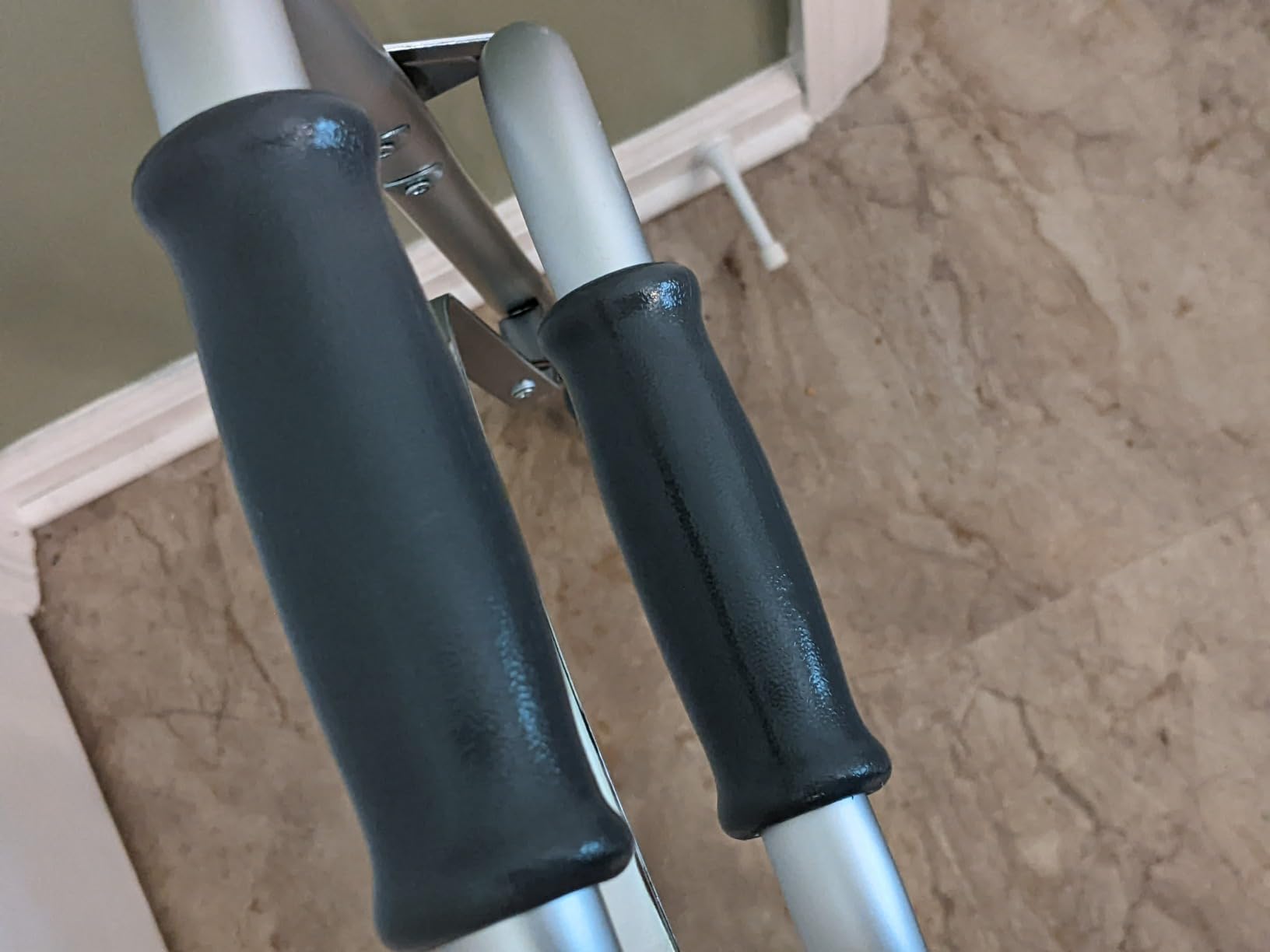
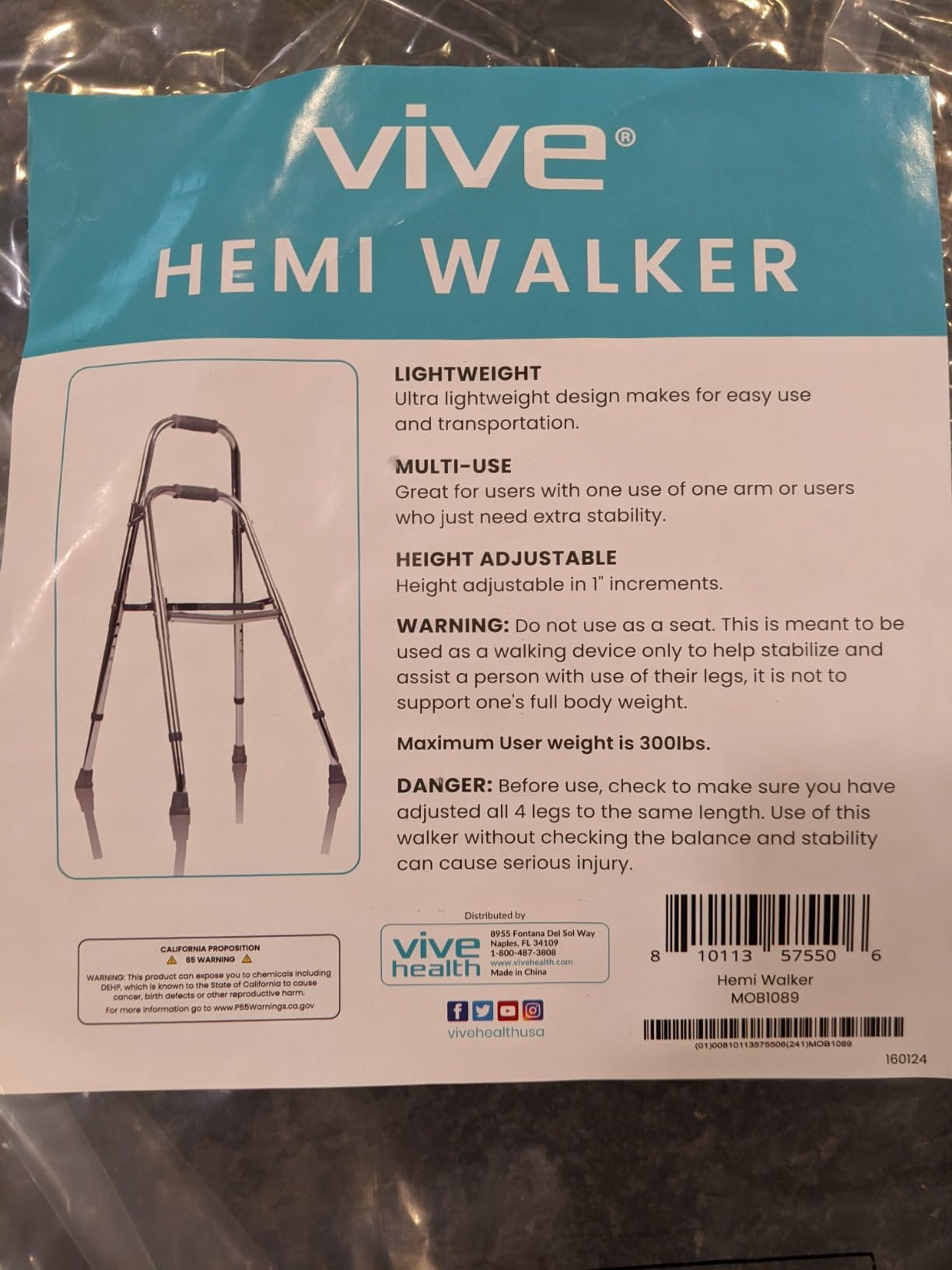
Where the Days wins on adjustability, the Vive Hemi wins on size. At 18 inches wide and 17 inches deep, this is one of the most compact hemi walkers available, and that single measurement decides whether it can move through the hallway and past the toilet in a small house. It weighs about 4 pounds and arrives fully assembled, so there is no setup on the day it is needed.
Reviewers typically bought it on a physical therapist’s recommendation during stroke or post-surgical rehab, and credit it with helping a parent stand and walk again. The strongest points in the reviews are the small size, the low weight, and the ready-to-use assembly, which matters enormously when the purchase is happening the day before discharge.
The cross-brace design with non-slip rubber tips and grip handles is rated to 300 pounds, and the manufacturer positions it as two devices: a walking aid and a stand-assist frame that can be placed in front of a couch, chair or toilet to help with rising, or used as a grab bar in a bathroom or shower. For a single-patient bathroom, that dual role is genuinely useful rather than a gimmick.
Height adjusts in 1-inch increments across a 30-inch assembled height, which gives finer resolution than the coarser indexed holes on many competitors.
Like the Days, this has fixed rubber tips and no wheels, so it is limited to short indoor distances. The single critical review in the set describes the one-handed operation as awkward, while still crediting it for sit-to-stand transfers, which is a good summary of the whole category in one sentence.
Both hemi walkers here are rated to 300 pounds, which matters because this is a category where weight limits are often lower than buyers expect. The trade between them is straightforward: choose the Days for independent leg adjustment and broader terrain tolerance, choose the Vive for a narrower frame and zero assembly.
If the diagnosis is hemiplegia with one usable arm, our full hemi walker roundup goes into more detail on frame geometry and when a side walker stops being appropriate.
For whom it suits
A patient with one-sided weakness who lives in a small space with narrow doorways, who needs a frame beside a chair, couch or toilet for sit-to-stand, and who needs something usable the moment it arrives. A good match for a smaller user who finds 20-inch frames uncomfortable.
The pre-assembled delivery matters most when the purchase is being made days before a hospital discharge, with no time to read a manual.
For whom it does not suit
Anyone who will walk outdoors or any real distance, and anyone for whom one-handed operation is not yet reliable. It is a newer listing with a shorter track record of long-term durability reports than the older models in this roundup.
Pick the Days instead if the floor surface is uneven, since independent leg adjustment is not available on this frame.
We earn a commission, at no additional cost to you. CERTAIN CONTENT THAT APPEARS ON THIS SITE COMES FROM AMAZON. THIS CONTENT IS PROVIDED 'AS IS' AND IS SUBJECT TO CHANGE OR REMOVAL AT ANY TIME.
8. Inspired by Drive Nimbo Posterior Walker – Best for Therapy Gait Training
Inspired by Drive Nimbo 2G Lightweight Posterior Walker Knight Blue Large (Pack of 1)
★★★★★★★★★★Posterior gait trainer
190 lb capacity
5-inch anti-rollback wheels
Five frame sizes
- Open back lets a therapist push from behind to encourage trunk extension
- Anti-rollback rear wheels and directional locks on the front casters
- Height and support-pad adjustments reconfigure as therapy needs change
- Folds for car transport
- Side handles help unload weight
- 190 lb capacity is well below the 300 lb common elsewhere
- Sling seat and pouches shown in images are not included
- Hardware bolts loosen with use and need re-tightening
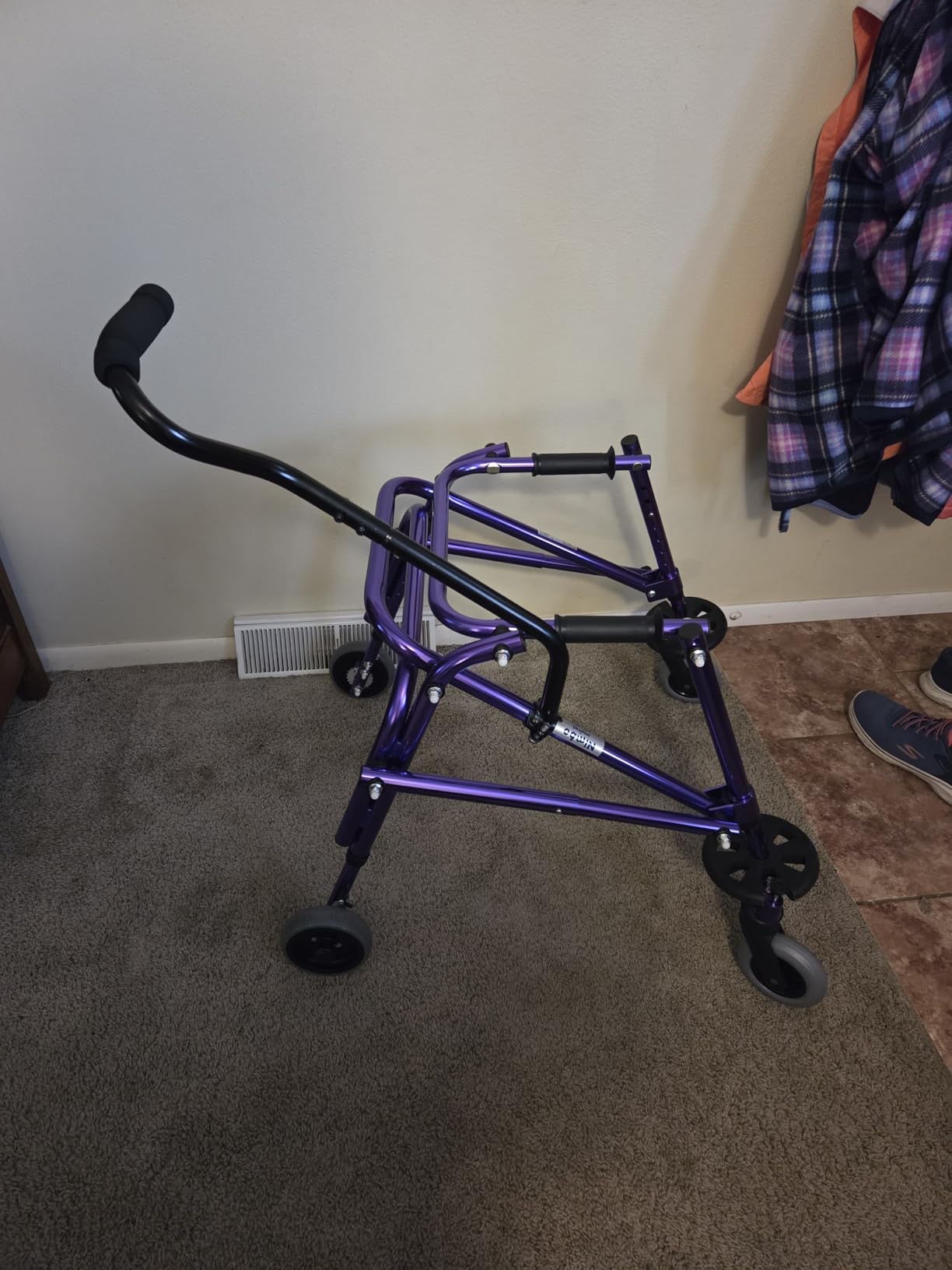
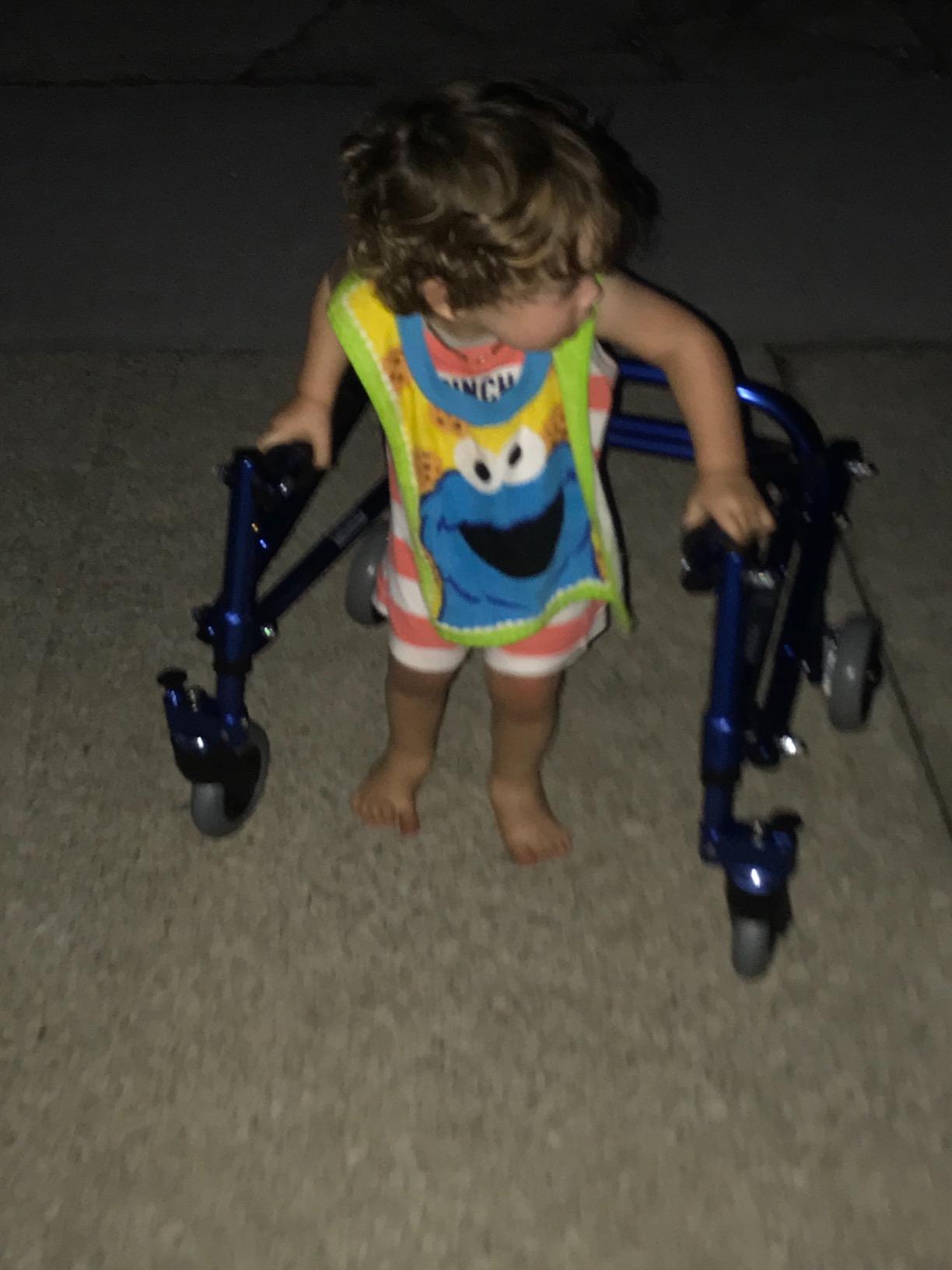
The Nimbo carries the highest rating in this roundup at 4.7 stars, and it is the only posterior-format device here, which makes it a different tool rather than a different brand. The defining feature is the open back: the user stands inside the frame and a therapist pushes from behind, which promotes trunk extension and a more upright posture than pulling from the front.
Buyers describe it as the device that finally worked after several other walkers failed, particularly for stroke survivors and for children in physical therapy. The open rear and the hip-level support bar are credited with immediately improving posture and walking confidence, and the side handles help unload weight and reduce sideways balance loss.
The 5-inch rear wheels have an anti-rollback setting that will not slide backward, and they can be configured to roll forward only for users with limited ambulation ability. Directional locks on the front casters add directional control, and the soft-textured handgrips are reported as comfortable over long sessions. Five frame sizes each with 4 inches or more of adjustment accommodate a range of growth, which is why this shows up in paediatric therapy as well as adult stroke rehab.
It is also foldable despite being heavy therapeutic equipment, and it fits into a car. The frame is aluminium, measures 26.5 by 34 inches, and the handle adjusts from 28 to 36 inches across a 16.5-inch width.
The 190-pound weight capacity is the significant limitation, well below the 300 pounds most picks here carry, and it is the reason this is not higher in the list despite the rating. Buyers also report that the sling seat and pouches shown in some images are not included, that hardware bolts loosen with use and need periodic re-tightening, that the frame finish scratches and dents easily, and a few that rear wheels would not roll even after adjustment.
My practical read is that this is a clinical or clinic device that a family adopts when a therapist specifically recommends gait training, not a general-purpose home walker. It weighs 16.85 pounds, which is manageable, but the low capacity and the maintenance fussy-ness make it a poor fit for a larger adult at home.
For general rollator use with a seat, brakes and a shopping-friendly setup, our rollator walker roundup covers that category properly.
For whom it suits
A patient under 190 pounds who is still being trained to walk, is working with a physical therapist who will push from behind, or is a child or young adult in physical therapy. Also right for a user who needs the rear wheels locked to forward-only to prevent rolling backward.
Households that can handle periodic bolt tightening will find the frame holds up well over a long therapy schedule.
For whom it does not suit
Adults over 190 pounds, anyone buying it as a general home walker without a therapist’s recommendation, and anyone who will not check bolt tightness periodically. Do not assume the pictured seat and pouches are in the box.
The frame finish dents and scratches easily, which matters in a home where the device doubles as everyday furniture-adjacent equipment.
We earn a commission, at no additional cost to you. CERTAIN CONTENT THAT APPEARS ON THIS SITE COMES FROM AMAZON. THIS CONTENT IS PROVIDED 'AS IS' AND IS SUBJECT TO CHANGE OR REMOVAL AT ANY TIME.
How to Choose a Walker After a Stroke?
Work through these in order. The order matters because the first question eliminates most of the catalogue and everything after it is a refinement.
1. Establish the weakness pattern. One side only, or both? One-sided weakness points to a hemi walker, full stop. Bilateral weakness with usable arms points to a front-wheeled or upright model. Unclear? Ask the therapist to demonstrate the transfer and the walking pattern before you buy anything.
2. Test grip strength with the working hand. A hemi walker needs one hand to control a frame through a step. A platform or upright walker needs forearms to bear body weight, which is a very different demand from gripping. If the patient cannot hold weight through the wrist or hand, a standard handlebar walker will aggravate the shoulder and wrist rather than help.
3. Check core stability and braking control. A rollator with a seat is only safe if the user can lower themselves without toppling and can brake with the hand that works. Unilateral neglect, common after a right-side stroke, means the user may not notice the frame or a parked wheel on one side, which changes the supervision question more than any spec.
4. Match weight capacity before anything else. These picks range from 190 to 300 pounds. Check the patient’s current weight, not the weight a year ago, and leave margin. The 220-pound and 190-pound frames are the two most likely to be wrong.
5. Measure the route, not the walker. Doorways, hallway turns, the gap beside a bed or couch, and whether a threshold is higher than half an inch will kill an otherwise good purchase. Note the narrowest frame you need to pass through. Several picks here are 26 to 32 inches wide, which is wider than a standard interior door in many homes.
6. Decide who does the lifting. Frames here run from 3.5 to 24 pounds. A 24-pound upright rollator is a two-person or caregiver-only lifting job in most households, and a 3.5-pound hemi walker is not. Write down who carries it, and choose for that person.
7. Set the height with the user standing. Most frames here adjust in 1-inch increments or in indexed holes. The person should stand upright with relaxed shoulders, not hunched over the frame, and the height should be rechecked as therapy progresses. Adjustable in an inch matters, because posture changes during recovery.
One question deserves a clear answer on its own, because it comes up constantly on stroke forums: is a rollator or a walker safer? A standard walker is safer for most early-stage stroke patients, because it requires less balance and coordination to operate and is harder to roll away unexpectedly. A rollator is faster, handles uneven ground better with larger wheels, and needs two-handed grip, braking control and turning awareness. If the user cannot brake reliably, the answer is the standard walker.
And on when a walker is the wrong recommendation: if the patient cannot bear weight on either leg, or is not standing at all, a gait trainer or a wheelchair is a better tool than any walker on this page. A therapist should be part of that conversation rather than after it.
On expected timelines, a rough rule of thumb families report: in the first days and weeks the priority is transfers and short supported walks indoors, which is where a hemi walker or a small platform walker fits. As the patient gains leg control and trunk stability and starts walking further, an upright rollator with a seat becomes practical. Nobody should plan this around fixed weeks, though, because recovery timelines vary enormously and the treating therapist’s read matters more than a calendar.
Will Medicare or Insurance Cover a Walker?
Most families do not ask this until the checkout page, so here is the short version. Medicare Part B covers walkers and rolling walkers as Durable Medical Equipment, or DME, when a physician has prescribed the device and documented it as medically necessary and the patient meets Medicare’s mobility criteria. Standard DME generally does not require prior authorisation, though the supplier will almost always need a prescription on file before they dispense.
The practical route is straightforward. Get the prescription from the doctor or, in many cases, the occupational or physical therapist who has already assessed the patient. Take it to a DME supplier rather than buying retail and hoping to be reimbursed, because Medicare’s benefit runs through the supplier and out-of-pocket costs work very differently depending on whether the purchase went through a covered channel. If you are on a Medicare Advantage plan rather than original Medicare, check the plan’s own DME rules, which can differ.
Two things people are often surprised by. First, the specific device usually has to be the one the clinician prescribed, so switching from a prescribed standard walker to a premium rollator at the register can void coverage. Second, replacement frequency is limited, so if the frame breaks in month three of a long recovery, that is a question for the supplier and the doctor before buying again.
Nothing in this section replaces advice from your insurer, your supplier or your treating team. Coverage rules change, and the answer depends on the policy and the prescription.
Frequently Asked Questions
Is it beneficial to use a walker after a stroke?
Yes, conditionally. A walker lets a stroke survivor walk more often and more safely than they otherwise could, and more supported walking generally supports recovery. It is a support tool rather than a treatment, does not restore function on its own, and the device only helps if the type matches the weakness pattern. Start walking only when the treating team says it is safe.
What is the best stand-up walker for stroke patients?
An upright or forearm rollator is the best stand-up walker for a patient with good leg control and core stability who cannot bear weight through the wrists or hands. The padded armrests transfer load to the forearms and keep the back erect. In this roundup the Helavo Upright Walker and the ELENKER Upright Rollator are the two strongest options.
Which is safer, a rollator or a standard walker?
A standard walker is safer for most early-stage stroke patients because it needs less balance and coordination and is harder to roll away unexpectedly. A rollator is better on uneven ground and lets the user walk faster, but it requires two-handed grip, working brakes and turning awareness. If braking control is unreliable, choose the standard walker.
What kind of walker will Medicare pay for?
Medicare Part B covers walkers and rolling walkers as Durable Medical Equipment when a physician prescribes the device, documents it as medically necessary, and the patient meets Medicare’s mobility criteria. Standard DME usually needs no prior authorisation, but the supplier will require a prescription on file. Buying through a covered DME supplier rather than retail usually protects the benefit.
Do stroke patients need a walker or a cane?
A cane suits mild one-sided weakness with short indoor distances and supervision. Once the person needs a frame for balance rather than reassurance, a hemi walker gives a much wider base of support and allows single-handed use. Discuss the change with an occupational therapist before switching, especially if falls are already happening.
Can you use a walker with one arm?
Yes, if it is a hemi or side walker. The open side lets the user step into the middle of the frame and control it with one hand, which is the reason the category exists. A standard four-legged walker needs two-handed grip, and a rollator needs both hands on the brakes. The Days Hemi Walker and the Vive Hemi Walker for Seniors are the two picks here designed for one-handed use.
What weight capacity walker do I need after a stroke?
Check the patient’s current weight and leave margin, because these frames range from 190 to 300 pounds. Five of the eight picks here are rated to 300 pounds, the Goplus to 220 and the posterior Nimbo to 190. If there is any doubt, choose a higher-rated frame rather than checking the limit on the day of delivery.
Conclusion
The best walkers for stroke patients are not the ones with the most features, they are the ones that match the weakness pattern. One-sided weakness needs a hemi walker that works with a single hand. Bilateral weakness with usable arms needs a front-wheeled or upright model, and an upright rollator is the right answer once the patient can stand tall and bear weight on the forearms.
Our top pick, the Helavo Upright Walker with Seat, is the strongest all-round choice for a patient in later-stage recovery who needs to get outdoors. The ELENKER Upright Rollator has the deepest review history in the category, the Goplus is the budget pick and the only one that reconfigures as recovery progresses, and the Days and Vive Hemi Walkers are the correct answer for one-sided weakness.
Take the measurements to your next appointment. Frame width, weight capacity, who does the lifting, and whether the patient can brake reliably will narrow the list faster than any specification, and an occupational therapist can confirm the choice in a few minutes. Compare these against our other mobility guides, check what your insurer will cover before you buy, and revisit the decision as therapy goals change.