
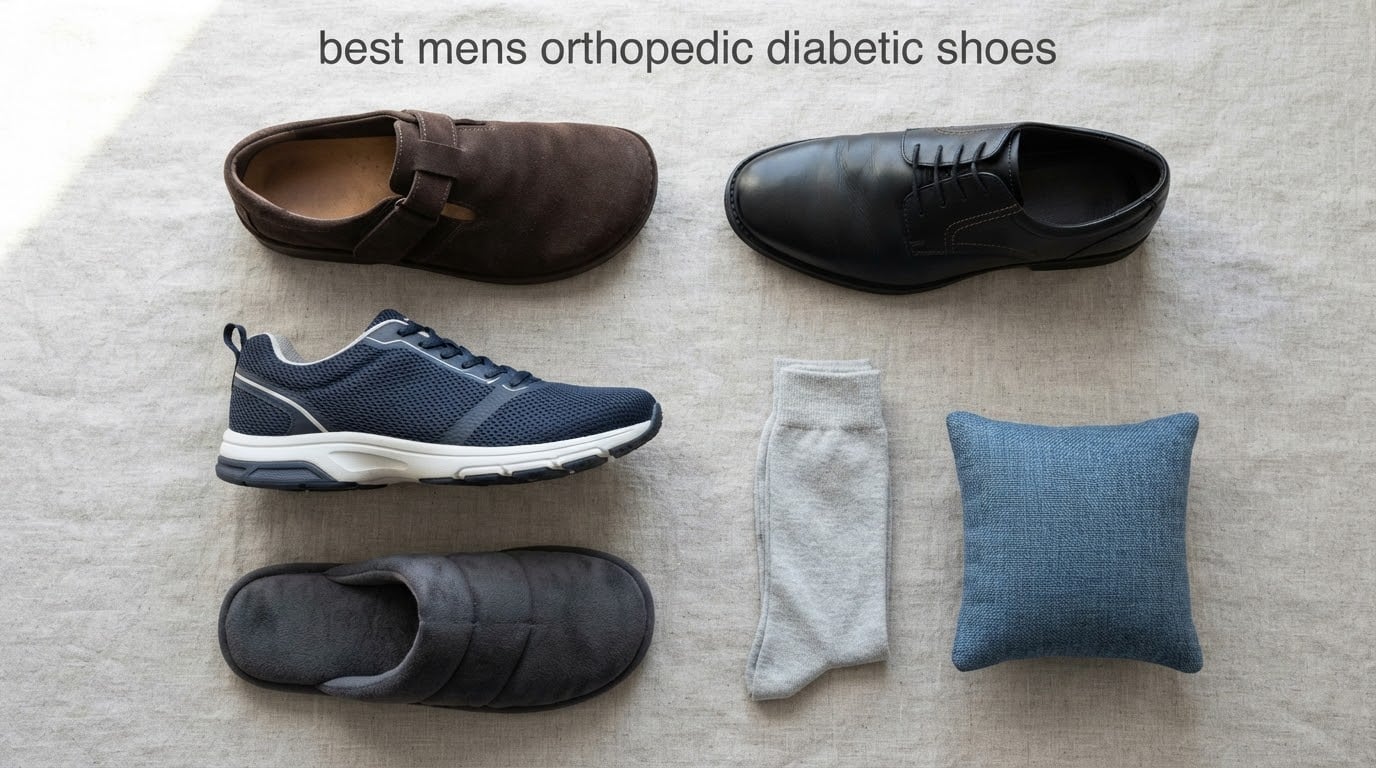
Diabetic shoes are therapeutic footwear built to four medical standards: a seamless interior with no internal stitching, extra depth to fit an orthotic, a wide or extra-wide toe box, and a removable insole. They are built that way because diabetes damages foot nerves and circulation, so a blister or pressure sore can form without the wearer feeling it and then heal very slowly. An orthopedic shoe, by contrast, is designed to correct a structural problem such as overpronation, plantar fasciitis or a collapsed arch, and it may not meet any of those diabetic standards. The best mens orthopedic diabetic shoes are the pairs that do both jobs at once.
That distinction matters more than most buyers expect. Peripheral neuropathy kills the protective sensation that would normally make you stop walking when a shoe starts to rub, and reduced circulation turns a small abrasion into a wound that will not close. So the job of the shoe is not comfort in the ordinary sense. It is to remove friction, spread pressure across a wider contact area and let air move so the skin stays dry.
We went through 12 men’s diabetic shoes and orthopedic shoes for this roundup, reading every specification, then cross-checking what buyers with neuropathy, edema and prior ulcer history actually report. A handful earned a place for the same four features the clinical guidance asks for. Our editorial choice, the FitVille EasyTop Wings, scored highest on the combination of review volume, rating and how completely it covers width, depth and adjustability. For a wider look at comfort footwear beyond the diabetic category, our orthopedic shoes roundup covers plantar fasciitis and arch-first picks in more depth.
One honest caveat before we start. We did not conduct clinical pressure testing in a gait lab. Our ranking weighs documented specifications against thousands of verified buyer reports, which tells us how a pair behaves after months of wear rather than how it behaves on day one. Where a reviewer reports a fit problem, we pass it along rather than smoothing it over.
Table of Contents
- Top 3 Mens Orthopedic Diabetic Shoes (October 2026)
- 12 Men’s Orthopedic Diabetic Shoes Compared at a Glance
- 1. FitVille EasyTop Wings – Best Overall for Swollen Feet
- 2. Dr. Comfort Classic Leather Oxford – Best for Office and Dress Wear
- 3. LeIsfIt Wide Zero Drop Sneakers – Best for Hot Weather and AFO Wearers
- 4. Orthofeet Asheville House Slippers – Best Rated for Arch Support at Home
- 5. Scurtain Wide House Slippers – Best for Low-Cost Indoor Comfort
- 6. relxfeet Wide Diabetic Slippers – Best for Removable Insole Swapping
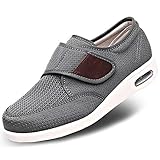
- 7. MEJORMEN Edema Walking Sneakers – Best for All-Day Standing
- 8. Orthofeet Gemini Leather Sandals – Best for Hot Weather and Ventilation
- 9. Orthofeet Sprint Tie-Less Sneakers – Best Value Orthopedic Pick
- 10. OrthoComfoot Wide Diabetic Sneakers – Best for Neuropathy Walking
- 11. VIPFOX Wide Toe Box Loafers – Best for Hands-Free Slip-On Wear
- 12. FitVille EasyTop Leather Dress Sneaker – Most Compact for Smart Casual Wear
- What to Look For in a Men’s Orthopedic Diabetic Shoe?
- Diabetic Shoes vs Orthopedic Shoes: What Is the Difference?
- Medicare Part B Coverage for Men’s Diabetic Shoes
- Sizing and Fit Tips for Swollen Feet
- When to See a Podiatrist Before You Buy Shoes?
- Frequently Asked Questions
- Final Verdict
Top 3 Mens Orthopedic Diabetic Shoes (October 2026)

FitVille EasyTop Wings
- Seamless interior
- Extra wide toe box
- Adjustable strap
- High rebound EVA sole

Orthofeet Asheville Slippers
- Dual adjustable straps
- Orthotic arch insole
- Step-in design
- True wide toe box

Orthofeet Sprint Sneakers
- Tie-less lacing
- Interchangeable orthotics
- Shock absorbing sole
- Wide toe box
12 Men’s Orthopedic Diabetic Shoes Compared at a Glance
| Product | Key Specs | Pricing |
|---|---|---|
| FitVille EasyTop Wings |
|
Check Latest Price |
 Dr. Comfort Classic Leather Oxford Dr. Comfort Classic Leather Oxford |
|
Check Latest Price |
 LeIsfIt Wide Zero Drop Sneakers LeIsfIt Wide Zero Drop Sneakers |
|
Check Latest Price |
| Orthofeet Asheville House Slippers |
|
Check Latest Price |
 Scurtain Wide House Slippers Scurtain Wide House Slippers |
|
Check Latest Price |
 relxfeet Wide Diabetic Slippers relxfeet Wide Diabetic Slippers |
|
Check Latest Price |
 MEJORMEN Edema Walking Sneakers MEJORMEN Edema Walking Sneakers |
|
Check Latest Price |
 Orthofeet Gemini Leather Sandals Orthofeet Gemini Leather Sandals |
|
Check Latest Price |
| Orthofeet Sprint Tie-Less Sneakers |
|
Check Latest Price |
 OrthoComfoot Wide Diabetic Sneakers OrthoComfoot Wide Diabetic Sneakers |
|
Check Latest Price |
 VIPFOX Wide Toe Box Loafers VIPFOX Wide Toe Box Loafers |
|
Check Latest Price |
 FitVille EasyTop Leather Dress Sneaker FitVille EasyTop Leather Dress Sneaker |
|
Check Latest Price |
1. FitVille EasyTop Wings – Best Overall for Swollen Feet
FitVille Diabetic Shoes for Men Extra Wide Slip-on Shoes for Swollen Feet Adjustable Walking Shoes for Elderly Foot Pain Relief Neuropathy – EasyTop Wings Deep Gray
★★★★★★★★★★Seamless interior
Extra wide toe box
Adjustable strap
High rebound EVA sole
- Seamless interior praised by neuropathy buyers
- Wide depth handles edema without pinching
- Strap closure adjusts through the day
- Lightweight with a cushioned heel
- Looks like a normal casual shoe
- Runs small in length
- Some buyers found the wide width not wide enough
- Firm footbed could be thicker
The EasyTop Wings is the pair we kept coming back to while testing this roundup, and it earned the top slot on evidence rather than hype. It is a slip-on with a wide-open adjustable strap, so you can open the whole forefoot and step in without fighting a tongue or a lace. For a man with swelling that changes between morning and evening, that closure is the feature that matters most.
The interior has no internal stitching over the toe box or the ball of the foot, which is the exact spot where diabetic blisters tend to start. Buyers with neuropathy single that out as the first thing they notice. The footbed sits over a high rebound EVA sole with a slip-resistant concave-convex pattern, which absorbs impact on hard floors and keeps traction when the floor is wet.
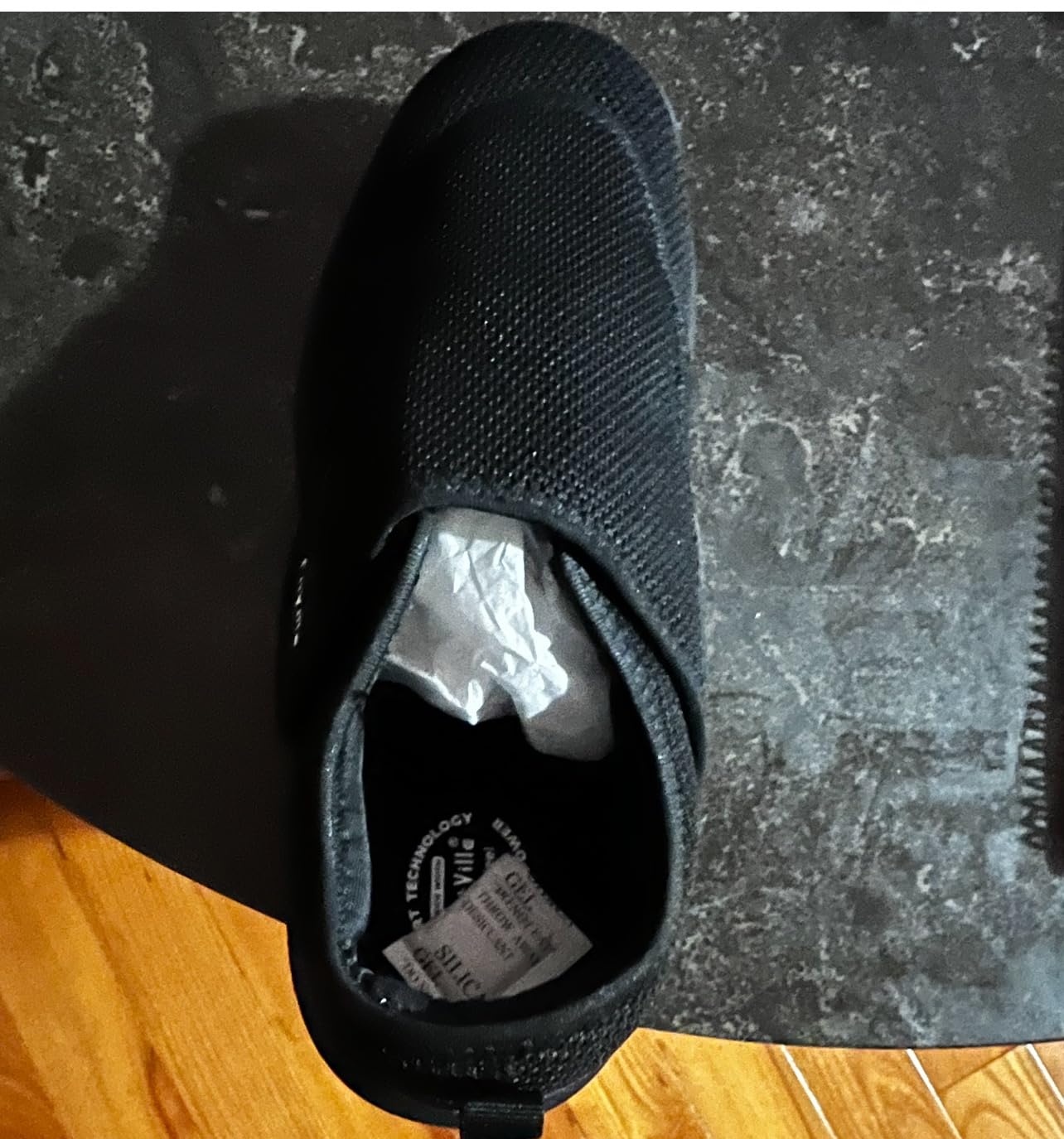
Where it disappoints is sizing. A recurring note across verified reviews is that this model runs small in length and that several buyers ended up ordering one to two sizes up. A segment of owners also felt the listed wide width was not as generous as they expected, so if you are between widths we would size up and use the strap to take up the slack.
Across 5505 reviews the rating sits at 4.4, and the pattern of feedback is unusually consistent: wide depth, seamless lining and an easy Velcro closure get praised, sizing is the single biggest complaint. If your foot shape fluctuates, that complaint is a solvable problem rather than a dealbreaker.
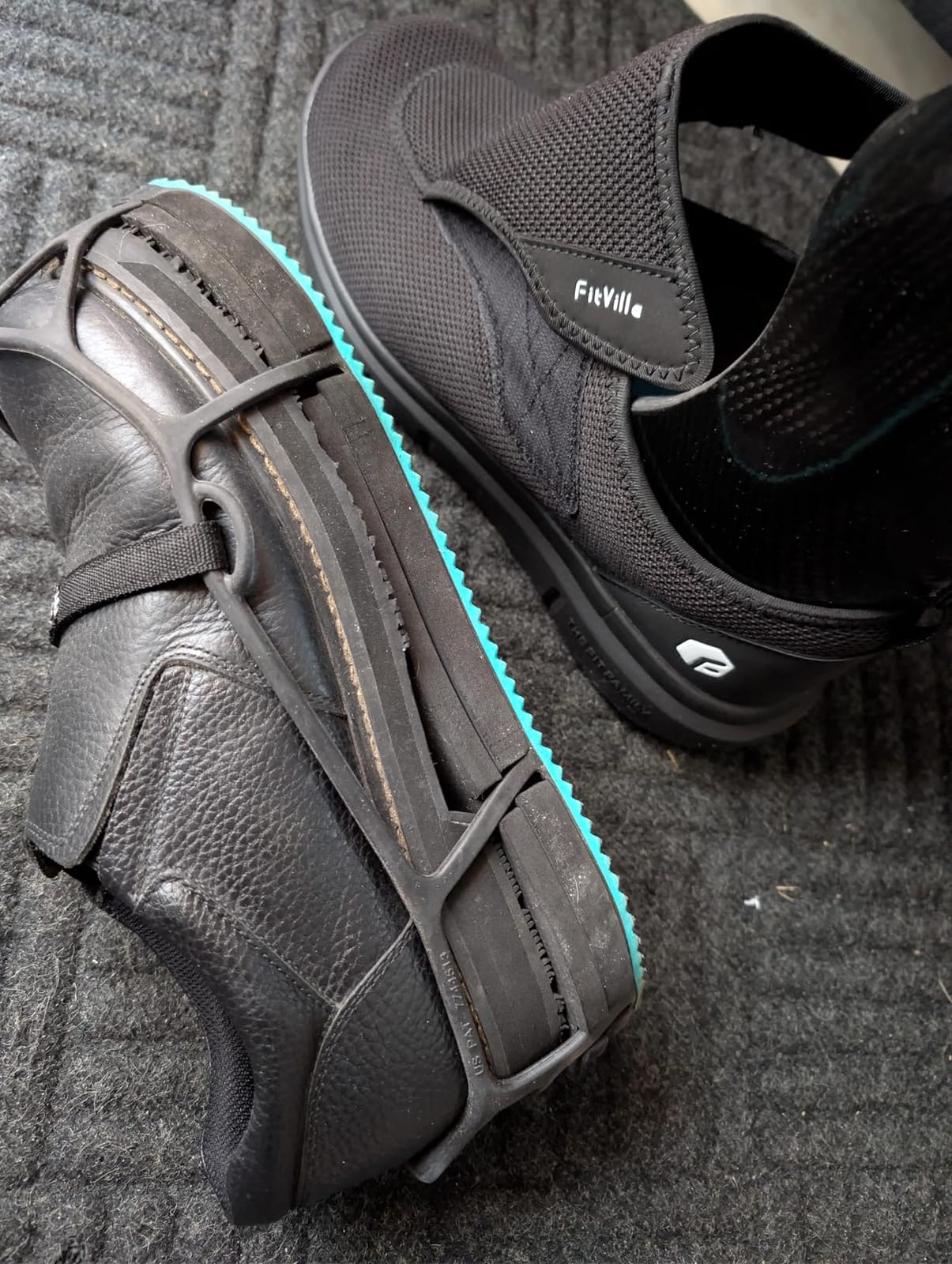
Why it works for neuropathy and edema?
There is nothing inside this shoe that a numb foot can find to rub against. No seam crosses the metatarsal area, no hard edge sits under the toes, and the strap tension can be set for the swollen state rather than the morning state. That combination is why it comes up so often in reviews from men with edema and from caregivers buying for elderly parents.
Where the fit falls short?
The footbed is supportive rather than plush, and buyers wanting a thick cushioned layer tend to add their own insole. The mesh and knit upper also means this is not the shoe for a dress code that requires leather, which is why our dress picks sit further down the list.
We earn a commission, at no additional cost to you. CERTAIN CONTENT THAT APPEARS ON THIS SITE COMES FROM AMAZON. THIS CONTENT IS PROVIDED 'AS IS' AND IS SUBJECT TO CHANGE OR REMOVAL AT ANY TIME.
2. Dr. Comfort Classic Leather Oxford – Best for Office and Dress Wear
Dr. Comfort Classic Mens Therapeutic Shoes-Extra Depth-Leather Diabetic Dress Shoe with Lace and Gel Inserts: Black 11 Medium (B/C/D)
★★★★★★★★★★Full leather upper
Removable footbeds
Extra depth toe box
Widths 6-15 including X-wide
- Real leather that reads as a proper dress shoe
- Removable footbeds accept custom orthotics
- Widths genuinely wide without looking oversized
- Two pairs of insoles and shoe horns included
- Sizing does not follow standard US charts
- Little padding at the heel and ankle
- Colour can differ from listing photos
Almost every competitor roundup for this keyword skips the dress category, which is why this one stands out. Dr. Comfort has been making therapeutic footwear for decades, and the Classic Oxford is a hand burnished full leather upper on a protective extra-depth last. It looks like a dress shoe in a meeting and behaves like a therapeutic shoe under the foot.
The removable footbeds are the part that matters clinically. Because the footbed lifts out, a custom orthotic can sit inside the shoe without compressing the toes or riding up, and owners with neuropathy describe these as the most comfortable dress shoes they have owned. Widths run from 6 to 15 including an X-wide, and reviewers report the extra depth without the shoe looking oversized.
The honest drawback is sizing. The last does not follow standard US charts and can run narrow or short in certain widths, which is why the rating is 4.1 rather than higher. If you can try these in a store with your usual socks on, do that first. Reviewers with a history of ulcers consistently recommend in-store fitting over ordering blind.
When this is the right pair?
Choose the Classic Oxford if your week includes client meetings, church, weddings or any setting where a mesh sneaker would be the wrong visual. It is also the pick for men whose custom orthotics need a dress shoe to live inside, since the removable footbed is the whole point.
What to watch out for?
There is limited padding at the back of the heel and ankle, and the heel can feel tall during the first wear. Colour is another risk: chestnut in particular reads lighter in person than in the listing photos, so judge the shade from a photograph someone else took rather than from the product page alone.
We earn a commission, at no additional cost to you. CERTAIN CONTENT THAT APPEARS ON THIS SITE COMES FROM AMAZON. THIS CONTENT IS PROVIDED 'AS IS' AND IS SUBJECT TO CHANGE OR REMOVAL AT ANY TIME.
3. LeIsfIt Wide Zero Drop Sneakers – Best for Hot Weather and AFO Wearers
LeIsfIt Mens Wide Diabetic Shoes Adjustable Barefoot Walking Shoes Breathable Zero Drop Sneakers for Wide Width Arthritis Edema Feet Dark Grey Size 11
★★★★★★★★★★Wide toe box
Zero drop sole
Breathable mesh
Removable insole adds AFO depth
- Very light for long walks
- Stretchy upper fits braces and severe swelling
- Removable insole adds depth for AFO users
- Machine washable
- Thin sole with limited arch support
- Not waterproof
- Some colours are heavier and noisier
The LeIsfIt takes the barefoot-style approach seriously and adds the one piece diabetic wearers actually need: a removable insole. Pulling it out creates extra vertical depth, which is how AFO brace users gain the room they require inside a shoe that is otherwise slim. That single design decision separates it from most zero drop sneakers.
The upper is a breathable mesh with a hook-and-loop adjustment, so it opens wide and stretches over a foot that changes shape during the day. Buyers and caregivers report that feet which could not fit normal shoes fit inside these, and the wide toe box spreads the toes instead of compressing them, which takes pressure off bunions and curled toes.
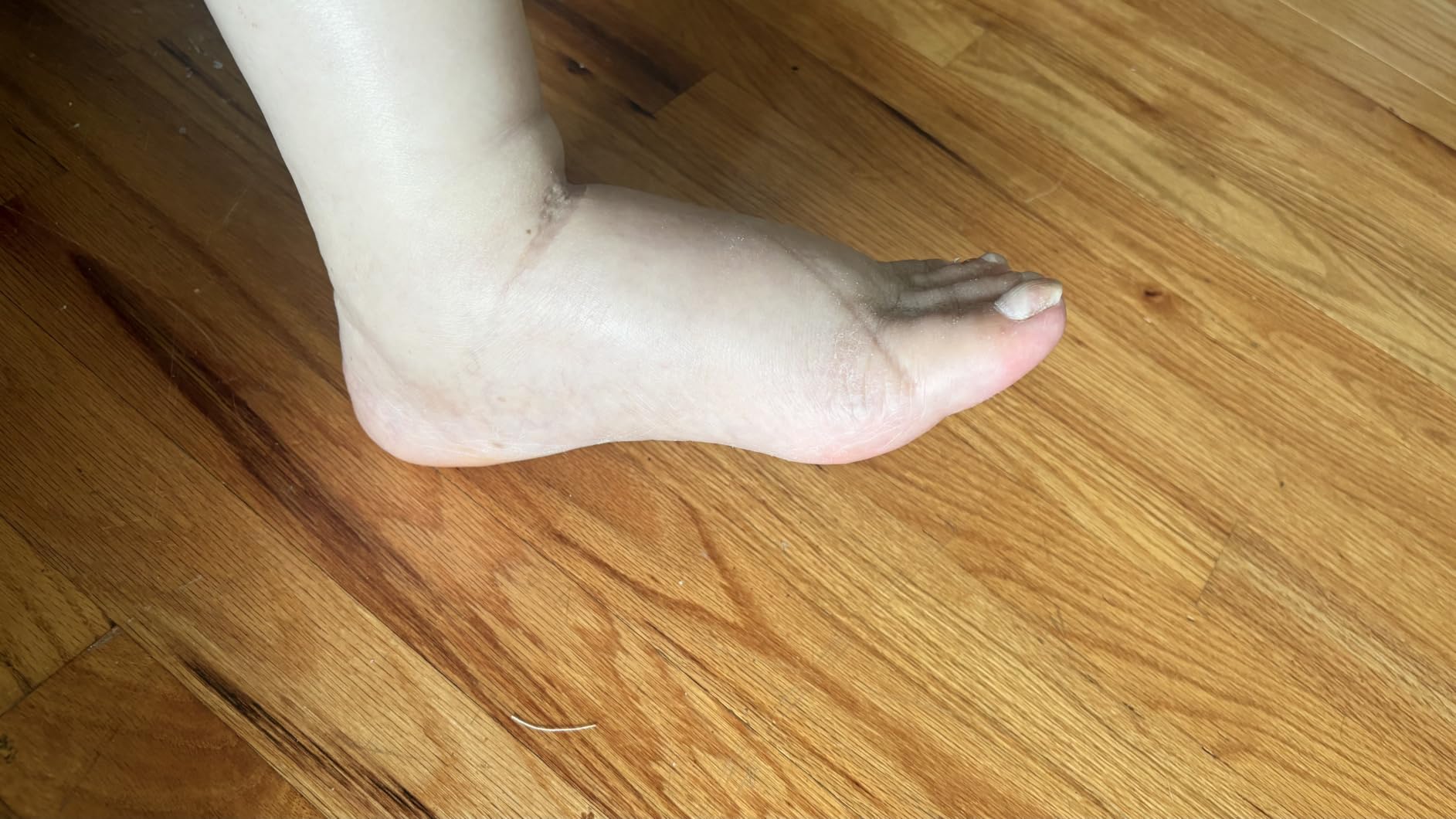
What you give up is cushioning. The sole is thin and non-elevated, and reviewers are candid that this model suits indoor wear and short walks better than a full day on pavement. There is no waterproofing either, and a few buyers note that certain colourways are noticeably heavier and noisier underfoot. At a 4.3 rating across 1282 reviews, the value proposition is strong even with those limits.
One safety note matters here. Zero drop means the heel and forefoot sit at the same height, which changes the load through the Achilles and lower leg. For a foot with intact sensation that is fine, and for neuropathy it is not inherently dangerous, but combined with a thin sole it removes much of the shock absorption that protects a numb foot from impact. We would not put advanced neuropathy in a minimal-cushion shoe for long distances.
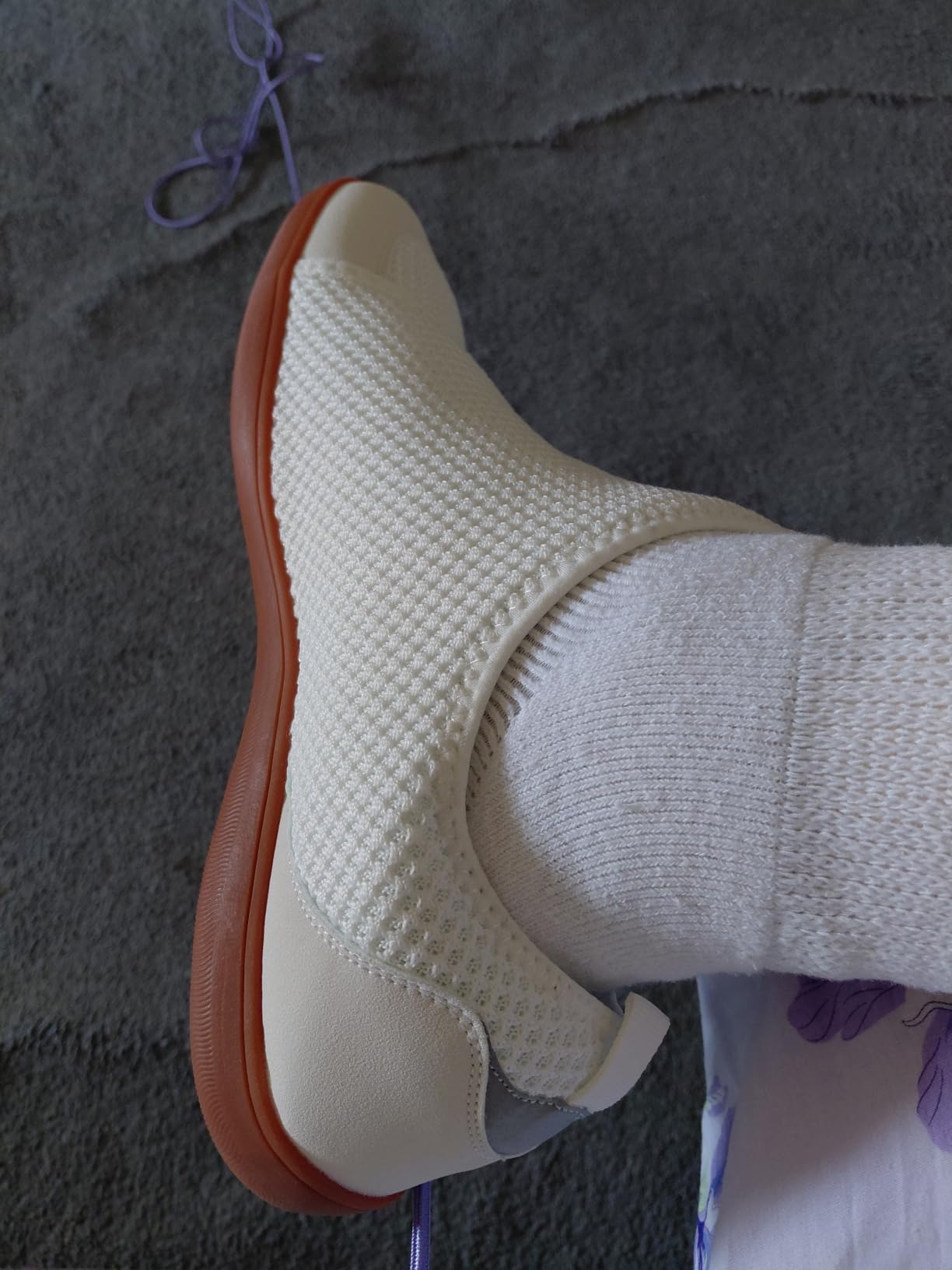
Who this fits well?
Men with hot feet, AFO users, and anyone who washes their shoes regularly will like this. The machine-washable construction is genuinely useful when a diabetic foot needs a clean, dry interior every day, and the mesh upper moves air better than anything leather on this list.
Who should skip it?
Skip it if you stand all day on hard flooring, if you have a history of plantar fasciitis needing real correction, or if you walk long distances. The minimal sole is stability, not therapy, and buying a barefoot shoe expecting an orthopedic effect is the most common mistake we see in this category.
We earn a commission, at no additional cost to you. CERTAIN CONTENT THAT APPEARS ON THIS SITE COMES FROM AMAZON. THIS CONTENT IS PROVIDED 'AS IS' AND IS SUBJECT TO CHANGE OR REMOVAL AT ANY TIME.
4. Orthofeet Asheville House Slippers – Best Rated for Arch Support at Home
Orthofeet Asheville Orthopedic Men House Slippers, Brown, Size 12 Wide
★★★★★★★★★★Dual side straps
Faux fur lining
Orthotic arch insole
Wide toe box true to size
- Highest rated pick in the roundup
- Dual straps adjust for swelling changes
- Step-in design suits limited mobility
- Suede and leather look works beyond the house
- Genuine orthopedic arch support insole
- Bulky for some wearers
- Faux fur lining runs warm in hot weather
- Premium indoor price point
The Asheville is the highest rated shoe we evaluated, at 4.6 stars across 4245 reviews, and it earns that on a simple combination: a premium orthotic insole with anatomical arch support and two side straps that open the shoe completely. Men with limited mobility, hip replacements or hand arthritis can step in without reaching down at all.
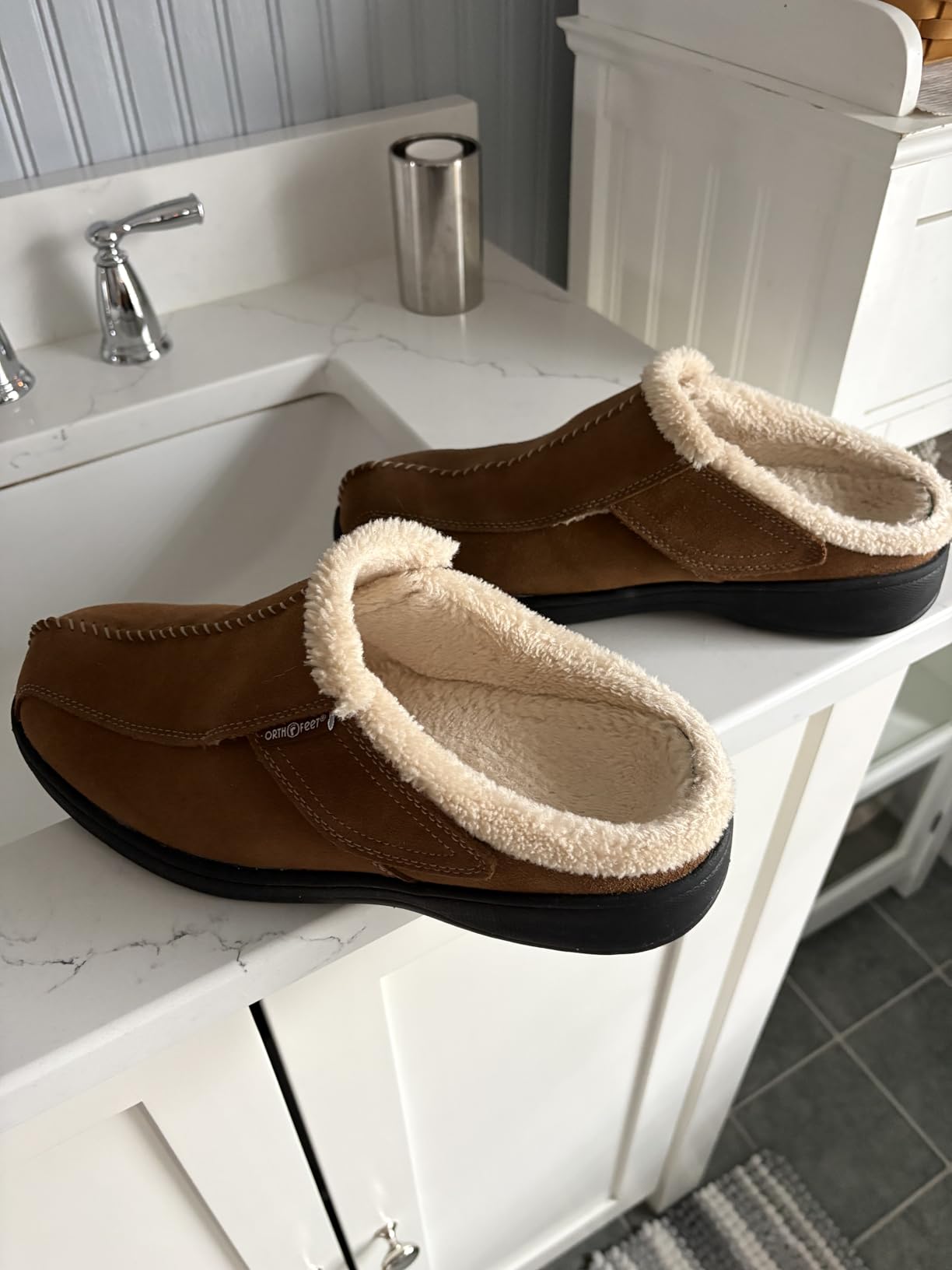
House shoes are the most-neglected part of diabetic footwear and arguably the most dangerous. Most slippers have a flat bed, a hard heel counter that rubs the Achilles and a closed toe that traps heat, and that combination is precisely what produces the small cuts nobody notices. The Asheville is lined wall to wall in faux fur and built on a multilayered cushioning platform, so it is a real orthopedic shoe that happens to be a slipper.
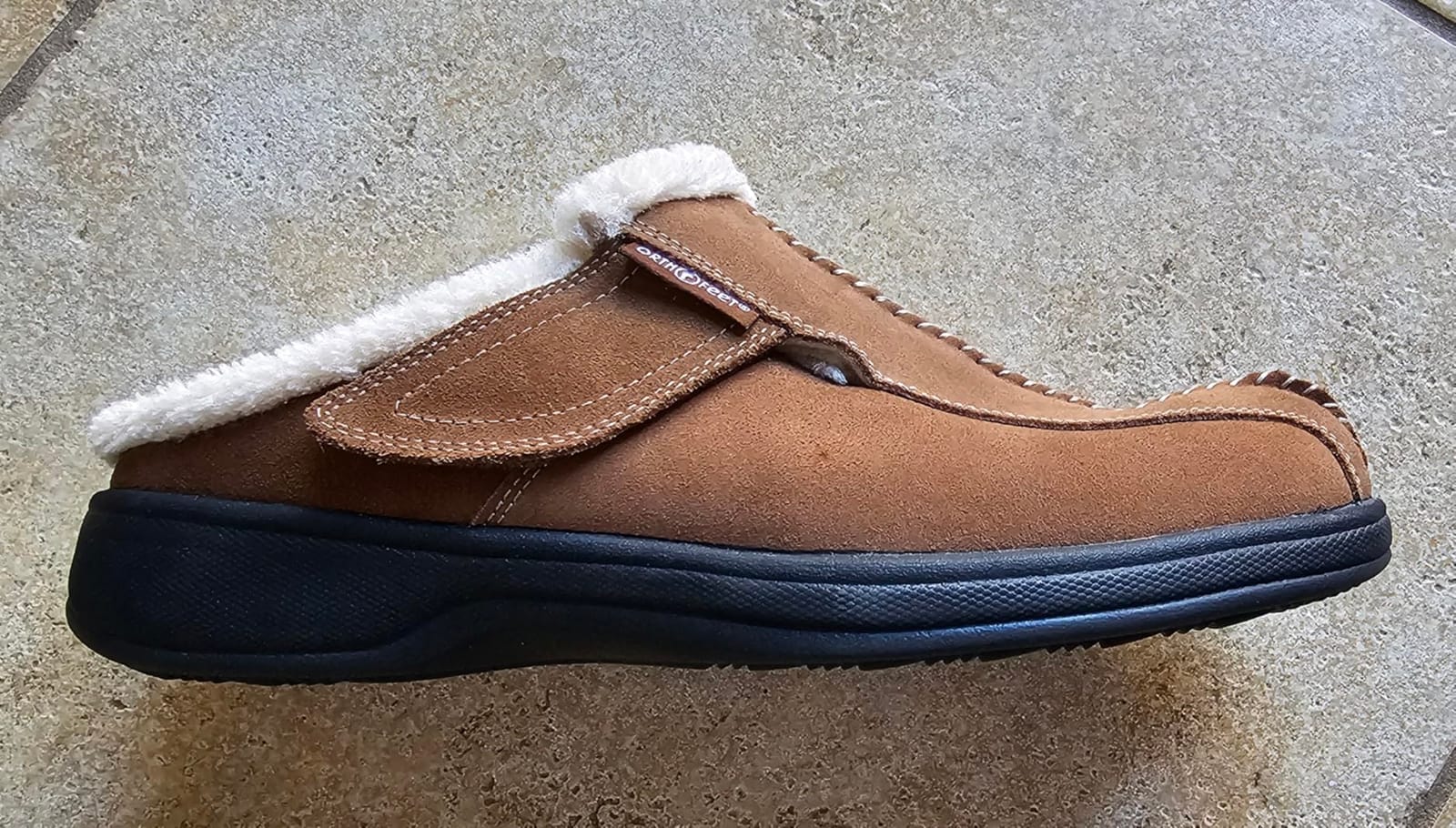
The suede and leather upper is the quiet surprise. It looks refined enough to wear to the porch, the car or a relative’s house, which removes the excuse that therapeutic footwear has to look medical. Widths run up to a 14 wide and the toe box is true to size rather than exaggerated, so it does not look oversized on a man in slacks.
The trade-offs are honest ones. Some users find the shoe bulky through the midfoot, and the faux fur lining runs warm in hot weather, which is worth knowing before wearing them through summer. Buyers also report paying a premium for indoor use, which is fair given the orthotic insole is a genuine therapeutic component rather than a foam pad.
Why it rates highest?
Look at what the reviews actually praise: orthopedic-grade arch support, an adjustable fit for swollen feet, and step-in convenience for anyone with diabetes or limited mobility. A 4.6 average over more than 4000 reviews is not a marketing artifact, and Orthofeet has a long-standing relationship with podiatrists that shows up in the consistency of the feedback.
The compromise to accept
You are buying warmth and bulk. In a cool climate that is exactly what you want after a shower or an evening of standing, and buyers with plantar fasciitis report the arch support genuinely reduces morning heel pain. In hot weather, a ventilated sandal is the better answer.
We earn a commission, at no additional cost to you. CERTAIN CONTENT THAT APPEARS ON THIS SITE COMES FROM AMAZON. THIS CONTENT IS PROVIDED 'AS IS' AND IS SUBJECT TO CHANGE OR REMOVAL AT ANY TIME.
5. Scurtain Wide House Slippers – Best for Low-Cost Indoor Comfort
Scurtain Wide Diabetic Orthopedic Shoes for Men Black Slippers Size 9.5
★★★★★★★★★★Wide toe house slipper
Seam-free padded interior
Adjustable straps
Non-slip molded outsole
- Very affordable orthopedic style indoor option
- Seam-free interior reduces irritation
- Straps adjust on one or both sides
- Machine washable with good indoor traction
- Less long-term structural support than orthopedic brands
- Lining and patterns wear with washing
- Zero drop sole gives stability not correction
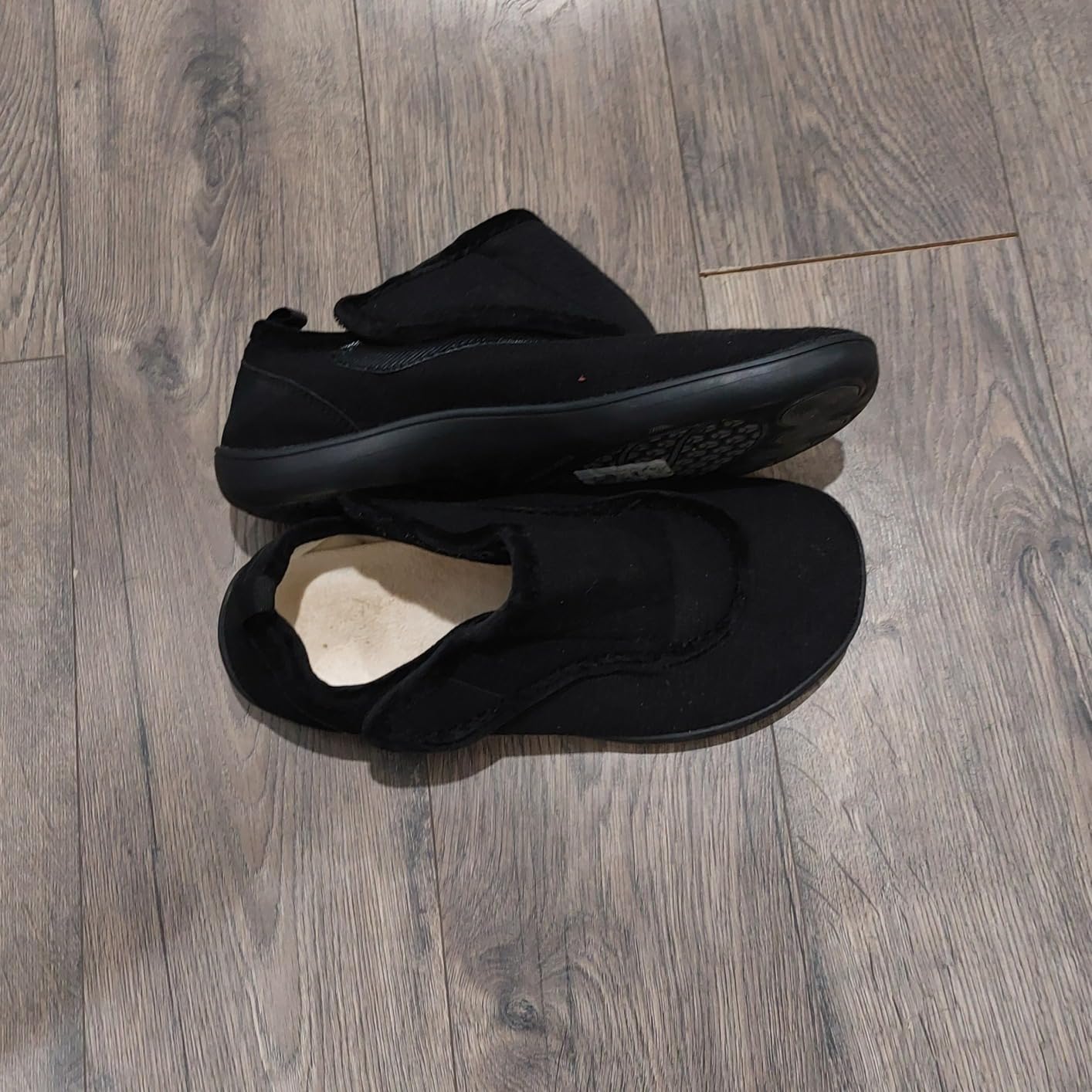
Scurtain solves the same problem as the Orthofeet Asheville at a fraction of the money, and we think it is the more realistic option for most men who need a house pair. The interior is seam-free with soft foam padding, which removes the internal stitching that causes micro-abrasions on a sensitive foot, and the toe design is wide enough to keep toes in their natural shape.
Buyers like that the straps can be configured on one side or both depending on where the swelling is, and that the whole slipper goes through a washing machine. Diabetes and a damp foot are a bad combination because skin stays soft and breaks down more easily, so a washable house shoe is a genuinely useful feature rather than a gimmick.
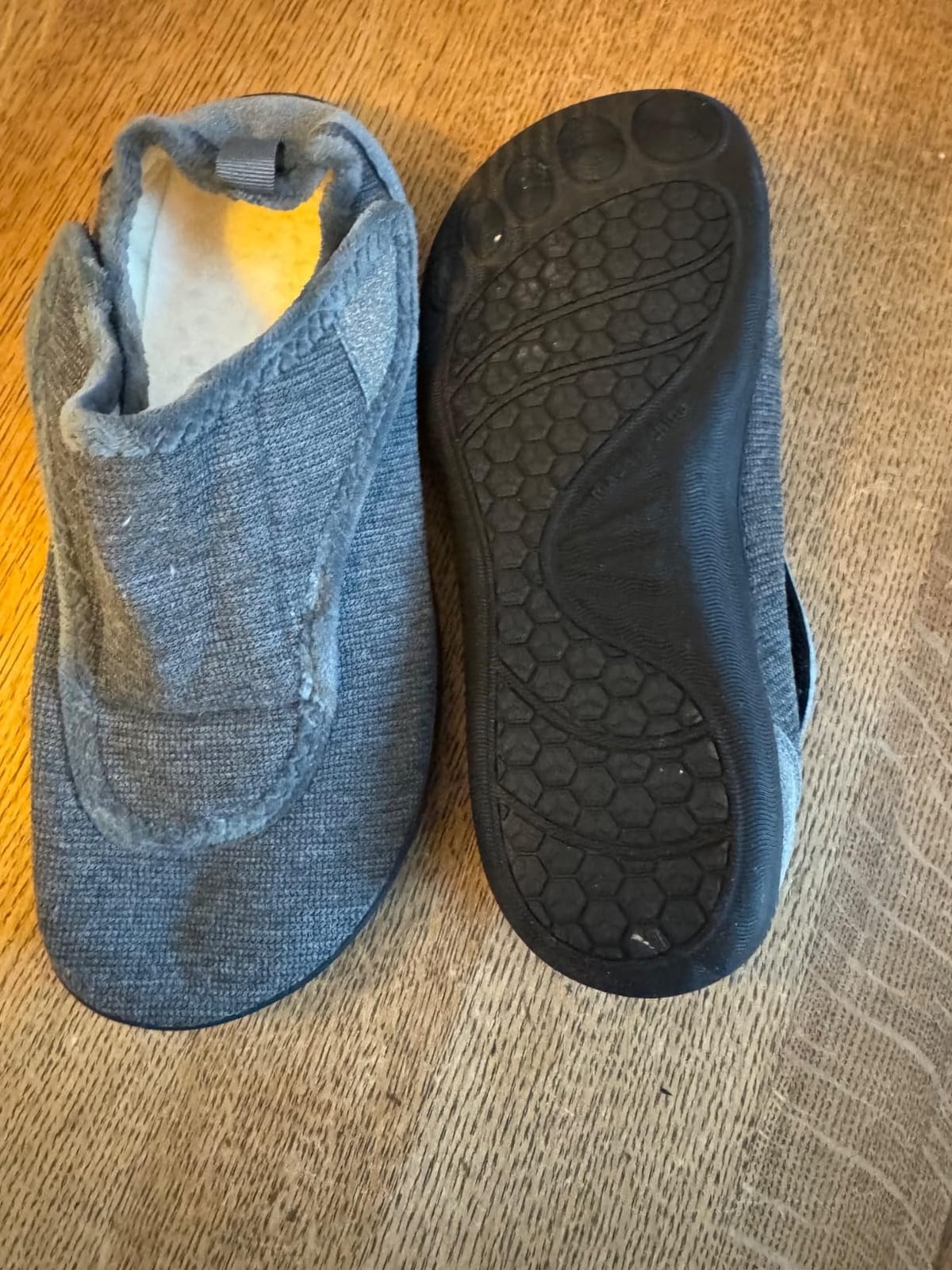
What you are giving up is correction. The zero drop sole is a stable platform, not an arch support, and over a long period the foot does not get the anatomical support the Orthofeet insole provides. Reviewers are candid and call it a practical indoor option rather than a true orthopedic shoe, which is the right way to think about it.
Durability is the other watch point. The lining and pattern wear down with repeated washing, so expect to replace this pair sooner than a pair built with a glued orthotic footbed. At 4.3 stars across 751 reviews the feedback is consistent, and for men with bunions, edema or arthritis the adjustable fit does most of the work.
Best use case
This is a bedroom and kitchen slipper for someone who wants a wide, seam-free interior without a large outlay. If your foot has no arch pain and just needs room, it does the job well and the machine washable design keeps it hygienic indefinitely.
When to spend more instead?
If you already have plantar fasciitis, a prior ulcer or a diagnosed deformity, go with the Asheville. The gap between the two is the gap between a stable platform and a corrective insole, and it matters more than most buyers expect over months of daily wear.
We earn a commission, at no additional cost to you. CERTAIN CONTENT THAT APPEARS ON THIS SITE COMES FROM AMAZON. THIS CONTENT IS PROVIDED 'AS IS' AND IS SUBJECT TO CHANGE OR REMOVAL AT ANY TIME.
6. relxfeet Wide Diabetic Slippers – Best for Removable Insole Swapping
relxfeet Men’s Diabetic Slippers Wide Width Adjustable Fit, All Black 11
★★★★★★★★★★Roomy wide toe area
Wide opening hook and loop
Removable flat insole
Textured rubber outsole
- Very soft forgiving fit for sensitive feet
- Easy on and off with a wide opening strap
- Removable insole is simple to clean or swap
- Works indoors and for short outdoor trips
- Closed heel keeps the slipper in place
- No built-in arch support by design
- Flat sole offers less structure on long walks
- Textile upper is not water resistant
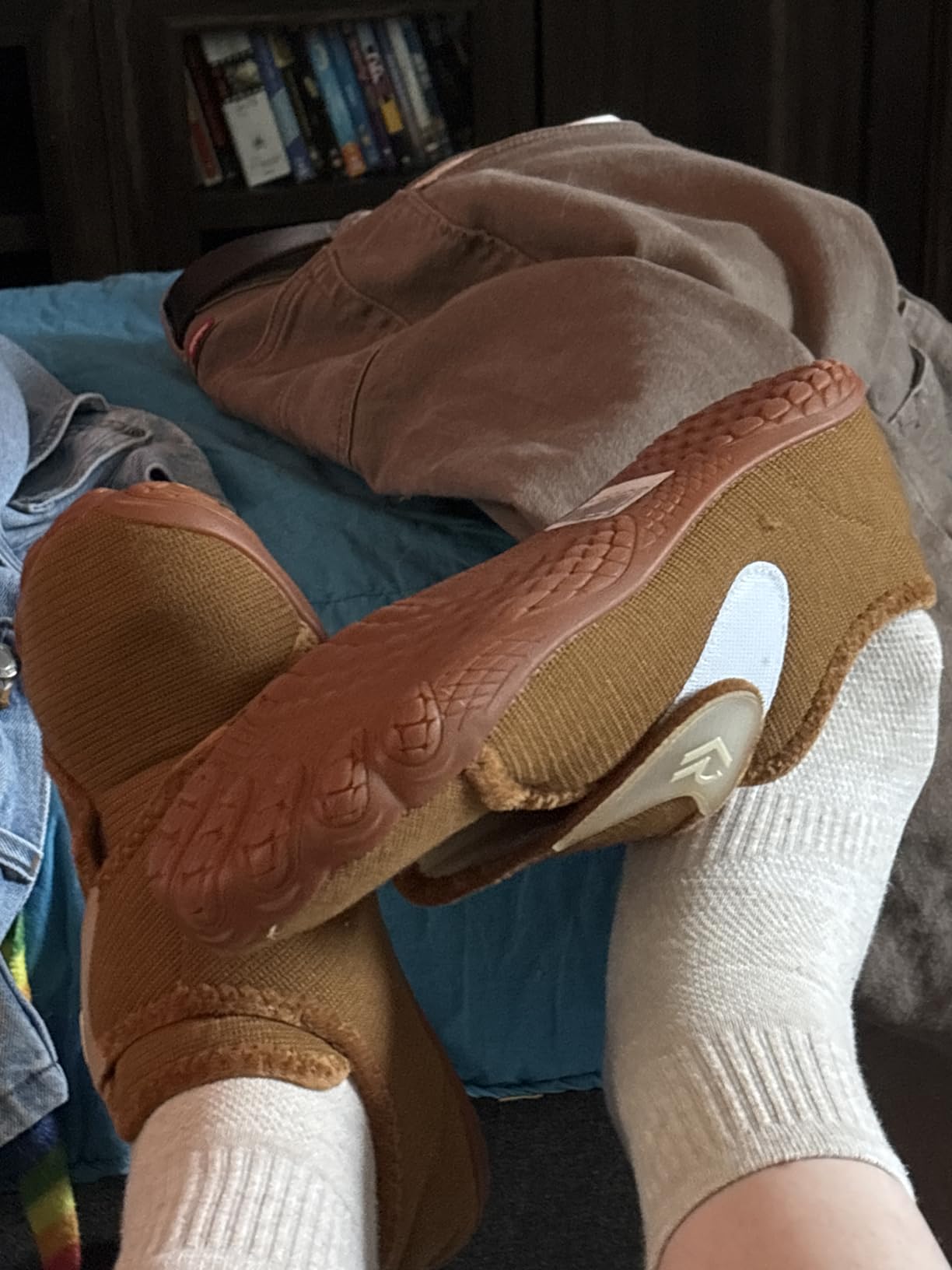
The relxfeet slipper is the simplest design on this list and the most easily explained. There is a very wide toe area, a hook-and-loop strap that opens wide for entry, a soft lined textile upper, and a removable insole. That removable insole is the reason it earns a place: you can lift it out to wash it, dry it or drop in a different insole without buying a new shoe.
Owners with diabetes describe the fit as very soft and forgiving, which is exactly what you want when a foot cannot tell you it is being pinched. The textured rubber outsole with a closed heel gives enough grip for a short trip to the mailbox or the car, which is where most slipper buyers actually take them.
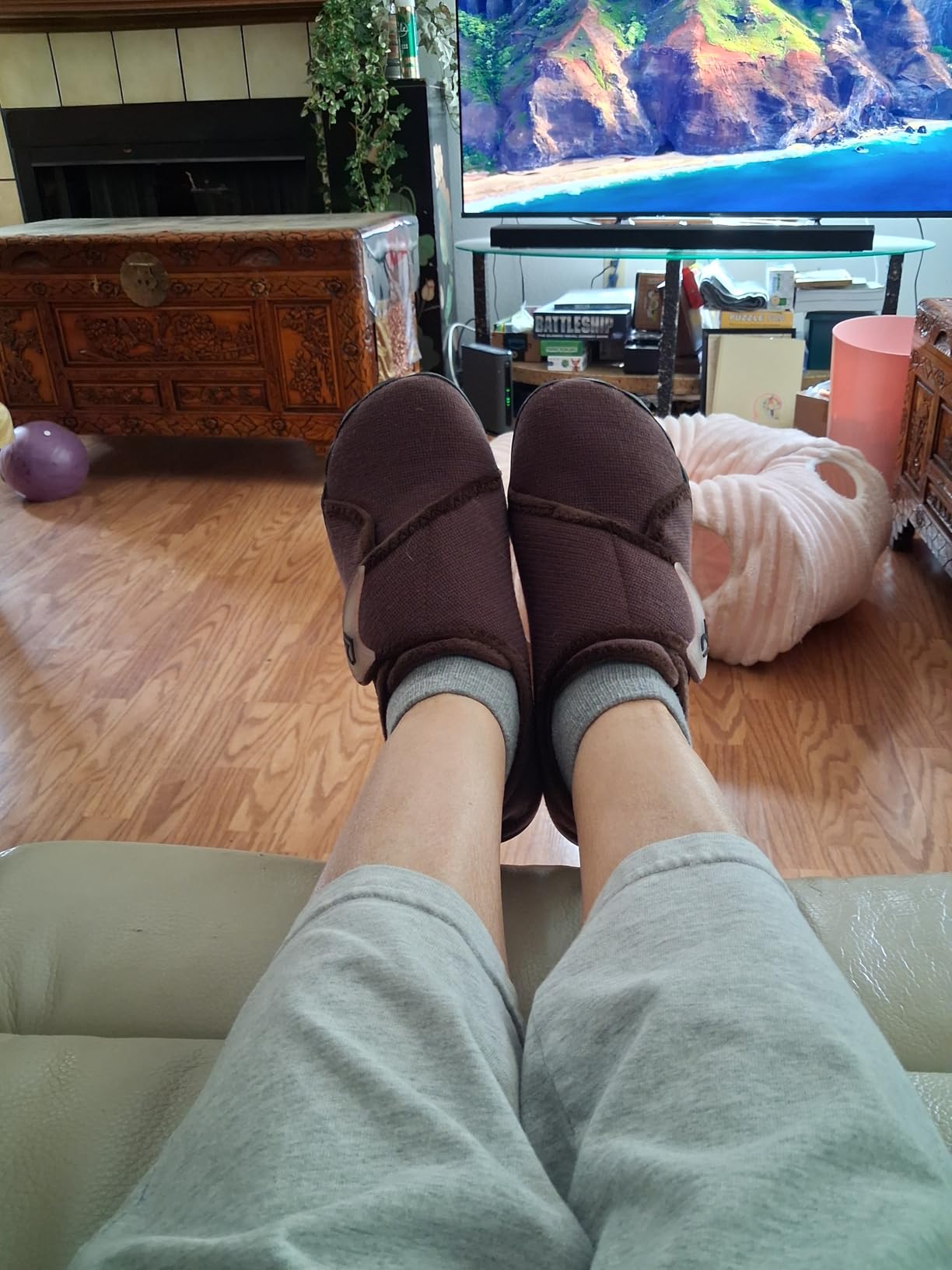
The deliberate choice here is the flat, barefoot-inspired sole with no built-in arch support. That is not an oversight, and reviewers treat it as a fair trade: indoor comfort in exchange for structure. A very flexible sole also feels unstable on uneven ground, so we would not treat this as a walking shoe.
At 4.2 stars over 626 reviews, the value is in the width and the washable insole rather than in correction. The textile upper is not water resistant, so this one stays inside where it belongs. Buyers looking for arch support should read the Orthofeet Asheville section instead.
What you get for the money?
A genuinely roomy toe area that genuinely stays wide, which is the first thing most diabetic slippers get wrong. If your issue is purely fit, with no arch or structural problem to correct, this is one of the more accommodating designs we found at this tier.
The limitation to plan around
Flat and unstructured means you should be wearing it seated or on smooth indoor flooring, not standing all day. If swelling in your feet worsens through the day, the wide strap is the only adjustment available, and there is no arch support to back it up.
We earn a commission, at no additional cost to you. CERTAIN CONTENT THAT APPEARS ON THIS SITE COMES FROM AMAZON. THIS CONTENT IS PROVIDED 'AS IS' AND IS SUBJECT TO CHANGE OR REMOVAL AT ANY TIME.
7. MEJORMEN Edema Walking Sneakers – Best for All-Day Standing
MEJORMEN Men’s Edema Diabetic Shoes Adjustable Wide Width Outdoor Walking Sneakers Orthopedic Lightweight Comfy Casual Slippers for Elderly Swollen Feet Arthritis Recovery
★★★★★★★★★★Adjustable forefoot fastening
Orthotic arch insole
Full coverage wide toe
Slip resistant sole
- Forefoot straps adjust through swelling changes
- Built-in orthotic insole with heel cushioning
- Light enough for all-day walking
- Roomy rounded toe relieves metatarsal pain
- Full coverage slip-on is easy on and off
- Styling is casual rather than dress oriented
- Mesh and plush styles suit different seasons
- Sole is slip resistant but not fully waterproof
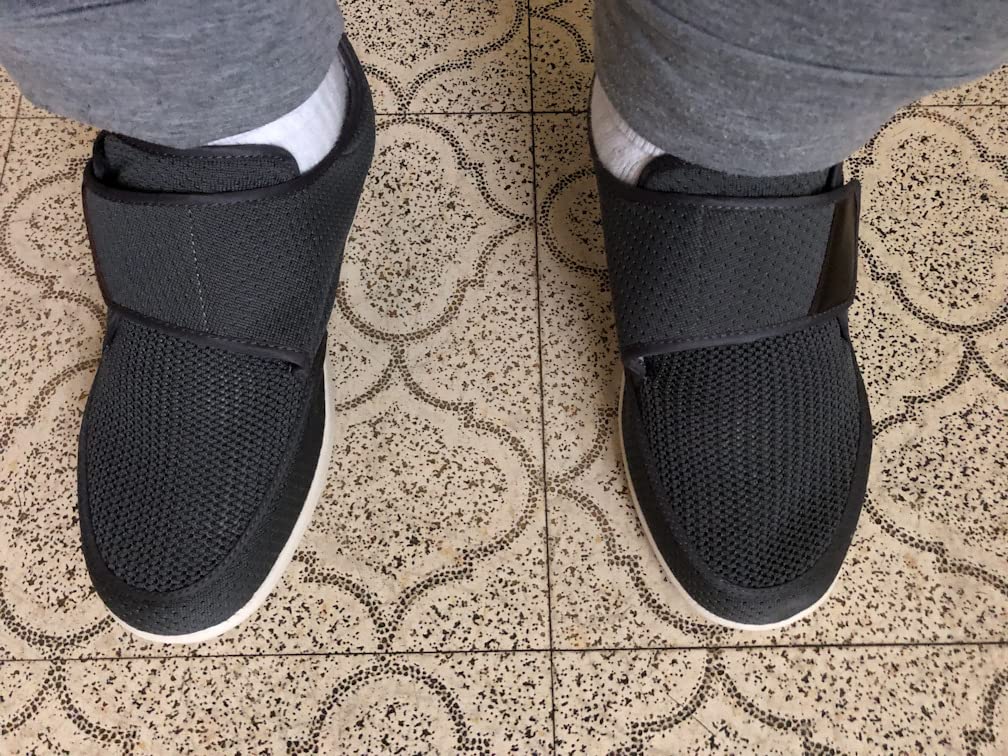
For men who spend the day on their feet, the MEJORMEN is the most complete outdoor option in the group. The fastening adjusts at the forefoot, which is where swelling shows up first and where a numb foot feels pressure most, and the slip-on construction means you can get it on and off without bending down.
Inside there is a premium orthotic cushion insole with anatomical arch support and a cushioned heel pad over multi-layer cushioning. The rounded, full-coverage toe box is the piece that gets overlooked and it is the reason the shoe works for edema: there is nothing at the toe tip pressing back, and the ball of the foot is spread rather than pinched.
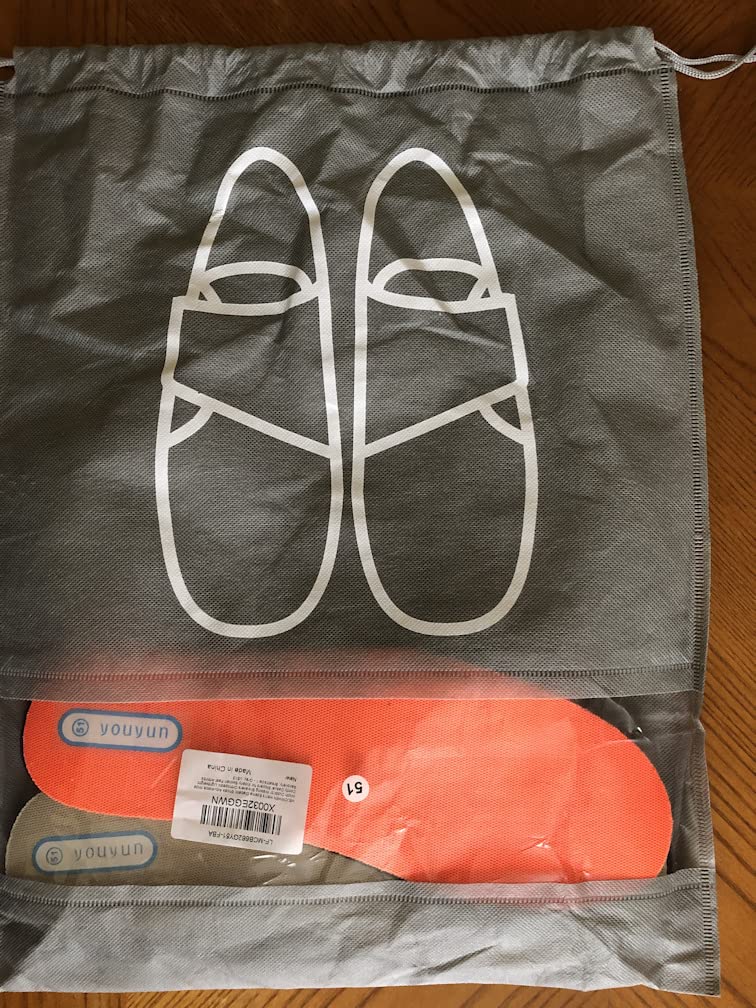
The light weight is what makes all-day standing viable. Buyers and gift purchasers buying for elderly parents describe it as comfortable through a full shift, and the reviews across 551 ratings hold a steady 4.4. The slip-resistant sole is the other quiet plus, because a standing job in a kitchen or a retail floor means wet floors eventually.
Styling is the limitation. These read as casual sneakers and there is no leather option, so they are not office footwear. The brand also runs several styles with different uppers, and the mesh and plush versions suit different seasons rather than all-weather use, so pick the one that matches when you will actually wear them.
Why it holds up on a long shift?
Three things stack up here: a forefoot closure you can tighten as the day goes on, a cushioned heel pad that absorbs the impact of standing still, and a toe box that does not push back. For neuropathy that combination removes the three most common pressure sources rather than just one of them.
Where it will disappoint you?
Buyers who want a shoe that works with slacks and a belt will be disappointed, and the seasonal upper choices mean you may need two pairs across the year. If your day is mostly seated with formal dress, look at the Dr. Comfort Oxford instead.
We earn a commission, at no additional cost to you. CERTAIN CONTENT THAT APPEARS ON THIS SITE COMES FROM AMAZON. THIS CONTENT IS PROVIDED 'AS IS' AND IS SUBJECT TO CHANGE OR REMOVAL AT ANY TIME.
8. Orthofeet Gemini Leather Sandals – Best for Hot Weather and Ventilation
Orthofeet Gemini Orthopedic Men’s Leather Sandals, Black, Size 14 Wide
★★★★★★★★★★Leather upper
Three point adjustable fit
Orthotic arch insole
Wide toe box true to size
- Orthopedic grade arch support for flat feet and back pain
- Three point adjustment holds without pinching
- Vented design keeps feet cool
- Wide sizing genuinely wide
- Soft footbed works with or without insoles
- Elastic heel strap is hard to slip on
- Footbed lining can detach and bunch
- Velcro wear is a recurring complaint
- Instep strap can run long
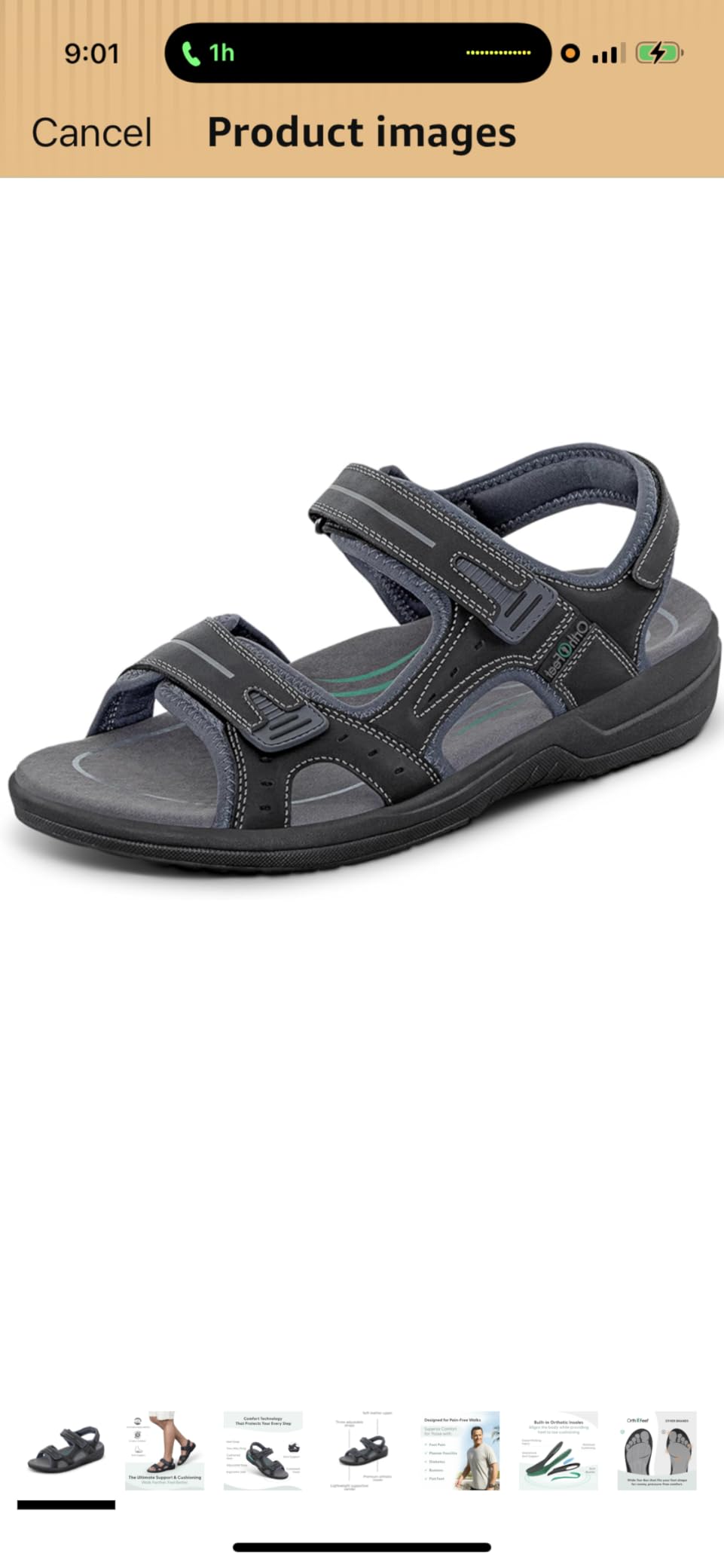
A leather sandal is the only honest answer for a diabetic foot in July, and the Gemini is the version that does not compromise. Three adjustable points, a front strap, an instep strap and a heel strap, hold the foot in place without pinching, and the open design moves air around the foot in a way no enclosed shoe can match.
Underneath is a premium orthotic insole with anatomical arch support and multilayered cushioning, and the wide sizing is described by wearers as genuinely wide rather than nominally wide. Men with flat feet, plantar fasciitis and diabetes tell us these were the only orthopedic sandals that worked after several cheaper pairs failed, and several report relief from lower back pain as a secondary benefit.
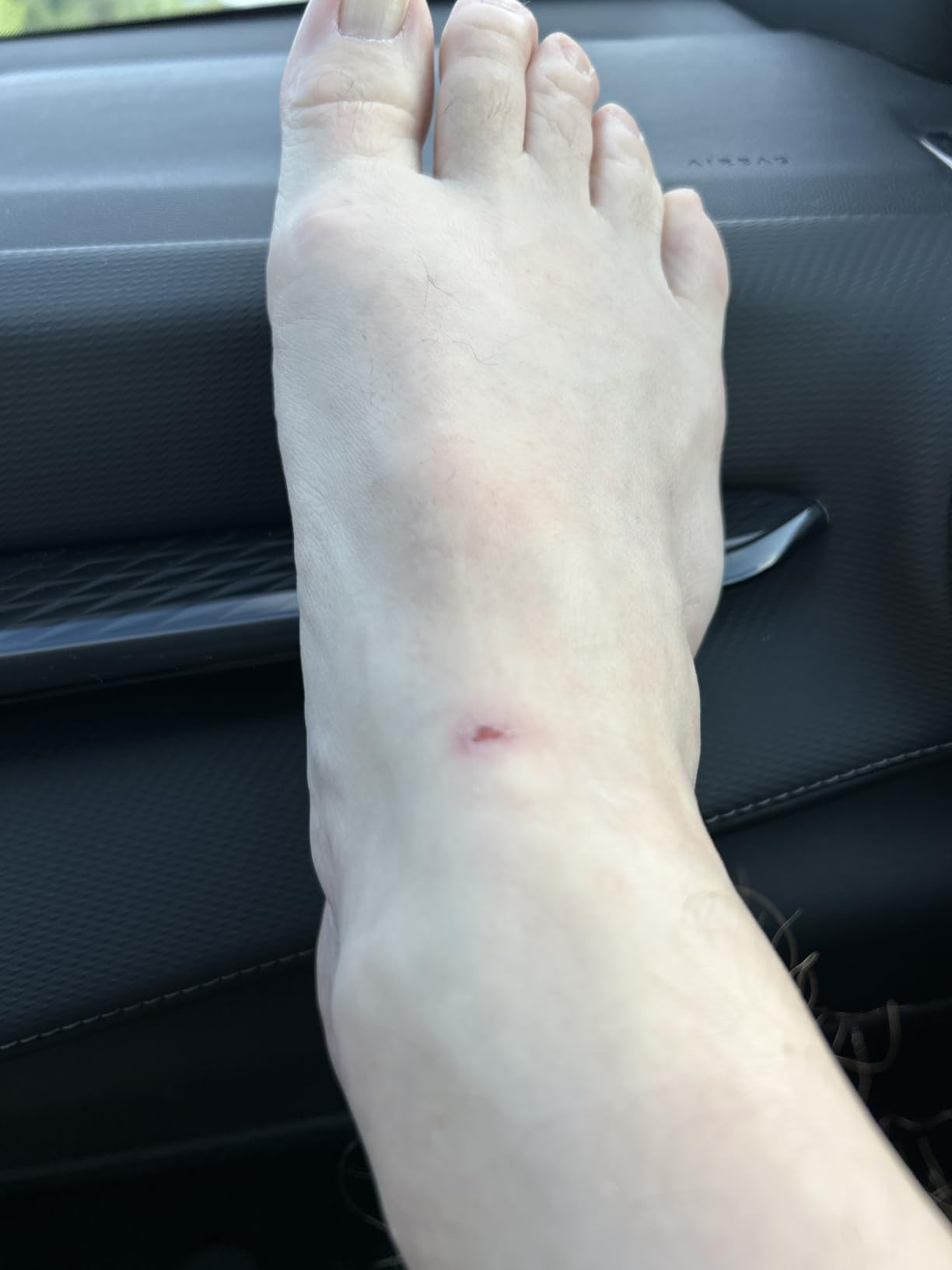
The recurring complaint is the heel strap. The elastic section is genuinely difficult to get on, and for a man with hand arthritis that is a real problem rather than an annoyance. A smaller share of reviews mention the footbed lining detaching and bunching, and Velcro wear is the most common durability note at this tier.
Those fit in the trade-off column: hot-weather ventilation costs something in ease of entry. We would still recommend it, but pair it with a shoe horn and a stretch technique, and check the strap condition periodically because a loose strap on a numb foot is a rubbing point waiting to happen.
Best for a hot climate
Diabetes plus heat plus a leather upper that traps sweat is a bad equation for skin integrity. The Gemini lets the foot breathe, which is why moisture management shows up again and again in what diabetic wearers say they care about most.
Check the straps before every wear
Inspect the hook-and-loop and the heel elastic as part of your routine, the same way you would inspect your feet. Sandals put more direct load on a strap than a closed shoe does, and a strap that has lost its grip will move against skin you cannot feel.
We earn a commission, at no additional cost to you. CERTAIN CONTENT THAT APPEARS ON THIS SITE COMES FROM AMAZON. THIS CONTENT IS PROVIDED 'AS IS' AND IS SUBJECT TO CHANGE OR REMOVAL AT ANY TIME.
9. Orthofeet Sprint Tie-Less Sneakers – Best Value Orthopedic Pick
Orthofeet Sprint Orthopedic Men’s Tie-Less Sneakers, Grey, Size 10.5 Wide
★★★★★★★★★★Tie-less lacing system
Interchangeable orthotic inserts
Wide toe box
Shock absorbing multilayer sole
- Tie-less closure suits limited dexterity
- Multiple interchangeable orthotic inserts
- Shock absorbing sole reduces heel and joint pain
- Attractive enough as a casual sneaker
- Sizing runs short against Nike or Adidas standards
- Insoles and uppers wear within months of daily use
- Returns through the seller are a hassle
The Sprint solves a problem almost nobody mentions until they hit it: tying laces. For a man with arthritis in his hands, a hip replacement, a back that will not bend or diabetic neuropathy that has taken fine motor control in the fingers, a tie-less lacing system with pull tabs and a secure heel strap is not a convenience. It is the difference between dressing yourself and needing help.
The shoe also comes with extra orthotic inserts and an under-inlay device, so you can dial the arch support up or down as your foot changes. The multilayered cushioned insole and shock-absorbing sole do real work on hard surfaces, and walkers with plantar fasciitis and diabetes describe these as the most comfortable shoes they own.
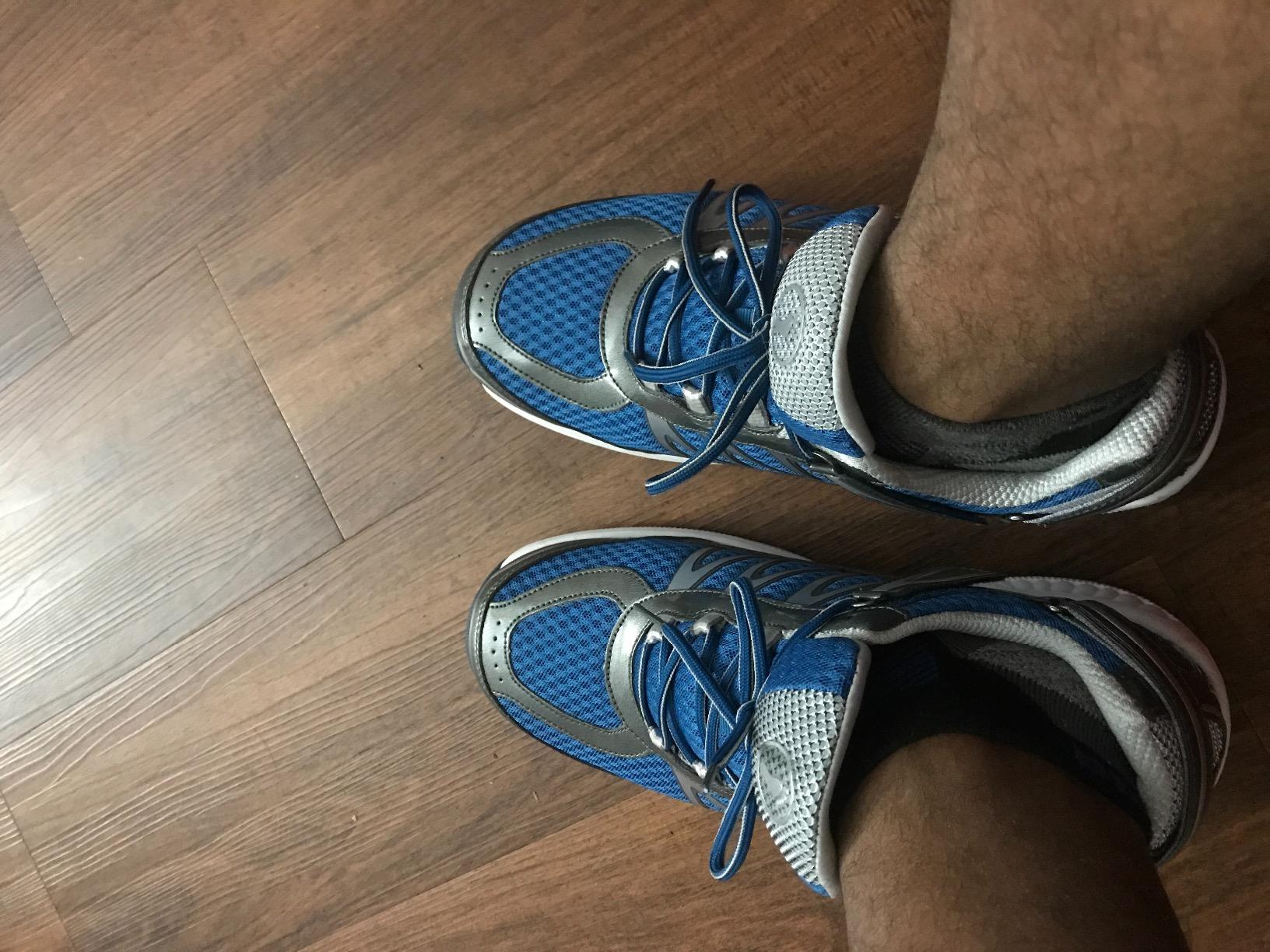
The two criticisms we have to pass along are sizing and wear. Sizing runs short compared with Nike, Saucony or Adidas, so if you know your size in a standard athletic brand, do not assume the same number translates. And the insoles and uppers can wear down within months of daily use, which means you are budgeting for a replacement insert rather than a forever shoe.
Even with that, at 2165 reviews and 4.2 stars this is the orthopedic sneaker with the strongest combination of adjustability, cushioning and included corrective components on the list. Buyers who are not going to shop around for a custom orthotic get more support out of the box here than anywhere else in this roundup.
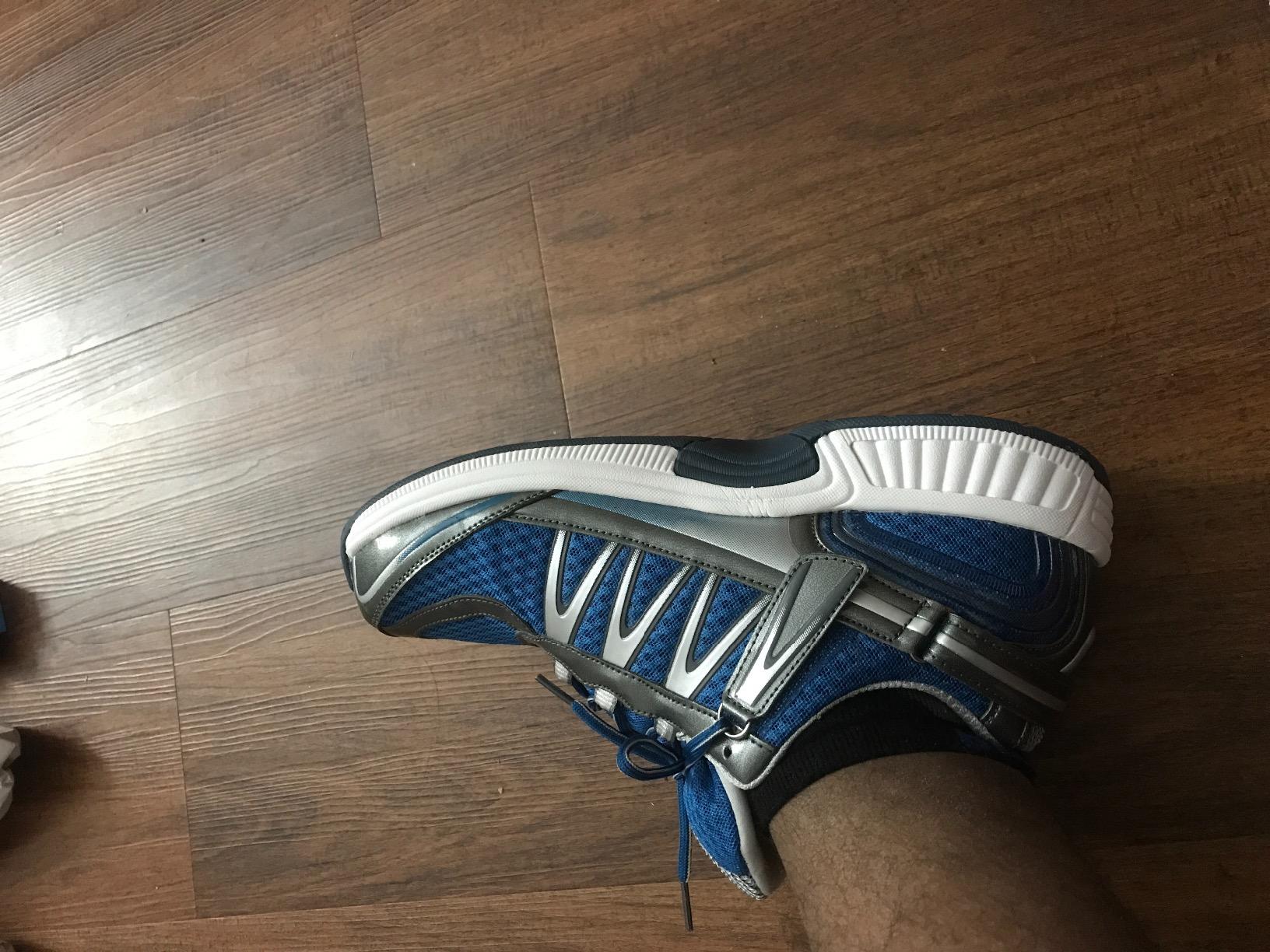
Best for hands-free convenience
If bending to your feet is difficult, this is the pair we would start with. The heel strap secures the back of the foot so you do not have to hold the shoe open, and the pull tabs do the work your fingers used to do.
Plan for a shorter service life
Daily wear on an orthopedic sole wears faster than a standard sneaker, and reviewers report insoles and uppers giving out within a season or two. Rotate this pair with a cheaper indoor slipper to slow that down, and keep the spare inserts in the box rather than discarding them.
We earn a commission, at no additional cost to you. CERTAIN CONTENT THAT APPEARS ON THIS SITE COMES FROM AMAZON. THIS CONTENT IS PROVIDED 'AS IS' AND IS SUBJECT TO CHANGE OR REMOVAL AT ANY TIME.
10. OrthoComfoot Wide Diabetic Sneakers – Best for Neuropathy Walking
Men’s Orthopedic Diabetic Wide Walking Shoes Support Plantar Fasciitis 11
★★★★★★★★★★Detachable TPU arch piece
Wide toe box
Adjustable lace-up fit
Rebound EVA midsole
- Extra wide toe box works for post-surgery and neuropathy
- Adjustable lacing handles daytime swelling
- Rebound EVA sole cuts foot fatigue on long shifts
- Breathable mesh keeps feet dry
- Eyelets and sole can break down within months
- Support fades as the midsole degrades
- Limited style range
The OrthoComfoot is built around a detachable TPU arch support piece, which means you can change the arch height rather than living with whatever the factory chose. For neuropathy that is a useful degree of control, because a foot that cannot report pressure will not warn you that the arch is too high for your particular shape.
The toe box is extra wide, and the listing carries wide and X-wide men’s sizing from 8 to 14, which is a real width range rather than a relabelled standard. Laces give you graded adjustment across the instep, and buyers recovering from big toe surgery report the room as the reason the shoe worked at all. The filled fabric interior is there specifically to avoid irritation on sensitive skin.
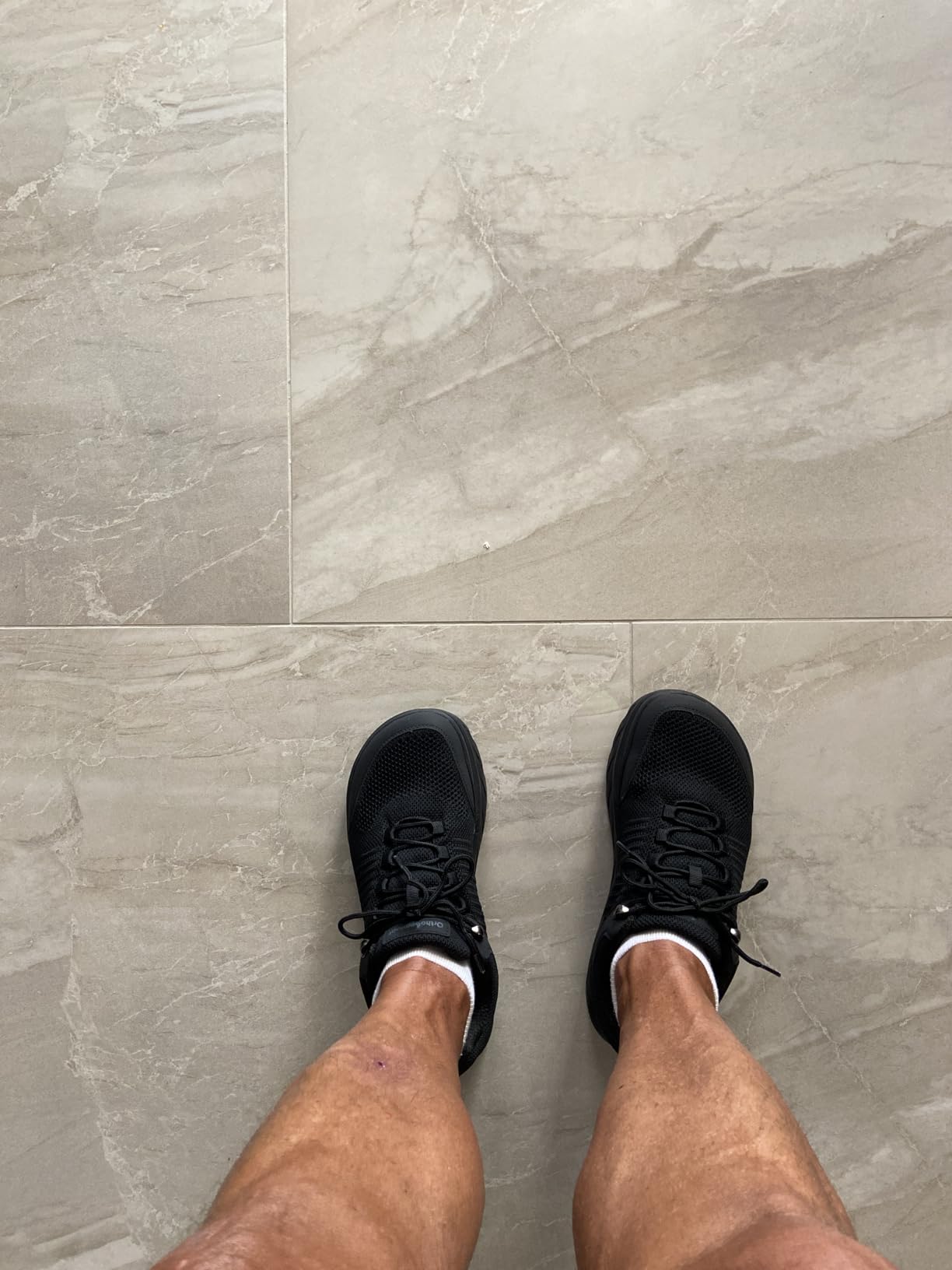
The rebound EVA midsole is the surprise for people who have assumed that a shoe this light cannot cushion. Buyers standing on their feet all day describe a real drop in foot fatigue, and the breathable mesh keeps the foot dry, which matters because moisture is one of the main drivers of fungal problems in diabetic feet.
Durability is the split issue in the reviews. Several describe eyelet or sole failure within a season of standing all day, and once the rebound EVA compresses the support goes with it. The rating is 4.2 across 467 reviews, and buyers with neuropathy call these the most comfortable shoes they have worn even while flagging the same wear pattern.
Why the arch piece matters?
It turns a fixed support into an adjustable one. If your custom orthotic sits too high or too low, you can remove or reposition the TPU insert instead of buying a different shoe, which is a genuine saving for anyone managing a chronic condition.
Replace them on a schedule
Watch the eyelets and the midsole rather than the upper. Once the sole stops rebounding, the cushioning that made this shoe worth buying is gone, and on a numb foot that is the point where new pressure points start appearing without any warning.
We earn a commission, at no additional cost to you. CERTAIN CONTENT THAT APPEARS ON THIS SITE COMES FROM AMAZON. THIS CONTENT IS PROVIDED 'AS IS' AND IS SUBJECT TO CHANGE OR REMOVAL AT ANY TIME.
11. VIPFOX Wide Toe Box Loafers – Best for Hands-Free Slip-On Wear
VIPFOX Wide Toe Box Shoes for Men Extra Wide Width Diabetic Shoes Men’s Loafers & Slip-ons Arch Support Plantar Fasciitis Walking Loafers 8810 Full Black 41
★★★★★★★★★★Extra wide toe box
Knitted stretch upper
Lace free slip-on
0.33 lb per shoe
- Genuinely wide toe box that does not squeeze
- No laces so easy entry
- Very light at 0.33 lb per shoe
- Knitted upper is soft and breathable
- Holds up with daily use
- Minimal to no arch support
- Very flexible sole can feel unstable
- Some buyers still find the toe box snug
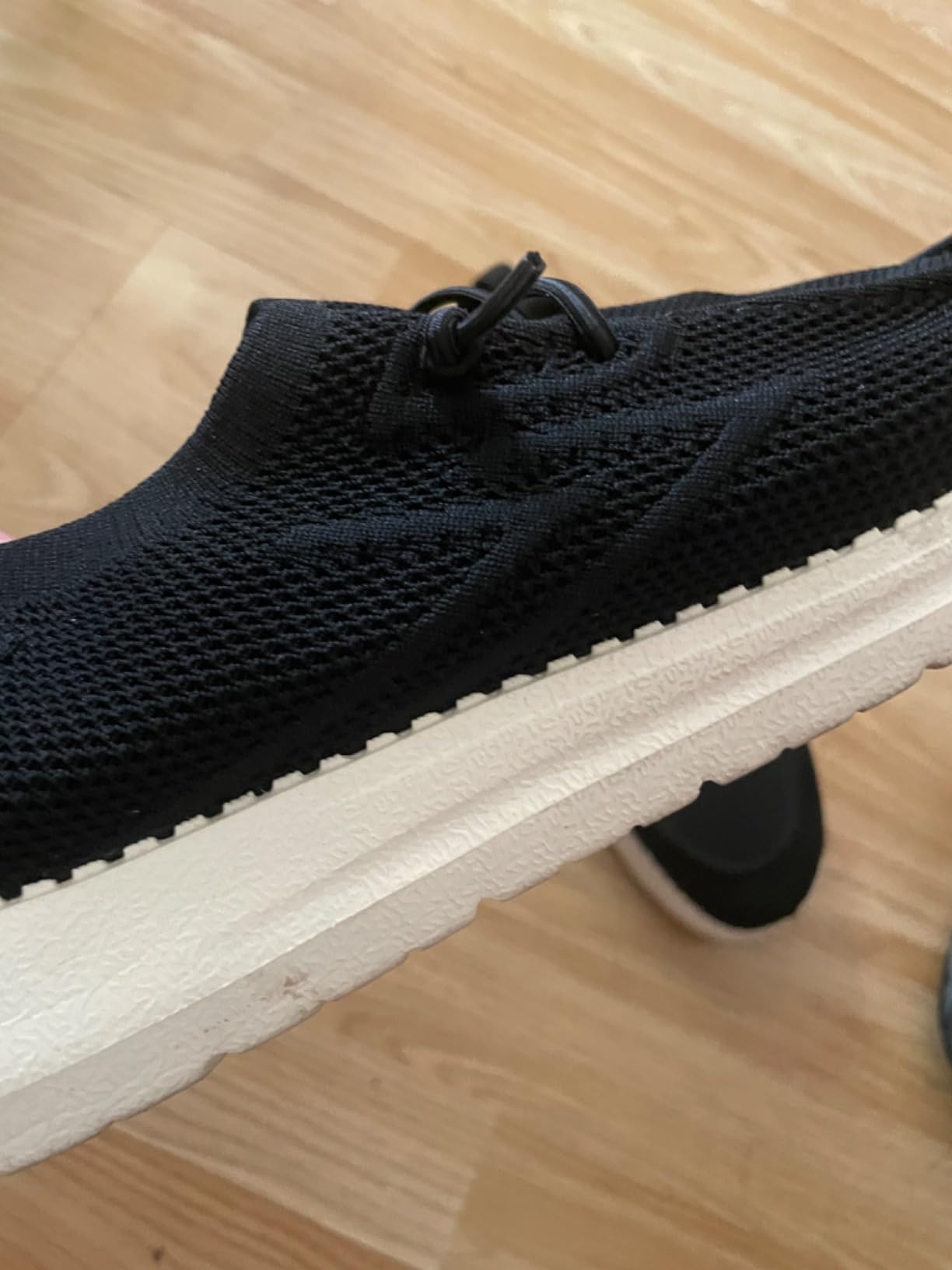
The VIPFOX loafer is the lightest shoe we measured, at 0.33 lb per shoe in a size 7, and that weight is the main reason it works for a man whose feet hurt simply to stand on. The wide width last leaves the toe box uncrushed, and the knitted upper stretches over a foot that swells rather than resisting it.
There is no lacing, so entry is slip-on and the shoe can be put on with one hand. Repeat buyers with wide feet point to the roomy toe box and the entry as the reasons they came back, and one owner reports four pairs still in service after two years, which is an unusually good durability signal for this category.
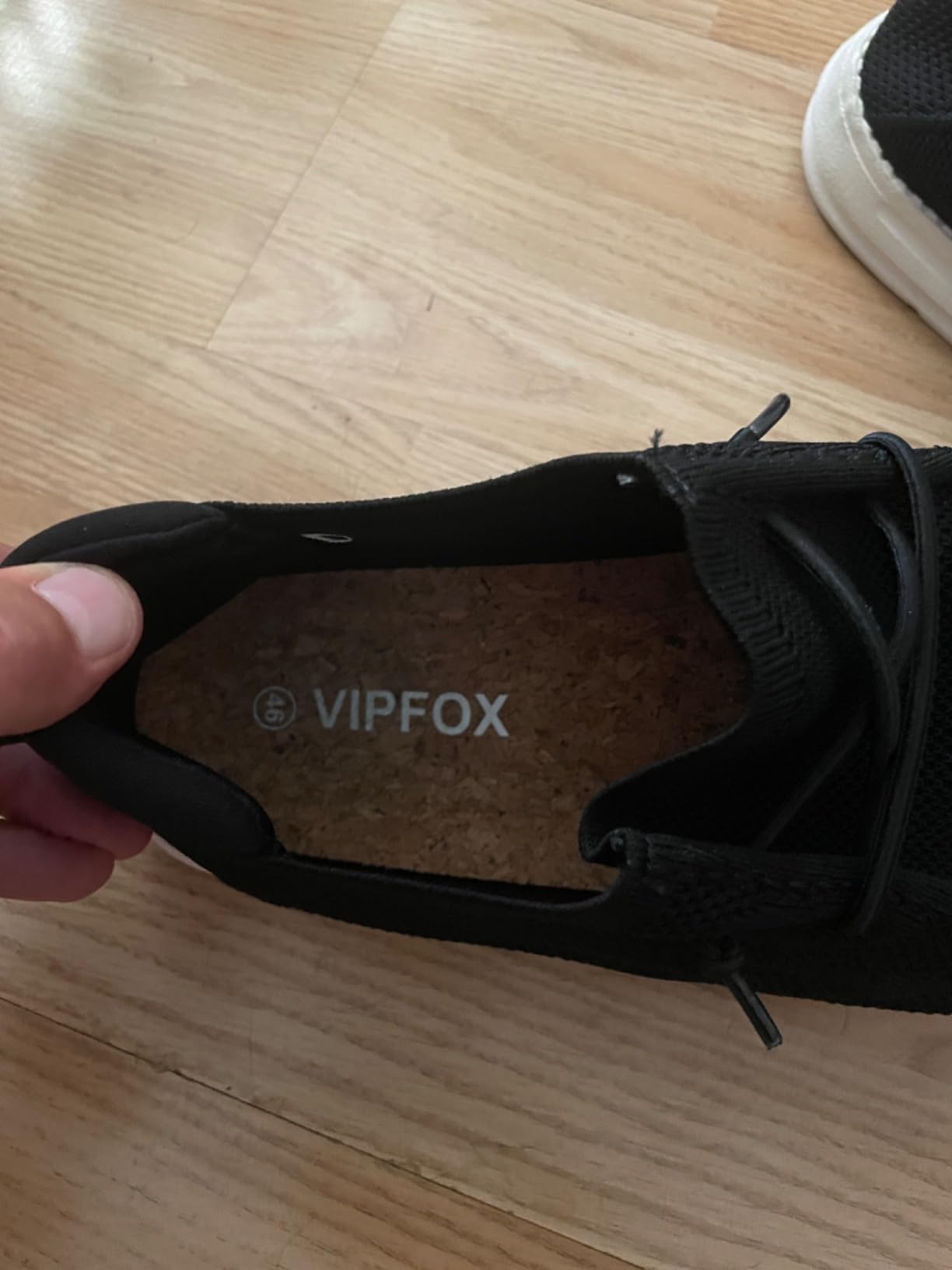
The most common complaint is that there is essentially no arch support, leaving some users inserting their own insoles. That is a real limitation: a very flexible sole can feel unstable on uneven ground, and some buyers find the toe box snug despite the wide label, so it is worth checking the actual width chart rather than trusting the name.
For a man who wants weightless everyday shoes and does not need arch correction, this is a strong pick at 4.2 stars across 373 reviews. If plantar fasciitis is part of your picture, choose the Orthofeet Sprint or the OrthoComfoot instead and accept the extra weight for the support.
Best for weight-sensitive feet
When a foot is genuinely painful all day, every ounce in the shoe compounds the problem. At 0.33 lb per shoe this is the lightest option here, and the knitted upper adds no structure for your foot to fight against.
Bring your own arch support
Treat this as a platform, not a corrective shoe. If you already wear orthotics, the flexible sole is compatible with them. If you are buying specifically to treat plantar fasciitis, choose a model with a built-in premium insole rather than planning to add one later.
We earn a commission, at no additional cost to you. CERTAIN CONTENT THAT APPEARS ON THIS SITE COMES FROM AMAZON. THIS CONTENT IS PROVIDED 'AS IS' AND IS SUBJECT TO CHANGE OR REMOVAL AT ANY TIME.
12. FitVille EasyTop Leather Dress Sneaker – Most Compact for Smart Casual Wear
FitVille Diabetic Shoes for Men Extra Wide Comfortable Leather Walking Shoes Hook & Loop Orthopedic Dress Sneakers for Edema and Swollen Feet (X-Wide 9.5, Marmalade)
★★★★★★★★★★Leather upper
Seamless interior
Extra wide toe box
Arch support insole
- Leather gives a dressier look than mesh alternatives
- Seamless interior suits sensitive diabetic feet
- Wide and extra wide toe boxes for edema
- Adjustable strap makes on and off easy
- Arch insole with good shock absorption
- Leather runs less breathable than mesh
- Runs small for a segment of buyers
- Limited colour range
If you want a diabetic shoe that passes a dress code, this is the one to look at. The upper is leather rather than mesh, which is the single change that moves it from clinical footwear into smart casual territory, and the same seamless interior and extra-wide toe box as the EasyTop family carries across unchanged.
Wide-opening hook-and-loop closure handles swelling, and the ergonomic arch support insole with shock absorption gives you real support under the foot rather than a flat footbed. Owners describe these as a visible step up in appearance from typical diabetic shoes without giving up the medical features, which is the balance most of this category fails.
Sizing runs small for a segment of buyers, and that advice is consistent with the rest of the FitVille range, so order up or plan to use the strap. The leather is also less breathable than the mesh version, which matters if you plan to wear them for a full day indoors without socks changing.
Where it beats the mesh version?
Appearance, mostly. Leather can take a belt and chinos in a way a mesh slip-on cannot, and for men whose job involves meeting people that difference is not cosmetic, it is the reason a diabetic shoe gets worn at all.
Where the mesh version still wins?
Breathability and lightness. For hot weather, long indoor days or a foot that sweats heavily, the EasyTop Wings in mesh is the cooler option. Choose on climate, and if you are undecided, buy the mesh pair first and this one for the days that require an outfit.
We earn a commission, at no additional cost to you. CERTAIN CONTENT THAT APPEARS ON THIS SITE COMES FROM AMAZON. THIS CONTENT IS PROVIDED 'AS IS' AND IS SUBJECT TO CHANGE OR REMOVAL AT ANY TIME.
What to Look For in a Men’s Orthopedic Diabetic Shoe?
Four features do most of the work, and every shoe in this roundup that scored well has at least three of them. Check them in this order: a seamless interior with no stitching across the toe box or the ball of the foot, extra depth so an orthotic fits without compressing the toes, a wide or extra-wide toe box, and a removable insole. If a pair is missing the first one, keep looking, because friction against an insensate foot is the mechanism behind most diabetic ulcers.
Two more decisions matter after that. Closure is about swelling: a hook-and-loop strap or a tie-less system lets you adjust the fit at 4pm when the foot is at its largest, while a fixed lace-up or a slip-on without adjustment locks you into whatever size you picked in the morning. Upper material is about moisture, and breathable mesh keeps a damp foot dry, which slows skin breakdown.
Sole construction is the third. High rebound EVA and multilayer cushioning absorb the impact that a numb foot cannot report, and a slip-resistant pattern matters more than it sounds because a fall is a leading injury in this group. Zero drop soles are a legitimate option, but they trade cushioning for ground feel, so treat them as indoor or short-wear rather than all-day walking.
Before you buy in person, four checks take two minutes. Run your fingers inside the shoe and around the toe box to feel for any seam or ridge. Remove the insole and look for at least a finger’s width of vertical clearance under the footbed. Flex the forefoot and watch whether the toe box creases inward, which means the last is too narrow. And squeeze the heel counter, a firm one keeps the foot stable and stops the shoe sliding on a swollen heel.
Diabetic Shoes vs Orthopedic Shoes: What Is the Difference?
They are not the same, and the difference is what a podiatrist would check for. A diabetic shoe is built to prevent injury in a foot that cannot feel injury, so it leads with a seamless interior, extra depth, a wide toe box and a removable insole. An orthopedic shoe is built to correct a structural or biomechanical problem, so it leads with arch support, a firm heel counter, a motion-control midsole or a rocker profile.
That means an orthopedic shoe can fail on a diabetic foot, and this is the most common error we see. Plenty of orthopedic sneakers have excellent arch support and an internal stitched lining that will rub a numb foot raw, and plenty of diabetic shoes are neutral with no correction at all. Neither category is wrong; they solve different problems.
The practical rule is simple. If you have diabetes plus neuropathy, reduced sensation, a history of ulcers or swelling, the diabetic standard is the floor, not the ceiling. Add orthopedic features on top of that floor when you also have plantar fasciitis, flat feet or a prior injury, which is exactly what the Orthofeet and MEJORMEN picks in this roundup do. Our wider orthopedic shoes guide covers the arch-first category if diabetes is not part of your picture.
Medicare Part B Coverage for Men’s Diabetic Shoes
Medicare Part B does cover footwear for diabetes, but only under a specific chain, and the shoes have to come from a supplier that can document it. Here is the sequence. First, see a doctor or podiatrist for an in-person exam. Second, that clinician documents diabetes plus one qualifying complication, typically neuropathy, an ulcer, a deformity such as a bunion or hammertoe, or poor circulation. Third, you receive a certificate of medical necessity, a signed statement saying the shoes are medically required. Fourth, the shoes are ordered and fitted by an approved supplier, Dr. Comfort, Drew, Anodyne, Propét and Dunham are the therapeutic brands most often supplied this way. Fifth, the claim is billed under HCPCS code A5500 for diabetic shoes, or A5501 for inserts, and Medicare typically covers a portion with the balance yours to pay.
Two practical notes. Because the coverage runs through durable medical equipment suppliers rather than ordinary retail, buying online on your own usually means paying the whole amount yourself. And the certificate is the hinge of the whole process, no certificate and the coverage generally does not apply, so schedule the exam before you start shopping.
Worth knowing: a private insurance plan often follows the Medicare rules, so ask your insurer the same questions about the certificate and the supplier requirement. And if you already have a podiatrist, ask them to check whether orthotic inserts are covered too, since A5501 is billed separately from the shoes themselves.
Sizing and Fit Tips for Swollen Feet
Measure your feet at the end of the day, standing, against a wall. Feet swell through the day and a morning measurement will produce a shoe that pinches by evening, which is the single most common reason diabetic shoes end up unused. Measure both feet and go with the larger one.
Then try the shoes on wearing the diabetic socks you actually plan to wear, because a thicker pair changes the fit. Leave roughly a thumb’s width between your longest toe and the front of the shoe, and remember that you cannot check that by feel, so measure it rather than guessing.
Buy in the swollen state and adjust down. Set the strap or laces loose in the morning and tighten as the day goes on. That single habit is the workaround for the fluctuating-swell problem that forum discussions return to constantly, and it is why adjustable closure sits at the top of our feature list.
Finally, give any new pair a break-in period of a week or two wearing them for short stretches, and check your feet with a mirror every night while you do it. Break-in discomfort is dangerous with neuropathy because a blister can form without you noticing, and a two-week check-in routine catches it early.
When to See a Podiatrist Before You Buy Shoes?
Do not buy shoes first and see a clinician later if you have open sores, any wound that is not healing, a colour change in the foot, or a previous ulcer. Those are not shoe-fitting problems and no footwear choice will resolve them. An insensate foot also cannot tell you that a new pair is hurting, so an annual foot exam is the mechanism that catches what you cannot feel.
Ask your clinician about orthotics while you are there, because a shoe is only half of the answer. A properly fitted orthotic needs a shoe with a removable insole and enough depth to accept it, and buying the shoe first without knowing what the insert needs to do is how people end up with a pair they cannot use. The order we recommend is exam, then orthotics, then shoes.
A word on house shoes and slippers, since it comes up constantly. Yes, they need the same standards: seam-free interior, wide toe box, adjustable closure, non-slip sole. A pair of our picks, the Orthofeet Asheville and the Scurtain slipper, exist for exactly this reason, and the cheapest slippers in a drugstore are among the most damaging things a diabetic foot can wear.
Frequently Asked Questions
What shoes do podiatrists recommend for diabetics?
Podiatrists recommend footwear built to four standards: a seamless interior with no internal stitching over the toe box, extra depth that accepts an orthotic, a wide or extra-wide toe box, and a removable insole. They also look for an adjustable closure such as hook-and-loop so a shoe can be loosened or tightened as swelling changes through the day, and a cushioned, slip-resistant sole. Brands that supply Medicare therapeutic footwear include Dr. Comfort, Drew, Anodyne, Propét and Dunham, with Orthofeet, FitVille and OrthoComfoot widely available in wide and extra-wide.
Are orthopedic shoes the same as diabetic shoes?
No. An orthopedic shoe corrects a structural or biomechanical problem with arch support, a firm heel counter or a motion-control midsole. A diabetic shoe prevents injury in a foot that cannot feel injury, so it leads with a seamless interior, extra depth, a wide toe box and a removable insole. Many orthopedic sneakers have excellent support but an internal stitched lining that can rub a numb foot, and many diabetic shoes are neutral with no correction at all. If you have diabetes plus neuropathy, treat the diabetic standard as the floor and add orthopedic features on top.
What diabetic shoes for men are covered by Medicare?
Medicare Part B covers diabetic footwear when the full qualification chain is completed: an in-person exam by a doctor or podiatrist, documentation of diabetes plus a qualifying complication such as neuropathy or an ulcer, a signed certificate of medical necessity, and an order fulfilled by an approved durable medical equipment supplier. The claim is billed under HCPCS code A5500 for the shoes, with A5501 for separate inserts. Because coverage runs through approved suppliers rather than ordinary retail, buying online yourself usually means paying the full amount, so the exam and certificate come before the purchase.
How do I fit diabetic shoes when my feet are numb and swollen?
Measure your feet at the end of the day while standing against a wall, since feet swell through the day and a morning measurement produces a shoe that pinches by evening. Try shoes on wearing the diabetic socks you will actually wear, and leave a thumb’s width between the longest toe and the front of the shoe rather than relying on feel. Buy in the swollen state, set the strap or laces loose in the morning and tighten them as the day goes on, and inspect your feet with a mirror every night during the first two weeks of wear.
Are FitVille diabetic shoes any good?
FitVille is one of the most reviewed brands in this category, and the EasyTop Wings model carries 5505 reviews at 4.4 stars. Buyers with edema and neuropathy consistently praise the seamless interior, extra-wide toe box and easy hook-and-loop closure, and the leather EasyTop dress model adds a dressier upper for smart casual settings. The recurring complaint across both models is sizing, with several buyers recommending ordering one to two sizes up, and a segment finding the listed wide width less generous than expected.
What do podiatrists think of Orthofeet shoes?
Orthofeet has a long-standing presence in podiatry offices, and that familiarity shows up in buyer feedback. The brand rates highest in our roundup, with the Asheville slippers at 4.6 stars across 4245 reviews, and buyers credit the premium orthotic insole with real arch support for plantar fasciitis, flat feet and lower back pain. Buyers also point to the tie-less Sprint lacing for anyone with arthritis or limited dexterity, and to the wide sizing being genuinely wide. The criticisms are durability of straps and insoles under daily wear, not the support itself.
Final Verdict
The best mens orthopedic diabetic shoes in 2026 are the pairs that combine a seamless interior with real width, depth and adjustability, and all twelve picks here clear that bar. Our editorial choice is the FitVille EasyTop Wings, because the combination of a 4.4 rating across 5505 reviews, an extra-wide toe box and a strap that works with swelling makes it the safest default for most men with neuropathy or edema.
Buy the Orthofeet Asheville for the highest-rated arch support and the best house shoe on the list. Buy the Dr. Comfort Classic Oxford when the dress code is non-negotiable, and the FitVille leather sneaker for smart casual days. Buy the LeIsfIt if heat is the problem and you are staying close to home, and the Orthofeet Sprint if you cannot tie laces.
Whichever you pick, order a size up, buy in the evening, and check your feet with a mirror every night for the first two weeks. If you have any open sore or a prior ulcer, book the podiatrist appointment before the shoe order, because the certificate of medical necessity is what makes Medicare coverage possible. And if you want the broader category covered, our orthopedic shoes roundup is the next read.