
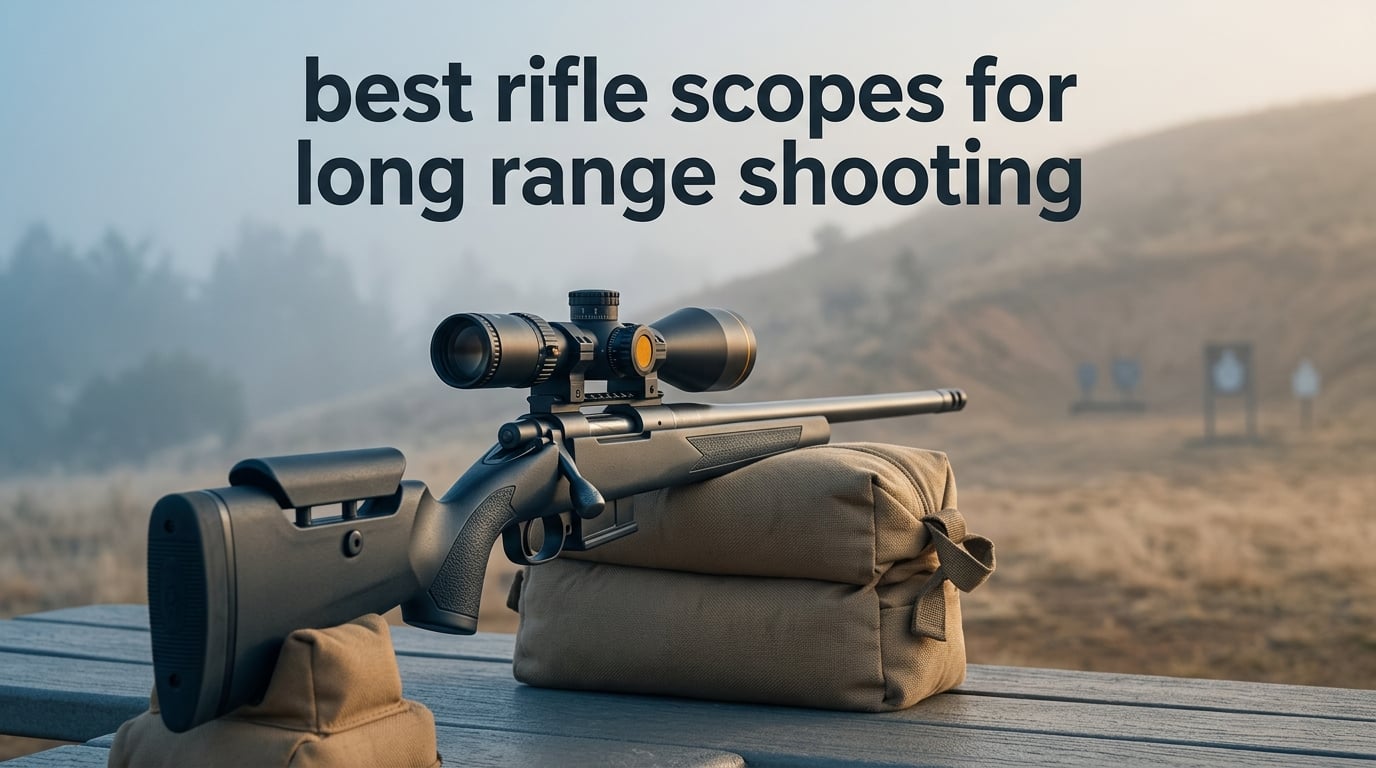
If you shoot past 300 yards, the optic decides whether a good shot is a good hit. We spent weeks working through twelve long range rifle scopes, comparing glass clarity, turret tracking, internal elevation travel, weight and reticle layout, and the CVLIFE 6-24×50 AO comes out ahead on the one metric that matters most over time: owner satisfaction across more than nine thousand ratings. For shooters who want more glass and a first focal plane reticle, the Vortex Strike Eagle 5-25×56 and the Vortex Venom 5-25×56 are the stronger precision instruments.
This guide covers the best rifle scopes for long range shooting in 2026, from entry-level 6-24×50 hunting glass to dedicated 5-25×56 precision optics built around a 34mm tube. Every scope below is scored on the same five things: how the image looks at dawn, whether the turrets return to zero without drift, how much internal elevation travel you get, whether the reticle stays true as you zoom, and how the whole package feels on a rifle at 8.5 pounds or under.
A word on what we did and did not do. We did not measure transmission with a spectrophotometer or count clicks on a gear-driven test fixture. What we did was compare published specifications, read thousands of owner reviews, and weigh each scope against the four things that decide a long range purchase: magnification range matched to your target distance, total internal adjustment in MOA, focal plane choice, and physical weight. Where a number appears below, it comes from the manufacturer specification or the owner review record.
If you also need glass for calling your own targets, our guide to the best spotting scopes for target shooting pairs well with this list. If you are still building a hunting rifle rather than a target rig, the best rifle scopes under 500 for deer hunting is the more relevant read.
Table of Contents
- Quick Picks: Best Rifle Scopes for Long Range Shooting in 2026
- All 12 Scopes at a Glance in 2026
- What Makes a Great Long Range Rifle Scope?
- 1. CVLIFE 6-24×50 AO – Most Owner-Proven Long Range Scope
- 2. Monstrum G3 6-24×50 FFP – Best for Tactical Platforms
- 3. Vortex Venom 5-25×56 – Best for Extreme Range Dialing
- 4. Athlon Argos BTR Gen 2 6-24×50 – Best MIL Long Range Scope
- 5. Vortex Strike Eagle 5-25×56 – Top Rated First Focal Plane Scope
- 6. Vortex Viper PST Gen II 5-25×50 – Best for Precision Match Shooting
- 7. Monstrum Hornet 6-24×50 FFP – Best Budget First Focal Plane Scope
- 8. SIG SAUER Tango-SPR 6-24x52mm – Best for 500 Yard Shooting
- 9. CVLIFE 2-10×32 MPVO AO – Best for Rimfire and Airsoft
- 10. Monstrum Spectre 1-8×28 LPVO – Best Lightweight Hunting Scope
- 11. Sniper MT 6-24×50 – Best for Tri-Color Illumination
- 12. PINTY 6-24×50 AO – Best Starter Long Range Hunting Scope
- How to Mount, Level and Zero a New Long Range Scope?
- Frequently Asked Questions
- Final Verdict for Long Range Shooting in 2026
Quick Picks: Best Rifle Scopes for Long Range Shooting in 2026
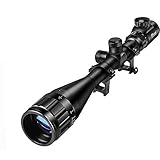
CVLIFE 6-24×50 AO
- 6-24x magnification
- 50mm objective
- Red and green illumination
- 1/8 MOA clicks

Vortex Strike Eagle 5-25×56
- 5-25x56 in a 34mm tube
- EBR-7C FFP etched reticle
- RevStop zero with locking turrets
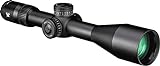
Vortex Venom 5-25×56
- 85 MOA of turret travel
- EBR-7C FFP reticle
- 34mm tube for extreme range
Best overall, most owner-proven: CVLIFE 6-24×50 AO – 6-24x power range with a 50mm objective, rated 4.4 out of 5 across 9483 ratings, the widest review base of any scope here.
Best extreme range: Vortex Venom 5-25×56 – 5-25×56 on a 34mm tube with 85 MOA of elevation and windage travel.
Best precision value: Vortex Strike Eagle 5-25×56 – 5-25×56 first focal plane glass in a 34mm aircraft-grade aluminum tube, rated 4.9 out of 5 from 663 ratings.
Best MIL long range option: Athlon Argos BTR Gen 2 6-24×50 – 0.1 MIL clicks, 18 MIL of total internal adjustment, side focus from 10 yards to infinity, 1.9 lb body.
Best 500 yard all-rounder: SIG SAUER Tango-SPR 6-24x52mm – 6-24×52 with a zero-stop elevation dial and a factory-installed SPR mount, so it needs no separate rings.
Best budget first focal plane: Monstrum Hornet 6-24×50 – first focal plane X-Tree reticle, 1/8 MOA clicks with a zero stop, throw lever and levelled rings included, backed by a lifetime guarantee.
All 12 Scopes at a Glance in 2026
Every scope in this roundup appears once below with the specifications that decide a long range purchase. Total internal adjustment is listed only where the manufacturer publishes it, which is a useful signal on its own: scopes that claim precision travel tend to publish the number.
| Product | Key Specs | Pricing |
|---|---|---|
| CVLIFE 6-24×50 AO |
|
Check Latest Price |
 Monstrum G3 6-24×50 FFP Monstrum G3 6-24×50 FFP |
|
Check Latest Price |
| Vortex Venom 5-25×56 |
|
Check Latest Price |
 Athlon Argos BTR Gen 2 6-24×50 Athlon Argos BTR Gen 2 6-24×50 |
|
Check Latest Price |
| Vortex Strike Eagle 5-25×56 |
|
Check Latest Price |
 Vortex Viper PST Gen II 5-25×50 Vortex Viper PST Gen II 5-25×50 |
|
Check Latest Price |
 Monstrum Hornet 6-24×50 FFP Monstrum Hornet 6-24×50 FFP |
|
Check Latest Price |
 SIG SAUER Tango-SPR 6-24x52mm SIG SAUER Tango-SPR 6-24x52mm |
|
Check Latest Price |
 CVLIFE 2-10×32 MPVO AO CVLIFE 2-10×32 MPVO AO |
|
Check Latest Price |
 Monstrum Spectre 1-8×28 LPVO Monstrum Spectre 1-8×28 LPVO |
|
Check Latest Price |
 Sniper MT 6-24×50 Sniper MT 6-24×50 |
|
Check Latest Price |
 PINTY 6-24×50 AO PINTY 6-24×50 AO |
|
Check Latest Price |
What Makes a Great Long Range Rifle Scope?
Long range shooting punishes a scope in ways close-range work never will. Heat shimmer at 600 yards, a mirage band that moves with the wind, a target that is only four pixels wide at 800 yards, and a firing line that steepens noticeably between 500 and 1000 yards all turn a marginal optic into an expensive paperweight. The criteria below are the ones that decided our ranking.
First focal plane or second focal plane: which one you need?
A first focal plane (FFP) reticle sits in front of the erector, so the reticle grows and shrinks with the target. The practical effect is that a holdover or a ranging mark written in MOA stays true at every magnification. A second focal plane (SFP) reticle sits behind the erector, which keeps the lines a constant thickness and easy to read at low power, but the same mark only measures correctly at the one magnification the manufacturer calibrated it to.
Forum consensus on r/longrange and Sniper’s Hide converges quickly here: FFP for anything involving holdovers, precision matches or dialing for distance, SFP for general hunting where fast target acquisition and a visible reticle at 3x matter more than subtension accuracy. Six of the twelve scopes here are first focal plane, and they cover every use case from 500 yard bench work to 1000 yard match strings.
Tube diameter and why it caps elevation travel
Tube diameter is the least understood spec on a data sheet. A 30mm tube is the standard, and it is what most mounting hardware is built around. A 34mm or 35mm tube is physically larger, which means more internal room for the erector to move, which means more total internal adjustment before you run out of mechanical travel.
That travel is what lets you dial to 1000 yards instead of holding over. A 30mm scope commonly gives you somewhere near 70 to 80 MOA of total elevation, a 34mm scope often gives you 85 MOA or more, and a 35mm pushes toward 100 MOA. The catch is physical: a bigger tube needs taller rings, raises the bore axis, pushes the scope further forward on the rail, and adds weight. Three scopes in this roundup use a 34mm tube, and one pairs a 34mm tube with a 1-8x hunting power range.
Magnification matched to your target distance
Matching magnification to distance is the single most useful table a long range shooter can keep in their head. Shoot a whitetail at 150 yards and 6x is more than enough. Push to 500 yards and you want 12x to 20x so a head-and-shoulder target fills enough of the field to aim at. At 800 yards, 20x to 25x is the working range, and past 1000 yards you will be glad to have 25x available even if you rarely dial there.
Be honest about the ceiling. Shooters regularly tell each other that 25x and beyond becomes a narrow straw where mirage, heartbeat and breathing dominate the picture, and that most of their shots are taken at 12x or less. The scopes here top out between 24x and 25x except the 1-8x and 2-10x hunting optics, which are included because a close-range shooting rifle is a legitimate part of this conversation.
Objective diameter, light gathering and the weight trade
The objective lens is the front element, and its diameter sets how much light you gather at dawn and dusk. A 50mm or 52mm objective is the practical sweet spot for general long range work. A 56mm objective gathers more, and that extra light matters in heavy overcast conditions and on shaded west-facing ridges, but it also adds weight, adds length forward of the receiver, and forces taller rings that can interfere with a bolt handle or a throw lever at full magnification.
Smaller objectives in this group, such as the 32mm and 28mm lenses on the low power variable scopes, cost you low light performance and buy you a compact, light optic that is easier to keep on a mountain rifle. That is a real trade, not a compromise to apologise for.
Zero stop, click value and turret feel
A zero stop is a hard mechanical stop at your zero position. Without one, you zero at 100 yards by counting clicks, and every time you dial for elevation you have to remember the count. With one, you dial to a numbered yardage, shoot, and drop back to zero without thinking. Six of the scopes here ship with a zero stop or RevStop system.
Click value is the other spec worth reading. 1/4 MOA clicks suit general hunting and varmint work. 1/8 MOA gives finer windage control, and MIL-based optics use 0.1 MIL increments, which is what match shooters tend to prefer. Exposed elevation turrets with markings are easier to dial from a position; capped turrets are cleaner and less likely to be knocked out of zero. Locking turrets reduce the chance of a bag bump costing you your zero.
Weight, warranty and fitment
Weight decides whether you carry the rifle up a drainage. A 1.9 lb scope on a 6.5 lb rifle leaves comfortable margin, while a 3.6 lb scope turns a light precision build into something you leave in the truck. If you are hunting at altitude, the lighter options in this roundup are the ones that make the trip possible.
Warranty is a first-class selection criterion in this category, not an afterthought. Vortex scopes carry an unlimited, unconditional lifetime warranty that transfers to the next owner. Monstrum lists a lifetime guarantee on the Hornet. The Sniper scope carries a limited lifetime warranty, and the CVLIFE 2-10×32 lists a one year warranty. Forum buyers consistently say a real warranty is what removes the risk from a first precision optic.
Fitment is where returns come from. A long objective bell needs more rail space forward of the receiver than a short hunting scope, and a 50mm or 56mm objective sits higher in its rings. Before you commit, check the overall scope length against the gap between your receiver and the forward ring position, and check the ring height against how your cheek weld will feel. Mounting a quality bipod does nothing if the optic itself crowds the action.
1. CVLIFE 6-24×50 AO – Most Owner-Proven Long Range Scope
CVLIFE Hunting Rifle Scope 6-24×50 AOE Red and Green Illuminated Gun Scope with Free Mount
★★★★★★★★★★6-24x magnification
50mm objective
1/8 MOA click value
28 ft FOV at 100 yards
1.4 lb
- Rated 4.4 out of 5 across 9483 ratings
- Red and green illuminated cross reticle
- 1/8 MOA click value
- 28 ft field of view at 100 yards
- Scope rings included
- Cross reticle is a basic holdover layout
- 9 cm eye relief is modest at high power
- No parallax dial listed
There is a practical reason this scope tops our list. A 4.4 average tells you very little on its own, but 9483 ratings behind that number is a much larger body of real-world evidence than any other optic we evaluated, and the distribution is consistent, with roughly 69 percent five-star and 16 percent four-star feedback. When a scope has been carried, mounted, zeroed and re-zeroed by that many owners, the failure modes that surprise you on a new purchase are already known.
The specification sheet is deliberately plain. You get a 6-24x magnification range, a 50mm objective for solid light gathering at dawn, and a 28 foot field of view at 100 yards, which is wider than most of the precision glass in this roundup and genuinely useful when you are moving between targets. The tube is a one inch body in aluminum, and the whole thing weighs 1.4 pounds.
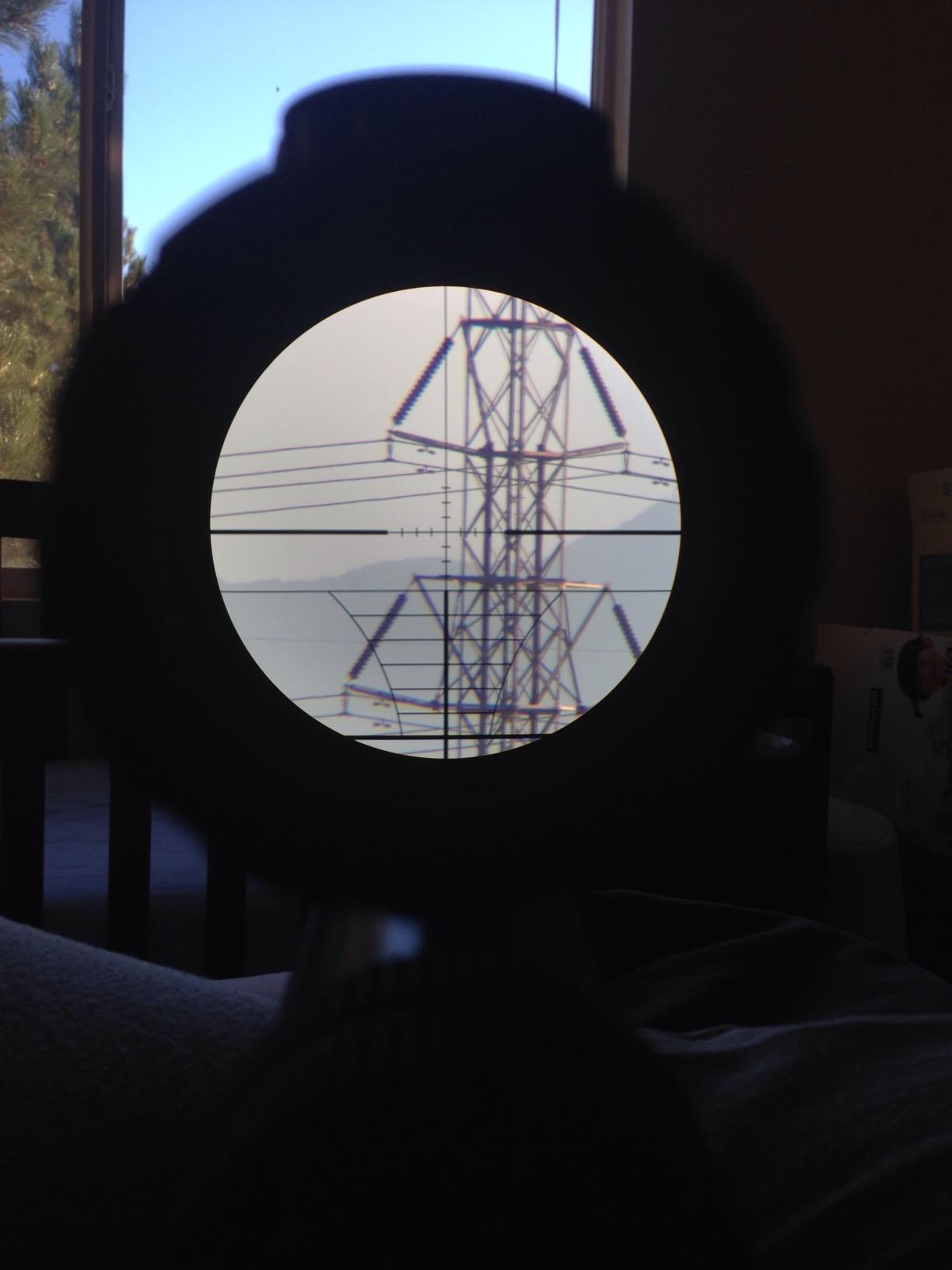
Adjustment comes via quick adjust turrets with a 1/8 MOA click value, and the reticle is lit in both red and green, which is more than plenty for a scope in this class. Eye relief is listed at 9 centimeters. The illumination is a cross reticle, which reads cleanly and instantly at any magnification but does not give you the fine structure that a first focal plane tree provides.
This is where honesty matters more than enthusiasm. A cross reticle with a plain holdover layout is not a precision instrument, and if your plan is to dial exact drop with a MIL grid, this is not the optic. What it is, is a dependable general long range scope for recreational shooting, varmint work and plinking where the priorities are a clear image, a usable reticle at any power and a body light enough to carry all day.
Who this scope fits?
This is the pick for a first long range setup, a weekend rifle, or anyone who wants to shoot steel or rock at 400 to 600 yards without thinking hard about the optic. The 6-24x range covers 500 yard work comfortably, and 24x is enough to resolve a target at 700 yards in decent light. Scope rings are included, so the cost of entry is the scope itself.
It also works as a backup optic. A lot of shooters keep a light general scope like this on a hunting rifle while their precision glass lives on a competition or varmint rifle. The weight leaves plenty of room in your budget for a bipod or a stock upgrade instead.
Where it falls short?
Two limitations shape who should skip it. First, 9 centimeters of eye relief is modest, and on a heavy bolt gun at full magnification you may find yourself settling back further than you would like to reach a comfortable sight picture. Second, the reticle is a simple cross with illumination rather than a subtension layout, so holdovers and ranging work is approximate.
For a 1000 yard precision program, look at the Vortex Strike Eagle or the Monstrum Hornet instead, both of which pair a first focal plane reticle with a zero stop. If you want the same dependable character with a proper FFP tree at the top of the power range, the Monstrum G3 reviewed below is the more capable version of the same idea.
We earn a commission, at no additional cost to you. CERTAIN CONTENT THAT APPEARS ON THIS SITE COMES FROM AMAZON. THIS CONTENT IS PROVIDED 'AS IS' AND IS SUBJECT TO CHANGE OR REMOVAL AT ANY TIME.
2. Monstrum G3 6-24×50 FFP – Best for Tactical Platforms
Monstrum G3 6-24×50 First Focal Plane FFP Rifle Scope with Illuminated MOA Reticle and Adjustable Objective (Flat Dark Earth)
★★★★★★★★★★6-24x50 first focal plane
Adjustable objective
30mm tube
3.6 lb body
- First focal plane MOA reticle holds subtensions at every magnification
- Adjustable objective removes parallax at distance
- 30mm high profile rings included
- Multiple illumination brightness levels
- 3.6 lb is heavy for a 30mm tube scope
- Tactical FFP layout is busier than a hunting duplex
The Monstrum G3 is the scope to look at if you want a real first focal plane reticle without stepping up to a precision price. The reticle is MOA-based and etched in the first focal plane, which means the holdovers stay accurate as you zoom, and that is the feature that separates it from the entry-level hunting glass in this roundup. Owners rate it 4.5 out of 5 from 995 ratings, with roughly 76 percent five-star feedback.
Two design choices set it apart. The adjustable objective lets you dial focus to the target, which sharpens the image and removes the parallax blur that makes long range shots wander off the intended point of impact. The illumination is controlled by a dedicated dial with several brightness levels, so you are not fumbling with a button under pressure.
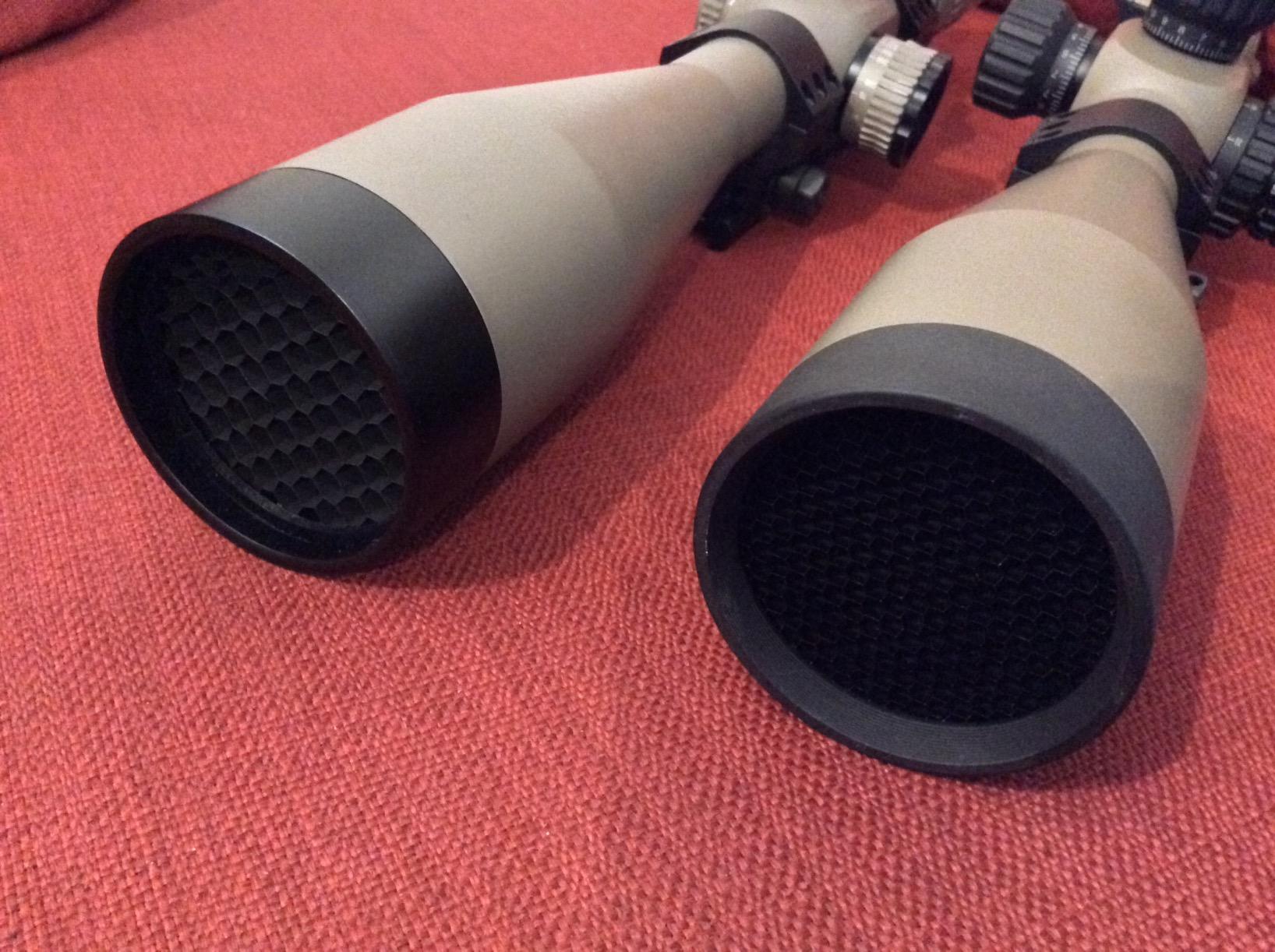
The 6-24x range is the workhorse long range power band, and the 30mm tube means it will mount on essentially any modern precision or tactical rifle without hunting for taller rings. Owners comment that the 6-24x range suits mid to long distance shooting out past 1000 yards in the right conditions, which is fair, provided your rifle has the elevation travel to get there.
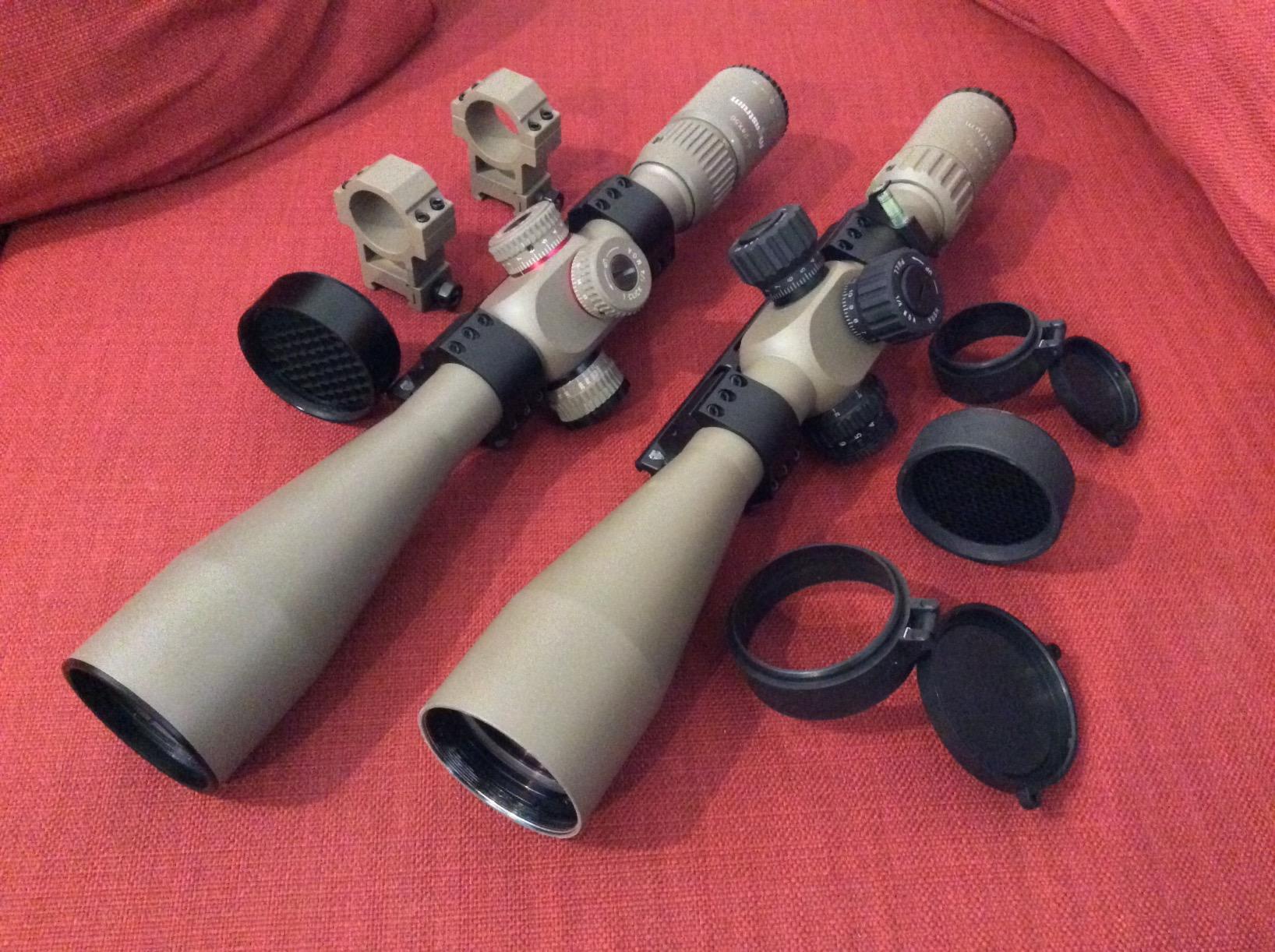
The box matters more than usual here. You get the scope, a set of 30mm high profile Picatinny rings, a sunshade, a lens cleaning cloth and spring loaded flip-up lens covers. For a first build, that removes the single most common early expense and the guesswork around ring height.
Who this scope fits?
This is the tactical and precision-adjacent pick. If your rifle is a modern bolt action with a full length rail, or an AR platform in a chassis, the 30mm tube and included rings drop straight in. The first focal plane MOA reticle gives you ranging capability that a hunting duplex simply does not have.
It is also a good value entry for recreational precision shooters who want to learn holdover shooting before committing to a MIL grid. The reticle is complex enough to grow into and readable enough to be usable on day one.
Where it falls short?
Weight is the headline drawback. At 3.6 pounds, this is the heaviest scope we evaluated, and on a 6.5 or 7 lb rifle you are carrying a rifle that is closer to eleven pounds. If your shooting is done from a hilltop with a light pack, the Athlon Argos BTR Gen 2 at 1.9 pounds is a much better answer.
Second, the tactical first focal plane layout adds visual density that a simple duplex does not. Shooters used to a clean hunting reticle sometimes find the tree busy at low magnification. For a dedicated hunting rifle where you need to find an animal quickly, a second focal plane hunting scope is still the faster option.
We earn a commission, at no additional cost to you. CERTAIN CONTENT THAT APPEARS ON THIS SITE COMES FROM AMAZON. THIS CONTENT IS PROVIDED 'AS IS' AND IS SUBJECT TO CHANGE OR REMOVAL AT ANY TIME.
3. Vortex Venom 5-25×56 – Best for Extreme Range Dialing
Vortex Venom 5-25×56 First Focal Plane Riflescope – EBR-7C (MOA) Reticle
★★★★★★★★★★5-25x56 on a 34mm tube
85 MOA of travel
EBR-7C MOA FFP reticle
2.2 lb
- 85 MOA of elevation and windage travel for extreme long range dialing
- EBR-7C first focal plane reticle stays accurate at every power
- XD optical system with fully multi-coated lenses
- RevStop zero ring included
- Very fine reticle lines can be hard to see with aging eyes
- Large and heavy for a lightweight hunting setup
When the question is how much elevation travel you can actually get, the answer is written in the tube diameter. The Venom runs a 34mm tube, which is what allows 85 MOA of maximum elevation and windage travel inside the scope. Owners rate it 4.8 out of 5 from 626 ratings with about 87 percent five-star feedback, and the repeated themes are glass clarity, turret feel, reticle quality and value.
That travel is the difference between dialing to 1000 yards and holding over. With 85 MOA available, a 6mm Creedmoor or a 6.5mm round shooting 1000 yards can often be dialled to a numbered yardage rather than eyeballed, and the return to zero is repeatable because the mechanics have room to move.
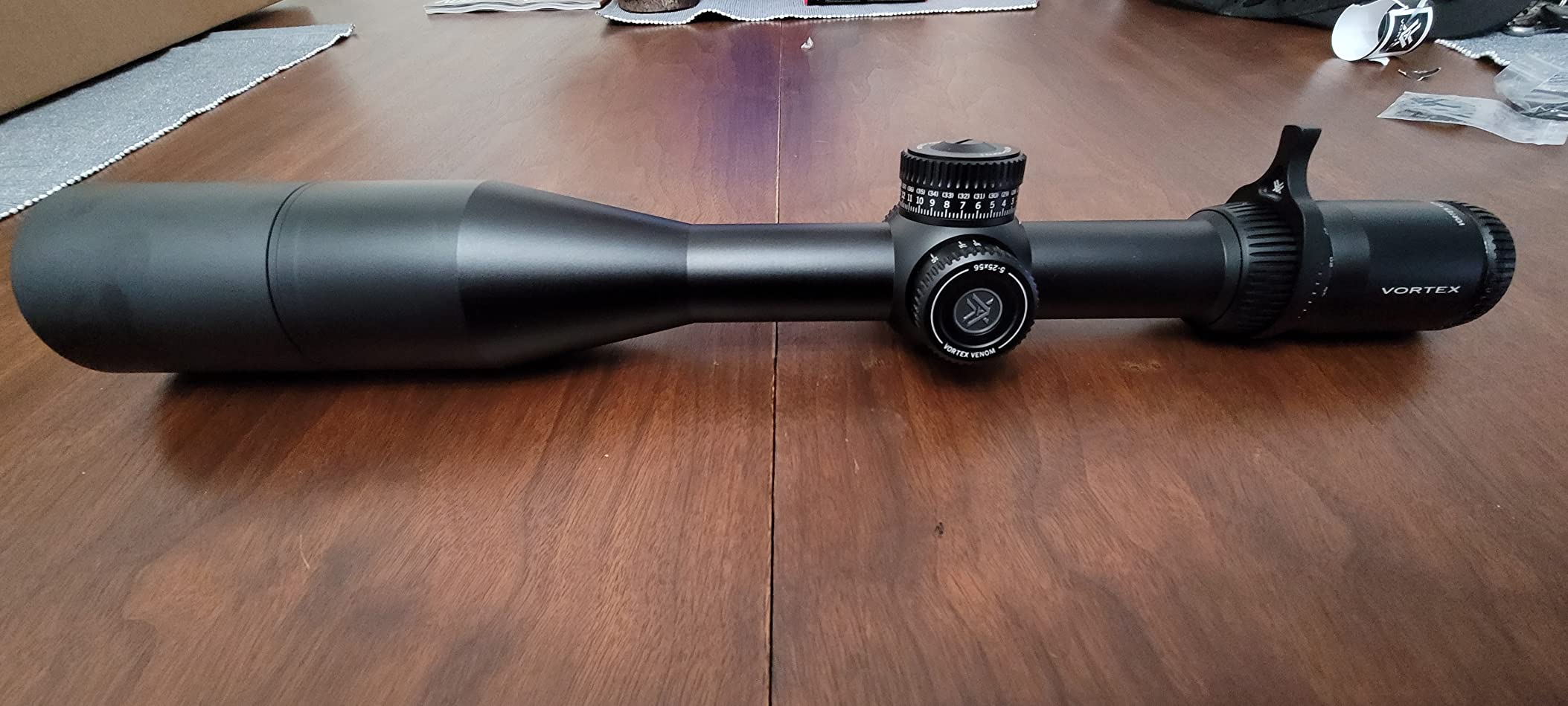
The EBR-7C reticle in MOA is a first focal plane design, so the holdovers and ranging marks are usable at any magnification from 5x to 25x. The optical system is labelled XD with fully multi-coated lenses, and owners consistently describe the image as sharp edge to edge with reduced chromatic aberration and good low light transmission. Turret adjustments are positive and tactile, with a fast focus eyepiece that comes with a throw lever.
The package is unusually complete. You get the scope, a three inch sunshade, a turret tool, rubber lens covers, a lens cloth, a throw lever, a 2mm hex wrench and a RevStop zero ring, all under Vortex unlimited lifetime warranty. The reticle is also available in MRAD and in 3-15×44 configurations if 25x is more magnification than your shooting ever needs.
Who this scope fits?
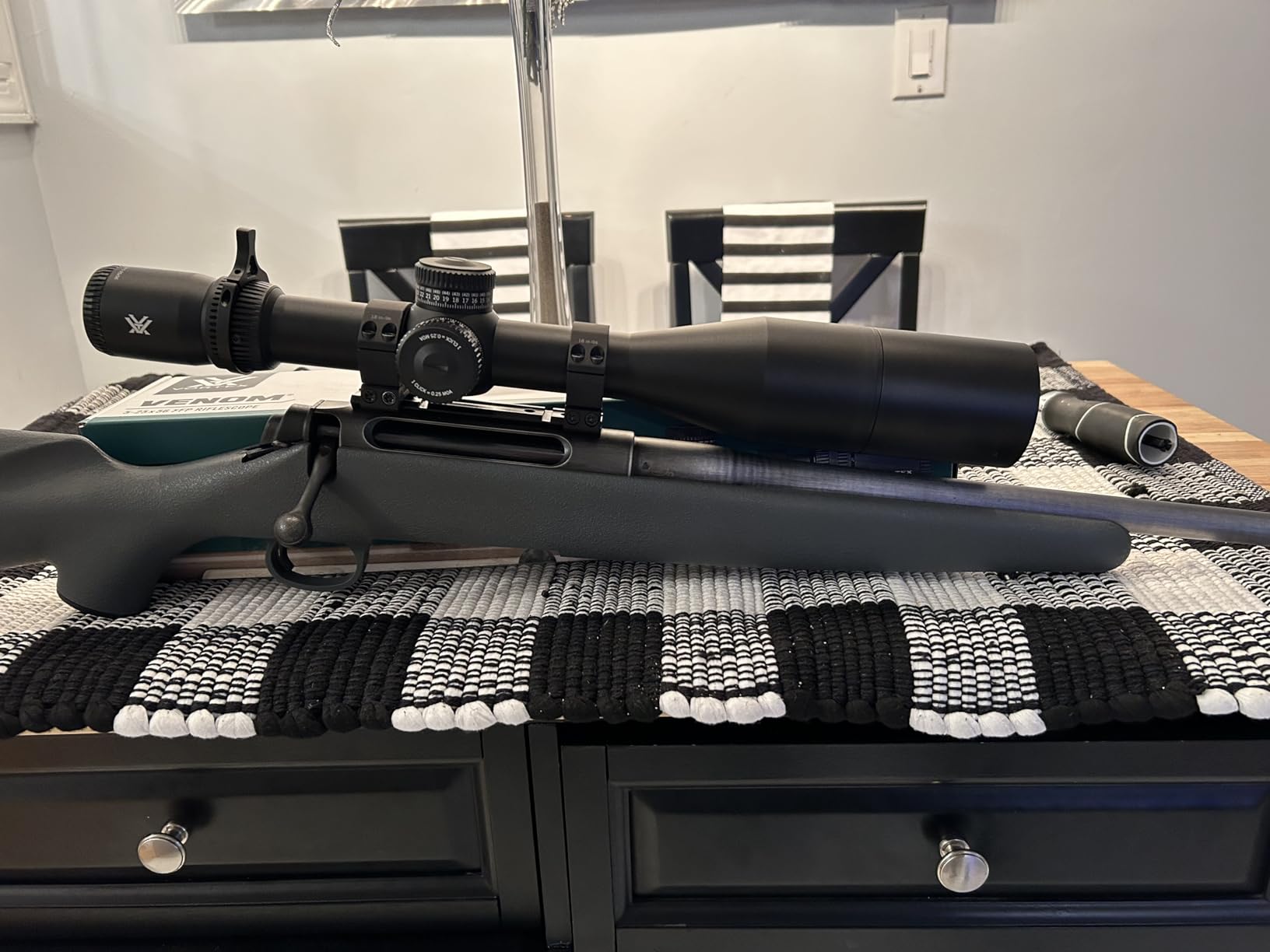
This is the pick for a dedicated precision rifle where 1000 yard work is the goal rather than the occasional shot. A 56mm objective gathers serious light for dawn and dusk sessions, and the 34mm tube means fewer future ceiling problems if you move to a steeper ballistic trajectory later.
It is equally at home on a precision hunting rifle for western big game, where shots at 400 to 700 yards are common and the ability to dial is valuable. The 5x floor is low enough that the same scope handles a close shot without a swap.
Where it falls short?
Reticle weight is the honest caveat. Owners note that the lines are very fine, which rewards good eyesight and penalises tired eyes at the end of a long day. If you already struggle to read thin lines, step up to a bolder reticle or move toward the Viper PST Gen II with its more open layout.
At 2.2 pounds this is a substantial optic. It belongs on a bench or a precision rifle, not on a mountain gun you intend to carry, and you should budget for tall enough 34mm rings to clear the action at full magnification. Buyers who want similar travel in a lighter package should look at the Strike Eagle at the same power range.
We earn a commission, at no additional cost to you. CERTAIN CONTENT THAT APPEARS ON THIS SITE COMES FROM AMAZON. THIS CONTENT IS PROVIDED 'AS IS' AND IS SUBJECT TO CHANGE OR REMOVAL AT ANY TIME.
4. Athlon Argos BTR Gen 2 6-24×50 – Best MIL Long Range Scope
Athlon Optics Argos BTR GEN2 6-24×50 Riflescope – APMR FFP IR MIL, Black
★★★★★★★★★★6-24x50 on a 30mm tube
0.1 MIL clicks, 18 MIL travel
Side focus 10 yards to infinity
Precision Zero Stop
1.9 lb
- 0.1 MIL click value with 18 MIL of total internal adjustment
- First focal plane reticle valid at all powers
- Precision Zero Stop returns to zero in the dark
- Side focus parallax from 10 yards to infinity
- 1.9 lb body
- Only a sunshade and manual are included
- No rings supplied
Most first focal plane scopes in this price class are MOA based. The Argos BTR Gen 2 is one of the few that is built around MIL, and that single decision shapes how you use it. The click value is 0.1 MIL, the total internal adjustment is 18 MIL, and owners rate the scope 4.7 out of 5 from 307 ratings with about 85 percent five-star feedback.
MIL subtensions scale directly with target size, which is why competitive long range shooters gravitate toward them. Combined with the first focal plane layout, the reticle stays true at every magnification, so a MIL holdover means the same thing at 12x as it does at 24x. The APMR FFP IR MIL reticle is also illuminated, which helps in low light or against a dark background.
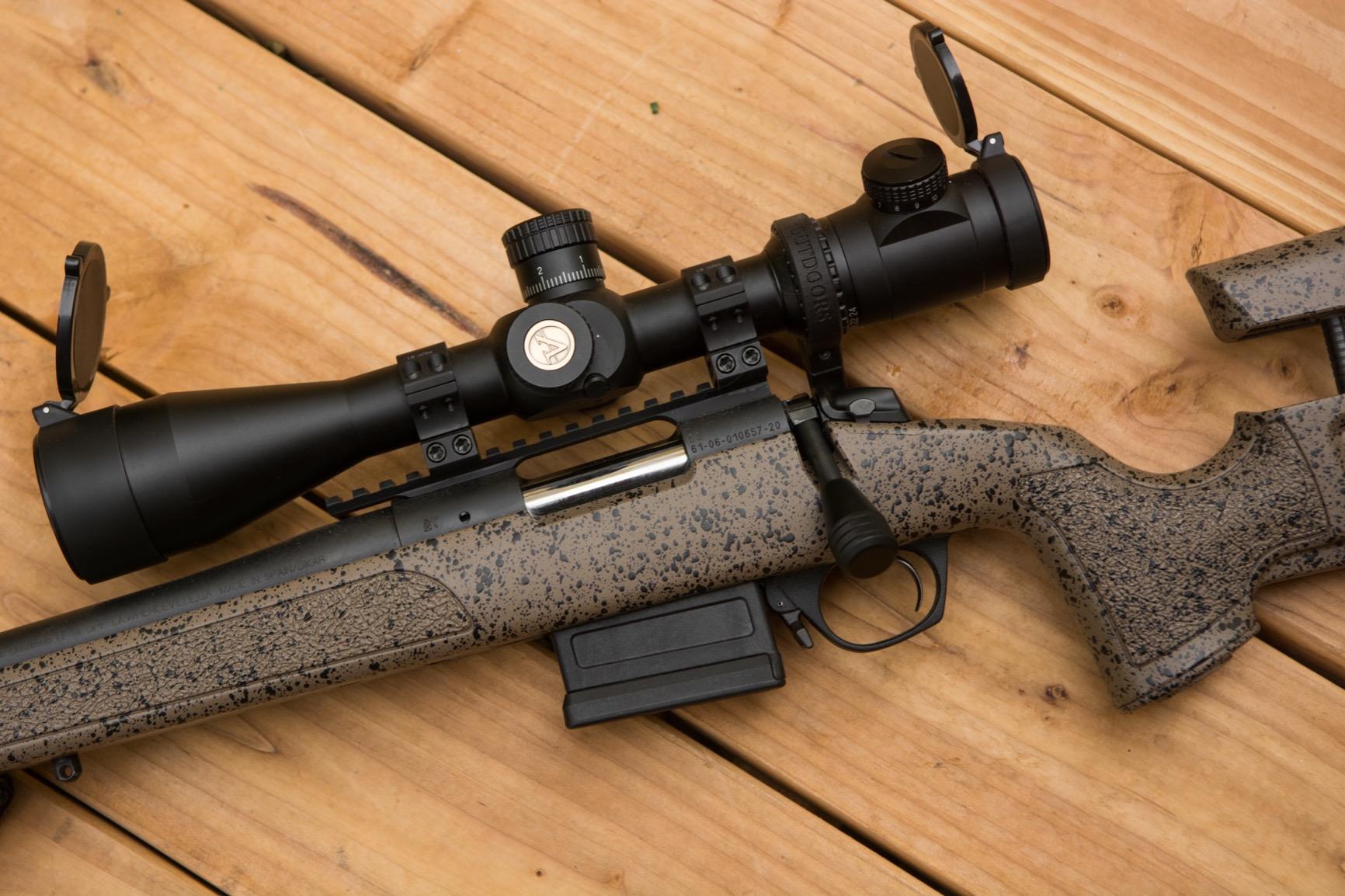
The Precision Zero Stop system is the feature that changes daily shooting. Instead of remembering a click count from your 100 yard zero, you lock the turret at a hard mechanical stop and return to zero by feel, which is exactly what you want when the light is fading. The parallax is handled by a side focus adjustment running from 10 yards to infinity, the standard long range range, so the target image sharpens and holds at distance.
Optically, the fully multicoated lenses are described by owners as noticeably brighter than single coated lenses, and the whole body weighs 1.9 pounds in aluminum. At that weight it works on a mountain rifle and on a precision chassis, which is unusual for a first focal plane scope in this class.
Who this scope fits?
This is our MIL recommendation, and it is the scope to buy if you plan to work up toward precision match strings, 1000 yard steel, or F-class style events where the reticle is the measuring instrument. The 6-24×50 pairing is also a good general long range combination because the 50mm objective is not so large that it dominates your rifle’s weight or ring height.
It is a strong first precision scope for someone who wants the architecture of a serious optic without a 34mm tube’s weight and length. The 30mm tube mounts on any standard ring set and will not crowd a bolt handle at full power.
Where it falls short?
18 MIL of internal adjustment is modest. It is ample for 500 yard recreational work and for many 800 yard shots, but it is not the travel you want if you are dialing steep drop at 1000 yards on a high ballistic coefficient round. If that is your plan, prioritise a 34mm tube scope such as the Venom or the Strike Eagle.
Also note what is in the box: a sunshade and an instruction manual. Rings are not included, so budget for a proper set and a torque wrench. That is a fair trade for the MIL layout and the light weight, but it is a real cost on the first build.
We earn a commission, at no additional cost to you. CERTAIN CONTENT THAT APPEARS ON THIS SITE COMES FROM AMAZON. THIS CONTENT IS PROVIDED 'AS IS' AND IS SUBJECT TO CHANGE OR REMOVAL AT ANY TIME.
5. Vortex Strike Eagle 5-25×56 – Top Rated First Focal Plane Scope
Vortex Strike Eagle 5-25×56 First Focal Plane Riflescope – EBR-7C Reticle (MOA)
★★★★★★★★★★5-25x56 in a 34mm tube
EBR-7C MOA etched reticle
RevStop zero and locking turrets
1.9 lb
- 4.9 out of 5 from 663 ratings
- 5-25x56 on a 34mm tube for more elevation travel
- Etched glass reticle readable in low light
- Locking turrets and RevStop return to zero reliably
- Nitrogen purged and sealed against water and fog
- Not as clear as premium razor-class optics
- Outermost reticle marks can fall outside view at full 25x
- Illumination weak in bright daylight
The Strike Eagle records the highest average rating in this group, 4.9 out of 5 from 663 ratings, with 92 percent five-star and 5 percent four-star feedback. At 1.9 pounds it is also the lightest 5-25×56 we evaluated, which is the part that surprises people. You get a 34mm aircraft-grade aluminum tube, a first focal plane MOA reticle etched on glass, and a zero stop system, in a package light enough for a backcountry build.
The mechanics are the reason owners are so enthusiastic. Locking turrets plus the RevStop zero system mean the scope comes back to zero reliably after dialing, and reviewers repeatedly describe it as sighting in quickly, tracking repeatably, and holding zero over extended sessions. The parallax adjustment matches the labeled yardage, which sounds like a small thing and is not.
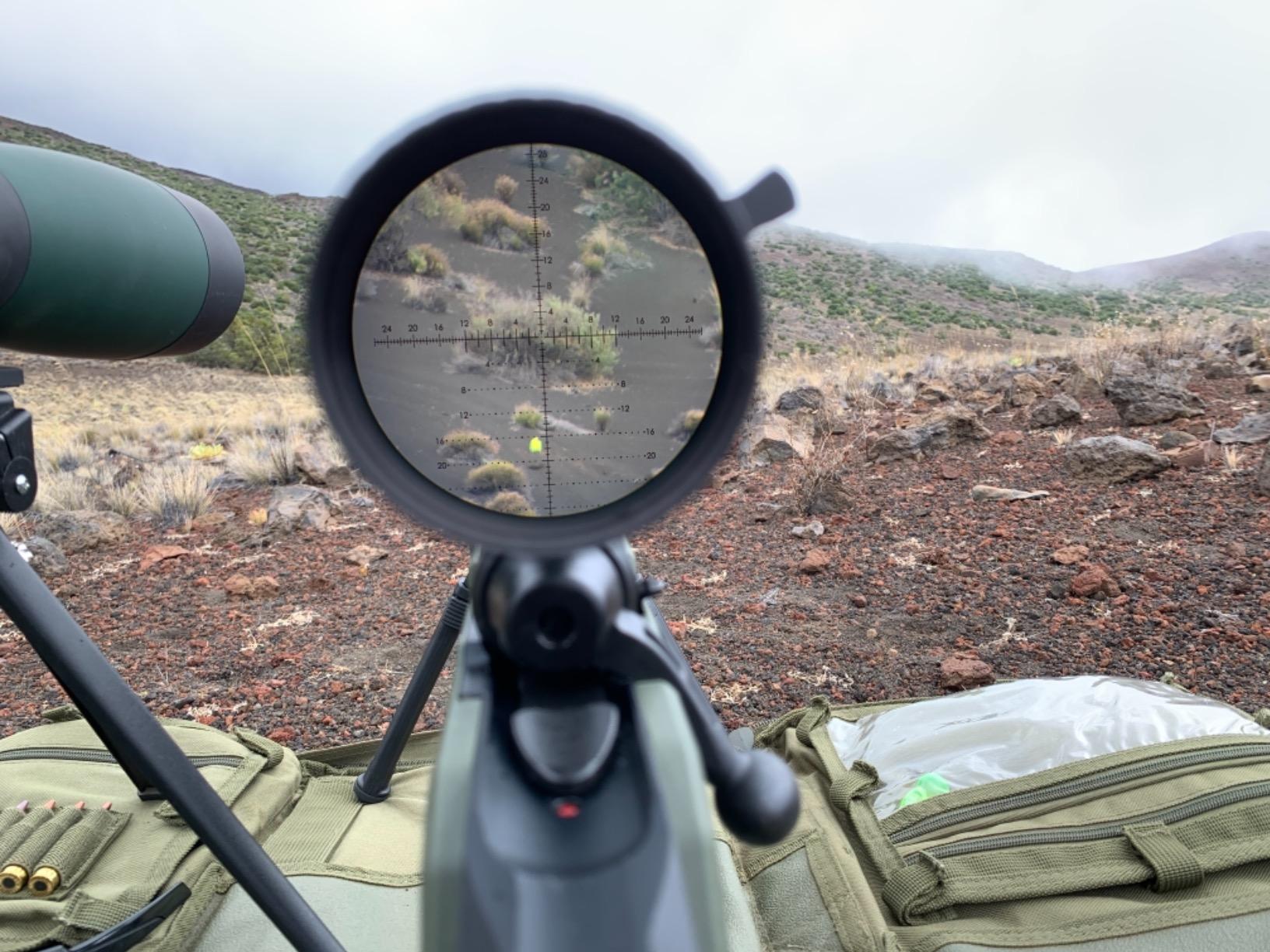
Optically it uses the XD system with anti-reflective coatings on all air-to-glass surfaces, and the etched glass EBR-7C MOA reticle is readable in low light and against dark backgrounds without needing illumination. The scope is nitrogen purged, o-ring sealed, waterproof and fogproof. A 24 foot field of view at 100 yards is reasonable for a 5x to 25x zoom, and a throw lever is included for fast magnification changes.
Owners consistently compare it favorably against scopes costing considerably more, and the warranty is the unlimited, unconditional, fully transferable Vortex lifetime VIP, which is the single most-cited risk remover in long range forums. The scope is also available in 1-10x, 1-8x and 3-18×44 configurations if 25x is beyond what your rifle needs.
Who this scope fits?
This is our recommendation for a shooter who wants genuine precision performance across 500 to 1000 yards on one optic, and who does not want to compromise on weight. A 5x floor handles a fast shot at close range, 25x handles 1000 yard steel, and the 34mm tube gives you headroom on elevation travel that a 30mm scope cannot.
It is also the best all-round choice for a hunting rifle that doubles as a precision rig, because the etched reticle reads well in low light without batteries and the weight does not punish you on a long walk.
Where it falls short?
Be honest about the glass. Owners are clear that it is not as clear as premium razor-class optics and that the overall feel is not high end. You are buying mechanical reliability, travel and weight efficiency, not flagship resolution, and at full 25x the outermost part of the first focal plane reticle may not be fully visible.
The illumination is also not readable in bright daylight even at the highest setting, so plan on the etched reticle for daytime work. Finally, the included RevStop ring constrains dialing; a few long range shooters remove it for unrestricted elevation travel, which is an easy modification but worth knowing before you rely on the zero stop.
We earn a commission, at no additional cost to you. CERTAIN CONTENT THAT APPEARS ON THIS SITE COMES FROM AMAZON. THIS CONTENT IS PROVIDED 'AS IS' AND IS SUBJECT TO CHANGE OR REMOVAL AT ANY TIME.
6. Vortex Viper PST Gen II 5-25×50 – Best for Precision Match Shooting
Vortex Optics Viper PST Gen II 5-25×50 First Focal Plane Riflescope – EBR-7C Reticle (MOA) , black
★★★★★★★★★★5-25x50 first focal plane
EBR-7C MOA laser etched reticle
RZR zero stop
1.9 lb
- Exceptional tracking with solid positive clicks
- Zero retention and precise return with the RZR zero stop
- Extra-low dispersion glass with XR multi-coating
- Detailed but uncluttered holdover reticle with 10 brightness levels
- Zero stop can feel mushy to some shooters
- Illumination turret is stiff and hard to turn
The Viper PST Gen II is the most refined instrument in this roundup in the sense that owners describe almost nothing about it as a compromise. It rates 4.8 out of 5 from 292 ratings with 91 percent five-star feedback, and the consistent description across reviews is flawless tracking, dependable zero retention, and a detailed reticle that works across the whole 5-25×50 range. For match shooters, that is the whole list of what matters.
The 5-25×50 pairing is a deliberate choice. A 50mm objective keeps the scope short and light enough for a competition rifle while still gathering good light, and the 5x floor gives you a usable close-range setting. The 24.1 foot field of view at 100 yards is comfortable to scan at the top end.
Two details justify calling this the precision pick. The reticle is laser etched rather than simply printed, with 10 illumination intensity levels and off positions between the settings, so you can find a genuinely dark setting instead of a dim one. And the turret caps carry a fiber optic rotation indicator, so you can confirm at a glance whether the dial is locked in firing position.
The optics use extra-low dispersion glass with XR fully multi-coated lenses and Armortek scratch protection, and the body is o-ring sealed and argon purged for waterproof and fogproof performance. Adjustable parallax and the RZR zero stop complete the mechanical set, and the warranty is again Vortex unlimited and unconditional.
Who this scope fits?
PRS and F-class shooters who dial for distance and want the finest mechanical feel available in a scope that is still light enough to compete with. It is equally strong for a serious recreational long range program where you will spend hours on a prone bag or in a shooting tent rather than a tree stand.
Because the reticle is a holdover design rather than a Christmas tree, it rewards a shooter who prefers to use the reticle to range and hold rather than working a target turret. Available variants include EBR-2C and EBR-2D trees in MOA and MRAD, plus 2-10×32 and 3-15×44 options, so the layout can be matched to your preference.
Where it falls short?
Two honest complaints from owners. The zero stop can feel mushy compared with the crisper exposed turrets on the Strike Eagle, which matters if you like to feel a positive stop under your thumb. And the illumination turret is stiff, which is an irritation in low light when you want to make a small adjustment without thinking about it.
There is also the length question. A 5-25×50 with a full 50mm objective is longer than a 4-16×44 and can crowd the front of a compact action, so measure before you order. The Viper PST sits at the top of this roundup on mechanical feel and glass for the magnification class, but the Venom gives you more objective and more travel for a different kind of shooting.
We earn a commission, at no additional cost to you. CERTAIN CONTENT THAT APPEARS ON THIS SITE COMES FROM AMAZON. THIS CONTENT IS PROVIDED 'AS IS' AND IS SUBJECT TO CHANGE OR REMOVAL AT ANY TIME.
7. Monstrum Hornet 6-24×50 FFP – Best Budget First Focal Plane Scope
Monstrum Hornet 6-24×50 FFP Rifle Scope | Includes Zero Stop, Bubble Level Scope Rings, 1 CR2032 Battery, and Detachable Sunshade | X-Tree MOA Reticle
★★★★★★★★★★6-24x50 first focal plane
X-Tree FFP reticle
1/8 MOA clicks with zero stop
6 illumination levels
- Feature set rivals scopes costing several times more
- Numbered hash marks make holdovers easy to read
- Holds zero through hundreds of rounds
- Levelled 30mm high profile rings included
- Lifetime guarantee
- Optics soften noticeably at full 24x
- Illumination appears off-center and lights part of the reticle
- Parallax scale is not marked accurately
The Hornet exists because the feature list you would expect from a precision scope is now available without a precision budget. You get a first focal plane X-Tree reticle with numbered hash marks, 1/8 MOA windage and elevation clicks, a zero stop mechanism, an integrated throw lever, six illumination levels and a lifetime guarantee. Owners rate it 4.4 out of 5 from 241 ratings with 75 percent five-star feedback, and the praise is concentrated almost entirely on features and zero retention.
The X-Tree reticle is the reason this scope is interesting for long range work. Numbered hash marks let you call your own holdovers in MOA, and because the reticle is in the first focal plane, those calls stay true from 6x through 24x. That is a capability most scopes in this price range simply do not offer.
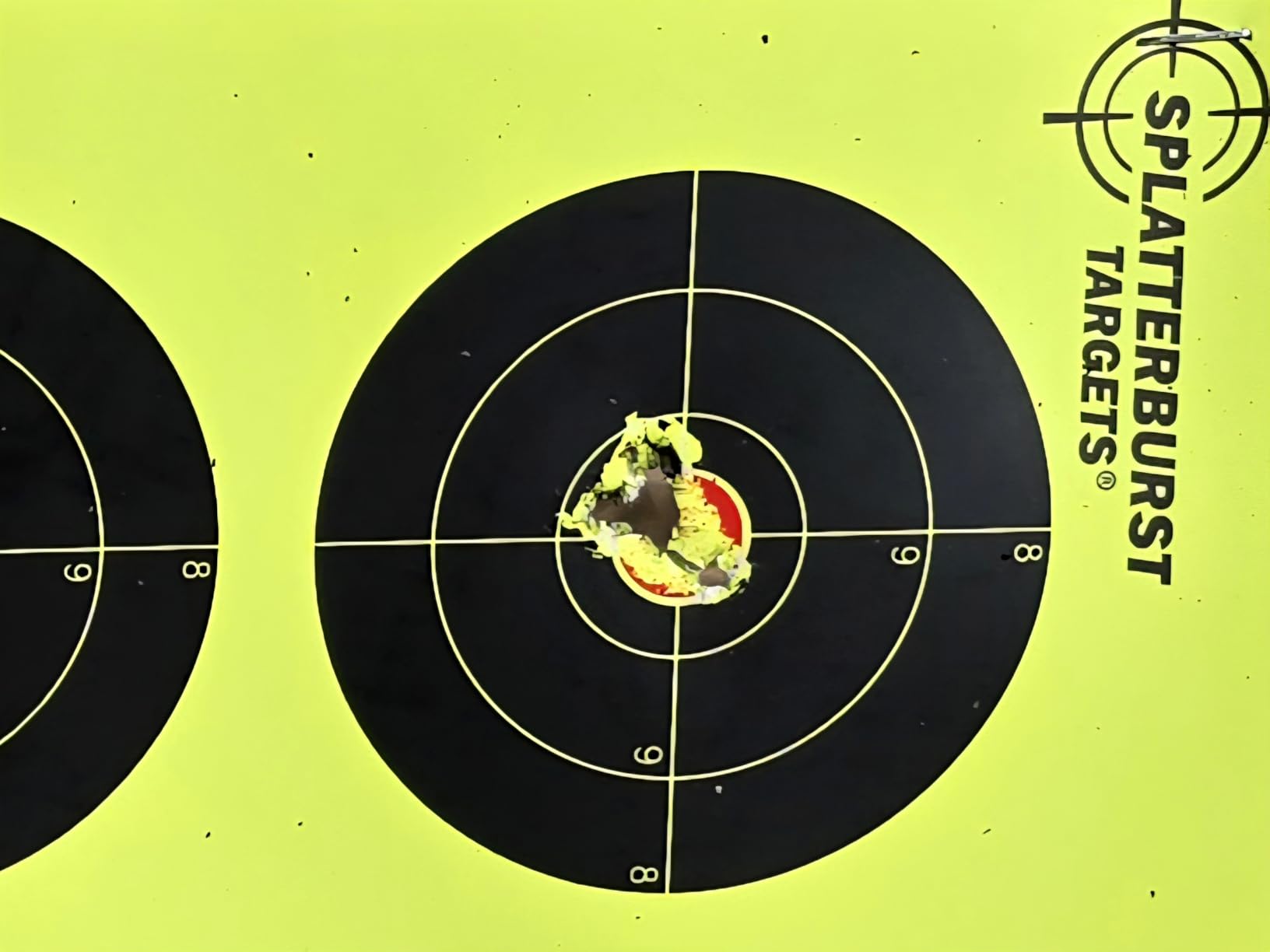
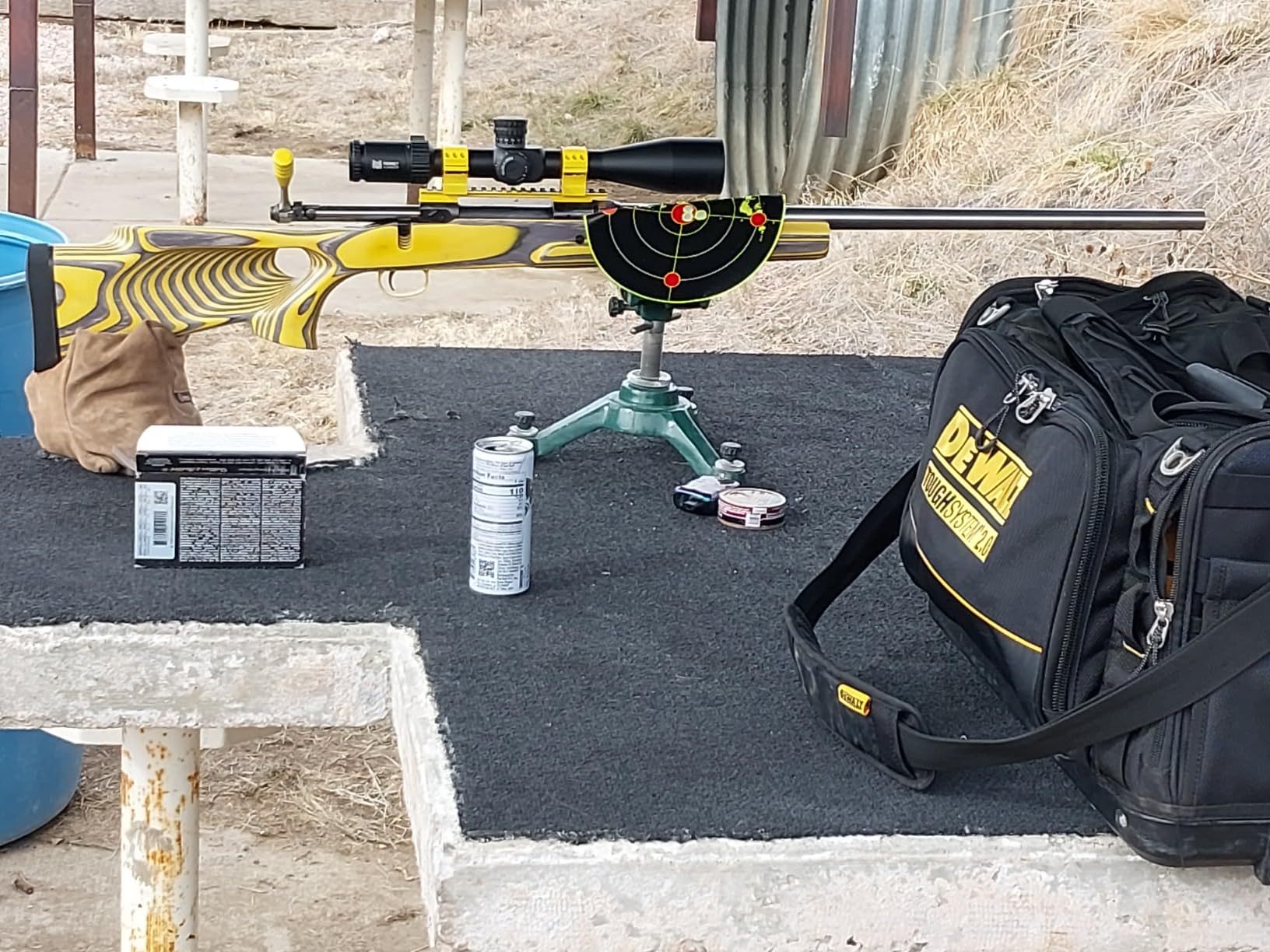
Zero retention is the second talking point. Owners report the scope holding zero through hundreds of rounds, including on heavy recoiling rifles, which is a durability signal rather than a spec sheet claim. The included rings are a real bonus: high profile 30mm rings with an integrated bubble level, six screws each, wide and solid enough to level a scope properly on the first try.
Owners also like that the package is compact. The scope, sunshade, bikini lens covers, battery and rings together allow a rifle and optic to stay under about 8.5 pounds, which matters more for a portable precision setup than an extra 0.2 inch of glass clarity. MOA and MIL reticle versions are both offered.
Who this scope fits?
This is our value pick for a shooter building a first long range rifle and who wants first focal plane capability plus a zero stop without spending serious money. If your plan is 500 to 800 yard steel and recreational precision, the features here cover it and the rings are already in the box.
It is also a good loaner or backup optic. If you are evaluating whether first focal plane glass suits your shooting style, this is a low-risk way to find out before committing to a higher tier scope.
Where it falls short?
Optical clarity degrades noticeably at full 24x and performs best around 14x, which is consistent with a mid-tier glass package. If your game is 1000 yard precision, plan to live at the middle of the power range rather than the top of it, or step up to the Strike Eagle or Viper PST.
The illumination is the most criticised feature. Owners report it appears off-center and lights only part of each reticle element, which means you will likely end up ignoring it. The parallax scale is also unmarked accurately, so you will need to learn the true settings by feel. A few units have arrived with a windage knob locked or a reticle element that moves out of view at high magnification, so inspect it carefully on arrival.
We earn a commission, at no additional cost to you. CERTAIN CONTENT THAT APPEARS ON THIS SITE COMES FROM AMAZON. THIS CONTENT IS PROVIDED 'AS IS' AND IS SUBJECT TO CHANGE OR REMOVAL AT ANY TIME.
8. SIG SAUER Tango-SPR 6-24x52mm – Best for 500 Yard Shooting
SIG SAUER Tango-SPR 6-24x52mm 30mm Tube Tactical Riflescope
★★★★★★★★★★6-24x52mm on a 30mm tube
MOA BDC-1 second focal plane reticle
Exposed zero-stop elevation dial
SPR mount installed
- Exceptionally clean bright image from low dispersion glass
- Holds zero after many rounds on 300 Win Mag and 6.5mm rifles
- Factory-installed SPR scope mount needs no extra rings
- Side focus parallax and throw lever included
- Some units arrive not centred in the rings
- Occasional elevation turret misalignment
- Turret adjustments can feel mushy
The Tango-SPR is the most conventional hunting-adjacent long range scope in this roundup, and for 500 yard work it is genuinely hard to argue with. Owners rate it 4.5 out of 5 from 132 ratings with 78 percent five-star feedback, and the recurring word in those reviews is clarity. The 4:1 optical system with low dispersion glass produces a clean, bright image with strong light transmission, and reviewers note the view stays clear across the entire 6-24x zoom.
It is a second focal plane scope, which is the right architecture for a general long range hunting and varmint rifle. The MOA BDC-1 ballistic drop compensator reticle gives you labelled holds, and because it lives in the second focal plane, the reticle line thickness stays consistent and easy to read whether you are at 6x or 24x.
The mechanical layout is the reason it suits a general shooter. You get an exposed elevation dial with a zero stop, so you can return to zero by feel without counting clicks, and a low profile capped windage turret, which stays out of the way in a pack or a truck bed. Parallax is handled by a dedicated side focus knob, and the removable throw lever makes fast magnification changes one-handed.
Zero retention is well documented by owners who have put it through many rounds on 300 Win Mag and 6mm rifles, and the flip-back lens covers and throw lever are in the box. The body is described as waterproof, shockproof and fogproof. It comes with a factory-installed SPR scope mount, which is unusual in a scope listing and saves you both money and a fitment problem.
Who this scope fits?
This is the pick for 300 to 500 yard work, whether that is deer season, varmint control, or a steel match you shoot with a hunting rifle. The 6x floor keeps a shot at close range instant, and the 24x top end is more than most 500 yard shooters ever use. The image quality and included mount make it a strong first long range optic on a hunting rifle.
It is also a good second focal plane counterpoint if you have been reading that first focal plane is the only correct answer. For a general rifle, the readable constant-weight reticle and the illuminated holdovers are the more practical combination.
Where it falls short?
Quality control is the honest weakness, and owners say so directly. Some units arrive with the scope not properly centred in the rings, which is an easy fix during install but a bad first impression. Others report elevation turret defects where the printed marks do not line up with the clicks, which is a genuine problem for a zero stop turret.
Turret adjustments are also described as somewhat mushy even though they remain accurate. If crisp tactile feedback matters to you, the exposed turrets on the CVLIFE 6-24×50 and the Sniper MT are more pronounced. And as a second focal plane scope, the BDC holds are only calibrated at one magnification, so switching power means re-thinking your hold.
We earn a commission, at no additional cost to you. CERTAIN CONTENT THAT APPEARS ON THIS SITE COMES FROM AMAZON. THIS CONTENT IS PROVIDED 'AS IS' AND IS SUBJECT TO CHANGE OR REMOVAL AT ANY TIME.
9. CVLIFE 2-10×32 MPVO AO – Best for Rimfire and Airsoft
CVLIFE 2-10×32 MPVO AO Rifle Scope with Locking Turret, 5 Levels Red & Green Illuminated Reticle, Parallax Adjustment, Second Focal Plane, 30mm Offset Scope Mount
★★★★★★★★★★2-10x32 with adjustable objective
1/2 MOA clicks and 70 MOA travel
Locking turrets
Cantilever mount included
- 2-10x range with adjustable objective and parallax adjustment
- Locking turrets with tactile audible 1/2 MOA clicks
- 70 MOA of total windage and elevation adjustment
- Cantilever mount included
- Waterproof and impact tested construction
- Holdovers only work at one magnification
- 1/2 MOA clicks are coarse for precision work
- 10x maximum is not a long range glass
This is not a long range scope, and reading it as one would be a mistake. It is here because a great many people buying into long range shooting start on a rimfire, an airsoft gun or a .308 plinking rifle, and the 2-10×32 answers a different question. Owners rate it 4.4 out of 5 from 293 ratings, with 68 percent five-star and 21 percent four-star feedback clustered around versatility and durability rather than precision capability.
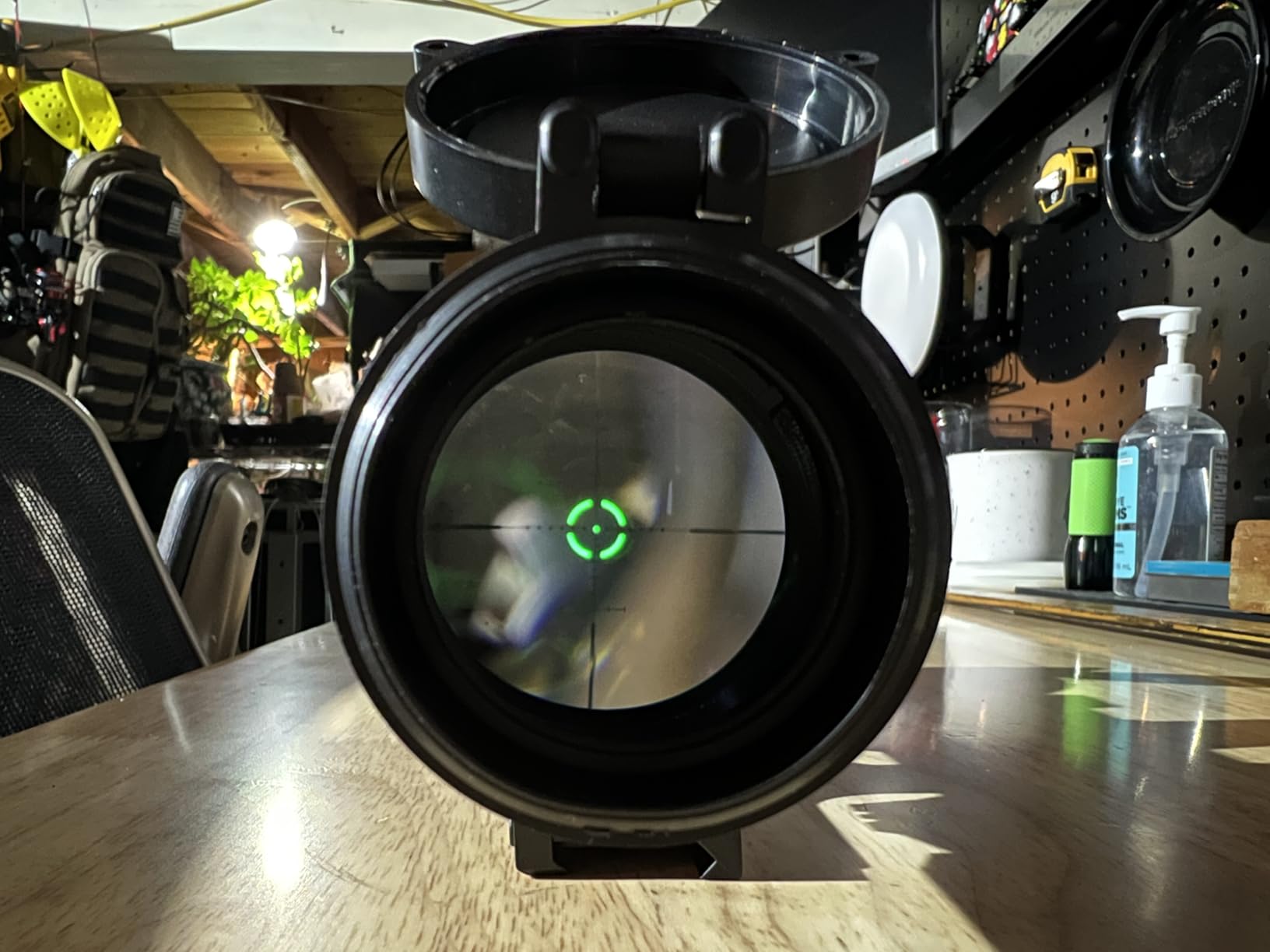
The specification sheet is solid for the class. You get a second focal plane CVX-1 reticle with five levels of red and green illumination, exposed locking turrets with 1/2 MOA clicks across 70 MOA of total windage and elevation adjustment, a side parallax adjustment, a fast focus eyepiece and fully multi-coated anti-reflective green lenses. The body is o-ring sealed, waterproof and fog resistant, and has passed 500 rounds of 1000G impact testing.
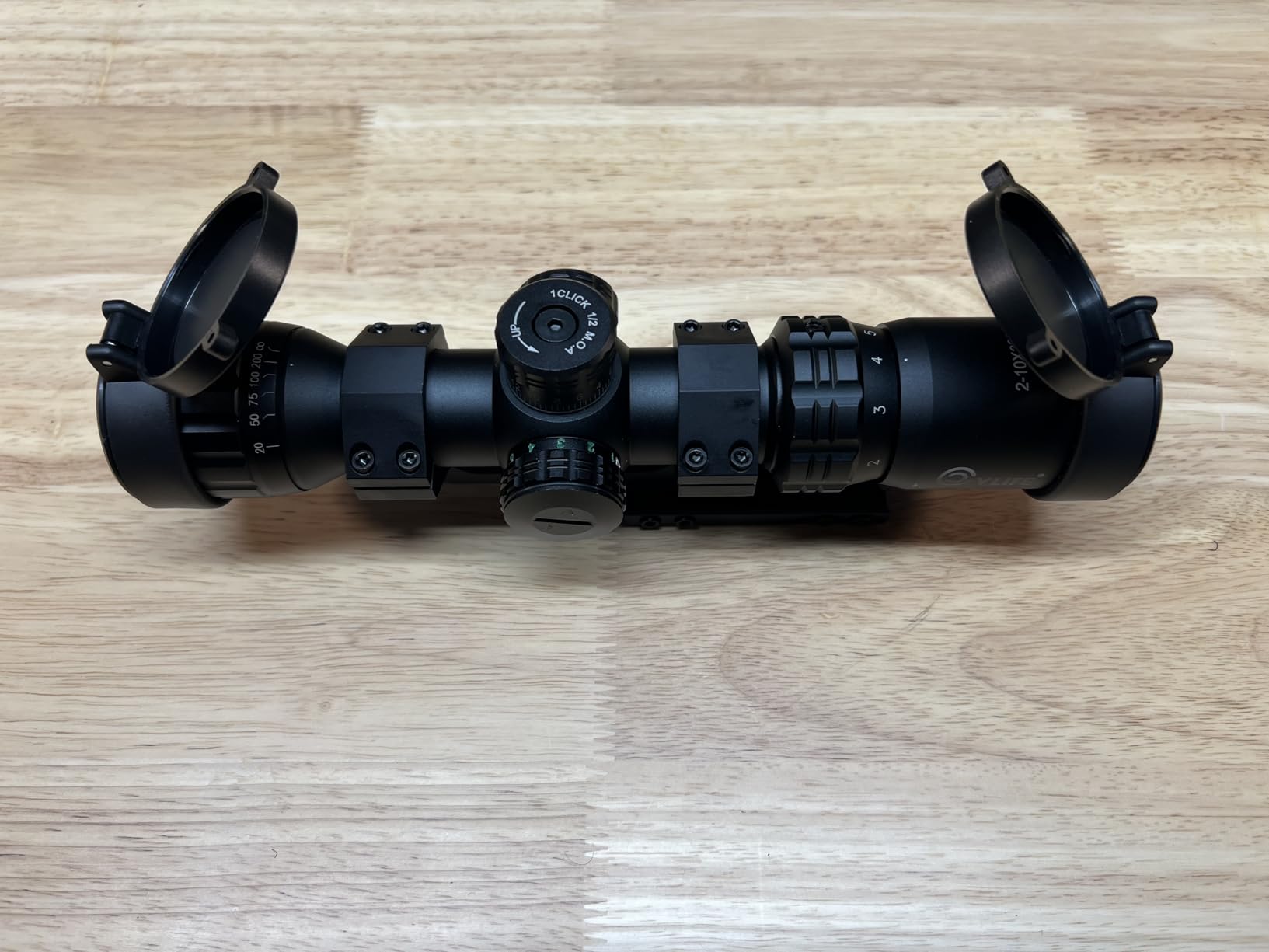
One detail stands out for a first optic. Seventy MOA of adjustment is a lot of travel, and combined with a 1/2 inch click value that is perfectly usable for rimfire zeroing where the distances involved are short. The exposed locking turrets give a real tactile click, which is more than many scopes at twice the price provide.
The box includes a cantilever offset scope mount, two flip-up lens caps, two wrenches, two CR2032 batteries, a lens cloth and a manual. At a listed weight of 0.8 kg, it is one of the lighter optics here, and the 32mm objective keeps the scope short and mounts low.
Who this scope fits?
Anyone starting out on a 10/22, a .22LR, an airsoft rifle, a pellet gun or a light-caliber plinking rifle. The wide 2x to 10x range means you can move from a close indoor target to 100 yard steel without changing optics, and the included mount means it goes on a standard 30mm offset rail immediately.
It also makes sense as a close-range companion scope on a second rifle, particularly for a hunting rifle that will see a lot of near-range shooting and small game. The listed warranty is one year, so treat it accordingly.
Where it falls short?
Three limits define it. As a second focal plane reticle, the holdovers only hold at one specific magnification, so any BDC or hashmark reference is useless at other powers. The 1/2 MOA clicks are coarser than the 0.1 or 1/10 MOA increments precision shooters prefer, so windage corrections in a crosswind will be steppy.
Most importantly, 10x is not a long range magnification. If your stated goal is shooting steel or targets at 600 to 1000 yards, this scope cannot get you there. Use it to learn fundamentals, then move to a 6-24×50 or a 5-25×56 when you are ready to reach further.
We earn a commission, at no additional cost to you. CERTAIN CONTENT THAT APPEARS ON THIS SITE COMES FROM AMAZON. THIS CONTENT IS PROVIDED 'AS IS' AND IS SUBJECT TO CHANGE OR REMOVAL AT ANY TIME.
10. Monstrum Spectre 1-8×28 LPVO – Best Lightweight Hunting Scope
Monstrum Spectre 1-8×28 LPVO Rifle Scope | Flat Dark Earth
★★★★★★★★★★1-8x28 low power variable
34mm tube with throw lever
MX1 SFP box reticle
Wide eye box and long eye relief
- 1-8x range with a proper offset cantilever mount
- MX1 box reticle with MOA hashmarks stays the same size
- 121.5 ft field of view and wide eye box
- Holds zero after hundreds of rounds on a heavy recoiling .308
- Pronounced edge distortion at 1x is disorienting for some shooters
- Illumination brightness control is limited
- Clarity does not match premium LPVOs
The Spectre answers the question a precision scope cannot: what do you put on a hunting rifle where weight and fast target acquisition matter more than 1000 yard capability. It is a 1-8x low power variable optic on a 34mm tube with an integrated throw lever, and the review base is smaller at 98 ratings averaging 4.4, with 68 percent five-star feedback. We are including it because the majority of long range rifle owners also own a hunting rifle.
At 1.27 kg it is one of the lighter optics we evaluated, and the offset cantilever mount is included, which matters because a low power variable needs to sit forward enough to clear the action. Owners like the wide 121.5 foot field of view and the wide eye box, both of which make the sight picture come up fast on a moving animal.
The MX1 second focal plane box reticle with MOA hashmarks is a sensible design here. Because it is in the second focal plane, the reticle keeps a constant size and weight as you zoom, so the aiming point stays visible at 8x on an open hillside. The lens coatings are heavier than competing models according to the manufacturer, and owners report a clear, crisp image with red and green illumination that works in daylight.
Zero retention is the other repeated positive. Owners report the scope holding zero after hundreds of rounds on a heavy recoiling .308, which is the practical test that matters most for a hunting rifle. The included spring loaded flip-up lens covers are a small detail that saves the glass in a truck bed.
Who this scope fits?
This is for the big game and general hunting rifle, and for anyone carrying weight over distance. A 1x floor lets you shoot a close black bear or a bird without craning, and 8x is ample for deer, pronghorn and most elk shots. The wide eye box also helps with older eyes and with shooting in low light.
It pairs naturally with a precision rifle. Many shooters run one rifle for hunting with this scope and a second for target work with a 5-25×56, which removes the argument about which scope to buy first.
Where it falls short?
The 1x end has a pronounced fisheye or edge distortion that some shooters find disorienting, and that effect is most noticeable in a confined space. The illumination also needs to be switched on in anything less than bright light, and brightness control is limited to a few levels.
Most importantly, the glass does not match the clarity of premium low power variable scopes in the same class, and 8x is nowhere near enough for long range target work. Buy this for the field, not for the 800 yard line.
We earn a commission, at no additional cost to you. CERTAIN CONTENT THAT APPEARS ON THIS SITE COMES FROM AMAZON. THIS CONTENT IS PROVIDED 'AS IS' AND IS SUBJECT TO CHANGE OR REMOVAL AT ANY TIME.
11. Sniper MT 6-24×50 – Best for Tri-Color Illumination
Rifle Scope MT 6-24×50 Red/Green/Blue Illuminated Reticle
★★★★★★★★★★6-24x50 adjustable objective
Red green and blue Mil-Dot
1/4 MOA QTA turrets
1 inch tube
1.6 lb
- Feature set normally found on scopes costing several times more
- Tri-color illuminated Mil-Dot reticle with auto-off
- Nitrogen filled and o-ring sealed
- Includes Picatinny rings and flip-up lens covers
- Image becomes hazy above roughly 18x
- Turret dials can develop play or lock up over time
- Short eye relief of 3.8 mm
- Second focal plane Mil-Dot
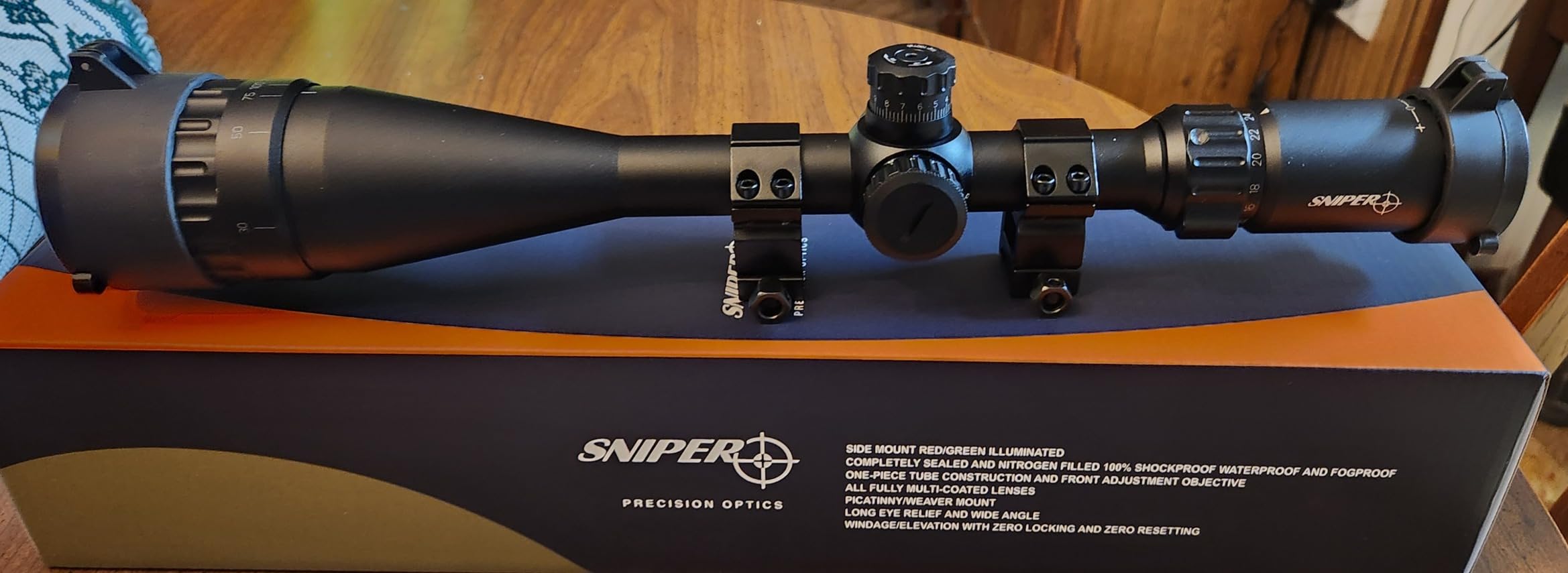
The Sniper MT is the widest-reaching budget 6-24×50 in this roundup, with 589 ratings averaging 4.2, the lowest average here, and a wider spread of feedback than the other budget scopes. The reason it still earns a place is the specification sheet: a 6-24×50 with an adjustable objective, a red green and blue illuminated Mil-Dot reticle with an auto-off battery saver, 1/4 MOA quick adjustment turrets, and a nitrogen filled, o-ring sealed, shockproof, waterproof and fogproof body.
The tri-color illumination is genuinely unusual. Red and green cover almost every lighting condition, and the auto-off function is a small piece of engineering that stops a dead battery from ruining a hunt. The quick adjustment turrets can be locked at your preferred yardage, which is a sensible feature on a hunting scope.
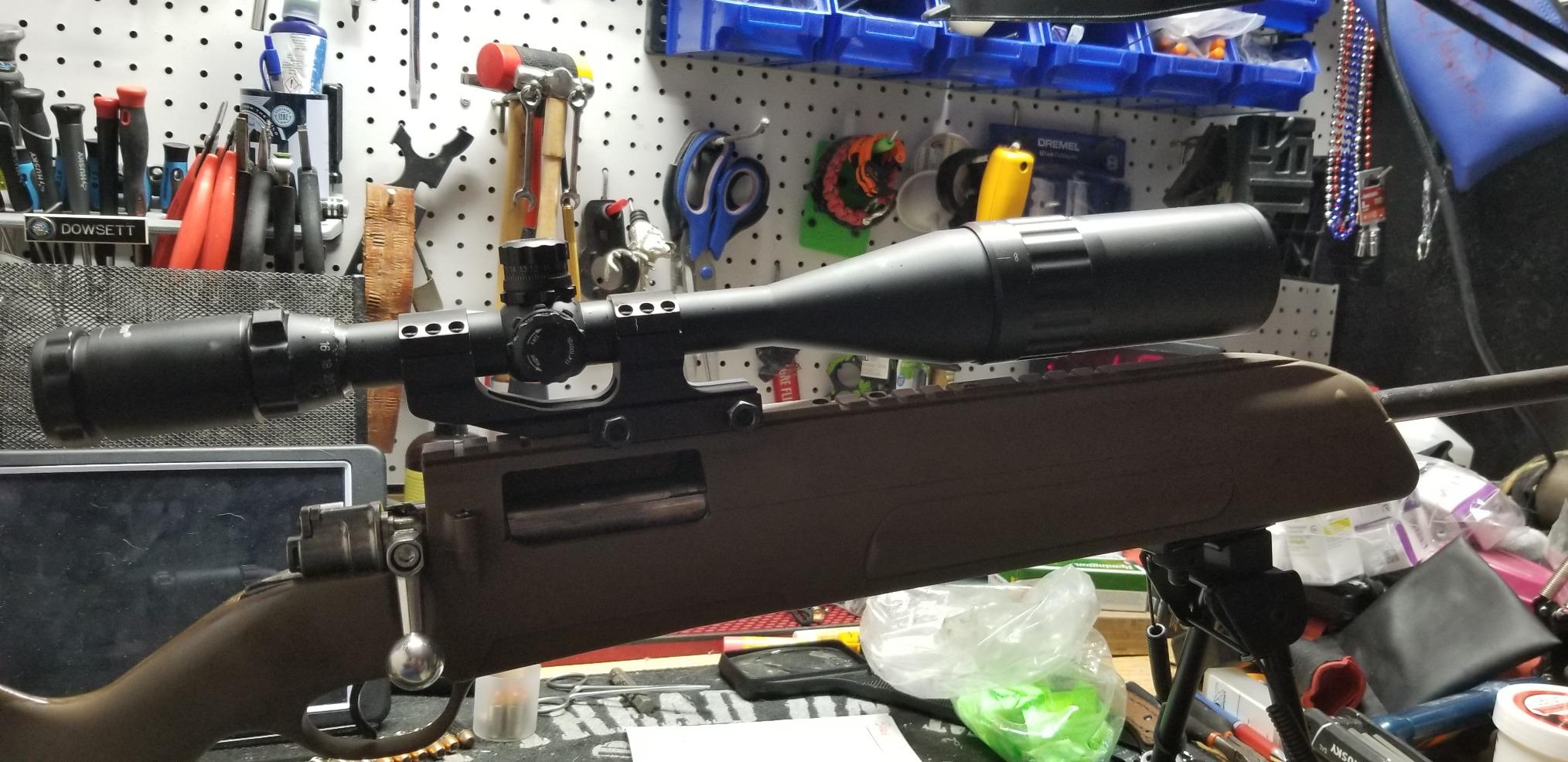
The body is a single piece of aircraft-grade aluminum on a one inch tube, and the multi-coated lenses are described by owners as giving a clear, crisp image with reduced glare and edge-to-edge brightness. Picatinny scope rings and flip-up lens covers are included, so again the first build costs less than it otherwise would. The warranty is a limited lifetime warranty, which is worth reading carefully rather than assuming.
What draws the 4.2 rather than something higher is a specific set of complaints. The most common is that the image becomes hazy and soft above roughly 18x, with eye relief changing noticeably there. That is not a problem if you shoot at 500 yards with a scope set around 12x, and it is a real one if you want to use the top of the range.
Who this scope fits?
The budget hunting and varmint shooter who wants more illumination options than most scopes offer and who is not planning to work past 600 or 700 yards. At 1.6 pounds it is light, and the 6-24×50 combination is a proven general long range layout for 300 Win Mag and similar cartridges.
It is also a sensible locker gun or first bolt gun optic. Included rings, a body light enough to carry, and a 6x floor for close shots make it a complete package.
Where it falls short?
There are four real limitations. The image softens above roughly 18x and eye relief changes there, which makes the top third of the power range less useful than the specification suggests. Turret dials can develop play or lock up over time, which is a durability concern on an optic you would like to keep for years.
Eye relief is listed at 3.8 mm, which is short, and on a long scope body that can be awkward to boresight on some rifles. And because the Mil-Dot reticle is second focal plane, holdovers only apply at one magnification. If any of those matter to your shooting, the Monstrum Hornet or the Athlon Argos BTR Gen 2 is a better use of the same money.
We earn a commission, at no additional cost to you. CERTAIN CONTENT THAT APPEARS ON THIS SITE COMES FROM AMAZON. THIS CONTENT IS PROVIDED 'AS IS' AND IS SUBJECT TO CHANGE OR REMOVAL AT ANY TIME.
12. PINTY 6-24×50 AO – Best Starter Long Range Hunting Scope
PINTY 6-24×50 AO Rifle Scope with Dual 1″ Scope Mount Rings for 20mm Picatinny Rail, Hunting Rifle Scope Rangefinder Mil Dot with RG Illuminated Optics, Shotgun Air Rifle Airsoft Scope, FDE
★★★★★★★★★★6-24x50 adjustable objective
Second focal plane Mil-Dot with rangefinder
Red and green illumination
1.4 lb
- Feature list normally found on more expensive optics
- 6-24x50 with a 50mm objective for early morning light
- Etched glass reticle usable without battery power
- Includes rings battery lens covers cloth and wrench
- Image gets fuzzy and dark above roughly 18x
- Objective end parallax is hard to turn and can be bumped by lens caps
- 16 inch body and large objective add weight
- Second focal plane rangefinder layout can be confusing
The PINTY closes out the roundup as the entry point, with 1441 ratings averaging 4.4 and about 71 percent five-star feedback, the second largest review base in this group. Owners consistently treat it as a high-value, low-risk optic for air rifles, plinking and entry-level hunting, and the specification sheet is more capable than the price tier suggests.
You get a 6-24×50 with an adjustable objective, a second focal plane etched glass Mil-Dot reticle with a built-in rangefinder, red and green illumination across five brightness levels, and 1/4 MOA click adjustments. The tube is nitrogen filled and hermetically sealed, rated water, fog and shock proof, and the lenses are fully multicoated ground glass.
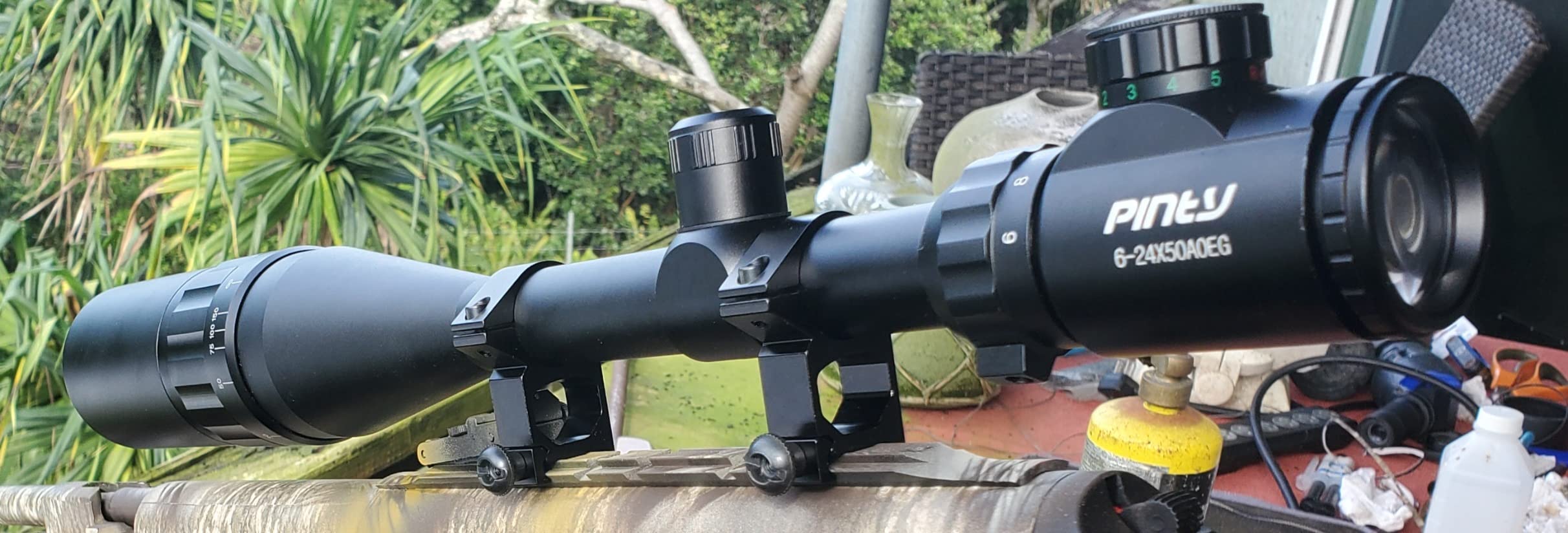
Two practical points stand out. The reticle is etched on glass, so it stays usable with no battery at all, which matters on a hunt that starts before dawn. And the box is complete, with dual one inch high profile rings, a CR2032 battery, lens covers, a cleaning cloth and an Allen wrench, so nothing else needs buying before the rifle is ready to shoot.
The 50mm objective gathers useful light for morning and evening shooting, and the 6x floor handles a close shot without any adjustment. Owners also report that the zero holds well when the scope is mounted on a rigid rail with proper rings, which is the correct way to mount it.
Who this scope fits?
This is the pick for a first rifle scope of any kind, and for shooters who work at 100 to 500 yards. The built-in rangefinder in the reticle gives a beginner a way to learn range estimation without a laser, and the SFP layout keeps the reticle a constant thickness so the aiming point is easy to find at 6x.
It is also a good second rifle optic, an air rifle or shotgun companion, and a low-risk purchase for a family member who wants to get into shooting without a significant commitment.
Where it falls short?
Long range shooters report the image gets fuzzy and dark above roughly 18x, which is a hard ceiling on practical use for this optic. The parallax adjustment sits at the objective end, is hard to turn, and can be knocked out of position by the flip-up lens covers, which is an annoying detail to live with.
Because the reticle is second focal plane with a rangefinder layout, the zero only holds at one magnification and the hashmarks can be confusing if you are used to a first focal plane tree. The 16 inch body and 50mm objective also add length and weight, and the included high profile rings are often replaced with better mounts for easier zeroing. A few units arrive with turret indexing or zero retention defects. For 500 yard work with better headroom, choose the SIG Sauer Tango-SPR instead.
We earn a commission, at no additional cost to you. CERTAIN CONTENT THAT APPEARS ON THIS SITE COMES FROM AMAZON. THIS CONTENT IS PROVIDED 'AS IS' AND IS SUBJECT TO CHANGE OR REMOVAL AT ANY TIME.
How to Mount, Level and Zero a New Long Range Scope?
Most disappointing first shots are installation problems, not optic problems. A scope that is not levelled, not torqued properly or not centred in its rings will never track the way the manufacturer intended, and no amount of long range glass fixes a cant error. Budget an afternoon for the install and an hour at the range.
Start with rings. Choose a ring height that puts the scope low enough for a comfortable cheek weld but high enough that the objective bell clears the barrel and the bolt handle or throw lever at full magnification. This is where the 34mm and 56mm scopes in this roundup earn their keep and also where they cause fitment problems, so measure the total scope length against the gap between your receiver and the front ring position before you commit.
Torque the ring screws with a torque wrench, not a screwdriver, and stay within the ring manufacturer’s specified range, which is commonly between 15 and 25 inch-pounds. Over-torquing twists the tube and can ruin point of impact in ways that look like a bad scope. If you are starting from nothing, spend a modest share of your scope budget on good rings and mounts, because a precision optic on cheap rings is a waste.
Set eye relief next. With the rifle supported, find the position where the full reticle is visible with a comfortable cheek weld and roughly a thumb’s width of space behind the ocular lens. Then set the turrets to their firing position, usually marked with a dot, and confirm the turrets return to zero consistently when you push them forward against the stop.
Zero in two stages. Start at 25 yards to get the bore axis lined up with the line of sight, which is faster to correct than a full 100 yard shot. Then move to 100 yards and set your final zero, firing three to five shots to confirm it holds. Verify the turrets come back to the same zero afterwards, which is the real test of whether the zero stop is doing its job. If you want to carry the rifle in a case between shoots, a proper rifle case protects the zero far better than a soft sleeve.
Frequently Asked Questions
What scope do I need for shooting 1000 yards?
For 1000 yard work you want a scope with a first focal plane reticle, a zero stop and enough total internal adjustment to dial the drop. In this roundup the Vortex Venom 5-25×56 stands out with 85 MOA of travel on a 34mm tube, and the Vortex Strike Eagle 5-25×56 delivers similar power in a lighter 1.9 lb body. A 5x to 25x or 6x to 24x power range is a sensible starting point.
What magnification is needed to shoot 1000 yards?
Most shooters reach for somewhere between 20x and 25x at 1000 yards, and 6x to 24x or 5x to 25x covers that comfortably. Be honest about the ceiling though: 25x and above magnifies mirage, heat shimmer, heartbeat and breathing along with the target, and many shooters find most of their shots come together around 12x to 20x. Buy for the power you will use most and treat maximum magnification as an option rather than a destination.
Is a 6-24x scope enough for long range shooting?
Yes for most recreational long range shooting. A 6-24×50 is one of the most popular long range configurations because the 50mm objective gathers good light without making the scope too heavy or too tall on the rings. It handles 500 yard work very well and reaches 800 yards in decent conditions. For 1000 yard dialing, a 34mm tube with 85 MOA or more of travel is the stronger choice.
Which is better for long range shooting, FFP or SFP?
First focal plane is better for precision because the reticle subtensions stay true at every magnification, so holdovers and ranging work at any power. Second focal plane is better for general hunting because the reticle keeps a constant thickness and stays easy to read at low magnification. Long range forum consensus leans FFP for anything involving holdovers or match shooting, and SFP when fast target acquisition matters more than subtension accuracy.
Do snipers prefer FFP or SFP?
Precision and long range shooters overwhelmingly prefer first focal plane, and the reason is arithmetic rather than preference. With an FFP reticle, the spacing between hashmarks measures the same amount of MOA whether the scope is on 6x or 24x, which is what makes holdovers and MIL ranging work. Second focal plane scopes are still common on hunting rifles and bolt actions where a clean, visible reticle at low power is the priority.
What scope should I use for 500 yard shooting?
At 500 yards you rarely need more than about 20x, so a 6-24×50 is the classic answer and the SIG SAUER Tango-SPR 6-24x52mm is a strong pick for it with a zero-stop elevation dial, side focus parallax and a factory-installed mount. If you want first focal plane capability at that distance, the Monstrum G3 6-24×50 and the Monstrum Hornet both give you a true MOA reticle with holdovers that stay accurate at every power.
Final Verdict for Long Range Shooting in 2026
The best rifle scopes for long range shooting in 2026 come down to what you are actually going to shoot. Our overall pick is the CVLIFE 6-24×50 AO, because a 4.4 rating backed by 9483 owner reviews is the most proven result in this roundup, and its 1.4 lb body, 50mm objective and rings-in-the-box package make it the lowest-risk place to start.
For precision work, the Vortex Strike Eagle 5-25×56 is the one we would build a rifle around. It pairs a 34mm tube for extra elevation headroom, a first focal plane etched MOA reticle, locking turrets and a RevStop zero, at 1.9 lb and a 4.9 average from 663 ratings. The Vortex Venom 5-25×56 is the answer when maximum travel and a 56mm objective matter more than weight, and the Viper PST Gen II 5-25×50 is the finest mechanical feel at the top of the power range.
Match shooters working in MIL should start with the Athlon Argos BTR Gen 2, and anyone building a first precision setup on a budget should look hard at the Monstrum Hornet, which puts a first focal plane reticle, a zero stop, levelled rings and a throw lever in one box. Whichever you pick, mount it level, torque the rings with a wrench, zero at 25 and then at 100 yards, and confirm the turrets come back to zero before you walk out to a thousand.