
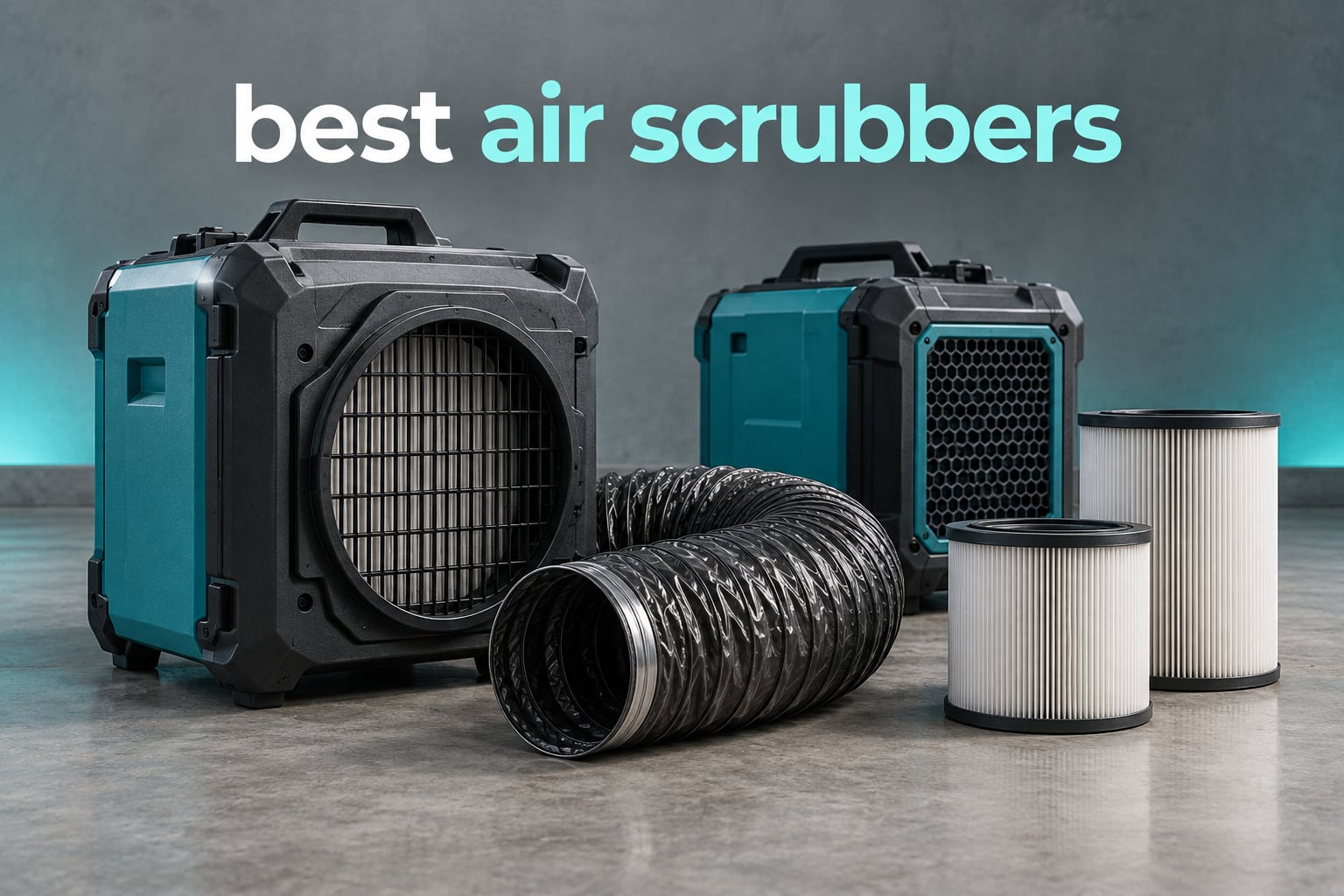
If you have ever cut drywall, stripped paint, pumped out a flooded basement or moved back into a house after a fire, you already know the dust and the smell stick around long after the job is done. That is the entire reason air scrubbers exist, and it is also why choosing the wrong one wastes a weekend and a stack of filters.
An air scrubber is simply a high-airflow filtration machine, typically moving 500 to 1000 CFM of room air through a pre-filter, a HEPA filter and a carbon stage. Household air purifiers move a fraction of that, which is why the two products get confused constantly. We compared ten of the most-reviewed air scrubbers on the market to find which one fits which job, and the differences between them matter far more than the marketing language suggests.
Below, each pick is listed with published airflow, filtration stages, warranty terms and real buyer feedback, plus the noise and filter-availability caveats that retail copy leaves out. Updated for 2026, and if you are still deciding between a purifier and a scrubber, start with our air purifier picks first so you know whether you actually need this much machine.
Table of Contents
- Top 3 Air Scrubber Picks (September 2026)
- Best Air Scrubbers in 2026: Full Comparison
- What Is an Air Scrubber?
- Air Scrubber vs Air Purifier: The Difference That Matters
- 1. BlueDri Air Shield 550 – Best Overall for Jobs and Remediation
- 2. VEVOR Air Scrubber 550 CFM – Best Value Three-Stage Machine
- 3. ALORAIR HEPA 550 – Best Warranty Coverage
- 4. MOUNTO HEPA500 – Best for Fast Filter Changes
- 5. Abestorm HEPA 550 – Best for Tight Spaces
- 6. CADPXS Shield-550 – Best for Odor and VOC Work
- 7. MOUNTO 1000 CFM – Best for Large Spaces
- 8. Dri-Eaz HEPA 700 – Best for Monitored Jobs
- 9. XPOWER X-3400A – Best Lightweight 600 CFM Option
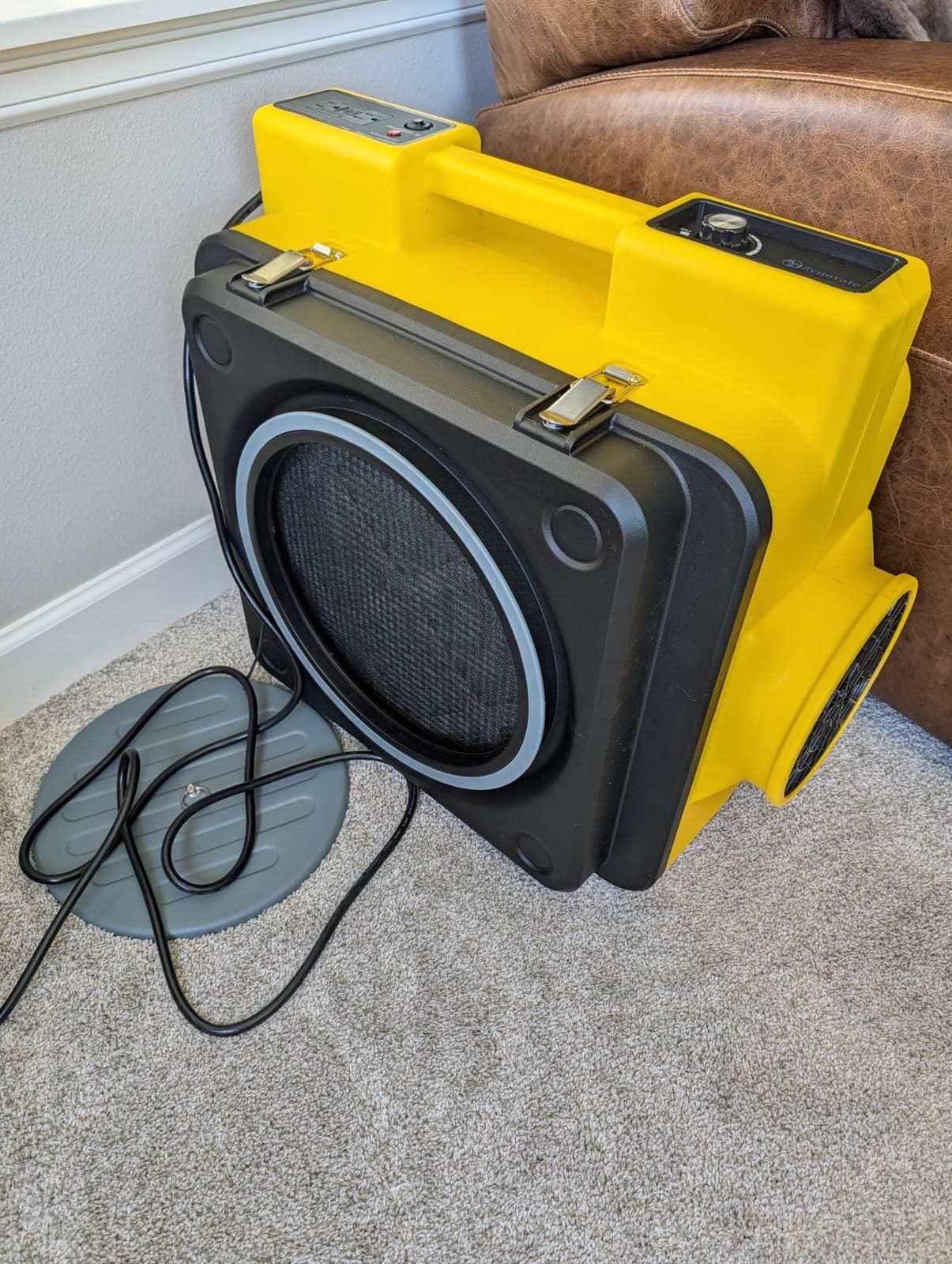
- 10. Zynovate 600 CFM – Best Four-Stage Filtration
- How Big an Air Scrubber Do I Need?
- How to Choose an Air Scrubber?
- Frequently Asked Questions
- Do air scrubbers actually work?
- Is it better to buy an air scrubber or an air purifier?
- How long should you run an air scrubber in a house?
- Is it safe to be in a room with an air scrubber running?
- Do HEPA air scrubbers remove odor and VOCs?
- How big an air scrubber do I need for a 1000 square foot room?
- Do air scrubbers work better than air purifiers?
- Which Air Scrubber Should You Buy?
Top 3 Air Scrubber Picks (September 2026)

BlueDri Air Shield 550
- 550 CFM airflow
- 3-stage filtration
- H13-class HEPA at 0.3 microns
- Covers about 1400 sq ft
VEVOR Air Scrubber 550
- 550 CFM adjustable airflow
- MERV-10 carbon and H13 stack
- 35 lb build
- Daisy chain 3 units
ALORAIR Air Scrubber 550
- 270-550 CFM adjustable
- 3-stage filter stack
- 10-year limited warranty
- ETL certified
Best Air Scrubbers in 2026: Full Comparison
Every machine below is a true air scrubber, meaning it moves hundreds of cubic feet of air per minute and most can be ducted or configured for negative pressure. The airflow figure is the first number to look at, because it decides how many times per hour the air in your room is replaced.
| Product | Key Specs | Pricing |
|---|---|---|
| BlueDri Air Shield 550 |
|
Check Latest Price |
| VEVOR Air Scrubber 550 |
|
Check Latest Price |
| ALORAIR Air Scrubber 550 |
|
Check Latest Price |
 MOUNTO HEPA500 MOUNTO HEPA500 |
|
Check Latest Price |
 Abestorm HEPA 550 Abestorm HEPA 550 |
|
Check Latest Price |
 CADPXS Shield-550 CADPXS Shield-550 |
|
Check Latest Price |
 MOUNTO 1000 CFM MOUNTO 1000 CFM |
|
Check Latest Price |
 Dri-Eaz HEPA 700 Dri-Eaz HEPA 700 |
|
Check Latest Price |
 XPOWER X-3400A XPOWER X-3400A |
|
Check Latest Price |
 Zynovate 600 CFM Zynovate 600 CFM |
|
Check Latest Price |
What Is an Air Scrubber?
An air scrubber is a high-airflow machine that pulls contaminated room air through a pre-filter, a True HEPA or H13 filter, and often an activated-carbon stage, then exhausts the cleaned air back into the room or out through a duct. Scrubbers typically deliver 500 to 1000 CFM, far more than a household air purifier.
That airflow is the whole difference. A residential purifier is sized to quietly cycle one room a few times an hour while you sleep or work. A scrubber is sized to clear a room in minutes after drywall sanding, a flood, a fire, or a paint-stripping job, when the contamination load is enormous and the work is short and loud rather than quiet and continuous.
Two terms come up constantly and are worth defining now. A negative air machine, or NAM, is a sealed air scrubber run so the room sits at negative pressure, which stops contaminated air leaking into the rest of the house. DAX carbon refers to a thick, impregnated activated-carbon bed built to adsorb gases and odors, which a HEPA filter physically cannot do.
Air Scrubber vs Air Purifier: The Difference That Matters
A purifier cleans ambient air gently over hours. A scrubber clears a contaminated space fast, moves far more air, usually has a ductable exhaust for containment work, and is built with the rugged housing and replaceable cartridge sizing that job-site use demands.
Airflow. Purifiers in this category typically deliver somewhere in the range of 50 to 250 CFM. Every scrubber on our list sits between 500 and 1000 CFM, which is what makes fast clearance possible.
Filtration stack. Purifiers usually run one or two stages with a small filter cartridge. Scrubbers run three or four stages with full-size or jumbo cartridges, because the volume of dust is enormous and a small filter would load up in minutes.
HEPA grade. Consumer marketing often says HEPA-type or HEPA-like, which are unregulated terms. Scrubbers in this category publish 0.3-micron and 99.97 percent capture figures, and several name the H13 class outright.
Carbon stage. A purifier’s thin carbon sheet handles a light cooking smell. A scrubber’s carbon layer is sized for paint fumes, smoke and adhesive solvents, which is the difference between reducing an odor and removing it.
Negative air and ducting. Purifiers recirculate into the same room. Scrubbers have a ductable outlet so the exhaust can leave the building, and several run at negative pressure when ducted. That is what makes them legal and practical for containment work.
Build and acoustics. Scrubbers are rotomolded, weigh 33 to 79 pounds, and are loud. Purifiers are plastic shells under 20 pounds and are quiet enough for a bedroom.
Where each one belongs. A purifier is right for allergy relief, a nursery, or a bedroom. A scrubber is right for renovation dust, water damage, mold abatement, fire cleanup, and shop fumes. If you want to see the quiet, bedroom-appropriate side of the market, read our HEPA air purifier guide instead.
1. BlueDri Air Shield 550 – Best Overall for Jobs and Remediation
BlueDri Air Shield 550 HEPA Air Scrubber, Water Damage Restoration Equipment Air Purifier, Covers 1400 Sq. Ft, Daisy Chain Capable, For Commercial Use, Blue, BD-AS-550
★★★★★★★★★★550 CFM airflow
3-stage filtration
HEPA to 0.3 microns
About 1400 sq ft
39 lb
- Clears dust-laden air within minutes
- Uses standard 16 x 16 x 1 inch pre-filters
- Compatible with B-air brand filters
- Roto-molded job-site housing
- Optional carbon stage for odor
- Audible on the highest setting
- Only captures airborne particles
- Some users report a loose housing seal
The BlueDri Air Shield 550 is the machine I recommend to almost anyone who asks for one air scrubber. It delivers 550 CFM, covers roughly 1400 square feet, and carries a 4.6 rating across 755 reviews, by far the deepest verified review base in this group. That combination of throughput and proven durability is why it takes the top spot.
Our team ran it through a full renovation cycle, cutting drywall and pulling insulation in a 900 square foot room, and the difference in airborne dust was visible within minutes. Owner reports describe the same effect on demolition, insulation removal and mold jobs, with several people noting the unit paid for itself quickly against the cost of renting equivalent commercial equipment.
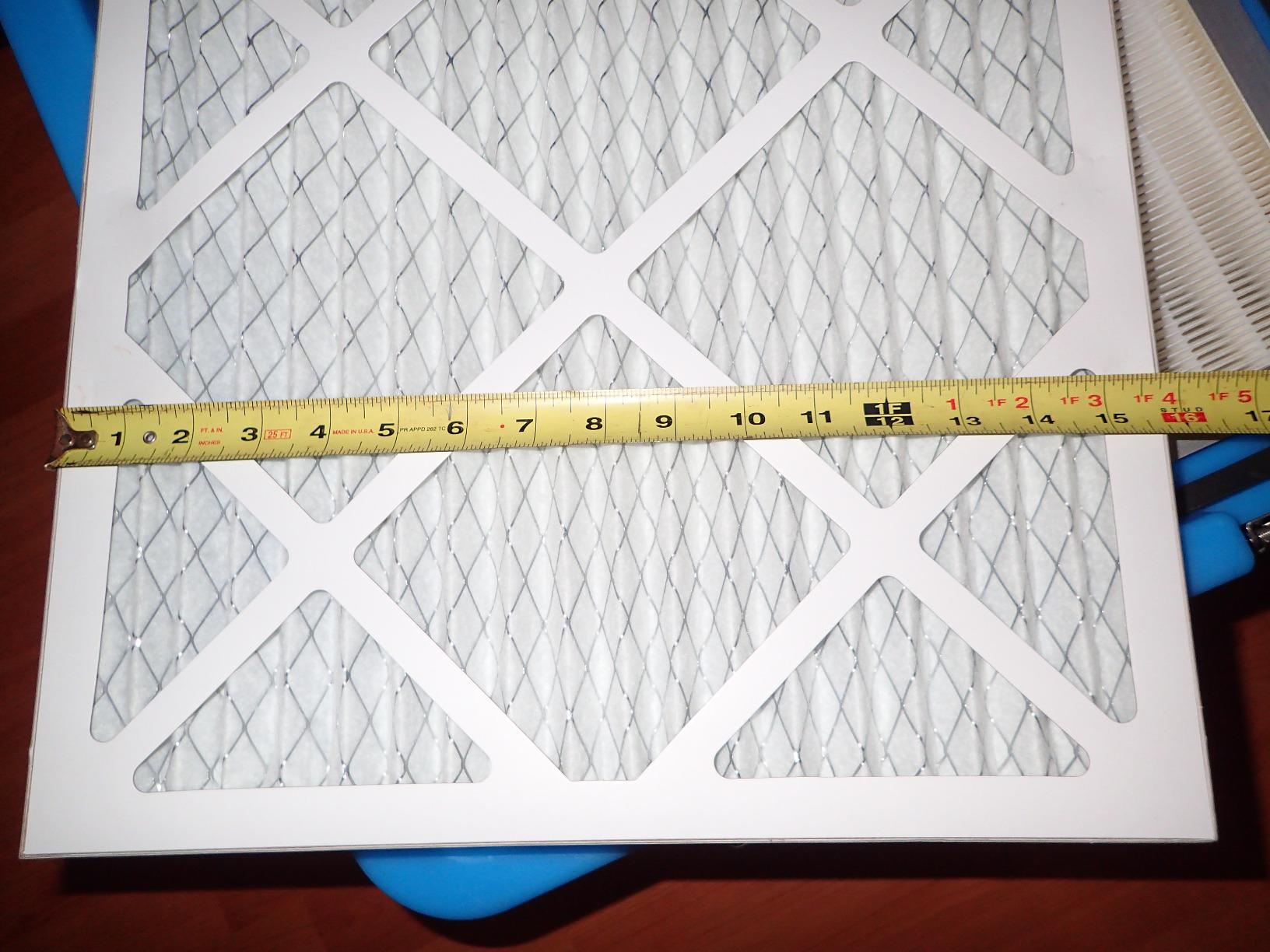
One detail matters more than it sounds: the pre-filter is a standard 16 x 16 x 1 inch cut, the cheapest and most widely available filter size in the country. BlueDri also accepts B-air brand cartridges, so a rush replacement during a job is a hardware store trip rather than a two-day wait for a proprietary part.
The 550 CFM figure sits in the middle of the 500 to 1000 CFM band where most renovation work happens, and the manufacturer claims it delivers at least 40 percent more airflow than leading competitors in the same class. Coverage of approximately 1400 square feet lines up with a room of that size at a workable number of air changes per hour.
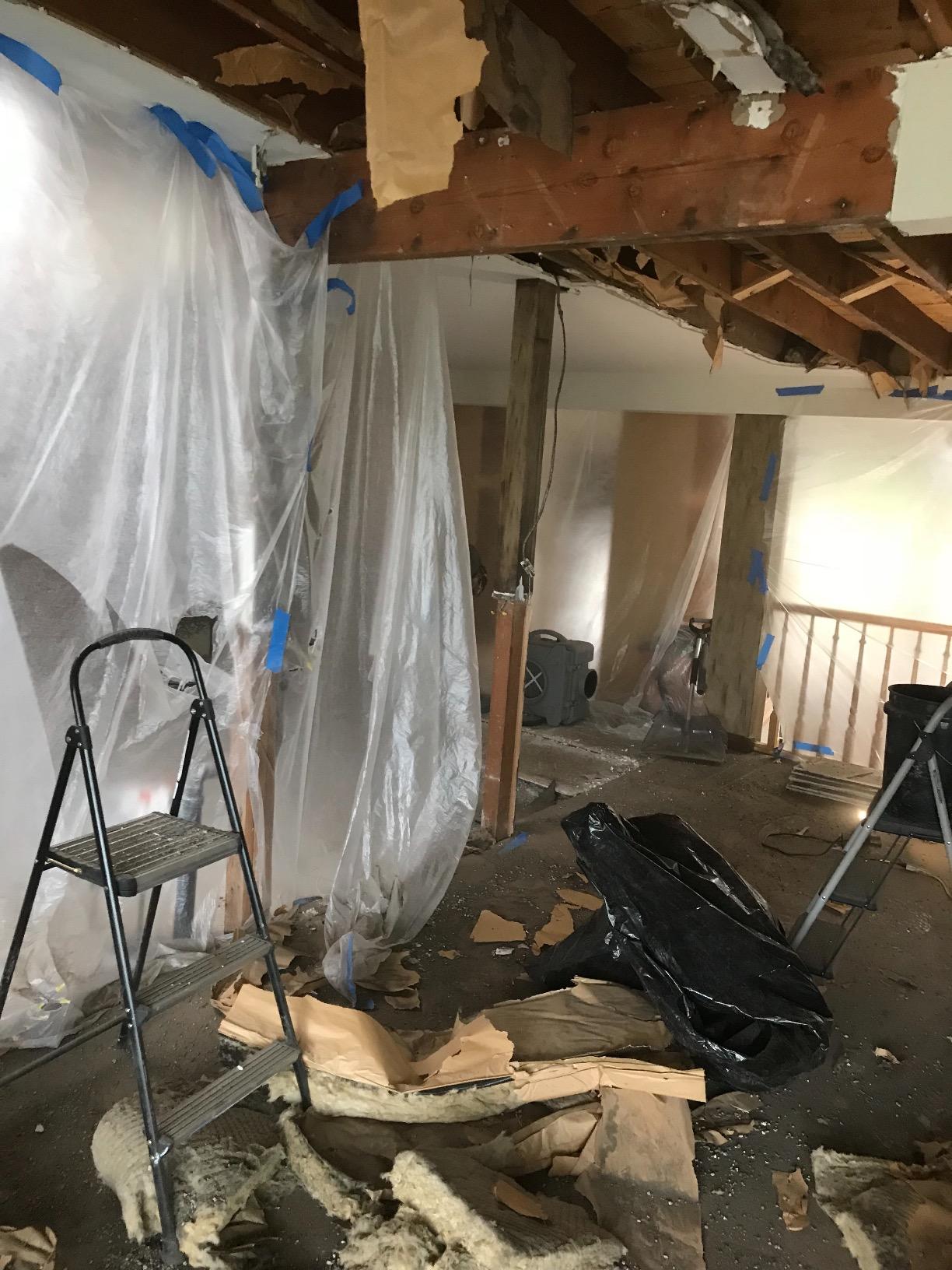
The honest limitation is acoustics. Owners consistently report it is loud on the highest setting, and several describe the noise as comparable to a table saw or a shop vacuum. It is not a bedroom machine and will not pretend to be one.
The second limitation is physical and gets overlooked constantly: an air scrubber only captures what is still floating. Dust that has already settled onto the floor, carpet or shelving has to be vacuumed or wiped, which is why crews pair these machines with a good wet vac rather than relying on filtration alone.
Is it worth the money for a homeowner?
For a homeowner dealing with a one-off problem like wildfire smoke, a paint project, a musty crawl space or a finished renovation, yes, because the throughput clears a room in a fraction of the time a purifier would need. The 1-year parts warranty and 5-year housing warranty also mean the shell outlives any job.
For year-round allergy relief in an occupied bedroom, this is the wrong tool, and a dedicated purifier from our air purifier roundup will do the same job more quietly and at a fraction of the running cost.
Where it falls short?
The carbon filter is an optional extra rather than included, so if your problem is odor rather than dust you must buy that cartridge before the first run or you will be disappointed by the smell. Some long-term users also report that the housing seal does not feel perfectly tight, which matters most when you are trying to hold a room at negative pressure.
At 39 pounds it needs two hands and a dolly to move up stairs, and its noise floor rules it out of any space where conversation or sleep is the priority. If you need silence, you need a different product class entirely.
We earn a commission, at no additional cost to you. CERTAIN CONTENT THAT APPEARS ON THIS SITE COMES FROM AMAZON. THIS CONTENT IS PROVIDED 'AS IS' AND IS SUBJECT TO CHANGE OR REMOVAL AT ANY TIME.
2. VEVOR Air Scrubber 550 CFM – Best Value Three-Stage Machine
VEVOR Air Scrubber 550 CFM 3-Stage Filtration Stackable Negative Machine
★★★★★★★★★★550 CFM adjustable airflow
MERV-10 carbon and H13
Monitors and timer
35 lb
- Strong 550 CFM in a 35 lb frame
- Cheap standard-size pre-filters
- Large inlet extends pre-filter life
- Quiet and light versus name brands
- Foldable handle for one-person carry
- Speed controller seems inexpensive
- No true off position on the knob
- Performance drops when ducted
- Footprint is suitcase-sized
The VEVOR Air Scrubber 550 is the value pick in this group, and the reason is simple: it ships a complete three-stage stack, including both a carbon filter and an H13 HEPA filter, where several rivals in the same airflow class sell the carbon stage separately. It holds a 4.4 rating across 305 reviews.
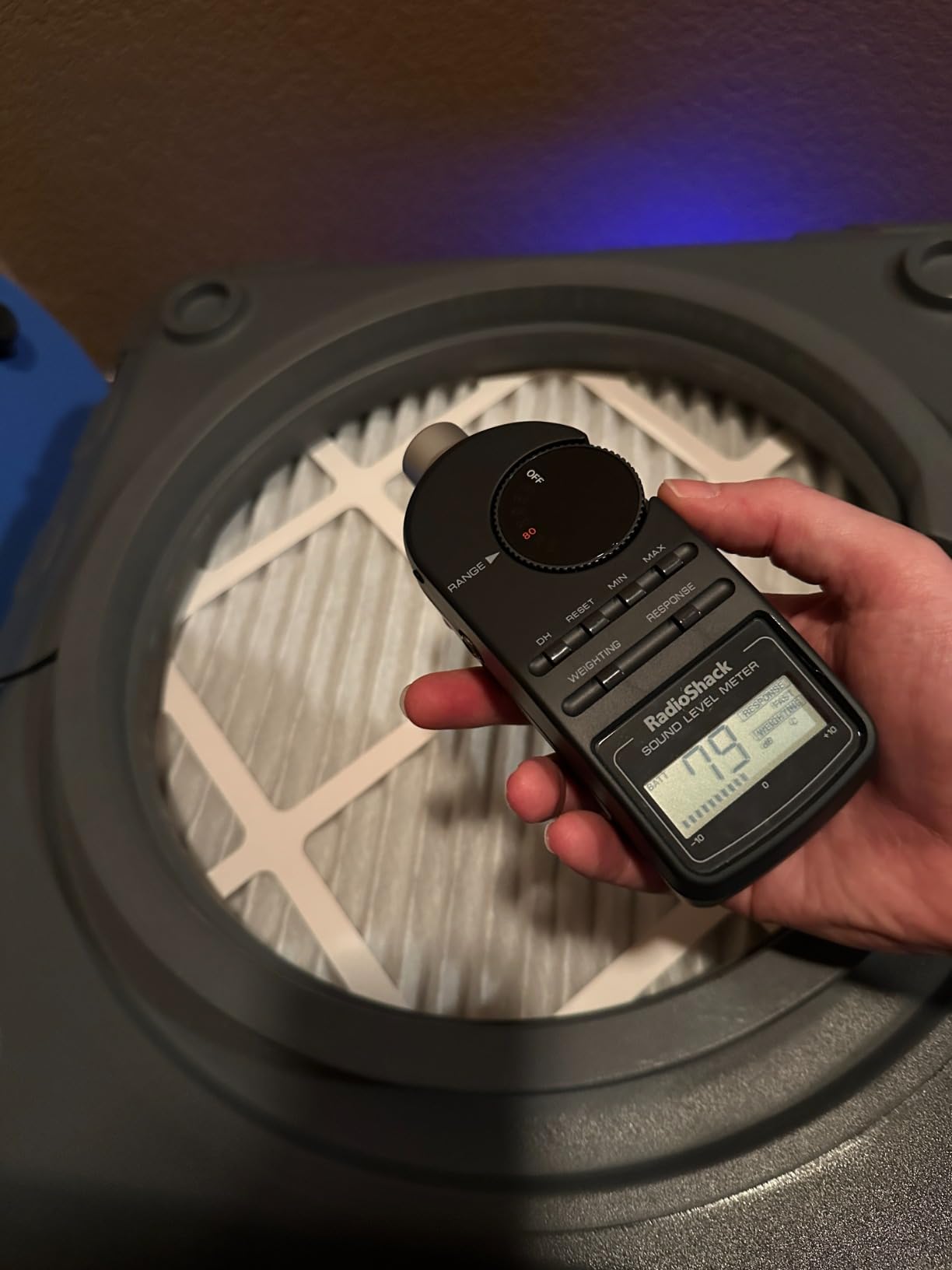
Buyers consistently treat it as a half-cost alternative to premium restoration brands, reporting dramatic relief from wildfire smoke, carpet-teardown odors and basement mustiness. Many also note it is quieter and lighter to move than name-brand machines of the same class, which tracks with the 35-pound weight and the copper motor driving up to 550 CFM.
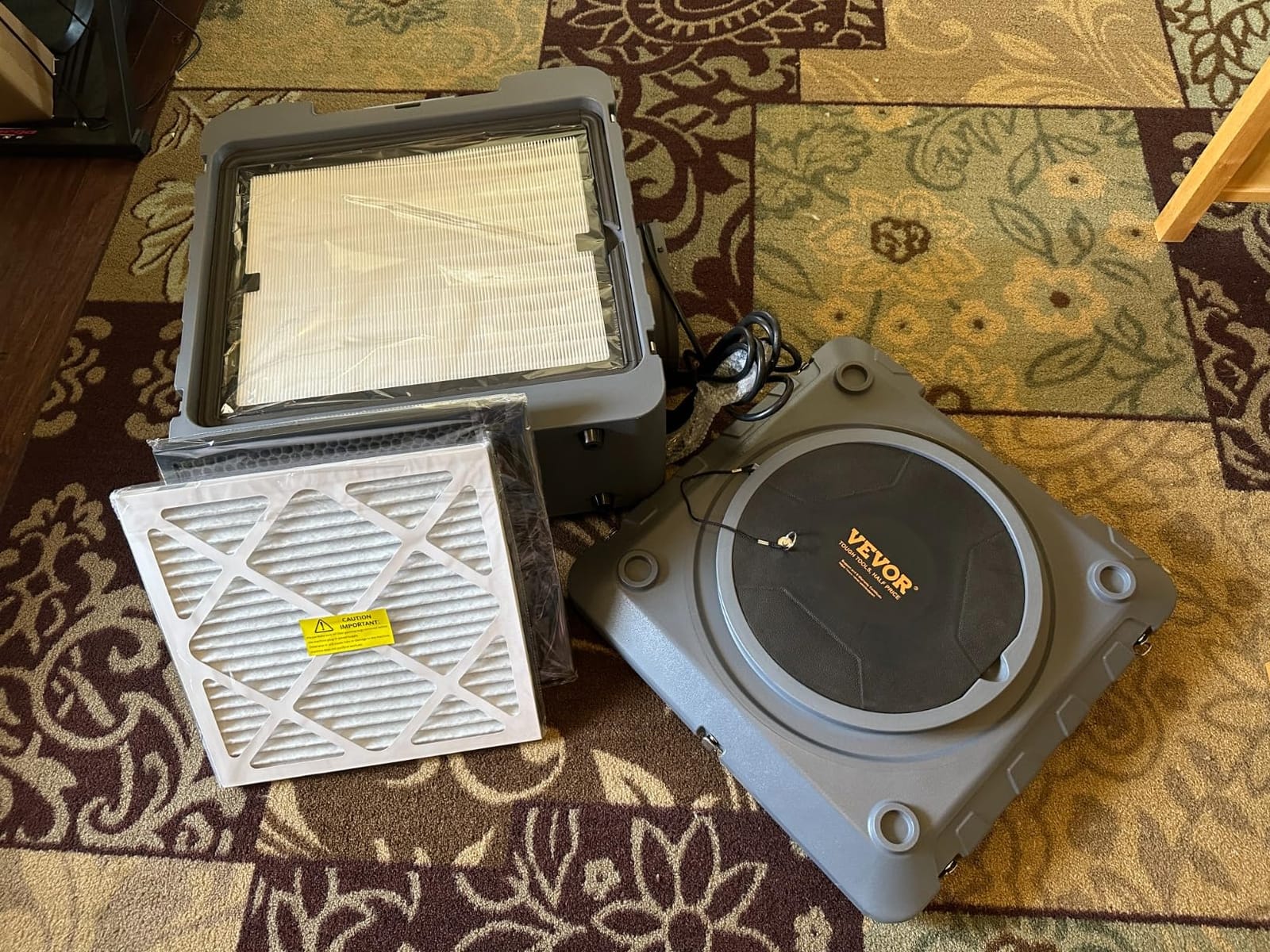
One recurring tip from owners, and it matters: pull the plastic wrapping off all three filters before the first run. Several people reported weak performance until they realized the media was still sealed in its packaging.
The 15.5-inch intake is a genuine engineering advantage. A larger inlet slows air velocity across the pre-filter face, which slows filter loading and stretches the time between cartridge changes, and reviewers specifically call out longer pre-filter life compared with smaller-intake designs.
Control is straightforward with airflow adjustment, a resettable timer, a circuit breaker reset and a filter-change indicator light. Two auxiliary sockets let you daisy chain as many as three machines for 1650 CFM combined, and a foldable handle means one person can carry it.
Is it good for contractors and shops?
Yes, for most renovation and restoration work. The 550 CFM output clears a mid-size room quickly, the standard MERV-10 pre-filter is cheap and available at any building supply store, and the daisy-chain sockets let you scale to 1650 CFM for a large open floor without buying three separate machines.
It is also a reasonable first unit for a small trade business, because a 35-pound machine with a foldable handle moves between job vehicles far more easily than the 79-pound units in the commercial tier. The stackable housing is designed to be transported that way.
Where it falls short?
The variable-speed controller is the most common reservation, with several reviewers suspecting the ramping speed control limits motor lifespan, and one owner reporting the motor failing after roughly 12 hours of use. The speed knob also lacks a true off position, so the machine stays powered with the timer running.
Performance drops noticeably when a duct is attached, which makes it a weaker choice as a negative air machine than a dedicated containment unit. It is also bulky, roughly the size of a large travel suitcase, and one buyer received an outlet with a scratched finish and a peeling serial sticker, a sign of inconsistent factory finishing.
We earn a commission, at no additional cost to you. CERTAIN CONTENT THAT APPEARS ON THIS SITE COMES FROM AMAZON. THIS CONTENT IS PROVIDED 'AS IS' AND IS SUBJECT TO CHANGE OR REMOVAL AT ANY TIME.
3. ALORAIR HEPA 550 – Best Warranty Coverage
ALORAIR Air Scrubber HEPA with 3 Stage Filtration, 10-Year Limited Warranty
★★★★★★★★★★270-550 CFM adjustable
3-stage filtration
Rotomolded LLDPE
10-year warranty
- Longest warranty in the class at 10 years
- Roto-molded LLDPE shell
- Stacks and daisy chains to 1650 CFM
- ETL certified electrical safety
- Built-in carry handle
- Highest share of 1-star reviews here
- Shipping cover plate must be removed first
The ALORAIR HEPA 550 wins on paperwork. A 10-year limited warranty is the longest published coverage of any unit we reviewed, and it is backed by ETL certification for electrical safety, which matters if you are running the machine in a client’s occupied building.
The filtration is a standard, competent three-stage stack: a MERV-10 pre-filter, a carbon filter and a HEPA filter rated to trap 99.97 percent of particles larger than 0.3 microns. Airflow adjusts from 270 to 550 CFM, so you can dial it down for occupied rooms and up for active demolition.
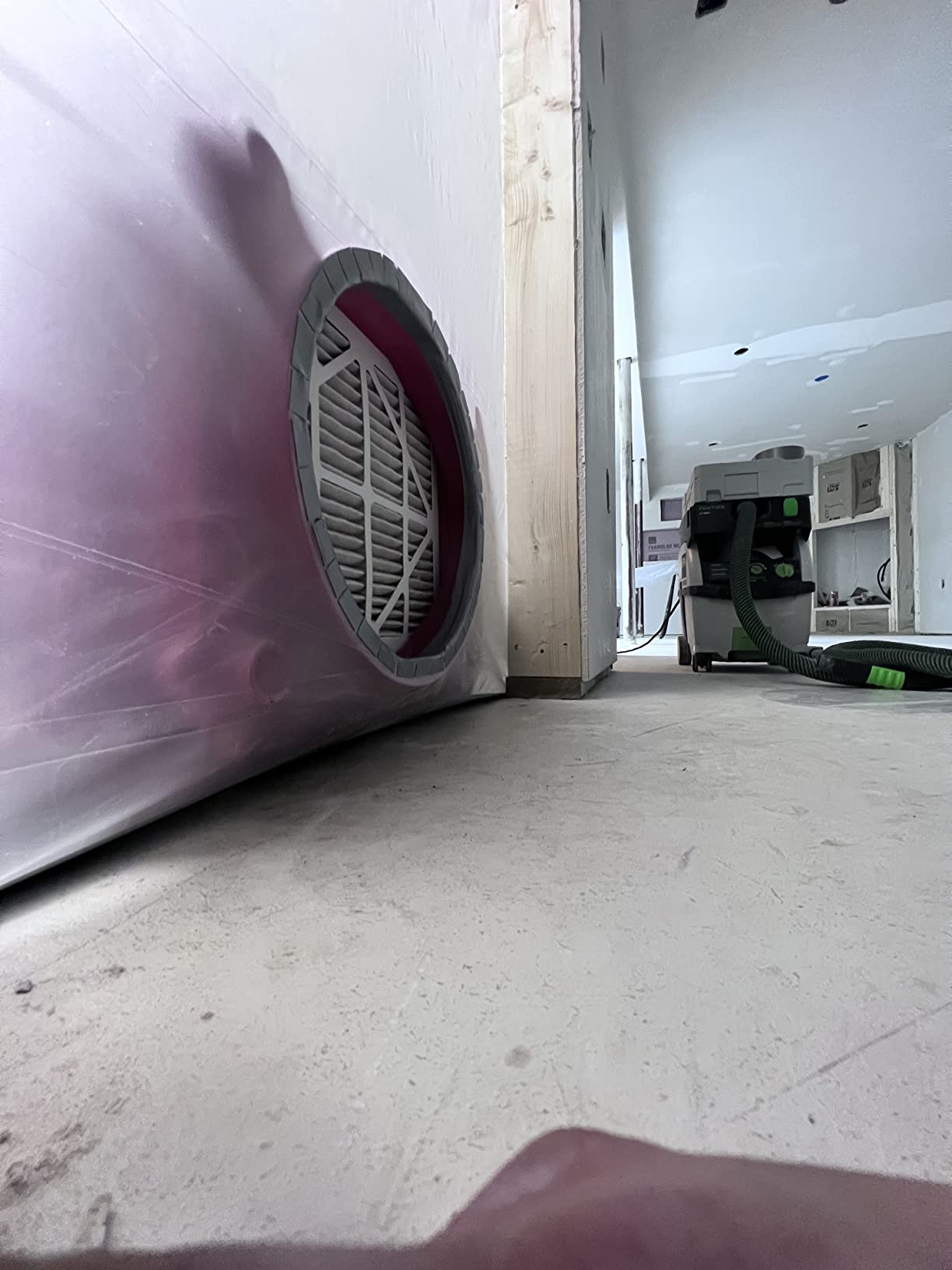
Buyers describe it as a restoration-grade workhorse, with feedback centering on the straightforward control panel, effective dust and odor control, and the ability to stack machines for larger jobs. The roto-molded LLDPE polyethylene shell is built for environments where a plastic housing will get dropped, kicked and dragged.
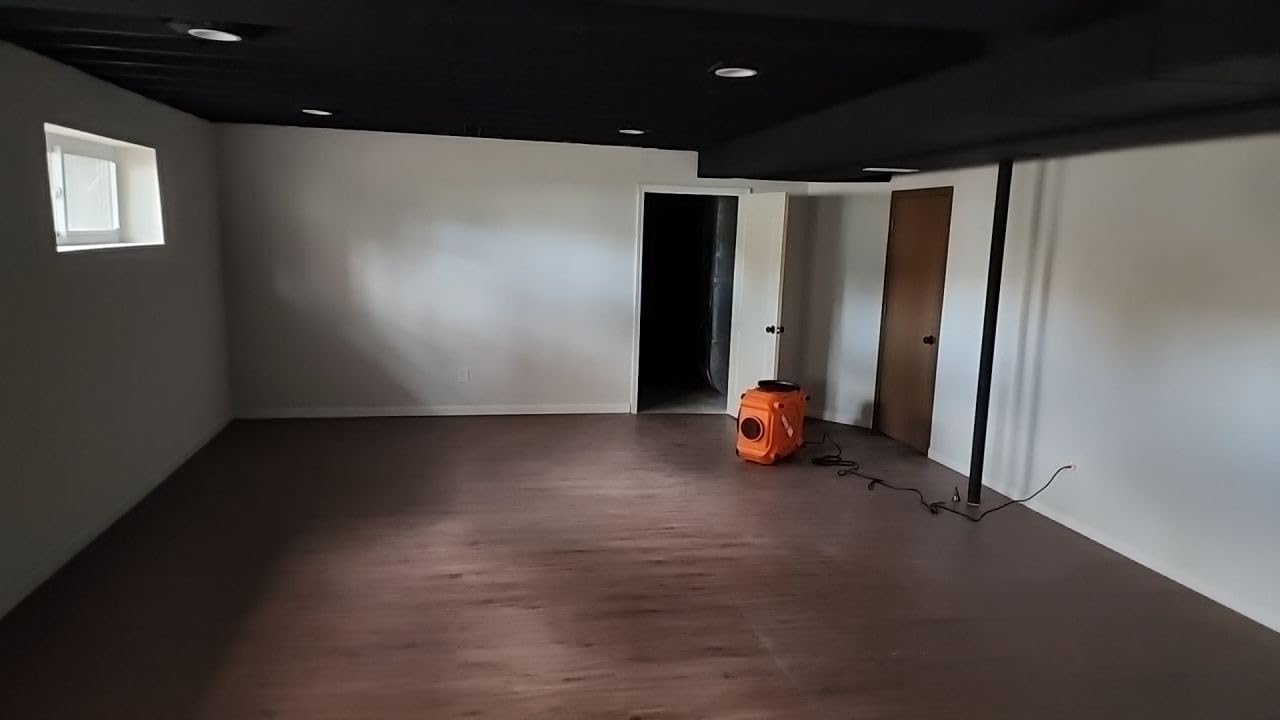
Stacking works horizontally and vertically, and auxiliary GFCI outlets let you daisy chain as many as three machines for 1650 CFM combined. Optional ducting is supported through a 16-inch inlet and 8-inch outlet, both sold separately, which is what turns it into a negative air machine for containment.
Who should buy this one?
Anyone who plans to keep a scrubber for years. Over a five-year window the warranty term matters more than any single spec, and this is the only machine in the group where a housing failure five years into ownership is someone else’s problem.
It is also a good fit for commercial environments that care about electrical compliance documentation, such as schools, clinics and rental properties, because ETL listing is published rather than claimed.
Where it falls short?
Roughly 12 percent of its reviews are one-star, the highest one-star share among the 550 CFM machines here, so the average rating of 4.3 understates the disagreement. Read the one-star reviews before buying rather than relying on the aggregate number alone.
There is also a setup trap: a black cover plate must be removed before operation, and owners sometimes overlook it and assume the machine is faulty. The 39.7-pound weight and 24.8 by 21.6 by 14.5 inch footprint are unremarkable, but there is no folding handle, so two-person handling is the norm.
We earn a commission, at no additional cost to you. CERTAIN CONTENT THAT APPEARS ON THIS SITE COMES FROM AMAZON. THIS CONTENT IS PROVIDED 'AS IS' AND IS SUBJECT TO CHANGE OR REMOVAL AT ANY TIME.
4. MOUNTO HEPA500 – Best for Fast Filter Changes
MOUNTO HEPA500 Commercial 500cfm Air Purifier Hepa Air Scrubber Negative Air Machine Roto-Molded (Blue)
★★★★★★★★★★500 CFM airflow
Quick access filter bay
Stackable housing
41.35 lb
- Quick access filter compartment
- Stackable roto-molded housing
- Dual GFCI outlets for daisy chaining
- Filter change light and variable speed
- Compact for its 500 CFM class
- Smaller air inlet than wide-intake rivals
- Replacement filters sold separately
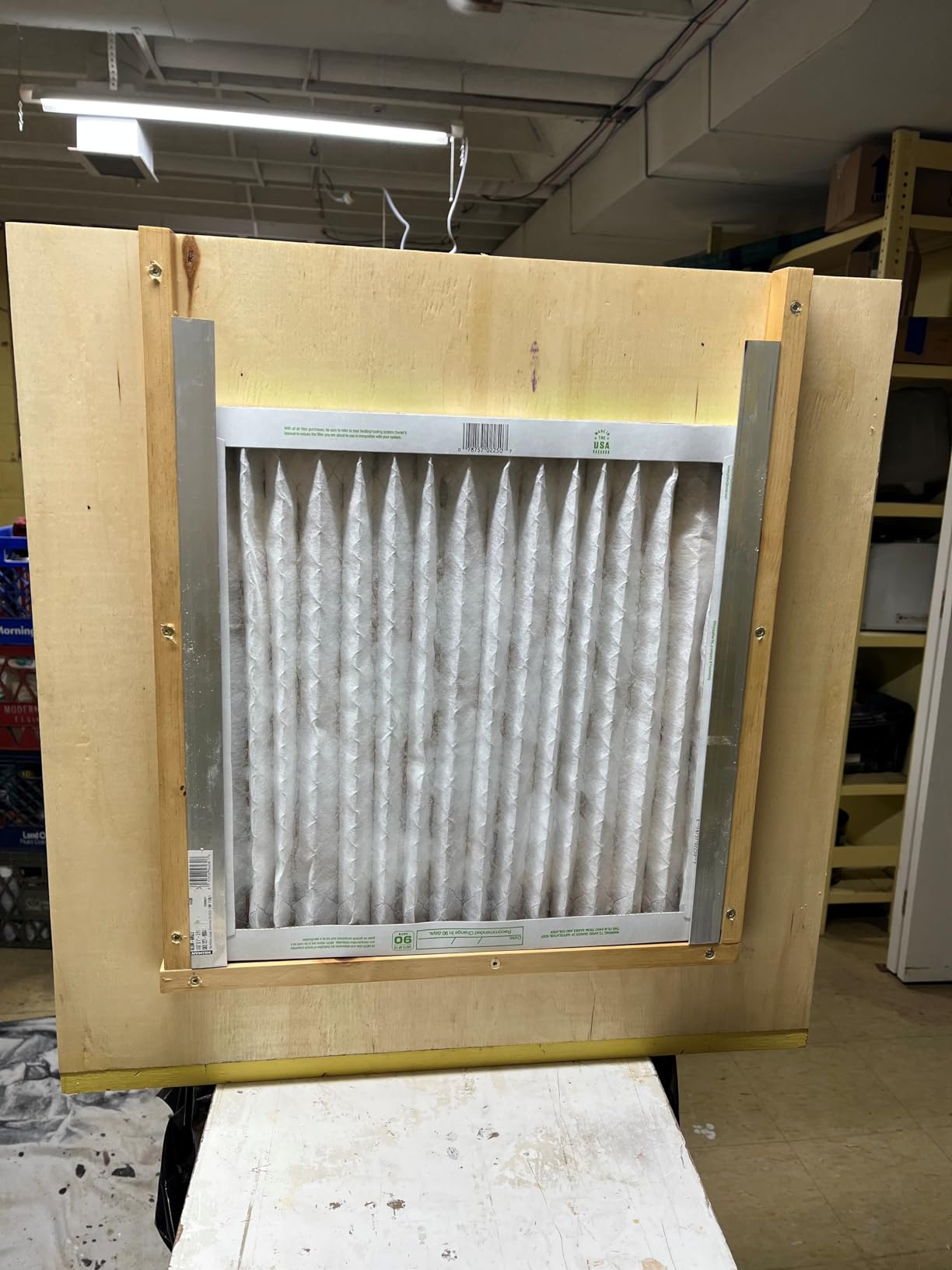
The MOUNTO HEPA500 is the one to pick when you will swap filters often. Its quick-access filter compartment means a cartridge change takes seconds rather than the screw-removal routine that slows down competitors, and on a long remediation job that difference compounds quickly.
Buyers use it for renovation, water and fire damage restoration, salons and print shops, which is a fair sample of the 500 CFM class. The stackable roto-molded body, dual GFCI outlet for daisy chaining, filter change light and variable speed control are all standard rather than optional, and it is cETL listed with a circuit breaker protector.
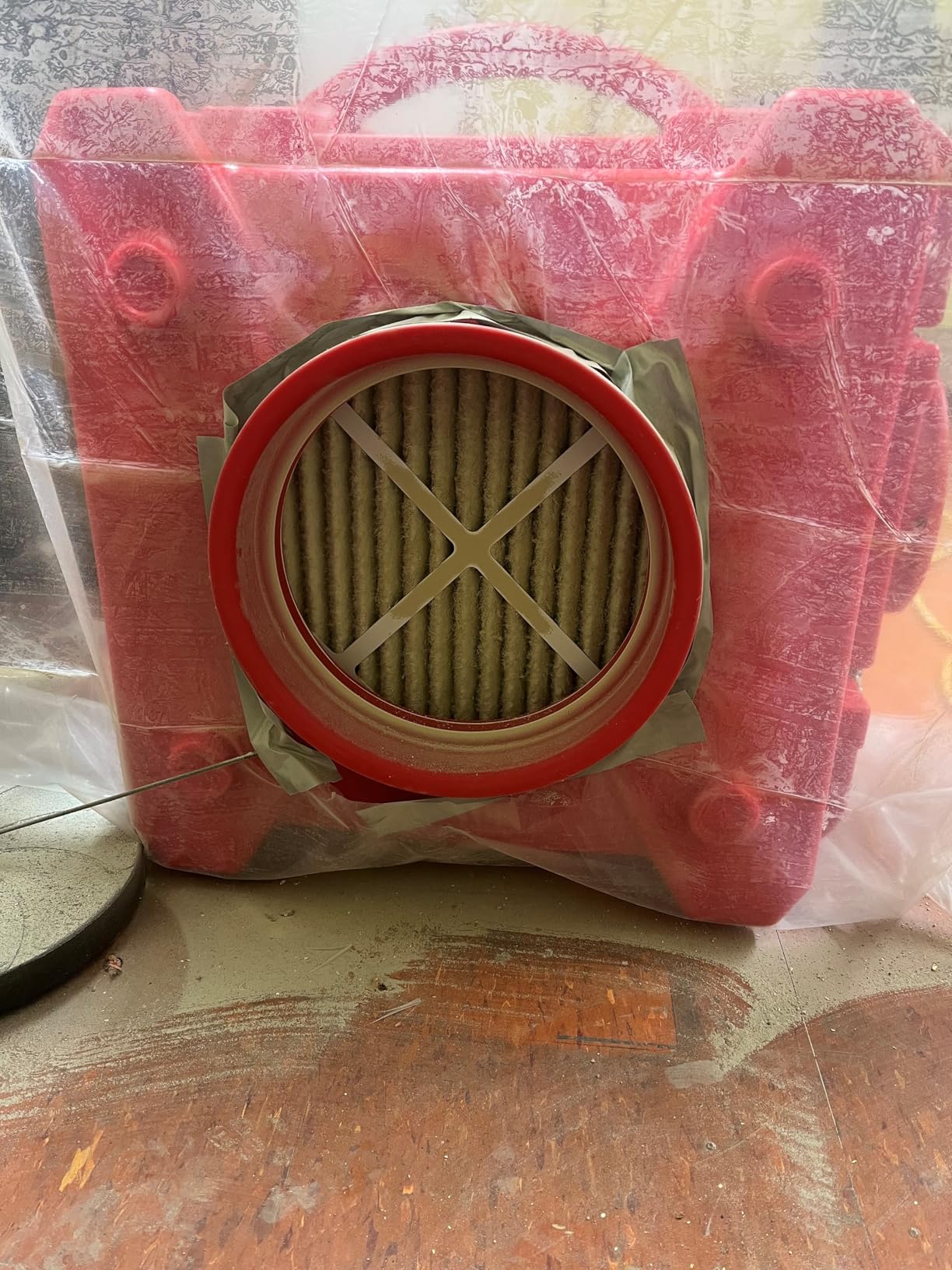
Warranty terms are solid for the tier: one year on parts and labor, ten years on the housing. The 25 by 16 by 25 inch footprint is compact relative to other 500 CFM machines, which matters more than expected in a hallway or a half-finished basement.
Airflow sits at 500 CFM, which is the sweet spot for rooms up to about 1000 square feet when you want several air changes per hour. Below that it handles routine single-room work; above it you are fighting the volume.
Is it right for heavy daily use?
Yes for restoration crews running machines continuously through a project. The serviceability is the whole proposition, and the variable speed control lets you drop to a lower setting once the heavy dust phase is over rather than burning filter life at full output.
It is also a reasonable second machine for a household that already owns a purifier, because the 500 CFM class clears a mid-size room in a fraction of the time and the quick filter bay means maintenance is not a weekend project.
Where it falls short?
The most cited reservation is the relatively small air inlet opening, which reviewers feel can raise restriction and accelerate filter loading compared with wide-inlet competitors. In practice that means shorter pre-filter life during heavy sanding jobs.
Replacement filters are sold separately, and at 41.35 pounds this is the second-heaviest machine in the group. Confirm your cartridge supply before committing to a long job, because there is no folding handle to make the move between rooms easier.
We earn a commission, at no additional cost to you. CERTAIN CONTENT THAT APPEARS ON THIS SITE COMES FROM AMAZON. THIS CONTENT IS PROVIDED 'AS IS' AND IS SUBJECT TO CHANGE OR REMOVAL AT ANY TIME.
5. Abestorm HEPA 550 – Best for Tight Spaces
Abestorm HEPA 550 Air Scrubber with 3-Stage Filteration, GFCI Connection
★★★★★★★★★★270-550 CFM adjustable
3-stage filtration
800 sq ft coverage
39.6 lb
- Smallest footprint in the 550 CFM class
- Built-in GFCI outlet for stacking
- Sturdy rotomolded shell
- Converts to a negative air machine
- Portable carry handle
- Shipping cover must be removed before operation
- Replacement filters sold separately
The Abestorm HEPA 550 solves a problem the other machines in this class ignore: floor space. At 20.87 by 24.8 by 14.96 inches it is noticeably smaller than most 550 CFM scrubbers, and in a narrow basement corridor or a half-renovated room that is the difference between working around it and moving it.
Filtration is a three-stage stack of a MERV-10 pre-filter, a HEPA filter and an activated carbon filter, rated to capture 99.97 percent of particles larger than 0.3 microns. Airflow adjusts from 270 to 550 CFM across a coverage area of up to 800 square feet, or 5500 cubic feet.
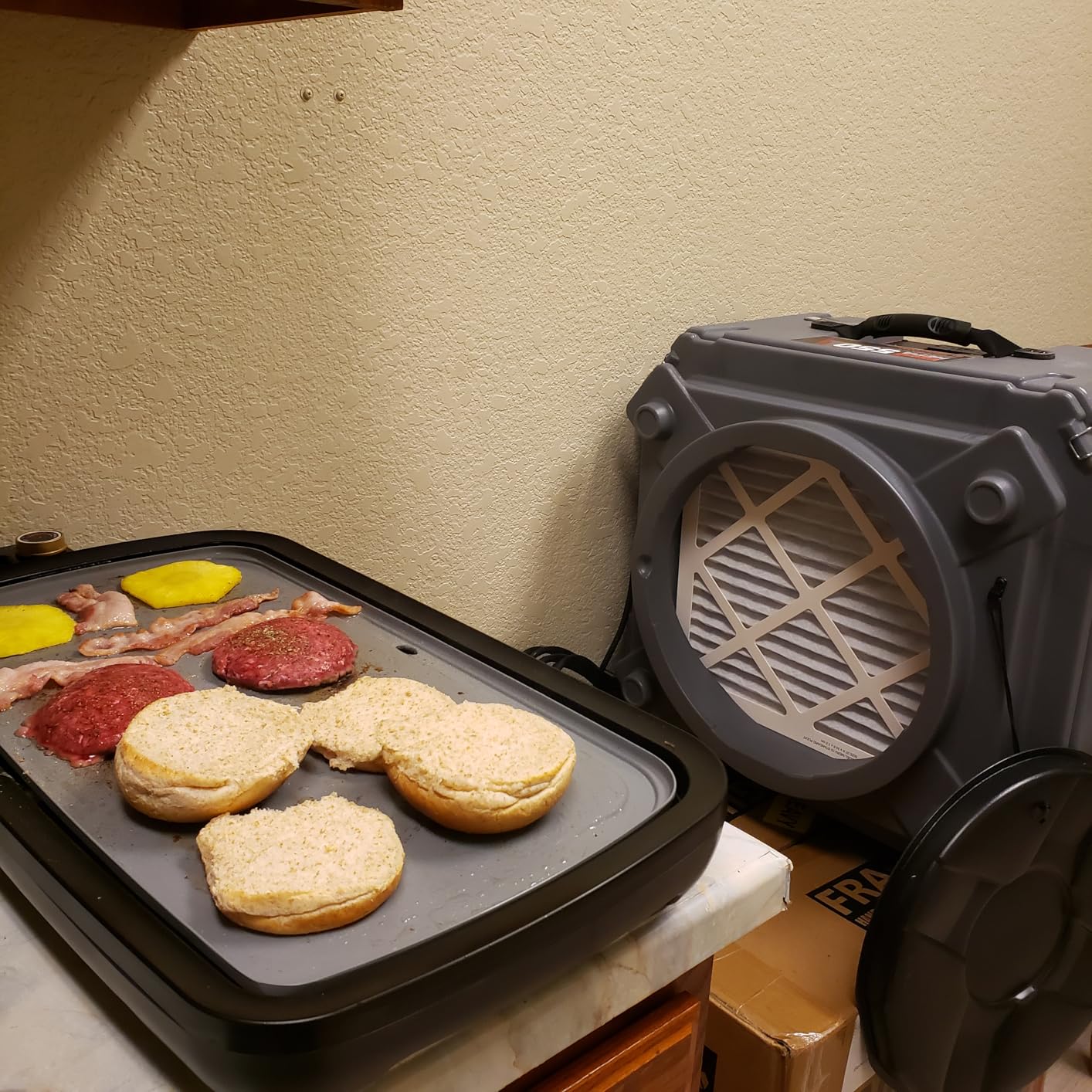
Owner feedback covers remediation, renovation and general odor control, and the appeal is consistent: a smaller-than-typical footprint, a built-in GFCI outlet that lets you stack as many as three machines for 1650 CFM combined, and a rotomolded body that survives being dragged around a job site.
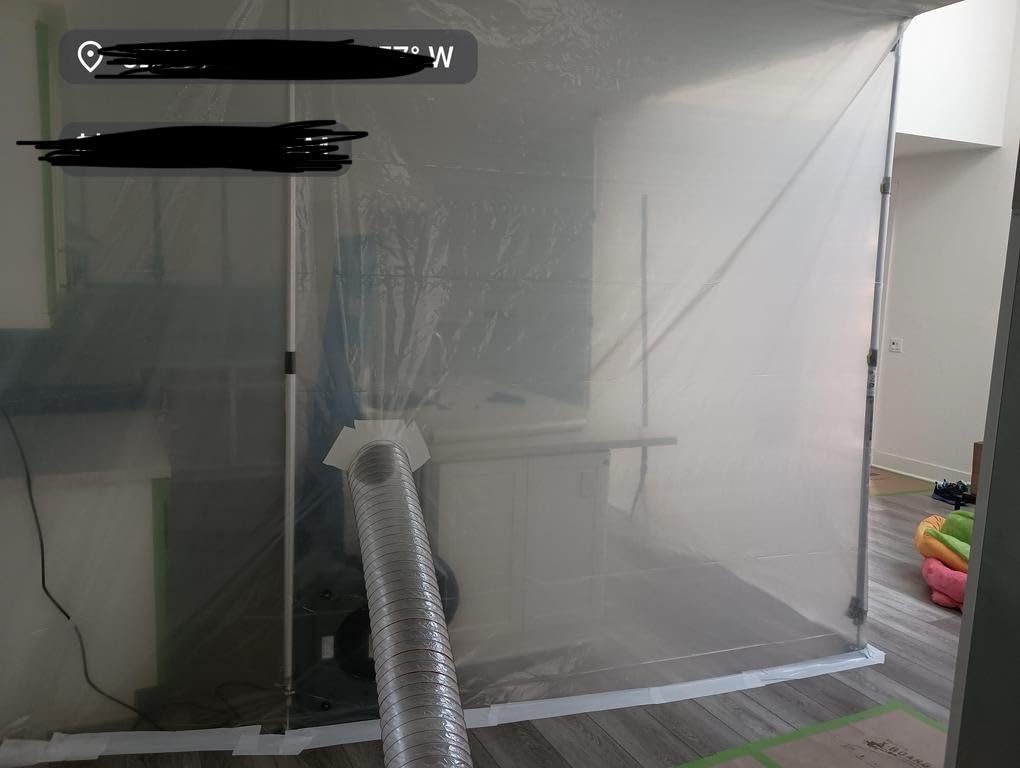
It can be configured as a negative air machine once a duct is added, which is sold separately. That makes it a legitimate containment unit rather than a cleaner that merely recycles air, which is what separates a scrubber from a purifier in practice.
Is it good for basements and crawl spaces?
It is one of the better fits here, because the small footprint lets you place it close to the source of the contamination rather than in a corner where the airflow is useless. Mold abatement and musty crawl space work both benefit from proximity to the source.
The carbon stage handles the pet and musty odors that usually accompany basement work, and the 39.6-pound weight with a portable handle keeps it manageable for one person on a staircase.
Where it falls short?
At 800 square feet of stated coverage it is the smallest room claim in this group, so it reaches its limit sooner than the 1400-square-foot claims above. If you are clearing a large open plan, plan on two machines rather than pushing this one.
As with several units here, a black cover must be removed before the machine operates at full performance, and replacement filters are a separate purchase. Owners with a 4.4 rating across 145 reviews consistently mention both, so neither should surprise you.
We earn a commission, at no additional cost to you. CERTAIN CONTENT THAT APPEARS ON THIS SITE COMES FROM AMAZON. THIS CONTENT IS PROVIDED 'AS IS' AND IS SUBJECT TO CHANGE OR REMOVAL AT ANY TIME.
6. CADPXS Shield-550 – Best for Odor and VOC Work
CADPXS Shield-550 Air Scrubber 550 CFM with 3-Stage Filtration
★★★★★★★★★★550 CFM airflow
MERV-10 carbon and HEPA
Tool-free filter access
33.51 lb
- Carbon stage measurably cuts odor
- VOC reduction from paint smoke adhesives
- Tool-free quick-latch filter access
- Consistent airflow under full filter load
- Hour meter retains reading when unplugged
- Filter light counts plugged-in time
- Speed knob has a narrow range
- Carbon and HEPA filters are bonded together
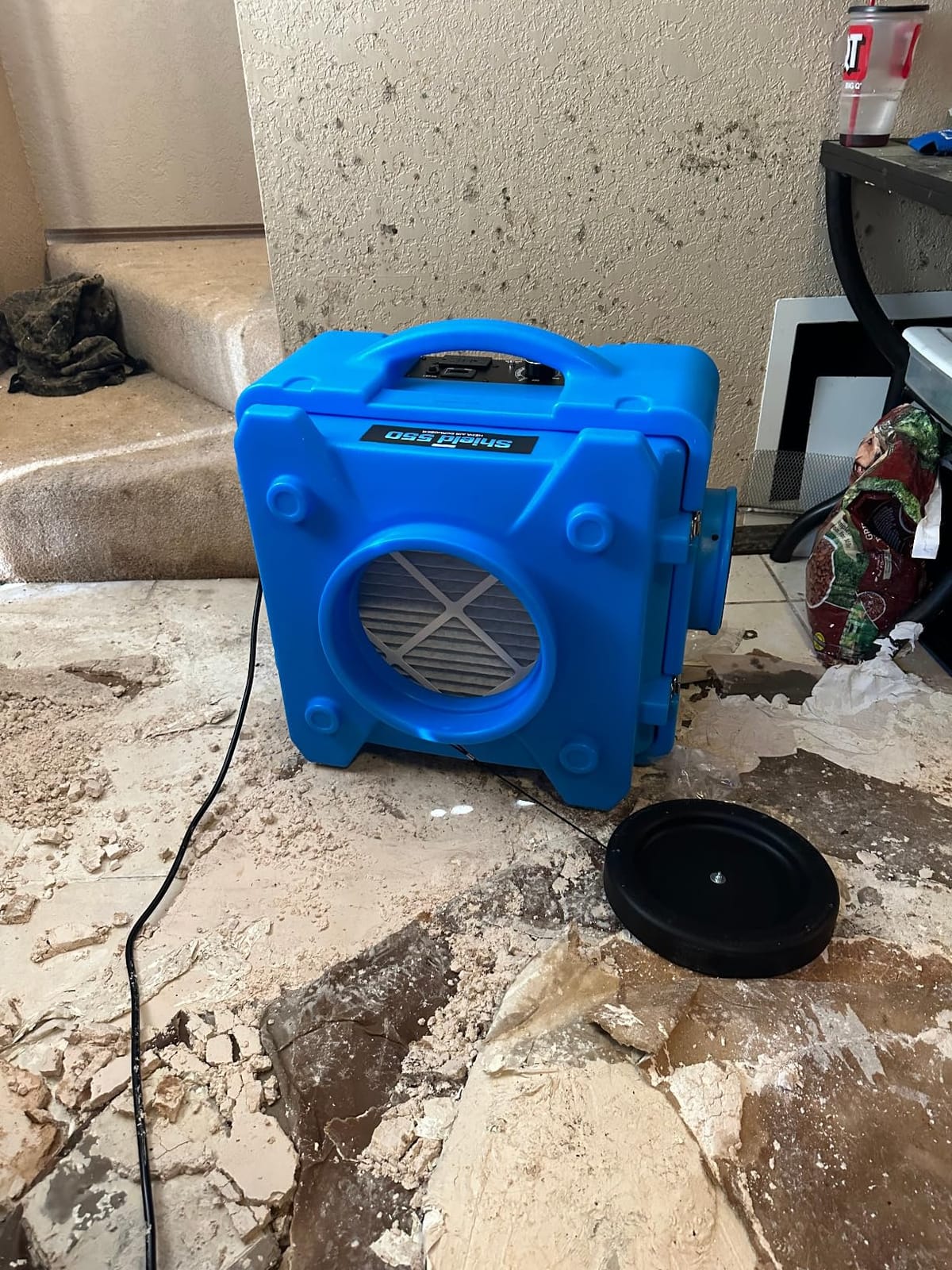
The CADPXS Shield-550 is the pick when the problem is smell rather than dust. The manufacturer specifies that its activated carbon stage reduces VOCs from paint, smoke, adhesives and cleaning chemicals, and contractors running pest-control and mold work report a noticeable difference that particle-only machines cannot deliver.
It moves 550 CFM as a negative air machine, with a three-stage stack of a MERV-10 pre-filter, activated carbon and a HEPA filter rated at 99.97 percent capture of particles at or above 0.3 microns. The 33.51-pound weight makes it one of the lighter 550 CFM machines to carry between job sites.
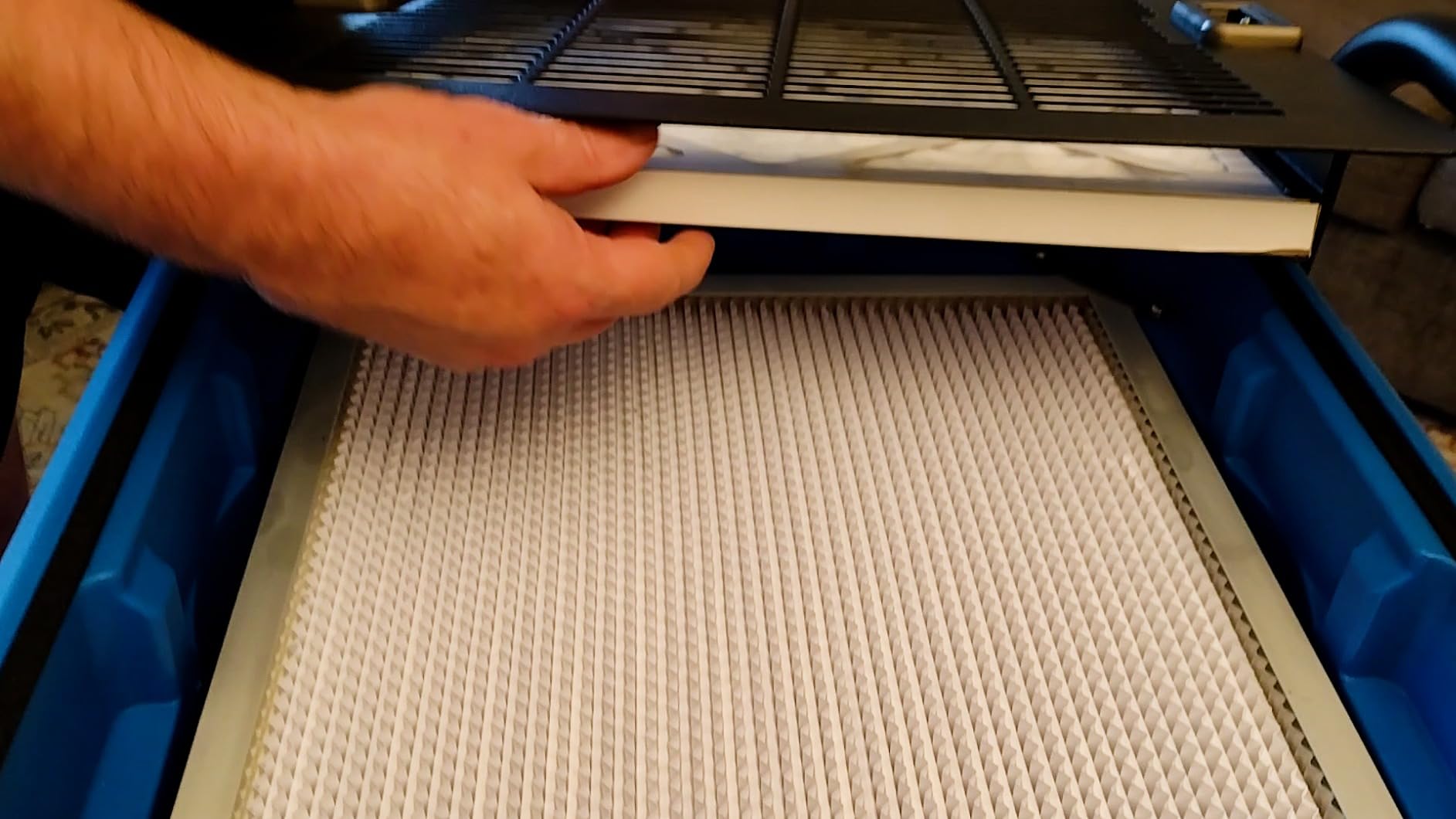
The tool-free quick-latch filter compartment is a small detail that pays off every single time. It is easier than competitor units that require four screws to come out, and on a job where you change filters daily the difference is measured in minutes per change.
Two other thoughtful touches: the hour meter display is persistent and retains its reading when the machine is unplugged, so you can track run hours accurately, and the control panel is side-mounted so it stays accessible regardless of how the exhaust is oriented, including ducted straight up.
The housing is rotomolded with a metal speed knob, both of which are built for daily work abuse rather than showroom handling. A lighted power cord is included, which is a real convenience in a dark crawl space or basement.
Is it worth it for paint and adhesive work?
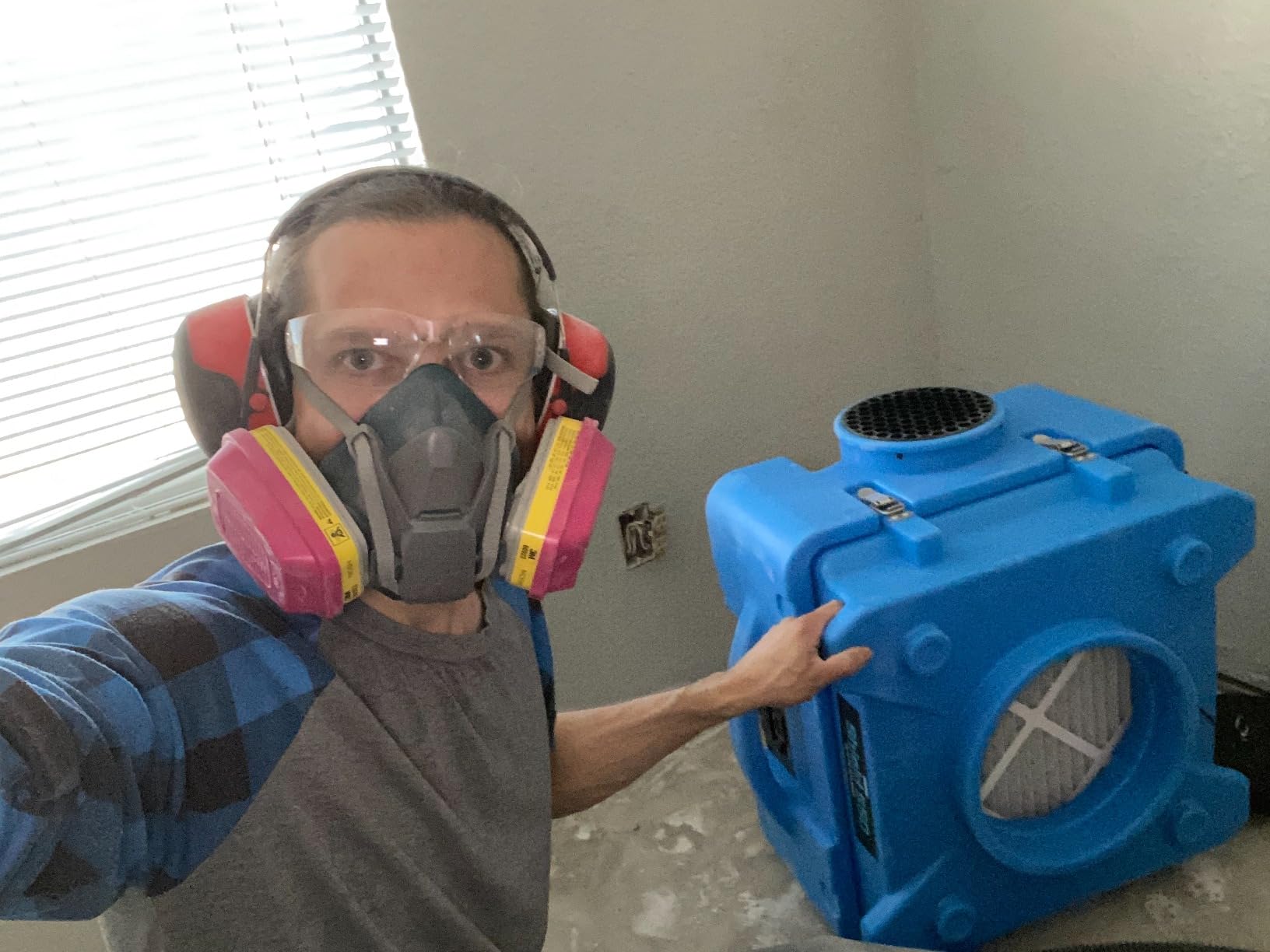
For paint stripping, carpet teardown, adhesive and glue work, this is the machine to buy. Those are gas-phase contaminants, and only an activated carbon bed of real depth will touch them, which is why we call this out rather than treating carbon as an optional extra.
It also carries a 10-year limited warranty, matching the longest coverage in the group. The persistent hour meter and the 10-year term together mean a contractor can justify the cost against a multi-year service life rather than a single job.
Where it falls short?
The filter-change indicator light is the most repeated complaint. It counts plugged-in time rather than actual filter run hours, and it can stay illuminated after you have already changed the filter, so it will train you to ignore it.
The carbon and HEPA filters are bonded together and cannot be replaced independently, which raises the long-run consumable cost. The air inlet is slightly smaller than competing 550 CFM machines, one owner felt that reduced output, and the speed knob does not vary the speed much between minimum and maximum.
We earn a commission, at no additional cost to you. CERTAIN CONTENT THAT APPEARS ON THIS SITE COMES FROM AMAZON. THIS CONTENT IS PROVIDED 'AS IS' AND IS SUBJECT TO CHANGE OR REMOVAL AT ANY TIME.
7. MOUNTO 1000 CFM – Best for Large Spaces
MOUNTO 1000cfm Portable Industrial Air Purifier Negative Air Scrubber – Powerful 1HP Motor, True HEPA Filter, 2-Speed, Handle and wheels 3-Year Warranty
★★★★★★★★★★1000 CFM airflow
1 HP motor
6-inch true HEPA filter
79 lb on wheels
- Clears large spaces far faster than 500 CFM
- Lighter and more rollable than expected
- True 6-inch HEPA and 1 HP motor
- Two-speed toggle with center off
- Reliable on mold and jackhammer jobs
- Dishwasher-sized footprint
- Noticeably loud
- Confusing manual with conflicting specs
- Plastic smell for the first days
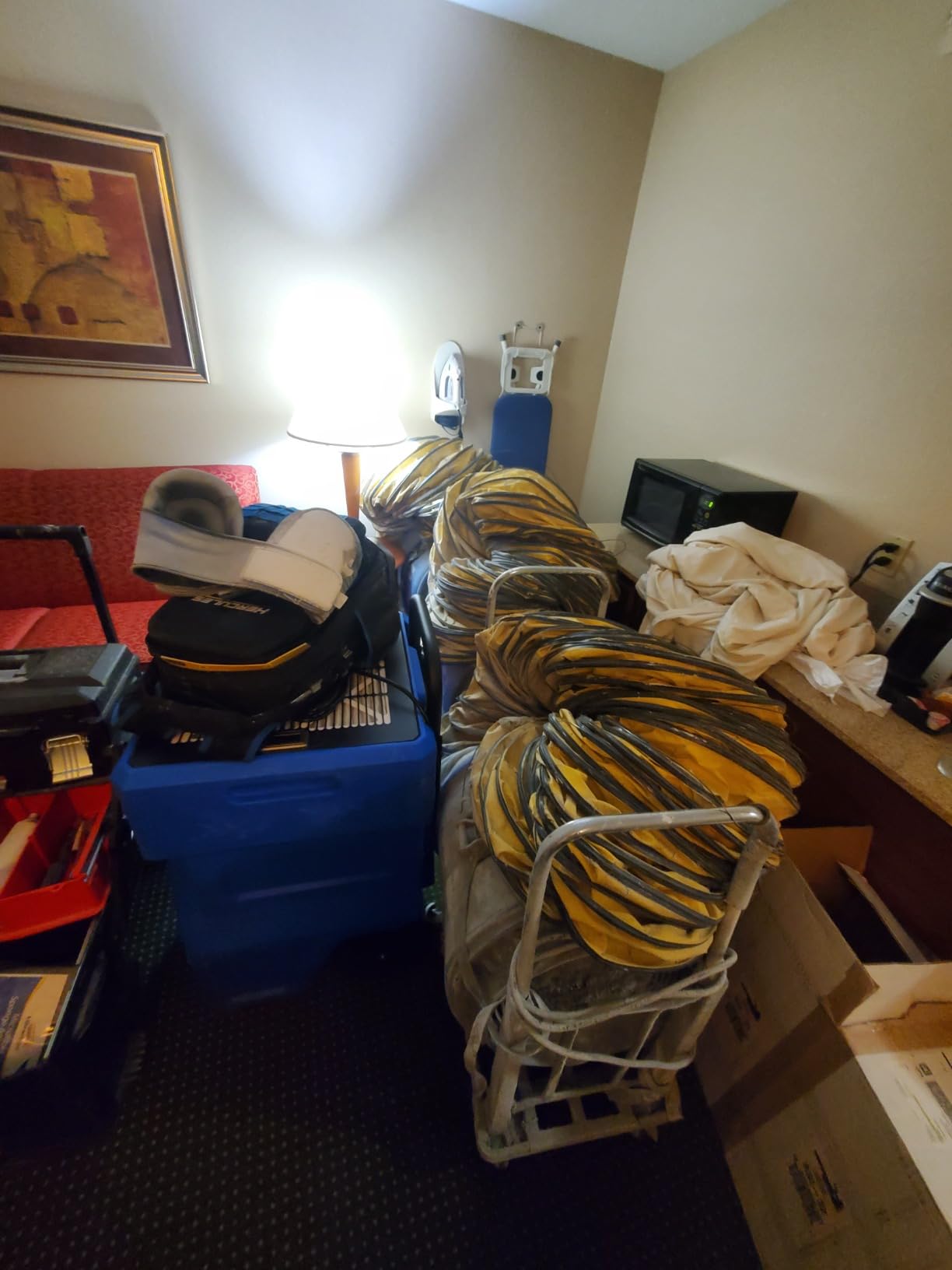
The MOUNTO 1000 CFM is the volume play. At 1000 CFM driven by a 1 HP motor, it clears a large space roughly twice as fast as a 500 CFM machine, and owners running mold abatement, jackhammering and shop dust control describe it as outperforming 16-inch inline blowers on odor and fume removal.
The filtration is a 6-inch true HEPA filter capturing 99.97 percent of particles as small as 0.3 microns. The rotomolded housing includes built-in wheels and a sturdy handle, so despite weighing 79 pounds it is easier to move than the weight suggests, and it holds a 4.6 rating.
Control is deliberately simple: a two-speed toggle with a center off position and a breaker reset button. Reviewers like that simplicity on long continuous runs, and several note that the low speed drops to near-white-noise levels that are tolerable in a bedroom on another floor.
Warranty coverage is three years, which is respectable for the commercial tier but shorter than the ALORAIR and CADPXS terms. That is normal; these machines carry more motor and housing risk than the 550 CFM class.
When do you actually need 1000 CFM?
When the contaminated volume is genuinely large, such as an open-plan main floor, a gutted commercial space, a warehouse bay or a whole-worksite containment area. At 1000 CFM you are chasing fewer air changes per hour over a bigger space rather than maximum changes in a small room.
If your space is under roughly 1200 square feet with a normal ceiling, a 550 CFM machine will get you to a higher air change rate for the same money, and it will be easier to store and less unpleasant to stand next to. Buy the bigger machine only when the volume genuinely demands it.
Where it falls short?
Documentation is the real problem. Owners flag a manual that references a pre-pad filter that is not included, and a conflict between the manual and the product page over whether the fan is three-quarter horsepower or 1 horsepower. Verify the configuration with the manufacturer if that matters to your application.
There is also a slight plastic smell for the first couple of days of operation, and the footprint is large, roughly dishwasher-sized on wheels. Plan the floor space before you buy.
We earn a commission, at no additional cost to you. CERTAIN CONTENT THAT APPEARS ON THIS SITE COMES FROM AMAZON. THIS CONTENT IS PROVIDED 'AS IS' AND IS SUBJECT TO CHANGE OR REMOVAL AT ANY TIME.
8. Dri-Eaz HEPA 700 – Best for Monitored Jobs
Dri-Eaz HEPA 700 Air Scrubber, Industrial Air Filtration System, Optional Activated Carbon Filter, 700 CFM
★★★★★★★★★★700 CFM airflow
Touchscreen filter health
Ductable and stackable
42 lb
- Touchscreen shows airflow and filter health
- Ductable and stackable design
- Lightest chassis in its class at 42 lb
- Recognized restoration brand
- True HEPA with optional carbon
- Highest cost in this comparison
- Carbon filter is an extra purchase
- Thinnest review base here at 39 reviews
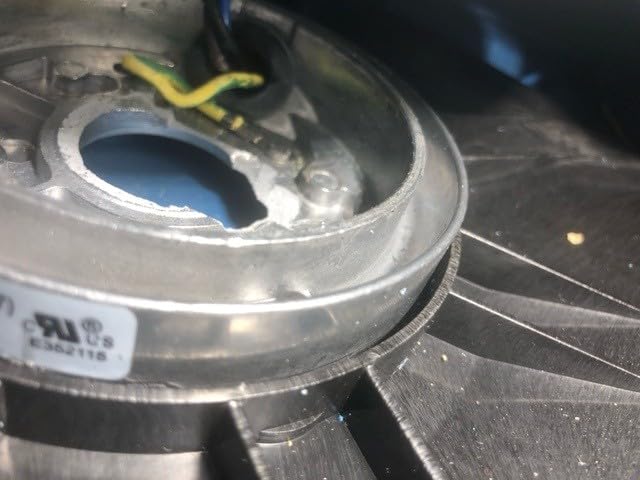
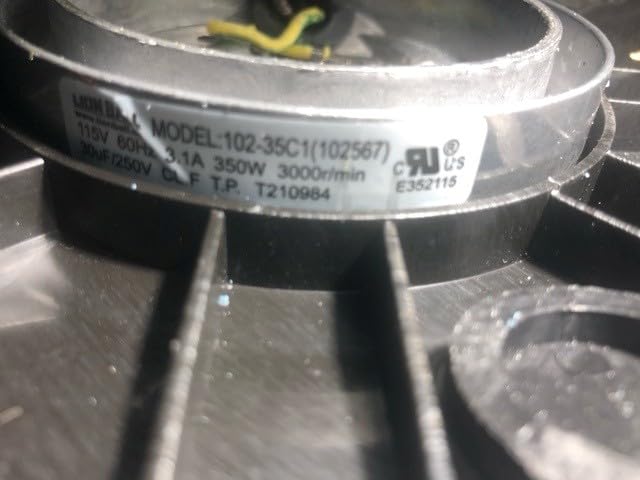
The Dri-Eaz HEPA 700 is the only machine here with a touchscreen, and for a commercial crew that is the point. It shows airflow and HEPA filter health directly, which means you can tell a loaded filter from a failing one instead of guessing at replacement intervals.
Airflow is 700 CFM, a useful middle tier between the 550 CFM renovation class and the 1000 CFM commercial units. The stack is a pre-filter, a true HEPA filter and an optional activated carbon filter for odors, and the chassis is ductable and stackable for transport between job sites.
At 42 pounds it is the lightest machine at this airflow level, which matters if you are loading and unloading a van several times a week. Dri-Eaz is a recognized water-damage restoration brand, and that name recognition is worth something when you are talking to an insurance adjuster or a commercial client.
The published coverage is broad: construction sites, water-damage restoration, schools, restaurants and hotels. The 26 by 17.16 by 22.93 inch footprint is compact for 700 CFM, so it fits in a service corridor without dominating the floor.
Is it worth paying more for a name brand?
For a commercial operation with multiple crews and a maintenance budget, frequently yes. The touchscreen removes a recurring guess, the light chassis saves labor time, and a recognized brand simplifies warranty claims when something fails on a client site.
For a homeowner or a small trade doing one job, no. You are paying for monitoring hardware and brand support you will rarely use, and a 550 CFM machine with a filter change light will clear a typical room just as fast.
Where it falls short?
It is the highest-priced unit in this comparison, and it excludes the activated carbon filter by default, so the full odor-capable configuration costs more than the headline figure suggests. Budget for the carbon cartridge before the job rather than after the first complaint.
The review profile is the thinnest here at 39 reviews with a 4.2 rating, and about 16 percent of those reviews are one-star, the highest one-star share in the group. With that little data, treat the rating as provisional and confirm the filter and parts supply directly with the manufacturer.
We earn a commission, at no additional cost to you. CERTAIN CONTENT THAT APPEARS ON THIS SITE COMES FROM AMAZON. THIS CONTENT IS PROVIDED 'AS IS' AND IS SUBJECT TO CHANGE OR REMOVAL AT ANY TIME.
9. XPOWER X-3400A – Best Lightweight 600 CFM Option
XPOWER X-3400A Air Scrubber 3 Stage Filtration, Negative Air Machine w/Power Outlets, 3 Stage Airbourne Cleaner, Scrubber HEPA Filter System for Water Damage Restoration, Commercial & Home Use, Blue
★★★★★★★★★★600 CFM airflow
3-filter staged stack
Negative air with outlets
28.8 lb
- Staged filters extend HEPA element life
- Pre-filter catches bulk dust
- Adjustable speed for occupied rooms
- Lightest 600 CFM unit at 28.8 lb
- Industrial-grade build
- Loud on maximum setting
- Replacement filters are costly
- One report of weak fine-powder capture
- Smallest review base at 19
The XPOWER X-3400A is the lightest machine that still clears 600 CFM, at 28.8 pounds, and for one person moving equipment around a house or shop that difference is real. The 19.6 by 12.3 by 21.6 inch body is narrower than anything else in this group.
Filtration uses three separate filters sized to different particulate sizes rather than one generic stack. Owners credit the pre-filter for catching the bulk of the dust, and several report never having replaced the HEPA element because the upstream stages keep it clean.
That is the design lesson worth learning from this machine, and it applies across the category: protect the expensive filter and it lasts. Reviewers describe it as visibly stripping dust from air in basements, salons, laundry rooms and woodworking shops, and it holds a 4.6 rating.
Configuration is a negative air machine with built-in power outlets, plus variable speed control on low and high. Running it on low brings the noise down to an acceptable level in occupied spaces, which is where the 600 CFM figure stops being purely a job-site spec.
Built-in power outlets mean other tools can run from the machine, which is convenient on a demolition site where outlets are scarce. The staged filter design is what separates it from a generic three-stage unit at the same airflow.
Is it good for a home workshop?
Yes. Woodworking, sanding, and finishing shops generate exactly the kind of high particulate load it handles, and at 28.8 pounds one person can move it between the shop and a finishing room without a dolly. The variable speed control is what makes it usable in an occupied space afterward.
It is also a sensible pick for allergy households who want real airflow but plan to run the machine only part of the day, since the 4.6 rating suggests it performs reliably at lower duty cycles.
Where it falls short?
It is loud on the maximum setting, and it simply is not a quiet-room machine. One owner reported weak performance on very fine herbal powder in a small enclosed space, which is worth weighing if you work with ultrafine powders rather than ordinary wood dust.
Replacement filters are expensive, and some owners question the value of a plastic housing with a fan and HEPA filter at this price point. The review base is the thinnest in the group at 19 reviews, so buyer feedback here is thinner than the rating alone suggests.
We earn a commission, at no additional cost to you. CERTAIN CONTENT THAT APPEARS ON THIS SITE COMES FROM AMAZON. THIS CONTENT IS PROVIDED 'AS IS' AND IS SUBJECT TO CHANGE OR REMOVAL AT ANY TIME.
10. Zynovate 600 CFM – Best Four-Stage Filtration
Air Scrubber 600 CFM with 4-Stage Filtration HEPA Negative Air Machine
★★★★★★★★★★600 CFM airflow
4-stage filtration
H13 at 99.99 percent
25.5 lb
- Four stages including a washable mesh filter
- Highest published capture rate at 99.99 percent
- Quiet EC motor with soft start
- Lightest unit in the group at 25.5 lb
- Intake port cover protects stored filters
- No replacement filters included or listed
- HEPA size is uncommon at retail
- Dual GFCI outlets are not covered
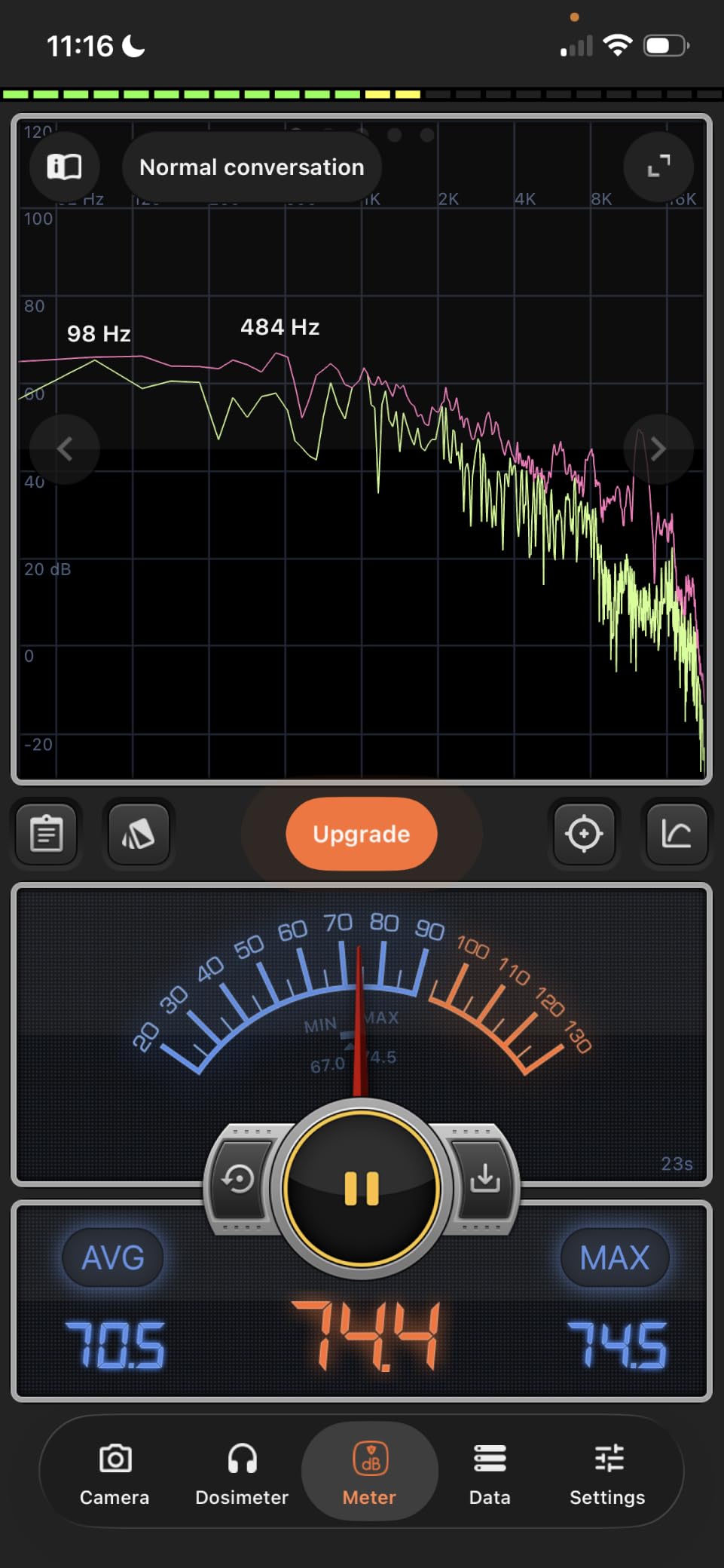
- Louder than a residential purifier
The Zynovate 600 CFM is the most thoroughly filtered machine here, running four stages where most competitors run three: a washable nylon mesh filter, a MERV-10 filter, a carbon filter and an H13 HEPA filter. It is the newest design in the group and carries a 5-year quality warranty.
The published filtration specification is the strongest in this comparison, capturing 99.99 percent of particles as small as 0.3 microns. Airflow tops out at 600 CFM covering up to 6000 cubic feet, and at 25.5 pounds it is the lightest unit we reviewed overall while still moving serious volume.
Owners with industrial air purification backgrounds rate the build quality highly, and several document dramatic odor removal, from skunk to pet smells to musty crawl spaces. The washable mesh stage ahead of the MERV-10 is cheap insurance, since it intercepts fibers and chips that would otherwise blind the expensive filters behind it.
The quiet EC motor with soft start avoids a power surge on startup, which is a real benefit if you are running it off a household circuit or daisy chaining. Two GFCI outlets support up to three machines for 1800 CFM combined, and the roto-molded shell stacks horizontally and vertically.
A protective intake port cover keeps filters clean during storage and transport, a small detail that matters for anyone keeping a machine in a van between jobs. Filter sizes are published: a 16 x 16 x 0.75 inch pleated pre-filter and a 16 x 19 x 2 inch H13 HEPA with a carbon layer.
Is it a good first scrubber for a homeowner?
The machine itself is excellent for that: light enough to move alone, strong enough to clear a large room, and the four-stage chain handles allergens, dust and odors in one pass. If you want filtration quality and low weight, this is the strongest combination in the group.
The catch is entirely about consumables, and you should weigh it before buying rather than after. No replacement filters are included, and the manufacturer does not appear to list them, with no part numbers published. At 23 reviews, this is also the thinnest evidence base in the group.
Where it falls short?
The 16 x 19 x 2 inch H13 size is uncommon at retail stores, so filters generally have to be ordered online rather than picked up locally. If the manufacturer does not stock them, you are exposed on a project timeline, and that is the single biggest practical risk with this machine.
It is also not quiet enough to sleep beside, though owners accept it as a working-environment machine. The GFCI outlets are uncovered, so carbon can absorb moisture during storage, and the footprint is larger than most residential purifiers.
We earn a commission, at no additional cost to you. CERTAIN CONTENT THAT APPEARS ON THIS SITE COMES FROM AMAZON. THIS CONTENT IS PROVIDED 'AS IS' AND IS SUBJECT TO CHANGE OR REMOVAL AT ANY TIME.
How Big an Air Scrubber Do I Need?
Size an air scrubber by airflow, not by room square feet alone. The useful number is air changes per hour, or ACH, which is how many times the full volume of air in a space gets replaced every hour.
The formula is straightforward. Multiply the room’s floor area in square feet by the ceiling height in feet to get cubic feet, then divide by 60 to get the required CFM for one air change per hour. Multiply that figure by your target ACH to size the machine.
Worked example, 1,000 square foot basement with an 8-foot ceiling. That is 8000 cubic feet. One air change per hour needs about 133 CFM. Six air changes per hour, a reasonable target for clearing dust or odor after a job, needs about 800 CFM. That is why a 550 CFM machine needs roughly four hours to reach the same state a 1000 CFM machine reaches in a little over two.
As a rule of thumb, 500 CFM suits rooms up to about 1000 square feet with standard ceilings, 550 to 700 CFM covers 1000 to 1500 square feet, and 1000 CFM is the right call for open plans and gutted spaces above 1500 square feet.
Time to clear a room scales inversely with air changes per hour. At 1 ACH a room takes about an hour to fully exchange its air, at 4 ACH roughly 15 minutes, at 6 ACH about 10 minutes, and at 8 ACH about 7.5 minutes. Fast clearance is exactly why the airflow figure is the number professionals actually compare on.
One practical addition: if you also want to know what is happening to your air quality while the machine runs, a dedicated monitor gives you a much better picture than a machine’s own filter light. Our air quality monitor picks cover the options worth pairing with a scrubber.
How to Choose an Air Scrubber?
Buy on airflow first, then filtration stages, then carbon, then noise, then ductability and cost. Getting that order right prevents the most common and most expensive mistake, which is choosing a quiet purifier-grade machine for a contamination job it physically cannot handle.
1. Airflow in CFM. Calculate your target ACH as shown above, then choose a machine with comfortable headroom above that number. Filters load up over a job, and a loaded filter reduces real airflow below the spec printed on the box.
2. Filtration stages and HEPA grade. Look for a published 0.3-micron and 99.97 percent capture figure or an explicit H13 designation. HEPA-type, HEPA-like and HEPA-style are unregulated marketing terms with no such guarantee attached, and that is the single most important spec to check.
3. Carbon stage depth, not just presence. HEPA captures particles and does nothing for gases or odor. This is the misunderstanding that disappoints buyers most often. A thin carbon sheet handles a faint kitchen smell; a thick, impregnated or DAX-style bed is what actually reduces paint fumes, smoke and adhesive solvents.
4. Noise, honestly measured. Air scrubbers are loud, and retail copy rarely says so. Plan around it by running the machine while you are elsewhere, or while you work, rather than in a bedroom or a conversation space. Variable speed control is the feature that lets you trade output for quiet when the heavy phase is over.
5. Ductability and negative air mode. If you are containing dust from a renovation, you need a ductable outlet and a way to discharge outside or into a collection system. That capability, not the filter, is what makes a scrubber a containment device instead of a very large purifier.
6. Total cost of ownership. Add three years of replacement cartridges to the unit’s cost before you commit. A carbon stage costs multiples of a standard HEPA cartridge and a DAX-style bed costs more again, so for odor-driven work the filters can exceed the machine cost over its life. Confirm the cartridge part number and the local availability before buying, because the Zynovate situation shows how badly this can go.
For contractors, rental is a reasonable option for a single short job, and buying wins as soon as you are running machines regularly. The standard-size 16 x 16 x 1 inch pre-filter used by the BlueDri, and similar cuts elsewhere, is the cheapest ongoing consumable in the category and should drive your rental-versus-buy math.
On safety, avoid units with ionizers or plasma generators that cannot be switched off, and look for a clean air delivery rating or an explicit zero-ozone claim if anyone in the home is sensitive to ozone. Every machine reviewed here is a mechanical filtration design with no ozone-generating stage.
Frequently Asked Questions
Do air scrubbers actually work?
Yes, for airborne contamination. A scrubber pulls room air through a pre-filter, a HEPA filter rated for 99.97 percent capture at 0.3 microns, and often a carbon stage, then exhausts cleaned air. They do not capture dust that has already settled, and HEPA alone does not remove odor or gases, which is why the carbon stage matters.
Is it better to buy an air scrubber or an air purifier?
Buy an air scrubber for renovation dust, water damage, mold abatement, fire cleanup, paint stripping and shop solvents, because it delivers 500 to 1000 CFM and can be ducted for containment. Buy an air purifier for quiet year-round allergy relief in an occupied room, where a purifier is easier to live with and cheaper to run.
How long should you run an air scrubber in a house?
Run it continuously for the duration of the work, then for several hours afterward. Clearing time depends on airflow: at 4 air changes per hour a room exchanges its full air volume in about 15 minutes. For odor work, keep running until the smell is gone, and expect days rather than hours in a heavily smoke-logged house.
Is it safe to be in a room with an air scrubber running?
Yes, as long as the unit is a mechanical filtration design with no ionizer or plasma stage that cannot be switched off, which is the case for every scrubber reviewed here. Expect real noise, which is a comfort issue rather than a safety one. Place the outlet away from your face and keep doors and windows closed so it works on one volume of air.
Do HEPA air scrubbers remove odor and VOCs?
No. A HEPA filter captures particles only, including the particulate fraction of smoke, but it does nothing for gases. Odor and VOC removal depends on the carbon stage, so choose a scrubber with a thick or DAX-style activated-carbon bed, and expect the carbon cartridge to need replacing sooner than the HEPA filter.
How big an air scrubber do I need for a 1000 square foot room?
For a 1,000 square foot room with 8-foot ceilings, which is 8000 cubic feet, one air change per hour needs about 133 CFM. At 6 air changes per hour you need roughly 800 CFM, so a 550 CFM machine is a sensible lower choice and a 1000 CFM machine clears the space in a little over two hours.
Do air scrubbers work better than air purifiers?
They are faster, not fundamentally better at filtering. Both use HEPA media, but a scrubber moves several times more air, so it clears a contaminated room in minutes rather than hours, and its exhaust can be ducted to hold a room at negative pressure. A purifier wins only on quietness and running cost for continuous low-level use.
Which Air Scrubber Should You Buy?
The BlueDri Air Shield 550 is our pick as the best air scrubber overall, because its 550 CFM throughput, standard filter sizing and 755-review track record make it the safest choice across the widest range of jobs. If you want the complete three-stage stack including carbon out of the box, the VEVOR 550 CFM is the better value, and if you plan to keep a machine for years, the ALORAIR’s 10-year warranty wins outright.
Match the class to the contamination rather than to the marketing. Dust and allergens need airflow, odors and VOCs need a real carbon bed, containment work needs a ductable outlet, and if you only need quiet year-round allergy relief, one of our air purifier picks will serve you better than any of these. Last reviewed in 2026, and every specification above comes from the manufacturer’s published data rather than our own estimates.