
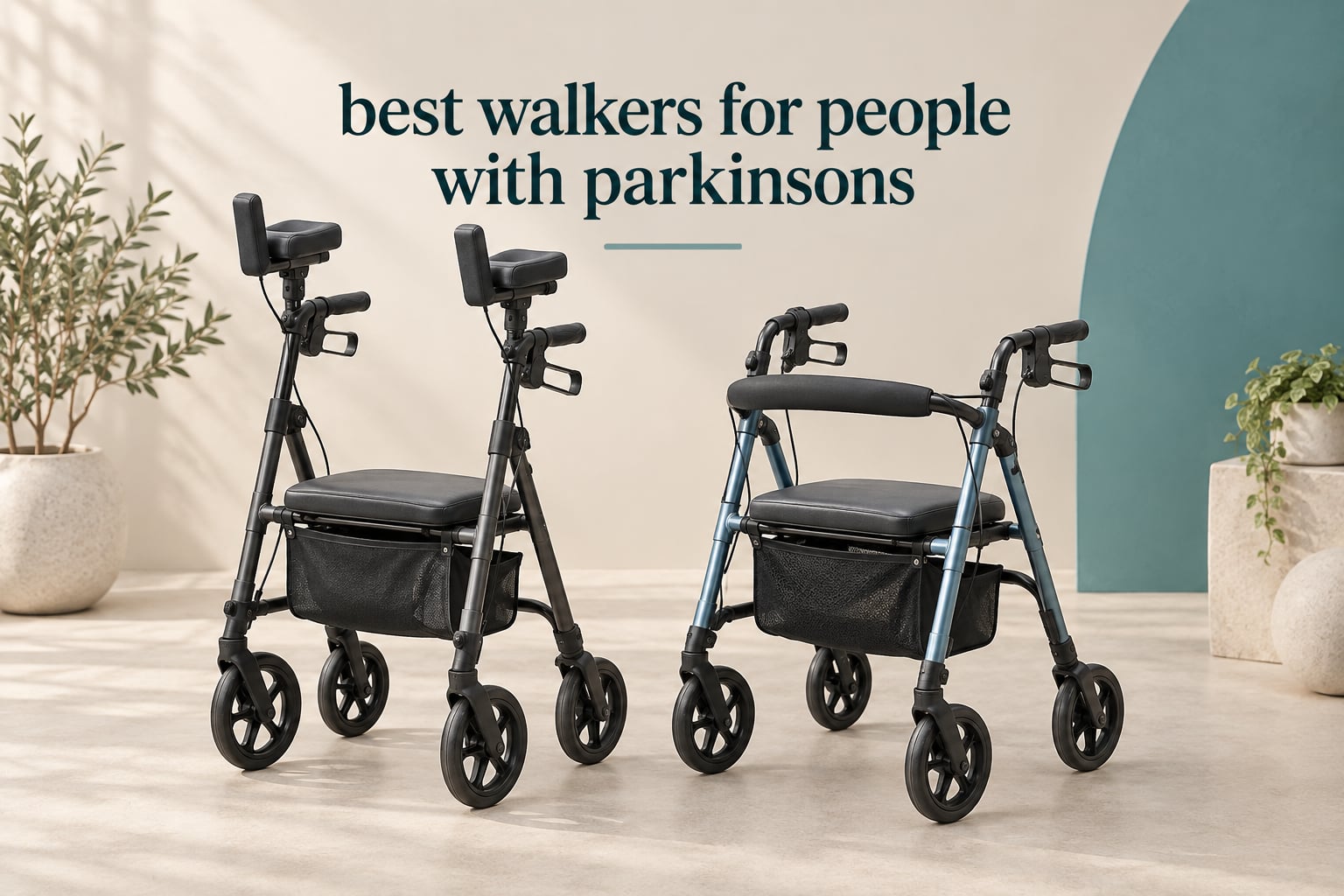
Parkinson’s changes the way a person walks in four specific ways, and a walker that ignores those four changes becomes a trip hazard rather than a help. Buying the best walkers for people with Parkinsons means matching the frame geometry to the symptom, not matching the price tag to the budget. After reviewing eight rollators and upright walkers, checking the brake systems, wheel sizes, weight capacities and seat layouts on each, and mapping them to freezing, retropulsion and posture problems, three picks stood out.
A quick definition first, because it changes how you read the rest of this guide. A rollator is a walking frame with wheels on all four legs, hand brakes on the push handles, and a built-in padded seat. You push it while steering with the rear wheels, squeeze the brake levers to slow or stop, and lock the brakes to sit when you need a rest. A standard walker has no wheels and no seat, and an upright walker adds forearm platform support so you can keep your torso extended. Our broader guides to rollator walkers with seats and upright walkers cover those categories in more detail than a Parkinson’s-specific roundup can.
Medical note: this article is buying guidance, not medical advice. Parkinson’s symptoms vary enormously between individuals and change over time. Anyone choosing a walking aid for Parkinson’s disease should be assessed by a neurologist, a physical therapist or an occupational therapist first, because the right aid depends on your fall history, your postural stability and how you rise from a chair. Treat everything below as a shortlist to discuss with your care team, not as a prescription.
One thing you should know before reading the picks: none of the eight devices below is a purpose-built Parkinson’s walker. Purpose-built models exist, including the U-Step line and the Veloped range, but they are specialist items a therapist usually arranges rather than devices you add to a cart. What we could verify in detail were eight mainstream rollators and upright walkers that families are already buying and adapting to the condition, which is exactly what most of our readers are doing.
Table of Contents
- Top 3 Best Walkers For People With Parkinsons (October 2026)
- All 8 Walkers Compared Side by Side
- Why Parkinson’s Changes Which Walker You Need?
- 1. Drive Medical Nitro Foldable Rollator – Best Overall Pick
- 2. Medline Premium Empower Rollator – Best Value for Everyday Use
- 3. ELENKER Upright Walker – Best Forearm Support for Forward-Leaning Posture
- 4. Helavo Upright Walker – Best Upright Walker for Padded Comfort and Outdoor Rides
- 5. MAXWALK 12-Inch All Terrain Rollator – Best for Gravel Paths and Uneven Ground
- 6. Helavo Extra Wide Bariatric Rollator – Best Rated at 550 lb Capacity
- 7. Pelegon Lightweight Rollator – Best for Car Travel and Small Homes
- 8. VOCIC Z22 Upright Walker – Best GelSoft Armrests for Elbow Pressure
- How to Choose a Walker for Parkinsons Disease?
- Who Should Not Use a Rollator Walker?
- Frequently Asked Questions
- The Walker Worth Buying for Parkinsons in 2026
Top 3 Best Walkers For People With Parkinsons (October 2026)
Drive Medical Nitro Rollator
- 10-inch front casters
- 17.5 lb frame
- One-hand fold with under-seat lock

Medline Premium Empower
- 16 x 14 inch memory foam seat
- Two-way flip backrest
- 300 lb capacity

All 8 Walkers Compared Side by Side
All eight devices require the user to bear their own weight while walking, and all eight include a seat and hand brakes. The columns that decide a Parkinson’s purchase are brake feel, wheel diameter, handle geometry and whether the frame supports an upright torso.
| Product | Key Specs | Pricing |
|---|---|---|
| Drive Medical Nitro Foldable Rollator |
|
Check Latest Price |
| Medline Premium Empower Rollator |
|
Check Latest Price |
| ELENKER Upright Walker |
|
Check Latest Price |
 Helavo Upright Walker with Seat Helavo Upright Walker with Seat |
|
Check Latest Price |
 MAXWALK 12-Inch All Terrain Rollator MAXWALK 12-Inch All Terrain Rollator |
|
Check Latest Price |
 Helavo Extra Wide Bariatric Rollator Helavo Extra Wide Bariatric Rollator |
|
Check Latest Price |
 Pelegon Lightweight Rollator Pelegon Lightweight Rollator |
|
Check Latest Price |
 VOCIC Z22 Upright Walker VOCIC Z22 Upright Walker |
|
Check Latest Price |
Why Parkinson’s Changes Which Walker You Need?
The best walker for someone with Parkinson’s disease is a rollator with brakes you can control deliberately, wheels sized for the ground you actually walk on, and handle geometry that matches your posture. For freezing of gait, add a frame that resists rolling backward. For forward-leaning posture, add forearm support. For tremor or weak grip, avoid brake designs that need precise timing.
Retropulsion is the involuntary tendency to fall backward. A four-wheel rollator has no frame behind the walker, so if backward momentum starts, the walker rolls with you. This is why people with retropulsion need brakes that lock by squeezing upward, and why the side-to-side steering designs on purpose-built Parkinson’s models exist at all. Wheel size matters here too, because small casters follow a backward path rather than resisting it.
Freezing of gait is a sudden inability to start, continue or stop walking. On r/Parkinsons, the U-Step is the most frequently recommended rollator, and the reason given for it is its reverse or loop brakes plus the laser line cueing painted on the ground. Both are designed to break a freeze or hold a frame that would otherwise roll away. That is exactly why purpose-built Parkinson’s walkers carry those features. None of the eight devices here has a laser line, so if freezing is your dominant symptom, treat cueing as a separate plan you build with your physical therapist.
Camptocormia is the forward-leaning, stooped posture that develops over years. Leaning into a standard rollator handlebar makes it worse, because the walker pulls the shoulders further forward. Upright and platform walkers were designed for exactly this: the user rests their forearms on padded supports, the spine extends, and the shoulders unload. A user on the Mayo Clinic Connect forum described using an upright platform walker at home and specifically credited the upright posture and the ability to walk further before tiring.
Bradykinesia and rigidity are what make braking awkward, because slow, hesitant movement and a stiff hand can leave a lever half engaged. Design matters more here than strength alone. Loop brakes, which lock by squeezing upward, suit many people, and push-forward brake levers that let you slow without a hard pull suit others. What does not suit anyone is a brake that engages sharply during an ordinary stop.
One asymmetry buyers routinely get wrong: an upright walker helps posture and short indoor trips, while a standard rollator wins on distance, terrain and manoeuvrability. Groups like the Parkinson’s communities on Facebook frame the choice the same way, treating upright walkers as the answer to bent posture and standard rollators as the better tool outdoors and for longer distances.
Match your dominant symptom to the category before you match the budget:
Tremor-dominant or early stage: a lightweight standard rollator with a wide seat. Ease of handling matters more than anything else, because the walker should feel like an extension of the arm.
Freezing-dominant: brake design first, then cueing. Look for levers that lock by squeezing upward, and plan a separate auditory or visual cueing routine with your therapist.
Postural-instability or forward-leaning dominant: an upright or platform walker with padded forearm support. Accept the trade-off of a smaller turning circle in exchange for an extended spine.
Retropulsion or backward-balance loss: the hardest case to buy for off a shelf. Ask your therapist about frames with braking geometry that resists rearward motion, and consider a supervised trial before committing.
Advanced stage with frequent falls or inability to rise unaided: a rollator may no longer be the right tool. Ask about a transport chair or wheelchair and caregiver-assisted transfers.
1. Drive Medical Nitro Foldable Rollator – Best Overall Pick
Drive Medical RTL10266BK Nitro Foldable Rollator Walker with Seat, Black
★★★★★★★★★★17.5 lb aluminum frame
10-inch front casters
One-hand fold with under-seat lock
- 10-inch front casters handle curbs and rough ground
- Light 17.5 lb aluminum frame
- One-hand fold with an under-seat locking mechanism
- Push-button handle and tool-free backrest adjustment
- Highest average rating in the group at 4.8
- Standard rollator handlebars so it does not support an upright torso
- Zippered pouch clips on rather than sitting under the seat
- No reverse or loop brake for retropulsion protection
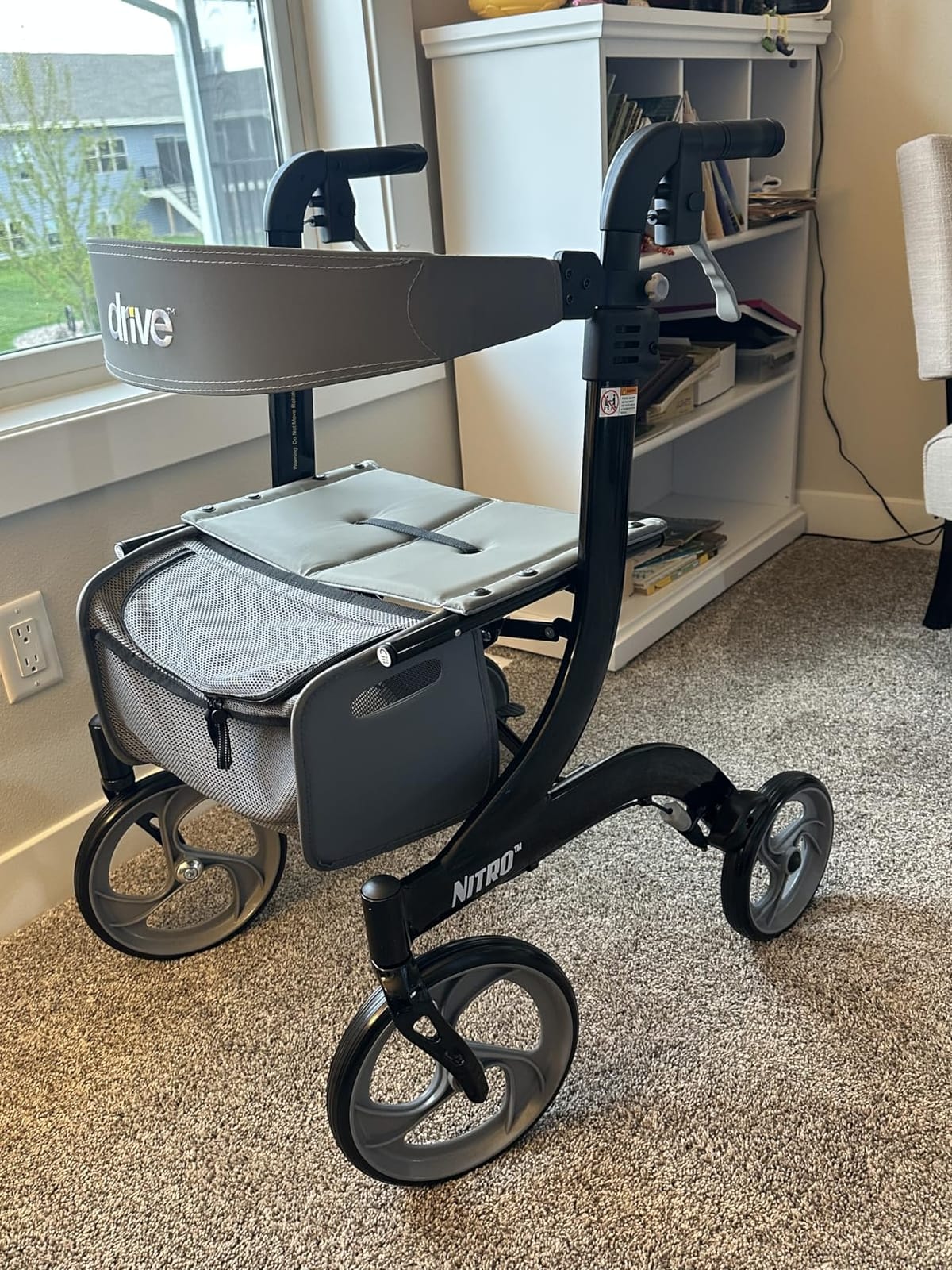
We kept coming back to the Nitro because it solves the two things that most often go wrong with a budget rollator: heavy steering and a fold you cannot manage one-handed. The 10-inch front casters are the reason it rolls over a curb or a cracked parking-lot seam without a jolt, and that matters more in a Parkinson’s context than it does for a general senior shopper, because a sudden stop or a sharp turn is what precedes a lot of backward losses of balance.
The frame weighs 17.5 pounds, and the fold collapses to a flat bundle using a lever under the seat. That is the single most practical detail for daily life. A walker that will not go into the car does not leave the house, and a walker that never leaves the house is decoration.
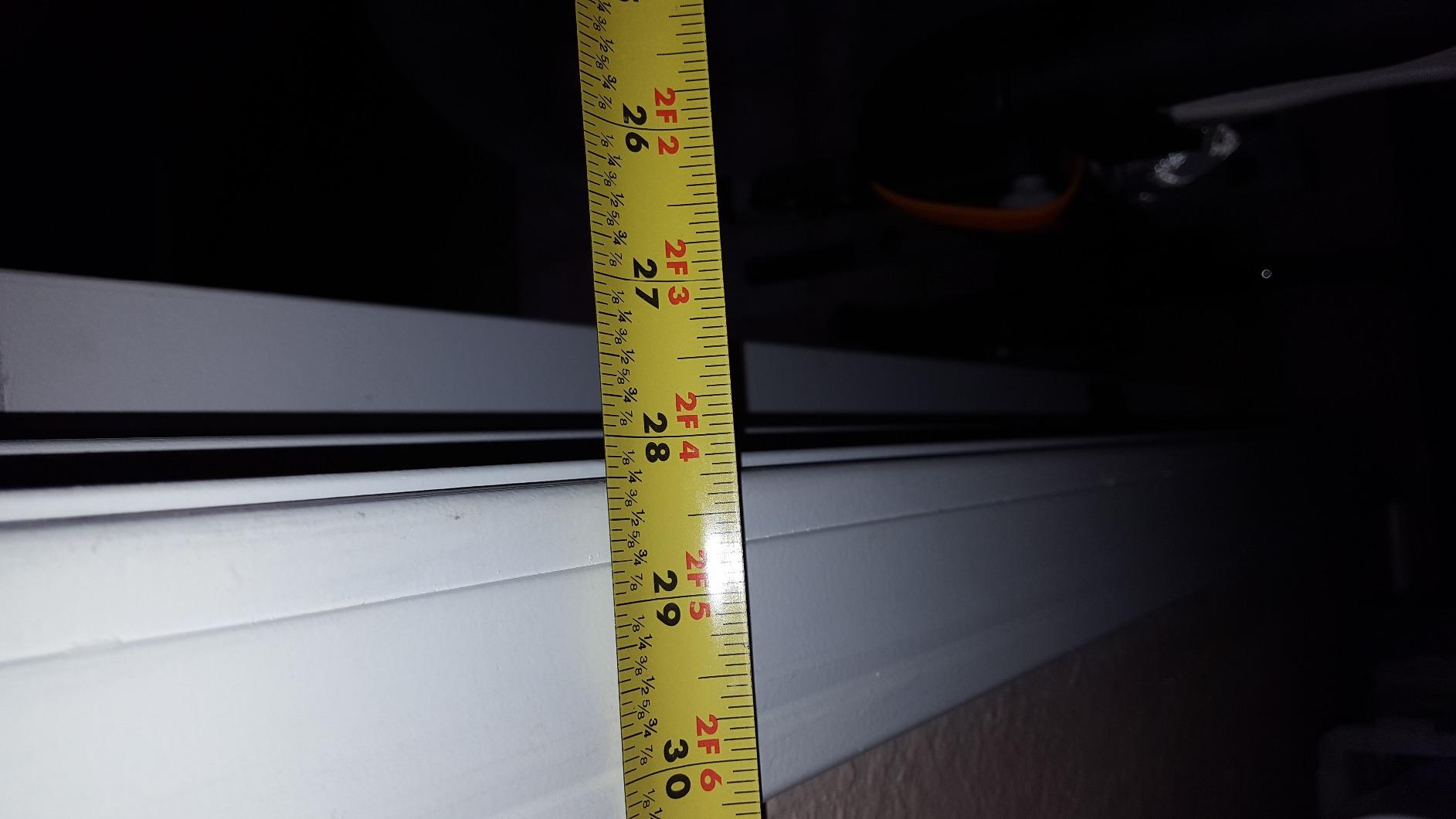
Handle height adjusts with push buttons rather than thumb screws, and the backrest adjusts without tools. In practice that matters for a user whose fine motor control fluctuates during the day, because you can change the setup in seconds instead of finding a screwdriver. The seat and backrest give you a genuine rest stop, and locking the brakes before sitting is a habit worth teaching early.
The one thing the Nitro does not do is support an upright torso. If you are already leaning forward noticeably, a standard handlebar rollator can reinforce that posture over months of daily use, because you lean into it to steer. That is the case for the upright models further down this list.
Who this suits for Parkinsons?
This is the pick for a person in the early or middle stages who can walk unaided but tires early, needs a seat for planned rests, and spends time on paths that are not perfectly smooth. The combination of a light frame, large front wheels and the highest rating in the group makes it the safest general choice we found.
It also suits a caregiver who is the one lifting the walker into and out of the vehicle. At 17.5 pounds, one person can manage it without a struggle, and the one-hand fold means no second pair of hands is needed to collapse it at the trunk.
Where it falls short?
Anyone whose main problem is forward-leaning posture should look at the upright walkers instead, because leaning into this handlebar is the opposite of what a stooped spine needs. Anyone whose main problem is freezing with backward momentum should know that a standard pull-down brake here is not engineered to hold the frame in place when the walker starts rolling without you.
We earn a commission, at no additional cost to you. CERTAIN CONTENT THAT APPEARS ON THIS SITE COMES FROM AMAZON. THIS CONTENT IS PROVIDED 'AS IS' AND IS SUBJECT TO CHANGE OR REMOVAL AT ANY TIME.
2. Medline Premium Empower Rollator – Best Value for Everyday Use
Medline Premium Empower Rollator Walker with Memory Foam Seat, Black & Red, 300 lb. Weight Capacity, 8” Wheels, Microban Technology, Cupholder, Rolling Walker for Mobility Impairment
★★★★★★★★★★300 lb capacity
16 x 14 inch memory foam seat
Two-way flip backrest
- Large memory foam seat with antimicrobial protection
- Backrest flips for seating from either side
- Ergonomic handles set up for weaker grip
- Generous 16 by 14 inch seating area
- Cupholder and tray organizer included
- 22 lb frame is heavy for one-handed lifting
- 8-inch wheels ride less smoothly on broken pavement
- Standard handlebars give no upright support
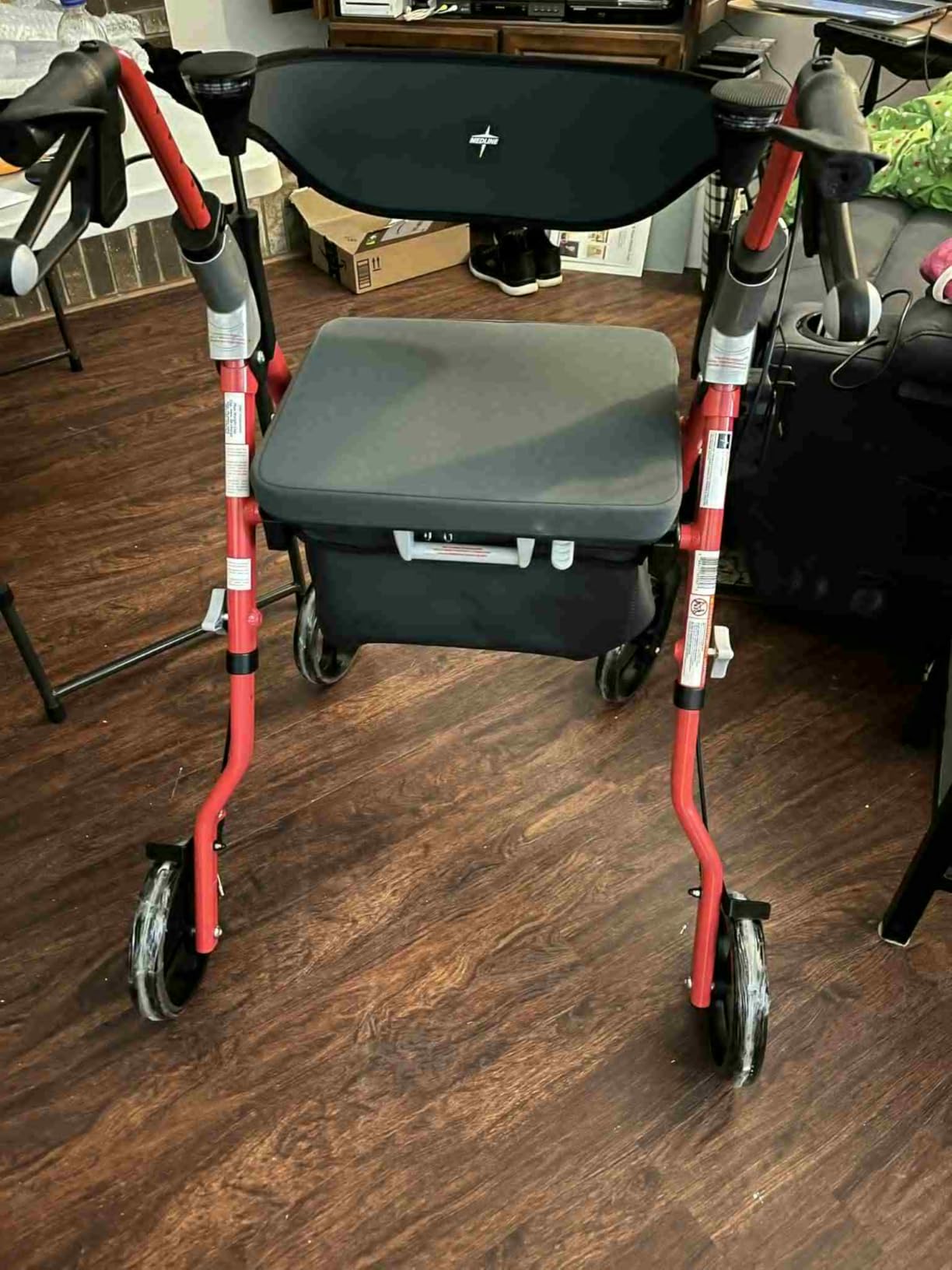
The Medline Empower is the one to buy when cost is the dominant constraint and the walking is mostly on pavement, sidewalks and indoor flooring. It is a mainstream medical-supply rollator from a brand that has been making them for years, and it does the basics properly: a 300-pound capacity, brakes that lock with a deliberate push, and a seat you would not mind sitting on for five minutes.
That seat is the reason this one stands out. A 16 by 14 inch memory foam pad with antimicrobial protection is generous, and the backrest flips forward or backward so the user can sit down from either side. For a person who plans rests along a route, being able to sit down without shuffling around the frame is a real quality-of-life difference.
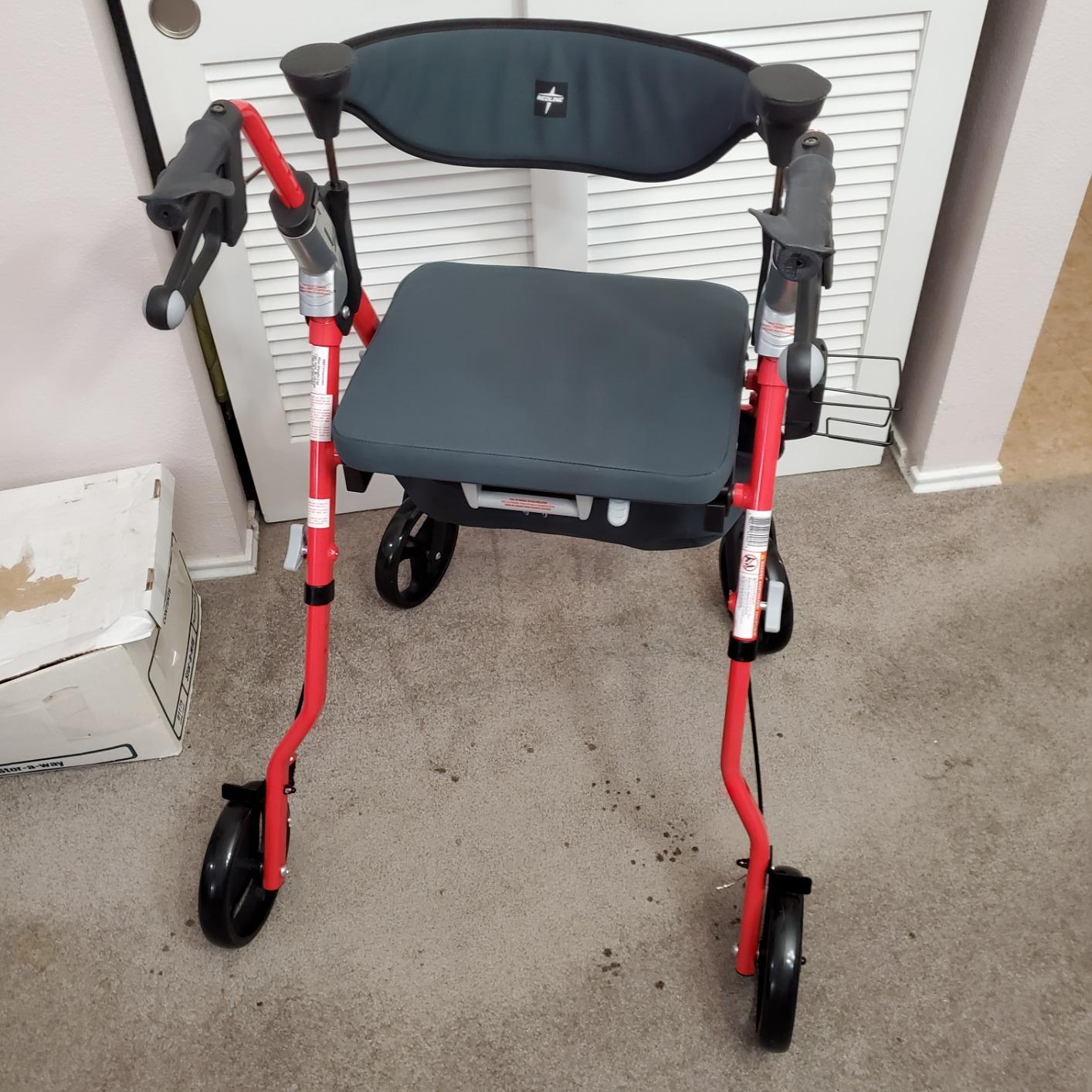
Brake operation is the other quiet strength. The levers push up to brake and push down to lock, and the handle geometry is designed around weaker grip than a small fashion brand would bother with. That is the right bias for Parkinson’s, where reduced hand strength and rigidity are common and a brake you cannot operate is a brake you do not have.
The frame is 22 pounds and the wheels are 8 inches. Those are the two compromises. Loading 22 pounds into a high trunk is a two-person job for some people, and 8-inch casters feel every crack in a pavement surface that a 10-inch or 12-inch wheel rolls over.
Who this suits for Parkinsons?
This is the sensible choice for someone on a fixed income, or simply buying a first walker before they know how much they will use it. It covers the real needs: a seat for rest, brakes that lock, height adjustment, and a capacity rating that fits most adults.
It is also a good choice for indoor-first use, because 8-inch wheels are quiet and manoeuvrable on hard flooring and small carpeted areas, and the turning circle is tighter than any of the upright models here.
Where it falls short?
Do not buy it for rough ground, unpaved paths or garden work, and do not buy it expecting forearm support. It also carries a documented durability complaint pattern in its reviews, with a meaningful share of one-star feedback about the seat canvas and frame fittings over time, so anyone buying it should check the warranty terms and keep the receipt.
We earn a commission, at no additional cost to you. CERTAIN CONTENT THAT APPEARS ON THIS SITE COMES FROM AMAZON. THIS CONTENT IS PROVIDED 'AS IS' AND IS SUBJECT TO CHANGE OR REMOVAL AT ANY TIME.
3. ELENKER Upright Walker – Best Forearm Support for Forward-Leaning Posture
ELENKER Upright Walker, Stand Up Folding Rollator Walker Back Erect Rolling Mobility Walking Aid with Seat, Padded Armrests for Seniors and Adults, Blue
★★★★★★★★★★Padded armrests adjustable 38-47 inch
10-inch front and 8-inch rear wheels
Push-forward braking
- Forearm armrests keep the spine extended
- Lightest upright model here at 18 lb
- Push-forward brakes give controlled slowing on inclines
- Breathable mesh seat stays comfortable on longer outings
- Tool-free assembly with detachable storage bag
- 8-inch rear wheels feel broken pavement
- Fit complaints leave taller users stooped
- Wobble reported by some owners
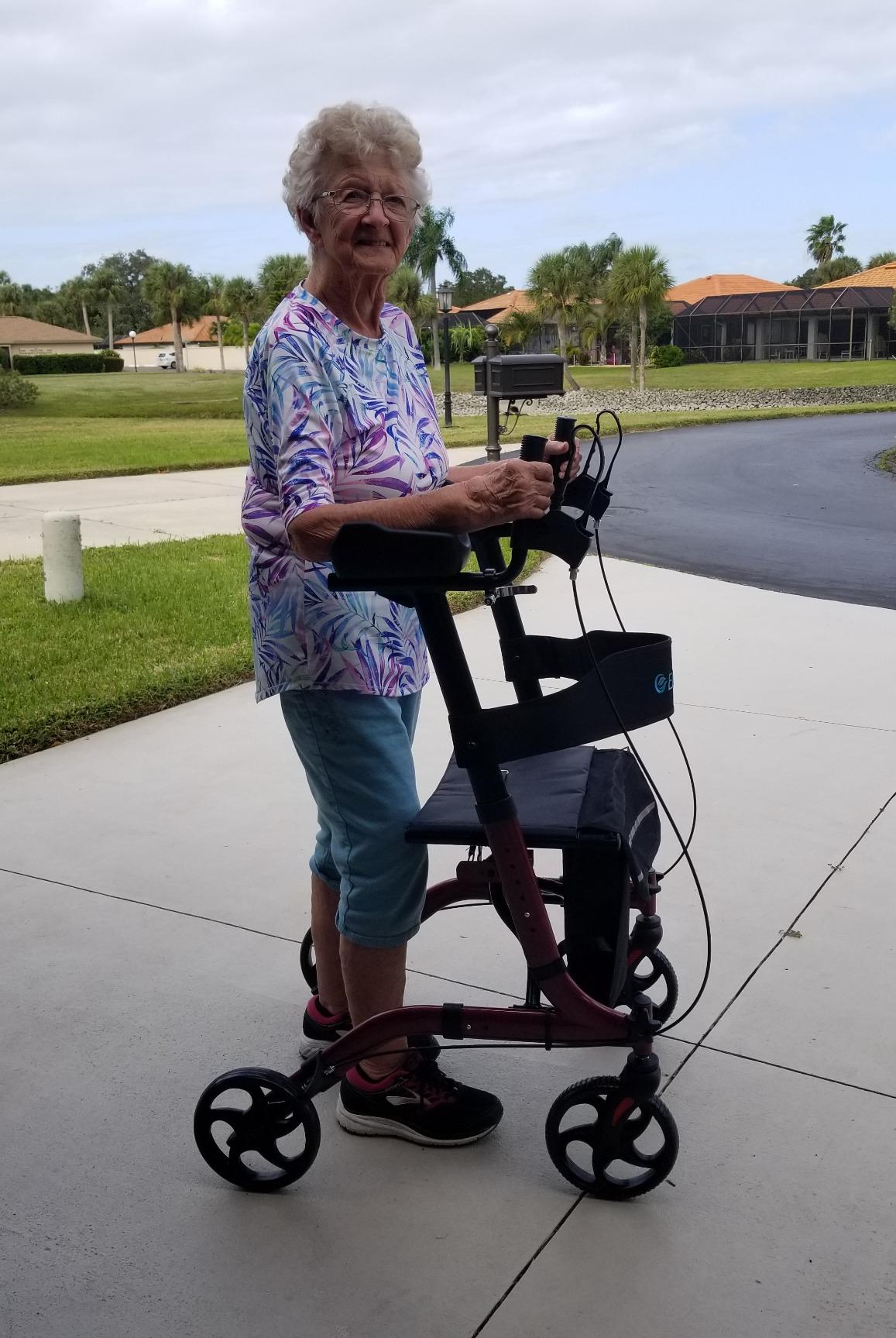
If camptocormia, or a forward stoop, is the dominant problem, this is the style of walker to test first. You rest your forearms on padded armrests instead of gripping a handlebar in front of you, and the frame holds the shoulders back. Our guides to folding walkers cover the mechanics of these frames in more depth, but the short version is that forearm support converts a walker from a thing you hang on into a thing you lean into correctly.
Brake design is the underrated feature here. The levers are push-forward: push the handle forward to slow or stop, push back to lock when you sit. That is far more forgiving than a pull-down lever for a person with tremor or limited grip strength, because you never have to make a strong downward pull to slow yourself on a slope.
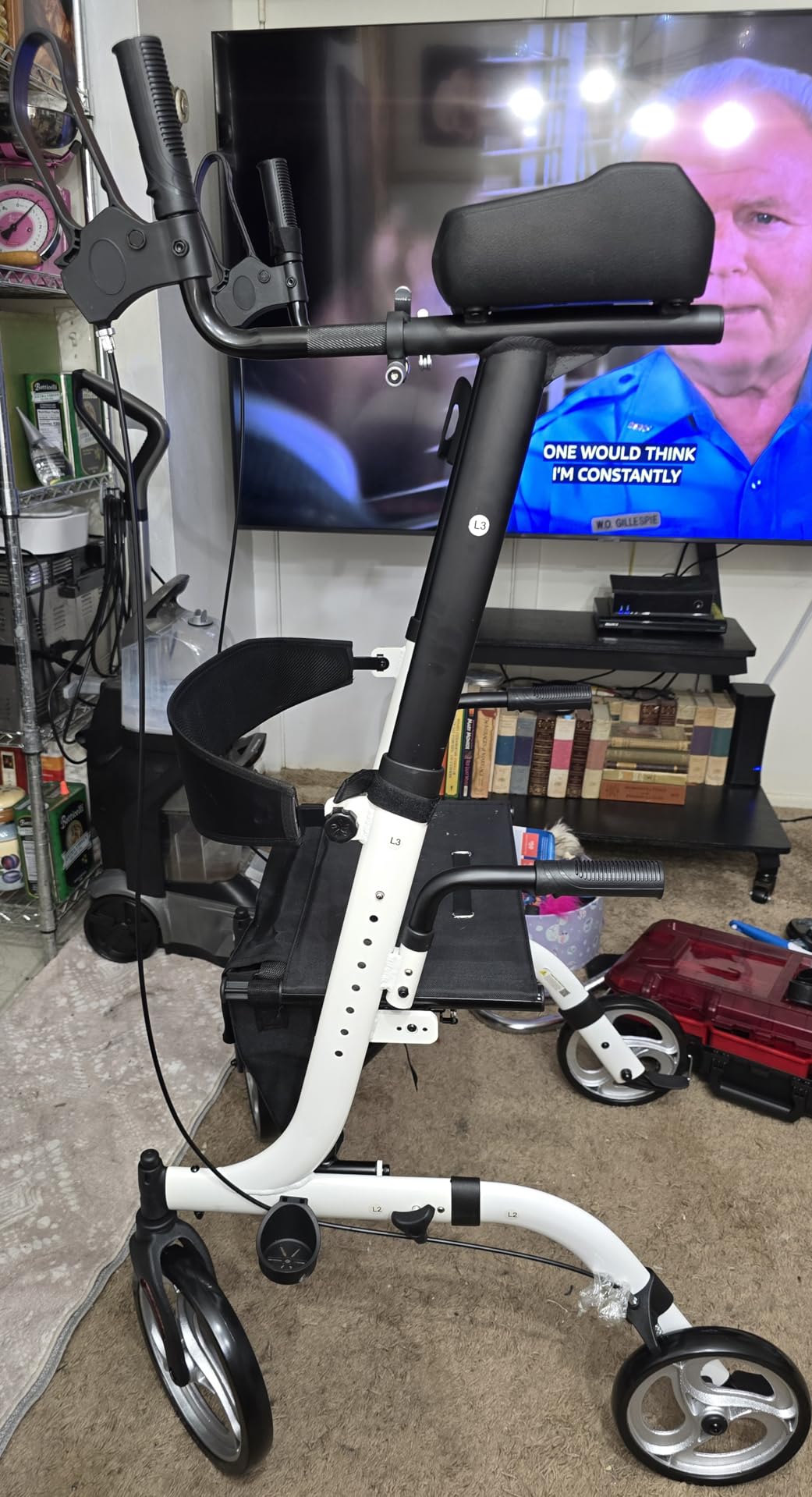
At 18 pounds, this is the lightest upright walker in the group, which matters if the walker has to be lifted into a car by a spouse or caregiver. The armrests adjust from 38 to 47 inches from the ground, and the 10-inch front casters with 360-degree swivel cover mixed indoor and outdoor surfaces reasonably well.
It is also the most heavily reviewed product on this list, which cuts both ways. A large sample means the reported drawbacks are real patterns rather than isolated complaints: 8-inch rear wheels, and a meaningful number of owners who found the sizing left them stooped anyway. Measure before you order.
Who this suits for Parkinsons?
This suits a person whose posture has progressed toward a forward lean, or who reports shoulder and back ache after using a standard rollator. It is a strong option indoors, on smooth paths and in places where tight turns are not required, because the forearm frame is wider and turns more lazily than a four-wheel rollator.
It is also the pick to look at first if the previous walker was abandoned because the handlebars made the user stoop. That complaint appears repeatedly in the reviews of standard rollators, and this is the direct fix.
Where it falls short?
Not for long outdoor routes, unpaved paths or travel. The 8-inch rear wheels transmit every bump, the turning circle is wide, and the wobble reported by a minority of owners is worth considering if balance is already the main concern. If you walk on gravel or uneven ground most days, spend the extra effort on a larger-wheeled model.
We earn a commission, at no additional cost to you. CERTAIN CONTENT THAT APPEARS ON THIS SITE COMES FROM AMAZON. THIS CONTENT IS PROVIDED 'AS IS' AND IS SUBJECT TO CHANGE OR REMOVAL AT ANY TIME.
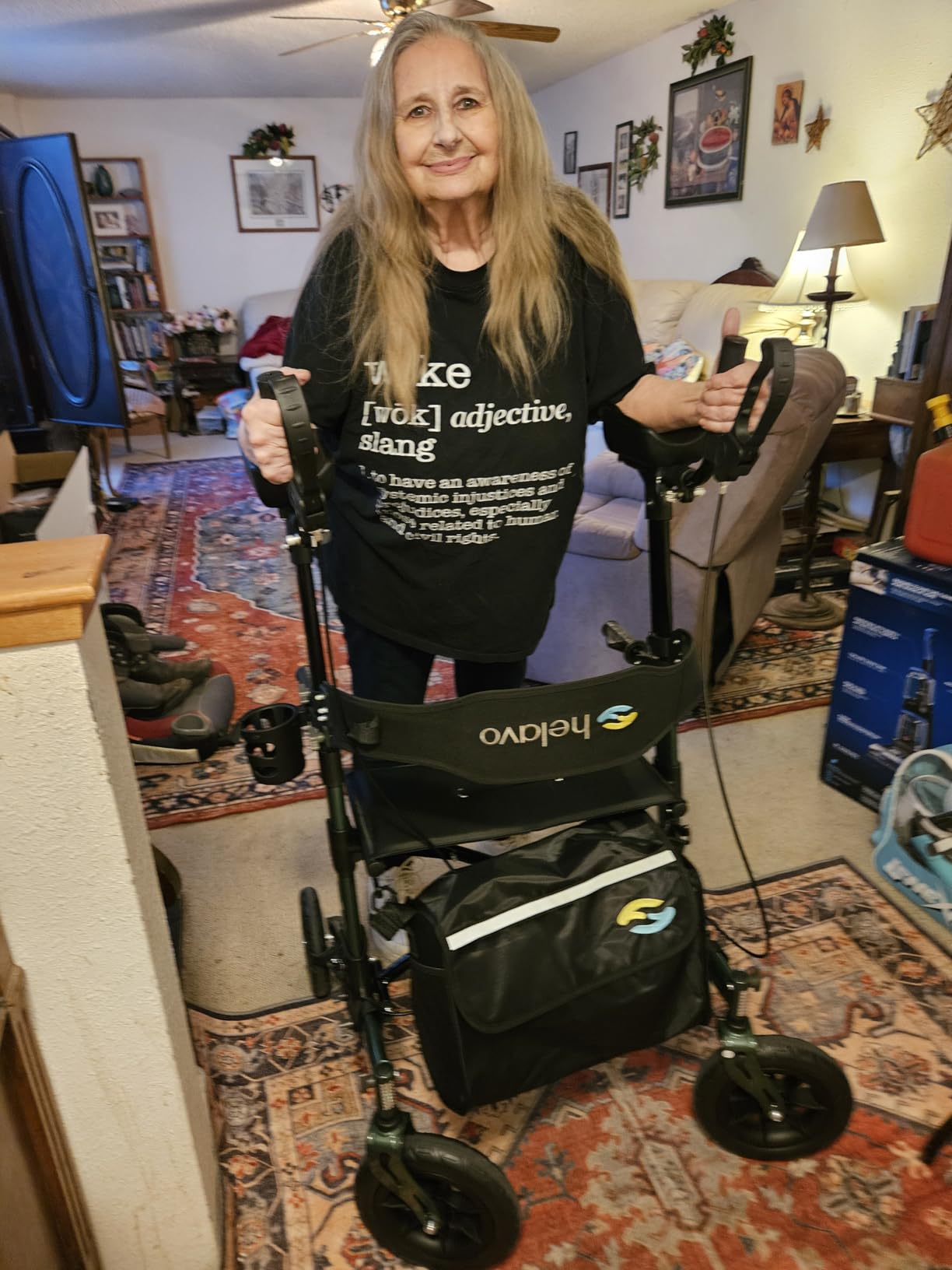
4. Helavo Upright Walker – Best Upright Walker for Padded Comfort and Outdoor Rides
Helavo Upright Walker with Seat, Foldable Stand Up Walker with Rubber Tires
★★★★★★★★★★Padded forearm armrests
10-inch puncture-proof rubber tires
300 lb capacity
- Upright forearm support eases shoulder and back strain
- Puncture-proof rubber tires remove flat-tire risk
- 18.9 inch wide padded seat with adjustable backrest
- Cup holder and cane holder keep hands free
- Two-year warranty extendable to three
- 22.7 lb frame is heavy for a single-person lift
- Fit and assembly complaints in some reviews
- Seat depth is shallow
The Helavo upright takes the forearm-support idea and improves the ride. Where most upright walkers use small hard casters, this one has 10-inch puncture-proof rubber front wheels, and the difference on a pavement joint or a garden path is immediate. Pneumatic-style rubber tires also mean you are not dealing with flat tires at all, which matters for a walker that lives outside.
The seat is 18.9 inches wide with an adjustable padded backrest, noticeably wider than the mesh seats on most upright models at this level. A wider seat is not a luxury when the purpose of the walker is to give you somewhere to sit down mid-route.
The practical touches add up. A cup holder and an integrated cane holder keep both hands on the armrests, which preserves the posture benefit that is the entire reason to buy an upright walker in the first place. A parking brake is fitted, and the warranty runs two years with an extension option to three.
Reviewers do raise two recurring points. The frame is 22.7 pounds, which is a genuinely heavy lift into a vehicle, and a small share of reviews describe assembly and sizing problems, particularly for shorter users who ended up with armrests too high.
Who this suits for Parkinsons?
Best for someone with a forward-leaning posture who still wants to walk outdoors on paths that are not showroom-flat. The upright frame handles the posture, the large rubber tires handle the ground, and the wide seat handles the rest stops.
It is also a good fit for a couple who intends to keep using the walker for years rather than months, since the puncture-proof tires and the longer warranty reduce the maintenance burden.
Where it falls short?
The 22.7-pound frame is the deal breaker for anyone who loads the walker into a car alone. If transport is part of the plan and the person using it cannot manage 20 pounds, choose a lighter upright model or a standard rollator. The upright frame also turns wide, so it is not the right tool for a narrow hallway or a small kitchen.
We earn a commission, at no additional cost to you. CERTAIN CONTENT THAT APPEARS ON THIS SITE COMES FROM AMAZON. THIS CONTENT IS PROVIDED 'AS IS' AND IS SUBJECT TO CHANGE OR REMOVAL AT ANY TIME.
5. MAXWALK 12-Inch All Terrain Rollator – Best for Gravel Paths and Uneven Ground
MAXWALK Rollator Walker for Seniors with Seat, 12″ All Terrain Wheels, Gold
★★★★★★★★★★12-inch front and 10-inch rear rubber wheels
20.3 lb triangular frame
Dual brake with speed control
- Largest wheels here at 12-inch front and 10-inch rear
- Built-in cable routing stops brake lines snagging
- Dual brakes give downhill control plus a lock
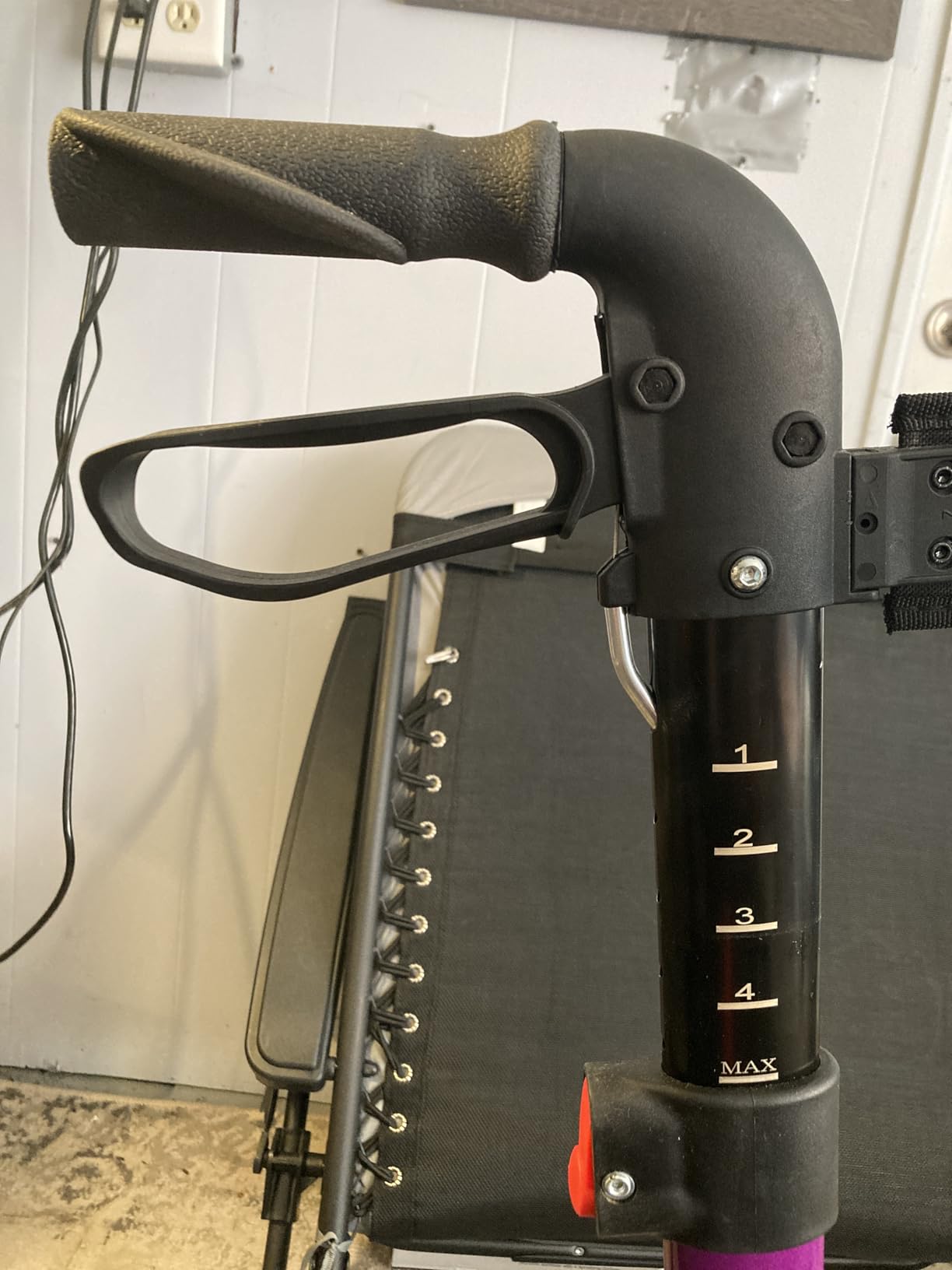
- Five-level handle adjustment fits 5 ft to 6.5 ft
- 18-month warranty
- Standard handlebars give no forearm support
- 17.5 inch seat is narrower than the bariatric options
- Handle range suits users roughly 5 ft to 6.5 ft
Wheel diameter is the feature that matters most here, and this is the biggest set on the list: 12-inch front and 10-inch rear rubber wheels with 360-degree swivel and non-slip tread. If the walking route includes a gravel driveway, a park path, grass or uneven sidewalk paving, this is the walker that will feel smoothest and least likely to stop dead in front of you.
Less visible but genuinely useful is the built-in brake cable routing. Rather than looping externally where a caster can catch a cable and where a trailing line can trip, the cables run inside the frame. For someone whose gait is already shuffling and unsteady, removing a trip hazard is not a small improvement.
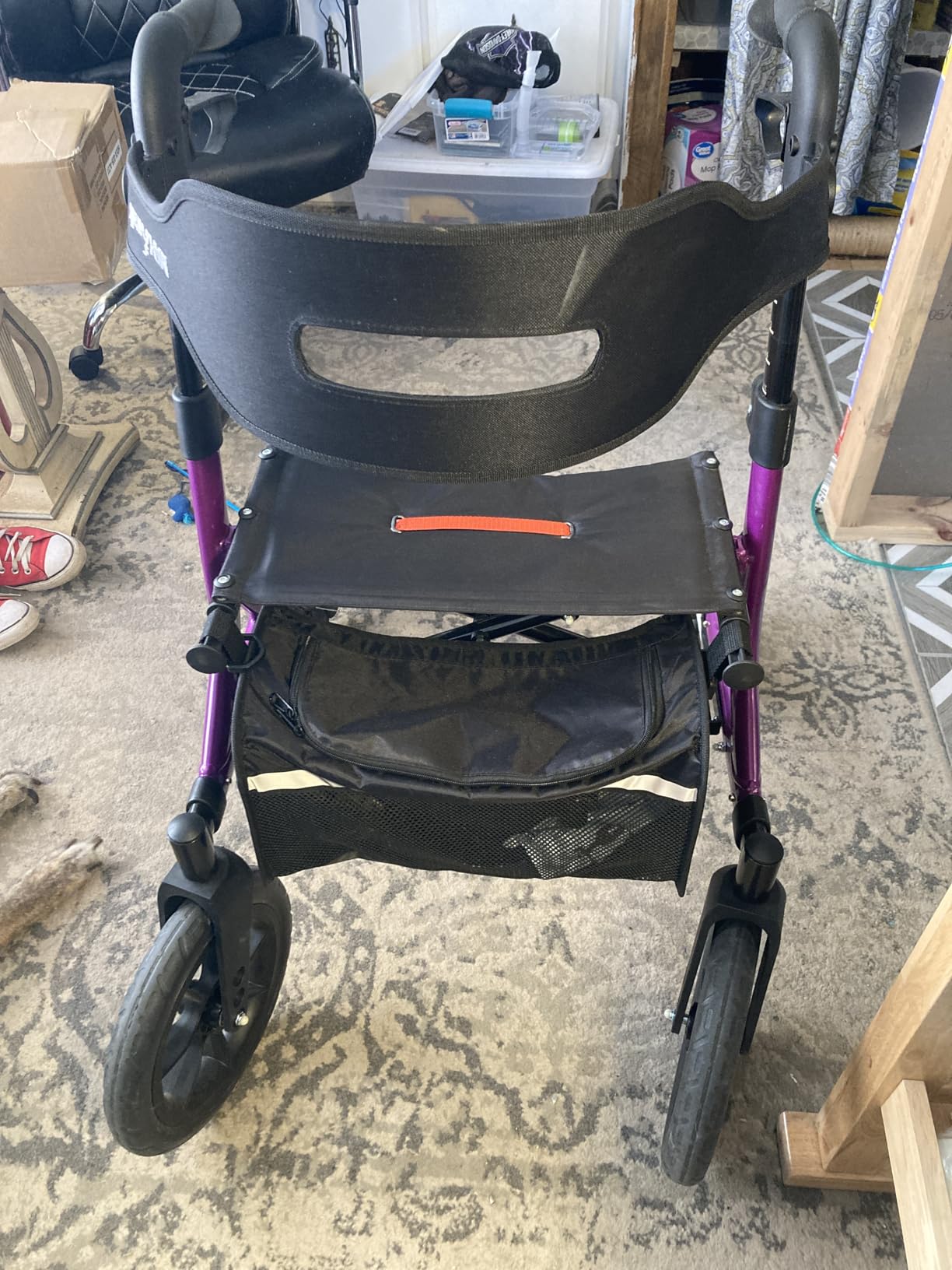
The dual brake system gives upward pressure for downhill speed control and a press-to-lock action when you sit. That two-way control is helpful on a slope, where the ability to bleed speed back rather than stop dead is the difference between a controlled descent and a fall.
It weighs 20.3 pounds, folds to a 30.7 inch flat package through a pull-cord under the seat, and carries an 18-month warranty. One detail to weigh carefully: the handle adjustment runs 33.5 to 37.4 inches, which suits users roughly between 5 feet and 6 feet 6 inches.
Who this suits for Parkinsons?
This suits someone who walks outdoors regularly on surfaces other than smooth pavement, and who has the grip strength to use a two-position brake lever. It is a strong choice for a person who still walks independently but needs a seat for longer routes and a walker that will not fight them on rough ground.
It is also worth considering for anyone who is still working or driving, because the flat fold and 20.3-pound weight make it simpler to move between a car and a destination.
Where it falls short?
If forward-leaning posture is the problem, the standard handlebar will not solve it. The 17.5-inch seat is narrower than the bariatric and Medline options, so larger users should measure their hips and check comfort. And anyone outside the 5-foot to 6-foot-6-inch handle range should skip this and pick a model with wider adjustment.
We earn a commission, at no additional cost to you. CERTAIN CONTENT THAT APPEARS ON THIS SITE COMES FROM AMAZON. THIS CONTENT IS PROVIDED 'AS IS' AND IS SUBJECT TO CHANGE OR REMOVAL AT ANY TIME.
6. Helavo Extra Wide Bariatric Rollator – Best Rated at 550 lb Capacity
Helavo 28.3″ Extra Wide Bariatric Rollator Walker, 550 lbs Capacity
★★★★★★★★★★550 lb capacity
22.4 inch handle spacing
Adjustable seat height
- Highest weight capacity in the group at 550 lb
- 22.4 inch stance gives real lateral stability
- Seat height and backrest both adjustable
- Compact folded size for storage
- Parking brake and cane holder included
- 8-inch wheels are the least smooth here on rough ground
- Standard handlebars with no forearm support
- 21.4 lb frame is heavy to lift
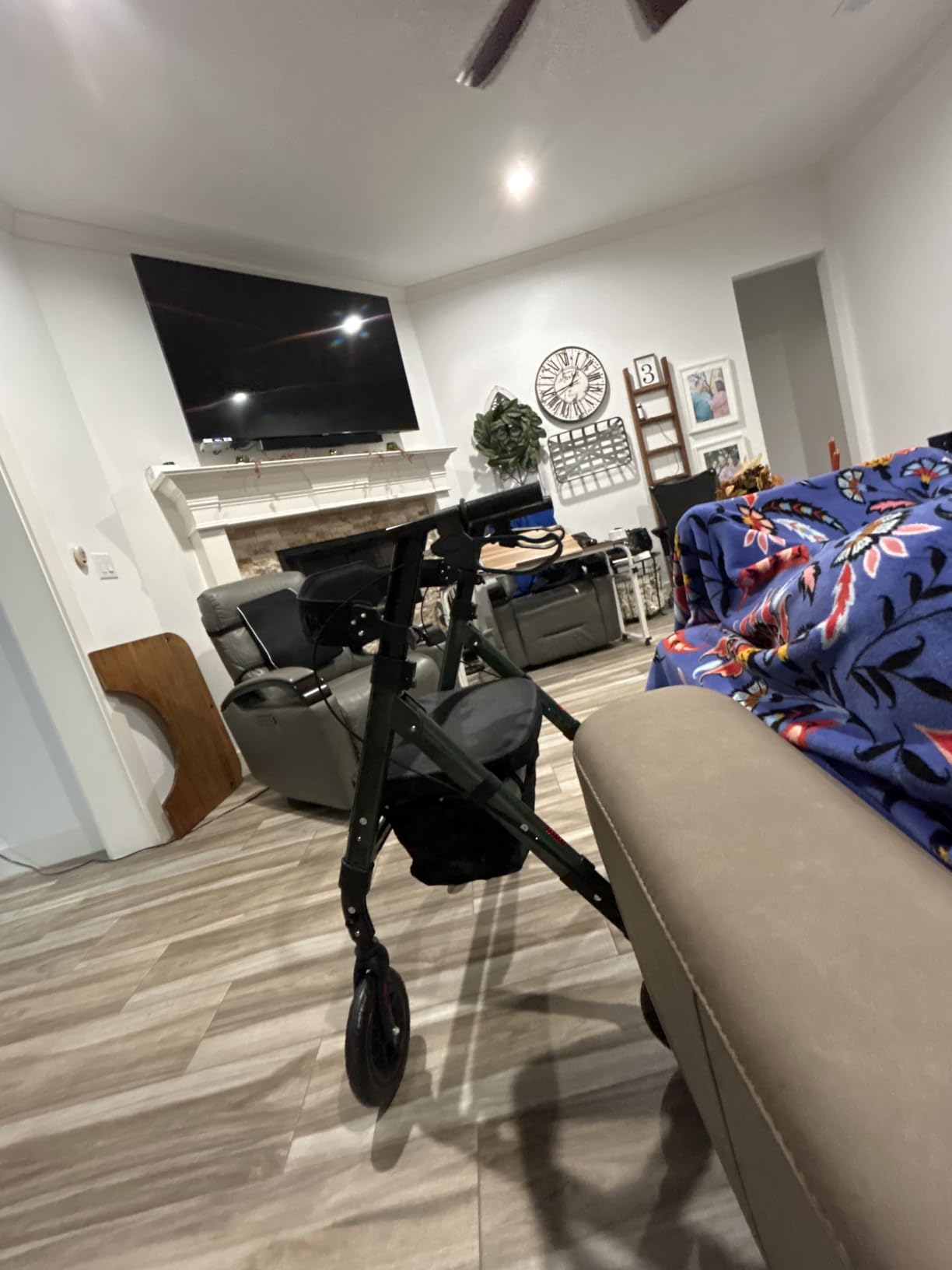
Capacity is the whole point of this one, and 550 pounds is well beyond anything else we reviewed. If the person using the walker is a heavier adult, a 300-pound rating is not a specification to gamble on: exceeding a frame rating voids the warranty and, more importantly, changes how the frame behaves when it is loaded. The wider 22.4-inch stance also resists side-to-side loss of balance, which is a different failure mode from going backward but is just as common in later-stage Parkinson’s.
Fit adjustment is unusually thorough for a bariatric frame. Handles run 33.1 to 39 inches, seat height adjusts from 20.9 to 22.8 inches, and the backrest adjusts vertically. A frame that can be dialled in is worth more than a frame that merely survives the load, because comfort is what determines whether the walker actually gets used.
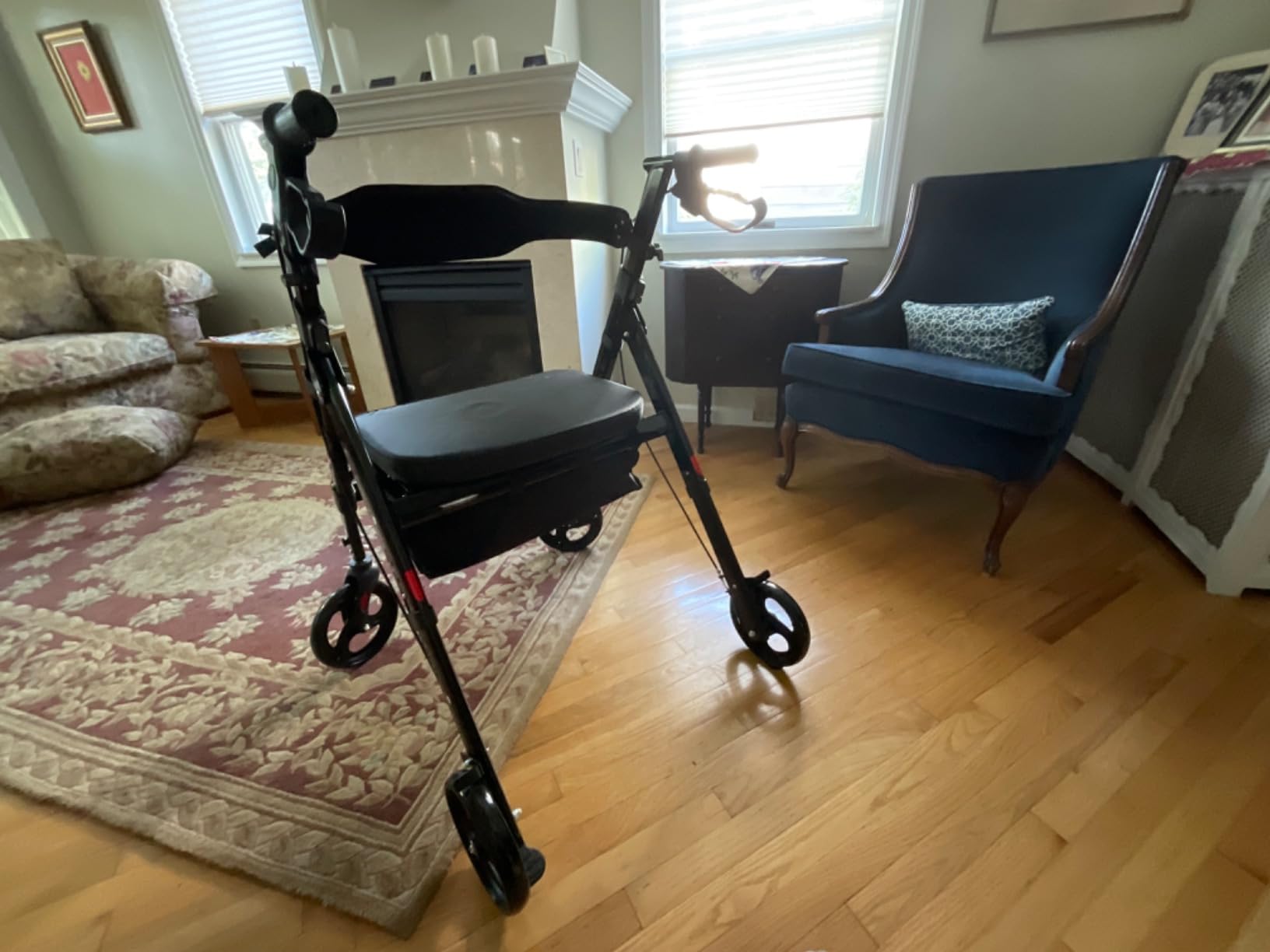
The flip-up seat over an under-seat transport basket is a practical design, and the frame folds to 37.8 by 28.3 by 13.8 inches, which stores against a closet wall more easily than the upright models. The warranty runs one year with an extension option to three.
The 8-inch wheels are the trade-off of the wider, more reinforced frame. On smooth indoor floors and decent pavement that is fine. On gravel or broken paving, expect a bumpier ride than the MAXWALK or the Nitro will give.
Who this suits for Parkinsons?
This is the pick for a heavier user who needs a rated capacity with real margin, and for anyone whose balance problems show up as side-to-side sway rather than backward motion. The wide stance and adjustable seat height also make it a good candidate for a person who finds transferring onto a low seat difficult.
Because the backrest adjusts vertically and the seat flips up, caregivers can also position it closer to a chair or bed than a fixed-back rollator allows.
Where it falls short?
It will not help forward-leaning posture, and the 8-inch wheels mean it is a poor choice as a long-distance outdoor walker on rough ground. Check the folded footprint against your storage and vehicle space before buying, because a 37.8-inch package is long.
We earn a commission, at no additional cost to you. CERTAIN CONTENT THAT APPEARS ON THIS SITE COMES FROM AMAZON. THIS CONTENT IS PROVIDED 'AS IS' AND IS SUBJECT TO CHANGE OR REMOVAL AT ANY TIME.
7. Pelegon Lightweight Rollator – Best for Car Travel and Small Homes
Pelegon Rollator Walker with Seat for Seniors – Lightweight Foldable Walker with Padded Seat & Backrest, Adjustable Handles, Reflective Frame, Carry Bag – Heavy-Duty 300lb Support – Red
★★★★★★★★★★15.6 lb frame
Folds to 7.5 inches wide
300 lb capacity
- Lightest frame in the group at 15.6 lb
- Folds to 7.5 inches wide for trunks and travel
- Reflective handle for low-light visibility
- Built-in step assist for climbing curbs
- 27 inch padded backrest
- 7.5-inch wheels are the smallest here
- Narrow 32-35 inch handle adjustment range
- Shortest listing history so less long-term data
The case for this walker is portability in a way none of the others match. At 15.6 pounds and folding to 7.5 inches wide, it goes into a car boot easily and stands against a wall in a small flat without becoming an obstacle. For a person with Parkinson’s whose world has quietly shrunk to a short corridor and a bus stop, a walker that travels is worth more than one with better suspension.
Two details are aimed squarely at outdoor use. The reflective handle improves visibility in low light, which matters for early-morning or evening walks, and the built-in step assist gives you something to step on to lift the front casters over a curb without tipping the frame.
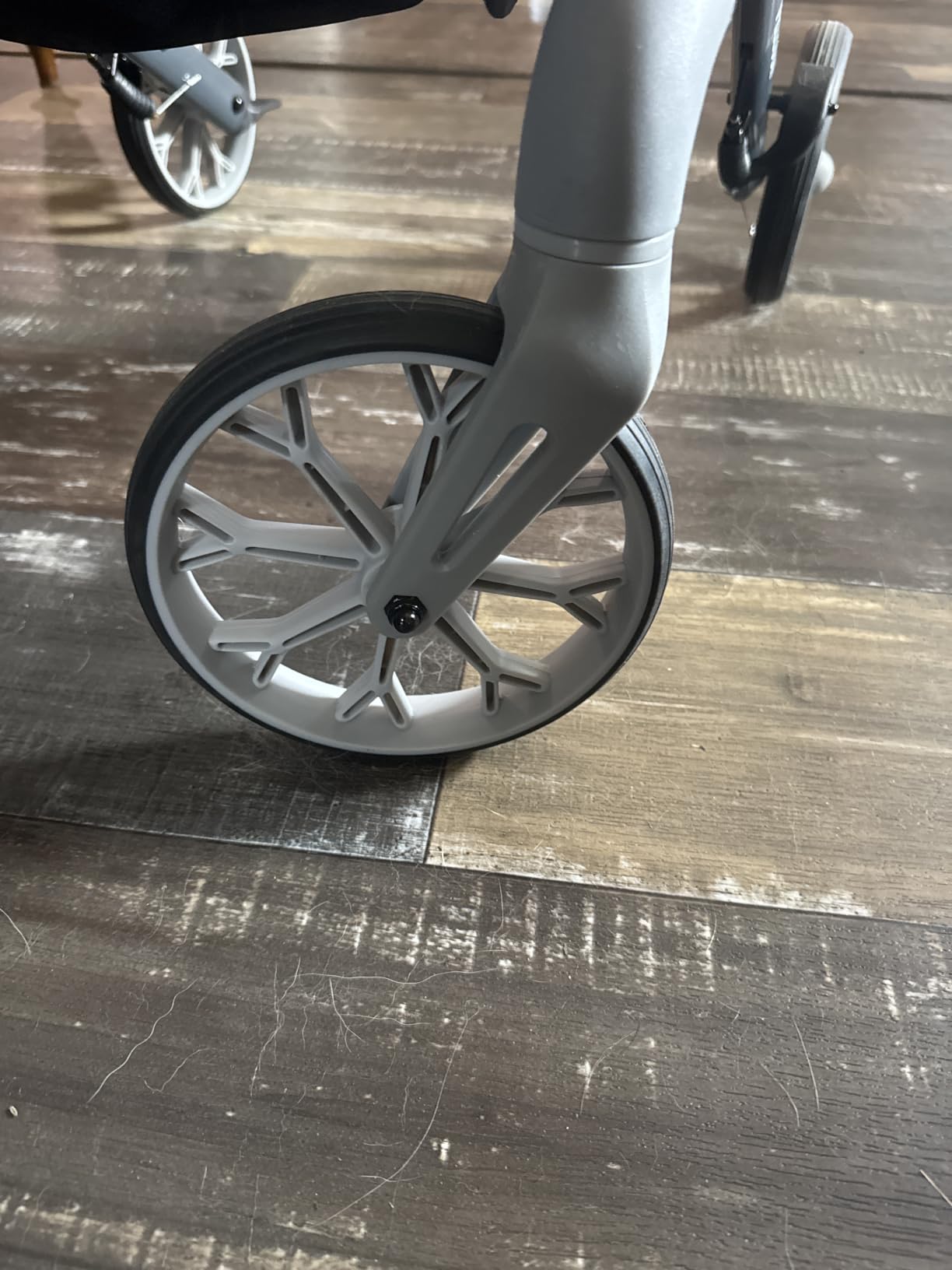
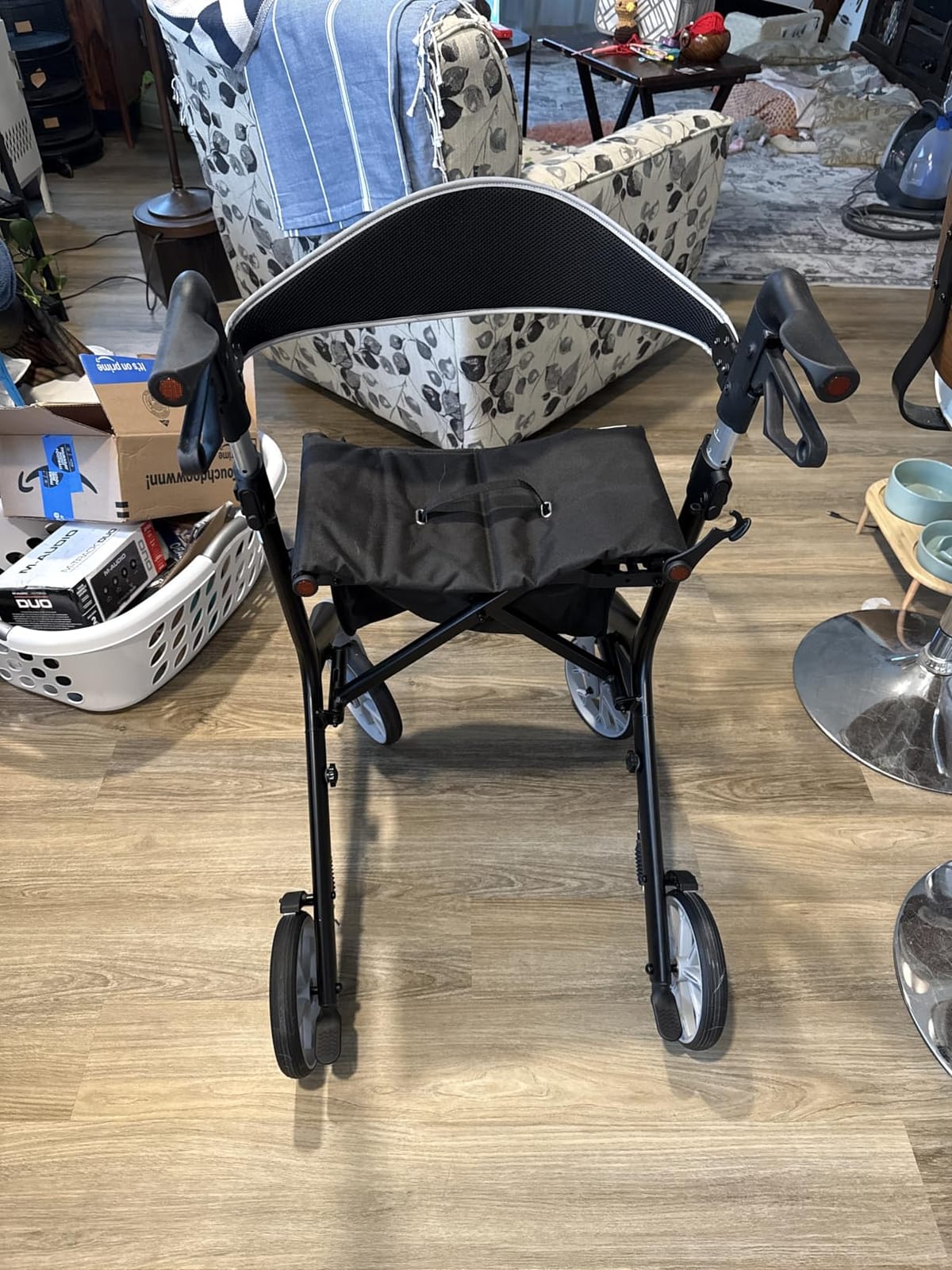
The seat is 16 by 10 inches with a 27-inch backrest, and the frame is rated to 300 pounds. Handle height adjusts from 32 to 35 inches, which is the narrowest range on this list and the main fit risk: if you are at the tall or short end of the range, look elsewhere.
Be aware of the evidence base. This is the newest listing among our picks and has the fewest reviews, so the 4.6 rating is encouraging but is a much thinner signal than the 1,842 reviews behind the Nitro.
Who this suits for Parkinsons?
This suits someone who still drives or travels, lives in compact housing, and needs the lightest frame that still has a full seat and brakes. For a person who is still working, or who splits time between a relative’s home and their own, the folded width is the feature that makes the walker usable.
The curb step assist also makes it a reasonable companion for neighbourhoods with pavement kerbs and no dropped crossings.
Where it falls short?
7.5-inch wheels are the smallest here and transmit every surface change, so it is not an outdoor-terrain walker. The handle range is tight. And because the listing is new, there is no long-term durability picture yet, which matters if the plan is a multi-year purchase.
We earn a commission, at no additional cost to you. CERTAIN CONTENT THAT APPEARS ON THIS SITE COMES FROM AMAZON. THIS CONTENT IS PROVIDED 'AS IS' AND IS SUBJECT TO CHANGE OR REMOVAL AT ANY TIME.
8. VOCIC Z22 Upright Walker – Best GelSoft Armrests for Elbow Pressure
VOCIC Z22 Upright Walkers for Seniors with Seat, GelSoft Stand Up Walker
★★★★★★★★★★GelSoft armrest layer
Flip-out armrest adds 4.7 inches
Handle 40-47 inch
- GelSoft layer disperses elbow pressure across the forearm
- Flip-out armrest widens the seat when needed
- Tall 40-47 inch handle range suits taller users
- Support has replaced a cracked armrest without a return
- Narrow seat and fixed armrests drive most returns
- No lower grab handles for rising from the seat
- Hand-brake only with no foot brake
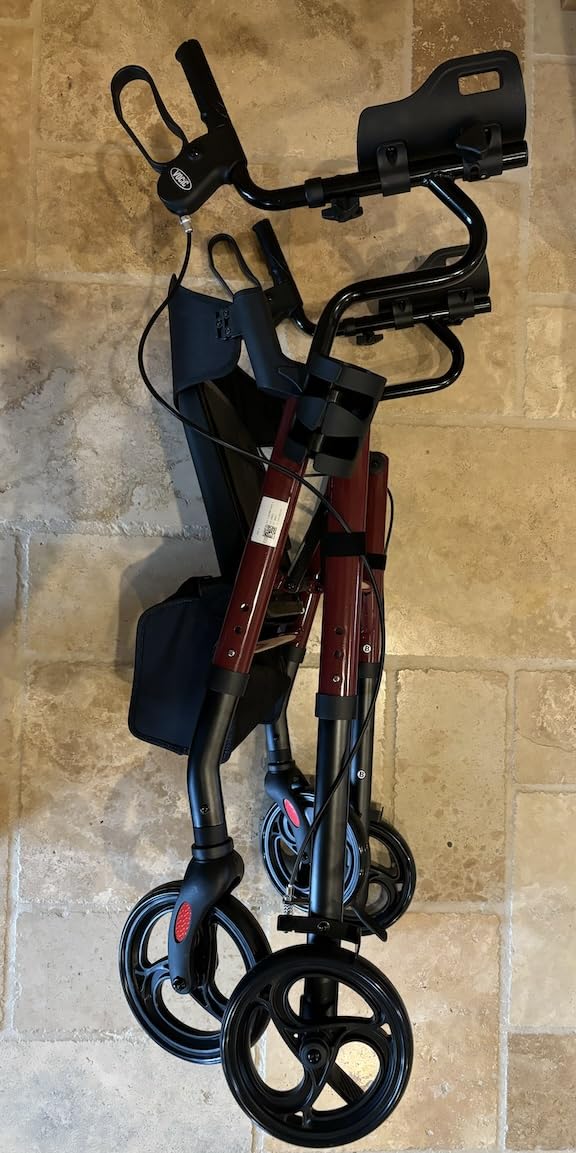
The VOCIC’s pitch is the armrests. A gel-like outer layer spreads the load of the forearm across the whole arm instead of concentrating it in a small contact patch, and users with joint problems report that the shock-absorbing feel reduces the impact that arrives at the wrist and elbow. One caregiver reviewing this model specifically for a relative with Parkinson’s-related movement described the upright format as removing shoulder and neck pressure that a standard walker had caused.
The patented flip-out armrest is a genuinely clever feature. Folding it out adds 4.7 inches of seat width on demand, which is the obvious answer to this walker’s most common complaint. Handle height reaches 47 inches, higher than most other models here, which matters for users who stoop on shorter upright walkers.
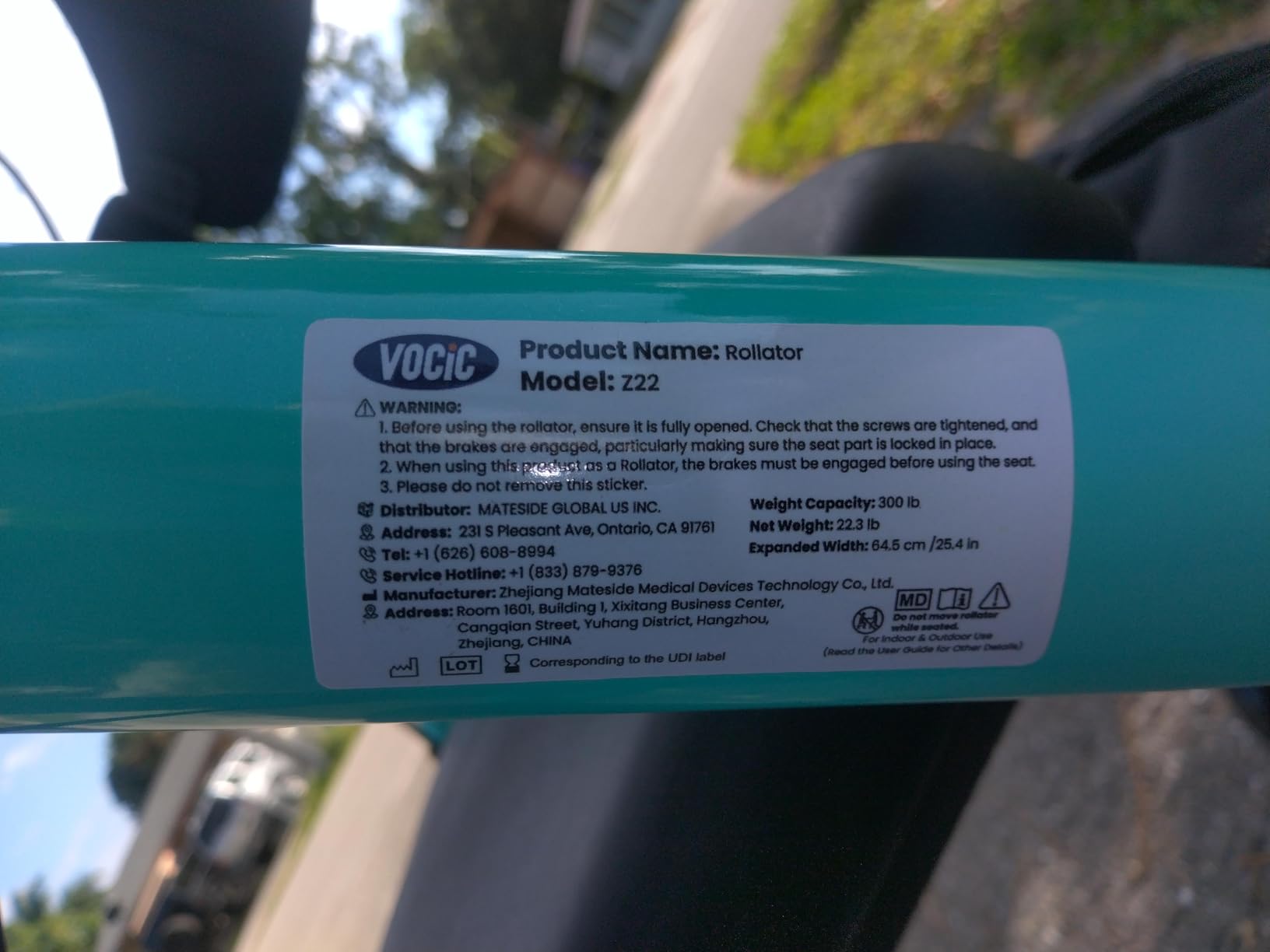
It is also the newest listing on the list, and sentiment is the most divided of any product we reviewed. Several buyers returned it because the seat is too narrow to use even with the armrest flipped out, and because the fixed armrests are struck by the arms when sitting down. We rate it lowest of the eight, and that is about the product rather than the reviewer pool.
One more caution: it is hand-brake only, with no foot brake, and it explicitly requires adequate hand grip. Anyone with advanced rigidity in the hands should rule it out.
Who this suits for Parkinsons?
This suits a taller user with forearm, wrist or elbow pain who has found standard rollator handles uncomfortable, and who has checked their seat width against their body before ordering. The 40-to-47-inch handle range makes it the best-postured option here for a user above average height.
It is also worth a look for anyone who spends long stretches walking with an existing shoulder or neck condition, since the upright format takes weight off the shoulders entirely.
Where it falls short?
Do not buy it without sitting in it first if possible. The narrow seat is the repeated reason for returns, and there are no lower grab handles, which makes rising from the seat harder precisely at the moment a person with freezing of gait needs it most. It is also the least-proven of the upright models here, with the fewest reviews behind its rating.
We earn a commission, at no additional cost to you. CERTAIN CONTENT THAT APPEARS ON THIS SITE COMES FROM AMAZON. THIS CONTENT IS PROVIDED 'AS IS' AND IS SUBJECT TO CHANGE OR REMOVAL AT ANY TIME.
How to Choose a Walker for Parkinsons Disease?
Rank the features by the symptom you actually have, not by the feature sheet. The order below roughly reflects how much each one changes day-to-day safety in this condition.
1. Brake type and feel. This is the first thing to test in person, with the salesperson watching rather than helping. On most models, pulling the lever down slows the walker and pushing up locks it. Lock-by-squeeze brakes lock when you squeeze upward, which gives you a controlled descent and a frame that resists rolling away. Push-forward levers let you slow without a hard pull. What to avoid is any brake that locks instantly and lightly during an ordinary stop, because an unexpected locked wheel is a fall.
2. Handle geometry. Standard handlebars let you grip in front of you, which encourages a forward lean. Upright or platform walkers support the forearms on padded rests and hold the spine extended. If you already stoop, an upright frame is usually the better long-term choice, at the cost of a wider turning circle and a heavier frame.
3. Wheel diameter and tyre type. Small casters are quiet and nimble indoors but feel every crack. 8-inch wheels suit smooth paving. 10-inch casters handle kerbs and uneven sidewalks. 12-inch front wheels handle gravel, grass and broken surfaces. Rubber or puncture-proof tyres remove flat-tire risk entirely and roll more quietly on hard floors than air-filled pneumatic tyres.
4. Seat width and seat height. A seat that is too narrow is a seat you cannot use, which defeats the purpose of a rollator. Look for 16 inches or more if the user is larger, and check whether the seat height is adjustable, because a higher seat means a lower centre of gravity and a shallower squat when standing up. The seat-transfer question deserves special attention: forums consistently identify getting up from a stopped rollator during a freeze as the hardest real-world moment, and a wider seat with back support makes that moment survivable.
5. Weight and folded size. The frame weight on this list runs from 15.6 to 22.7 pounds, and the difference decides whether one person can load it into a car. If a caregiver is the one lifting the walker, the light end of the range is worth a great deal. Our guide to hemi walkers covers lighter-frame options for anyone still partly weight-bearing.
6. Weight capacity. Standard frames here are rated to 300 pounds. The bariatric model is rated to 550 pounds. Check the rating against the user’s actual weight with some margin, and never exceed it.
7. Accessories that matter. A removable storage pouch or under-seat basket for medication and a phone, a cup holder so both hands stay on the armrests, a cane holder, and reflective elements if walks happen at dawn or dusk. A parking brake is worth insisting on.
Brakes when grip is the problem. Parkinson-related rigidity and reduced hand strength make some brake designs unusable. Push-forward levers need the least force. Lock-by-squeeze brakes need a controlled upward pinch. Anyone who cannot reliably apply deliberate hand force should not be left to discover that at the bottom of a ramp, which is one more reason the clinical assessment comes before the purchase.
Buying for a home, not a showroom. Walk the route before you buy. Measure the narrowest doorway, the hallway turn radius, and the trunk opening. Lift the walker into the car yourself, unaided, on a bad day rather than a good one. Note where the user will sit, because that surface needs to be firm and reasonably high.
Insurance and prescription. In the United States, walkers are durable medical equipment and can be covered under Medicare Part B or a Medicare Advantage plan when a doctor documents medical necessity. Because coverage rules vary, confirm the plan’s requirements and whether a prescription is needed before buying out of pocket, and keep all documentation.
When a rollator is no longer the right tool. If the user cannot reliably stand from the seat, cannot operate the brakes safely, or is falling multiple times a week, escalate. A transport chair or wheelchair with caregiver assistance protects both the user and the caregiver. This is a conversation to have early, not after a bad fall.
Who Should Not Use a Rollator Walker?
Some situations call for a different aid, or a clinical assessment first. Do not choose a rollator without advice if any of the following apply:
You cannot stand up from the seat with a normal, controlled push. A rollator is a walking aid, not a transfer aid, and a seat you cannot leave is worse than no seat.
You cannot operate the brakes deliberately and reliably. This includes both cognitive impairment that prevents safe brake use and hand weakness or rigidity that makes a lever impossible to control.
Your weight exceeds the frame’s rated capacity.
You are actively collapsing in standing, or need full weight-bearing support through both arms. That calls for a standard walker or a transfer device, not a rollator.
You have significant backward falls, or a history of injuries from a walker rolling away. A four-wheel rollator has no frame behind you, so it cannot stop a retropulsion episode on its own.
You have not been assessed by a neurologist, physical therapist or occupational therapist. Parkinson’s symptoms vary widely, and the wrong geometry can make a gait worse rather than safer.
Frequently Asked Questions
What is the best rollator for people with Parkinsons disease?
The best rollator for Parkinson’s is one with brakes that lock by squeezing the lever upward, wheels at least 8 inches for the ground you walk on, and a seat you can stand up from. For freezing of gait, add a separate visual or rhythmic cueing routine, and consider a frame designed to resist backward rolling. Always have a physical therapist assess you before buying.
What is the best upright walker for Parkinsons disease?
The best upright walker for Parkinson’s is one with padded forearm armrests that hold your torso extended, because this directly counters the forward-leaning posture that develops over time. The trade-off is real: upright walkers turn more slowly, weigh more, and suit shorter routes on smooth ground rather than long outdoor walks.
What type of walker is best for Parkinsons and fall risk?
For fall risk caused by backward motion, look for a walker with brakes that lock by squeezing upward, larger wheels, and a wide stance. For falls caused by forward-leaning posture, an upright or platform walker is the better match. For falls caused by shuffling and tripping, a lightweight rollator with large front casters and routed brake cables is the practical answer.
Are loop brakes better for Parkinsons?
Loop brakes, which lock when you squeeze the lever upward rather than pull it down, suit many people with Parkinson’s because they give controlled slowing on a slope and stop the walker rolling away. They are not universally better. They require deliberate hand force, and users with tremor or advanced rigidity can lock the wheels unintentionally. Test the brake in person with a salesperson watching.
Does Medicare cover a walker for Parkinsons?
In the United States, walkers are durable medical equipment that can be covered under Medicare Part B or a Medicare Advantage plan when a doctor documents medical necessity. A prescription may be required. Coverage rules vary by plan and by whether the supplier is in network, so confirm with your plan and keep all documentation before buying.
How do I stop freezing while using a walker?
Freezing during a walk is usually broken by an external cue rather than by force. Auditory cueing, like a metronome or a rhythmic sound played at a steady beat, and a visual line on the ground are the two most commonly used approaches and are worth building into your routine with a physical therapist. Practise the cue in a safe environment before relying on it outdoors, and never try to force your way out of a freeze on uneven ground.
The Walker Worth Buying for Parkinsons in 2026
For most people with Parkinson’s, the Drive Medical Nitro is the safest first purchase: light enough to load into a car, big wheels for uneven ground, and the strongest review record of anything we reviewed. If forward-leaning posture is the main complaint, test an upright walker such as the ELENKER or Helavo in person. If rough ground is the reality, the MAXWALK’s 12-inch front wheels are the difference between a smooth walk and a stop-start shuffle.
Whatever you choose, have your neurologist or physical therapist look at the fit before you commit, and remember that the right aid changes as symptoms change. Our related reads on knee walkers with brakes and upright walker frames cover the other styles people ask us about most.