
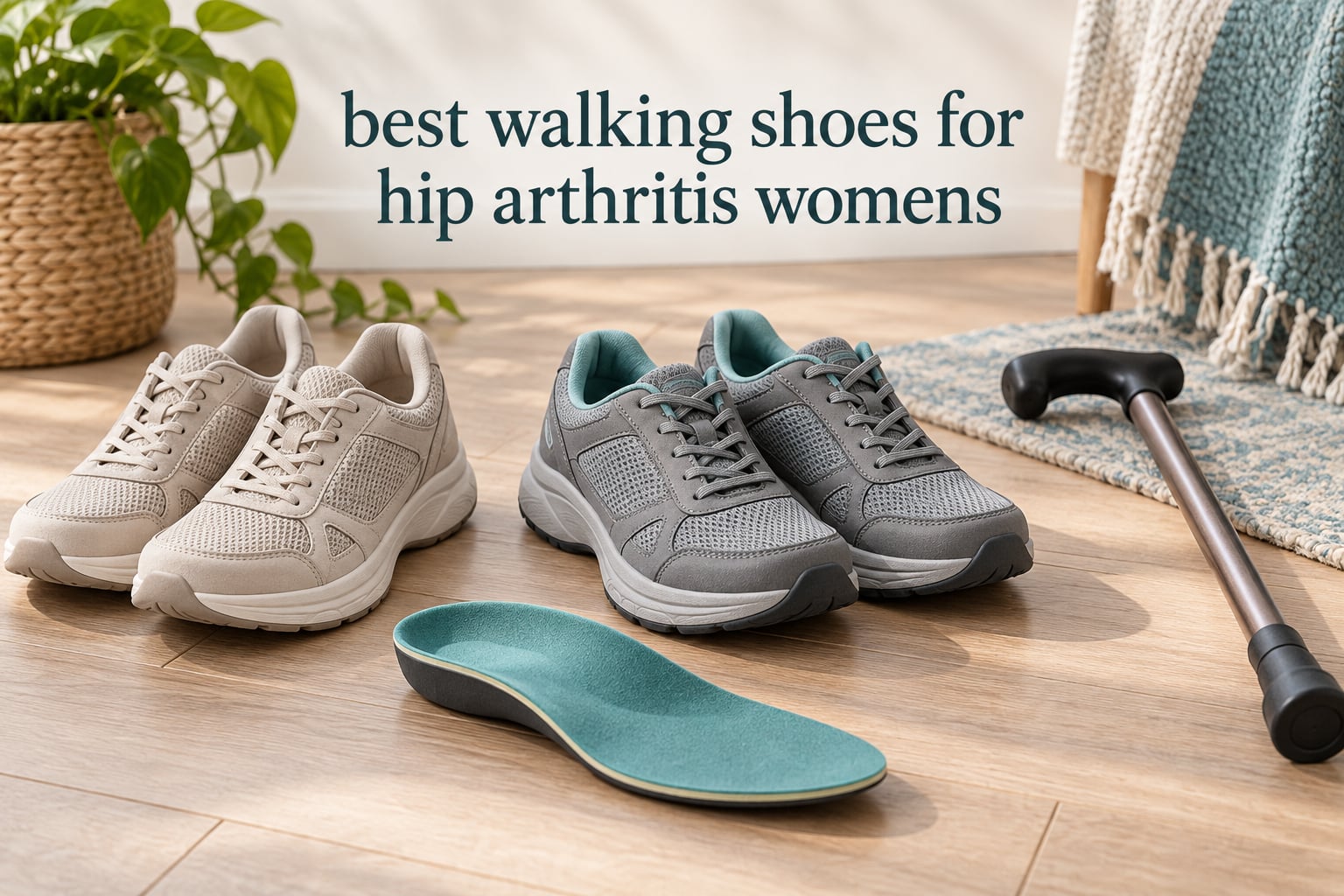
If you are looking for the best walking shoes for hip arthritis, women should start with three picks: the New Balance Fresh Foam Roav for lightweight cushioning that does not drag your gait, the Skechers Go Walk Flex Grand for hands-free slip-on entry, and the New Balance 608 V5 for a firm, durable workhorse that survives daily pavement walking. All three share the three things that matter most: a cushioned sole, a low heel, and a firm heel counter.
I have spent the last few months reading thousands of verified buyer reviews on orthopedic, running, and walking shoes for women, and cross-referencing them against what podiatrists and physical therapists actually tell arthritis patients about the foot-to-hip connection. This is the list that came out of that work, updated for 2026.
One important note before we start. This article is not medical advice, and no shoe treats or reverses arthritis. What shoes can do is change how much impact reaches an already-weary hip joint over the course of a day, which for many people is the difference between walking the dog and sitting out.
Last updated: 2026. We earn a commission from qualifying purchases, and that never changes which shoes make this list or how they are ranked.
Table of Contents
- Key Features to Look For in a Hip-Friendly Walking Shoe
- Why Shoe Choice Changes the Load on Your Hip?
- Top 3 Best Walking Shoes For Hip Arthritis (October 2026)
- All 10 Picks Compared Side by Side
- 1. New Balance Fresh Foam Roav – Lightweight Cushioning Without the Weight
- 2. Skechers Go Walk Flex Grand – The Answer When You Cannot Bend to Tie Laces
- 3. New Balance 608 V5 – The Durable Daily Workhorse
- 4. Hoka Bondi 9 – Maximum Cushioning, With a Durability Warning
- 5. New Balance 877 V1 – The Widest Range of Widths Available
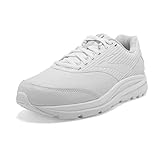
- 6. Brooks Addiction Walker 2 – Stability Control With Medical Credentials
- 7. Ryka Devotion Plus 3 – Built on a Women’s Last
- 8. Orthofeet Coral – The Dedicated Orthopedic Pick
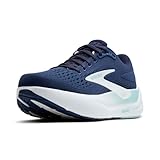
- 9. Brooks Ghost Max 3 – High Arches and Orthotic-Friendly Volume
- 10. Brooks Adrenaline GTS 25 – If You Still Run
- How to Choose: A Buying Guide for Hip Osteoarthritis?
- The Heel-Counter Pinch Test in 3 Steps
- Women’s Fit Problems Nobody Mentions
- Shoes to Avoid With Hip Arthritis
- Insoles, Rotation, and Surgery
- When a Shoe Is Not Enough?
- Frequently Asked Questions
- Bottom Line
Key Features to Look For in a Hip-Friendly Walking Shoe
Before any brand name, these are the three attributes that do the most work. Every pick below was chosen because it delivers at least two of them clearly.
A cushioned sole. A midsole that absorbs and returns less impact per step reduces the ground reaction force travelling up through your leg into the hip joint. This matters most on concrete, tile, and airport floors.
A low heel, ideally under one inch. Every inch of heel raises you at the front of the foot, which tilts your pelvis forward and pushes the hip joint into a position where load concentrates in the front of the joint capsule. A flatter sole keeps your weight distributed.
A firm heel counter. This is the rigid cup around the back of the heel. A firm counter limits pronation, which limits how far your femur and hip rotate inward on each step. A soft, collapsible heel counter is the single most common reason a “comfortable” shoe still aggravates hip pain.
Two more that matter for women specifically: a removable insole, so you can add an orthotic later without replacing the whole shoe, and a wide toe box, so bunions and swelling do not force your foot into a compromise fit all day.
Why Shoe Choice Changes the Load on Your Hip?
Your foot, ankle, knee, and hip function as a single kinetic chain. Every time your heel lands, the ground pushes a force back up through your leg. How much of that force reaches your hip depends almost entirely on what is between your foot and the pavement.
Research indexed in the NIH/PMC literature describes this chain in terms of ground reaction force and joint load, and the practical takeaway is straightforward. A foot that over-pronates rotates inward, and that rotation carries the femur and the hip joint with it, grinding the joint surfaces rather than absorbing the shock. Footwear controls that: the midsole absorbs impact, the heel counter limits the rotation, and the heel-to-toe drop determines how much your pelvis tilts forward at mid-stride.
This is why the wrong shoe can make hip pain worse even though your hip has not changed. And it is why a genuinely supportive shoe often feels slightly less plush than the one you are used to. You are trading a little cloud-like softness for a lower load reaching a joint that already has less cartilage than it did ten years ago.
Long-time patients on the BoneSmart hip replacement forum put it more bluntly: a firm heel counter limits pronation, which means less rotation of the hip. A flat, even sole matters more to most people than any brand name. That is the principle behind every pick on this list.
Top 3 Best Walking Shoes For Hip Arthritis (October 2026)

New Balance Fresh Foam Roav
- Fresh Foam midsole cushioning
- Removable insole with arch support
- Lightweight bootie construction

Skechers Go Walk Flex Grand
- Hands-free slip-on entry
- Ultra GO cushioning
- Memory foam insole
All 10 Picks Compared Side by Side
| Product | Key Specs | Pricing |
|---|---|---|
| New Balance Women’s Fresh Foam Roav |
|
Check Latest Price |
| Skechers Women’s Go Walk Flex Grand |
|
Check Latest Price |
 New Balance Women’s 608 V5 New Balance Women’s 608 V5 |
|
Check Latest Price |
 Hoka Bondi 9 Hoka Bondi 9 |
|
Check Latest Price |
 New Balance Women’s 877 V1 New Balance Women’s 877 V1 |
|
Check Latest Price |
 Brooks Women’s Addiction Walker 2 Brooks Women’s Addiction Walker 2 |
|
Check Latest Price |
 Ryka Women’s Devotion Plus 3 Ryka Women’s Devotion Plus 3 |
|
Check Latest Price |
 Orthofeet Coral Orthopedic Sneakers Orthofeet Coral Orthopedic Sneakers |
|
Check Latest Price |
 Brooks Women’s Ghost Max 3 Brooks Women’s Ghost Max 3 |
|
Check Latest Price |
 Brooks Women’s Adrenaline GTS 25 Brooks Women’s Adrenaline GTS 25 |
|
Check Latest Price |
1. New Balance Fresh Foam Roav – Lightweight Cushioning Without the Weight
New Balance Women’s Fresh Foam Roav V1 Running Shoe, Sea Salt/Bone/Incense, 7.5 W
★★★★★★★★★★Fresh Foam midsole
Removable insole with arch support
Lightweight bootie construction
- Very lightweight for a cushioned shoe
- Plush impact absorption on hard surfaces
- Removable insole accepts an added orthotic
- Wide width versions fit wider feet
- Runs small in standard widths
- Mesh over the toes thins with heavy use
- Little vertical room under the insole
This is the shoe I come back to for most women describing hip pain on long walks. The Fresh Foam midsole gives you a genuinely soft landing without the slab-like sensation that makes some cushioned shoes feel like walking with blocks strapped to your feet, and at eight ounces for the package it barely registers on your scale at all.
The Ultra Heel design cups the back of the foot and, according to reviewers, does not stab the heel the way a conventional collar can. That matters more than it sounds. A heel that rubs or shifts changes your step, and a changed step is exactly what you are trying to avoid with a sore hip.
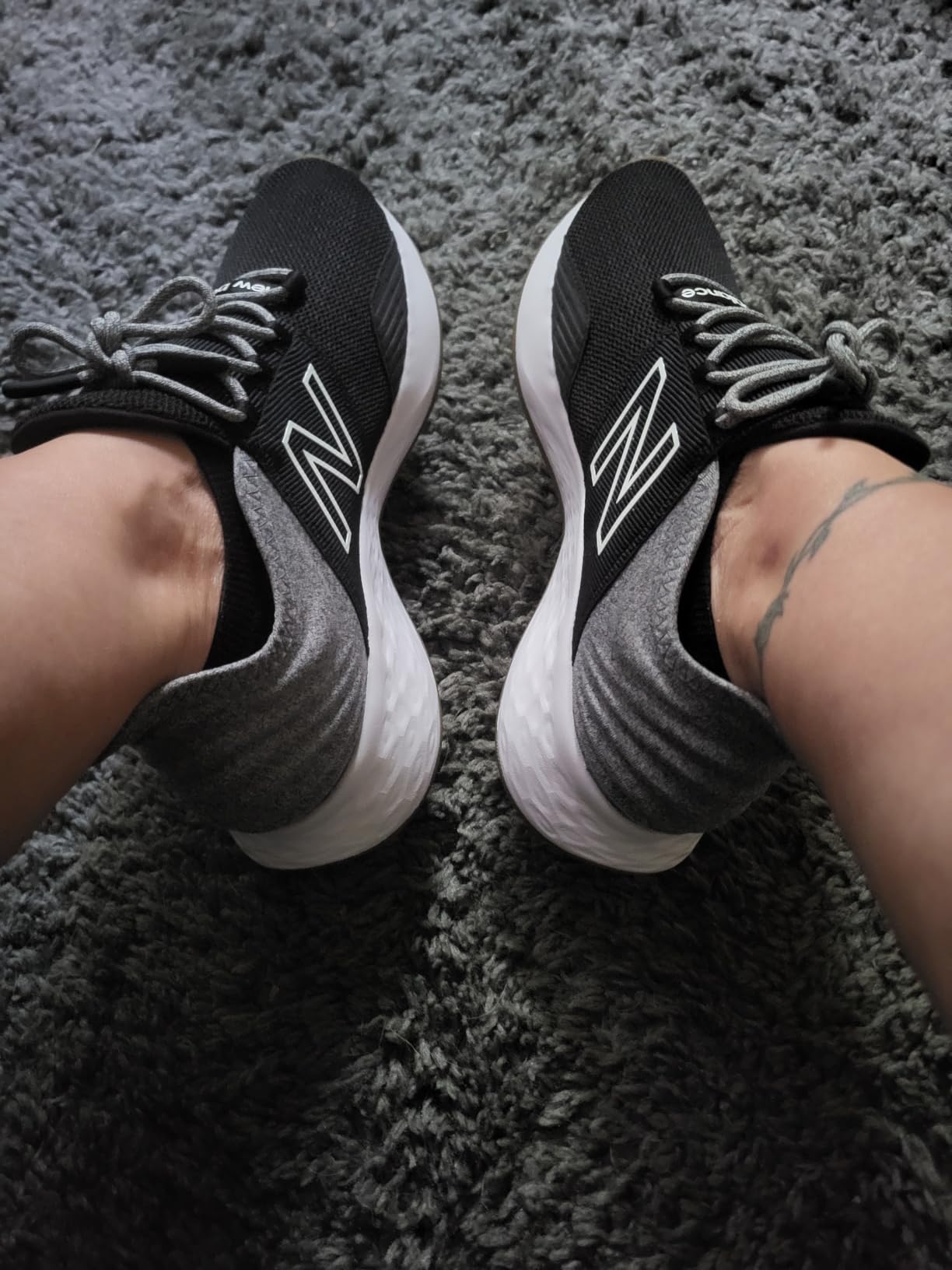
The removable insole with arch support is the feature I would point to first. You can take it out and replace it with a prescription orthotic later, and you can swap in a thinner insole on days when your foot is more swollen than usual. Shoes with a glued-in footbed give you no second chance.
Reviewers are near-unanimous that the mesh upper stays comfortable on long shifts on your feet, though it is a running-shoe upper, so the mesh over the toes thins after a couple of years of heavy daily use. Keep that in mind if this becomes your every-day pair rather than your walking pair.
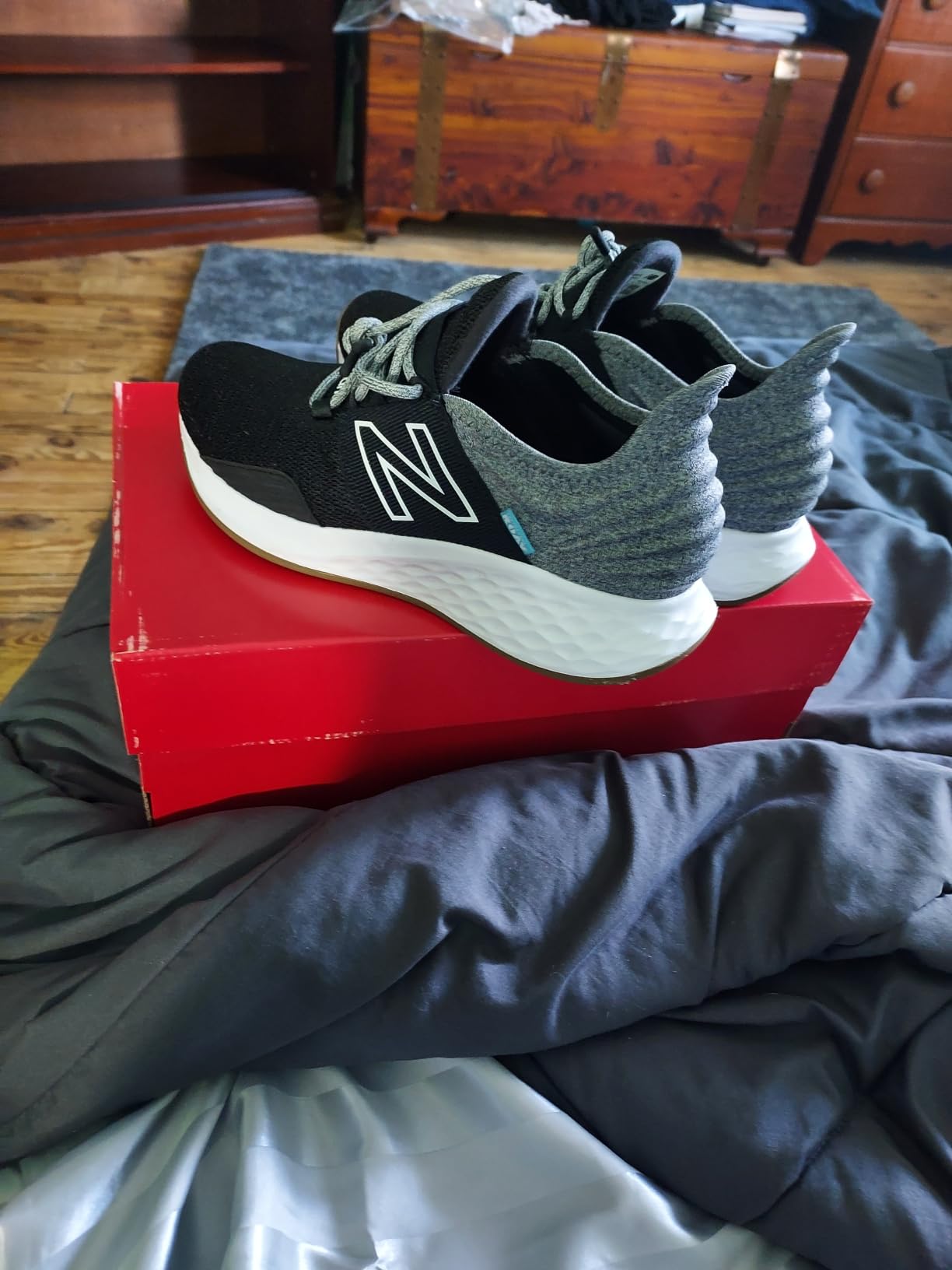
Why this is the top pick for arthritic hips?
It hits all three primary criteria at once: cushioned midsole, low heel, structured heel cup. On top of that it is genuinely light, and low weight matters because every extra pound you carry is extra ground reaction force at hip level on every single step.
It also solves the break-in problem. Reviews repeatedly describe comfort on the first wear with no adjustment period, which matters when a stiff new shoe means a week of limping. For an arthritic hip, a short painless break-in is worth more than a marginally better midsole.
When to skip it?
Skip it if you need a very deep, rocker-sole shoe to get through a long standing shift, or if your foot needs a lot of vertical volume for a thick custom orthotic. Reviewers note the fit runs small in standard widths, so if you have a wide forefoot or bunions, go straight to the wide width rather than trying to force the standard one.
Also skip it if you need a dress-casual silhouette. This is unmistakably a running shoe profile, and it will not pass an office dress code.
We earn a commission, at no additional cost to you. CERTAIN CONTENT THAT APPEARS ON THIS SITE COMES FROM AMAZON. THIS CONTENT IS PROVIDED 'AS IS' AND IS SUBJECT TO CHANGE OR REMOVAL AT ANY TIME.
2. Skechers Go Walk Flex Grand – The Answer When You Cannot Bend to Tie Laces
Skechers Women’s Go Walk Flex Hands Free Slip-Ins – Grand Entry Sneaker, Mauve, 7 US
★★★★★★★★★★Hands-free slip-on entry
Molded heel panel and stretch laces
Ultra GO cushioning
- No lacing at all
- memory foam insole stays comfortable all day
- Machine washable
- Generous sizing across wide and narrow widths
- Collar less secure on very long walks
- Less structured than a lace-up shoe
- Sporty rather than dressy styling
Lacing difficulty is the most-raised problem in the hip arthritis conversations that exist online, and almost none of them is answered. If getting down to your feet is genuinely hard, tying laces is not a small inconvenience, it is the reason many people stop walking altogether. This slip-on removes the problem entirely.
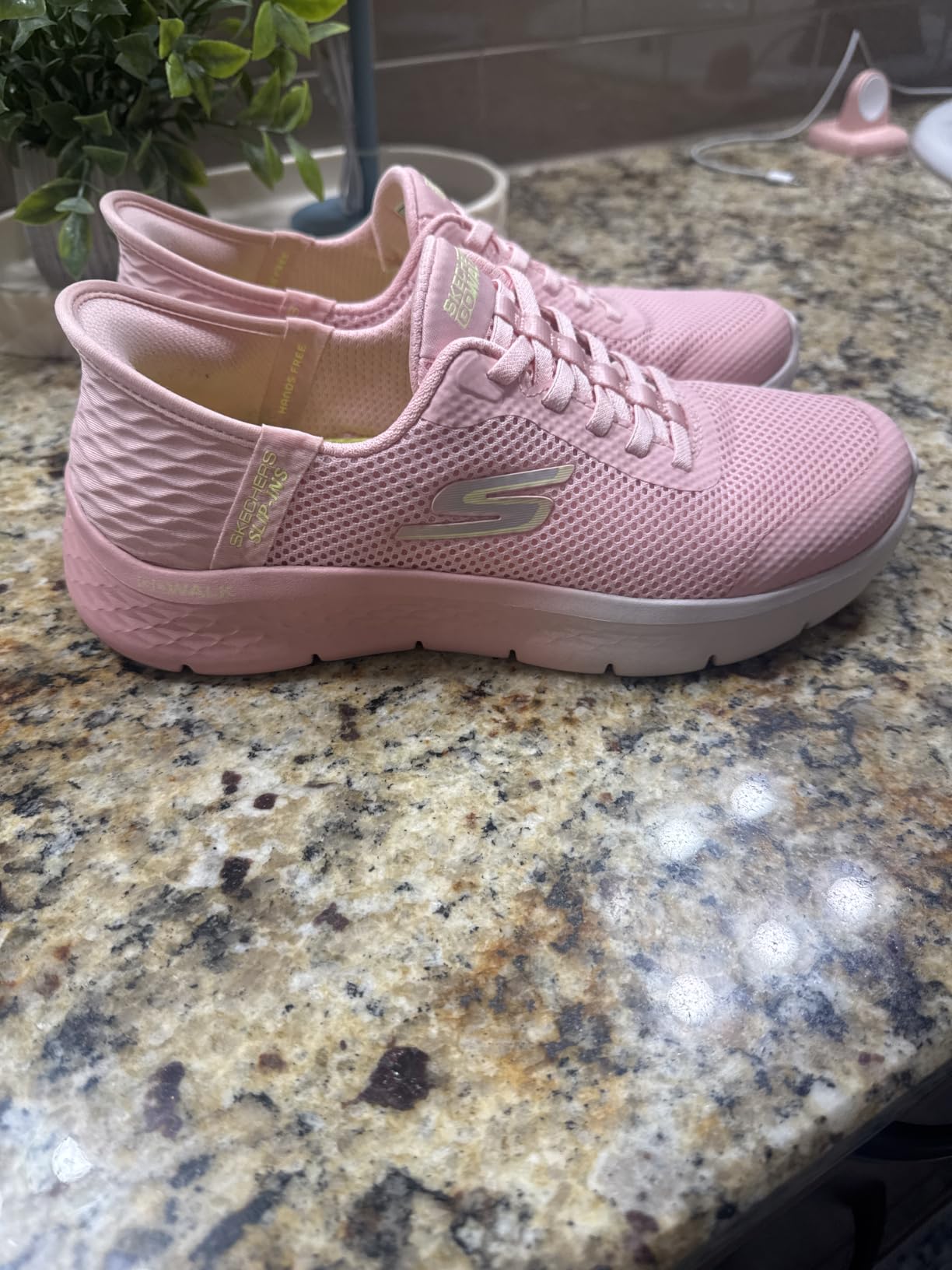
The molded heel panel and stretch laces give you a close fit without a single eyelet, and Heel Pillow technology keeps the back of the foot from sliding forward on longer walks. The Ultra GO cushioning and Air-Cooled Memory Foam insole do the shock absorption, and the flexible traction outsole is built for pavement rather than for a treadmill.
Users on arthritis support forums describe it as genuinely comfortable for errands and all-day walking, and being machine washable is a bigger practical win than it sounds if you wear the same pair daily. Sizing runs generous, and the brand offers both wide and narrow widths across a large size range, which solves a lot of fit frustration.
The honest limitation is structural. A slip-on has no laces to tighten as the day goes on, so on a very long walk or on uneven ground some wearers report the collar letting go slightly. It is a small trade for people who physically cannot tie, but it is real.
Why this is the best pick if bending is the problem?
Nothing else on this list solves the lacing problem outright, and the difficulty is more common than the average shoe roundup admits. A Quora thread asking for a good walking shoe for someone with hip problems where tying laces is difficult is one of the highest-ranking results for this whole search topic, and the answer is almost always a slip-on.
It is also the easiest shoe here to get into on a bad morning, which means you are far more likely to actually go for the walk. That behavioural advantage matters as much as the biomechanical one.
When to skip it?
Skip it if you need serious motion control or a very firm heel counter. This is a soft, flexible walking shoe, not a stability shoe, and reviewers consistently note it is less structured than a lace-up alternative. People whose pain is driven by significant overpronation will want the Brooks Addiction Walker instead.
Skip it for offices that expect something other than a sporty sneaker. The stretch-lace collar also means you cannot fine-tune the fit if one foot is meaningfully wider than the other.
We earn a commission, at no additional cost to you. CERTAIN CONTENT THAT APPEARS ON THIS SITE COMES FROM AMAZON. THIS CONTENT IS PROVIDED 'AS IS' AND IS SUBJECT TO CHANGE OR REMOVAL AT ANY TIME.
3. New Balance 608 V5 – The Durable Daily Workhorse
New Balance Women’s 608 V5 Casual Comfort Cross Trainer, White/Light Blue, 9 Wide
★★★★★★★★★★ABZORB heel cushioning
IMEVA midsole
Suede leather upper that molds to the foot
- Immediate comfort with no break-in
- Wide width options available
- Arch and heel support
- Built to last years of daily wear
- Firm rather than plush cushioning
- Minimal arch support compared to orthopedic models
- Plain utilitarian styling
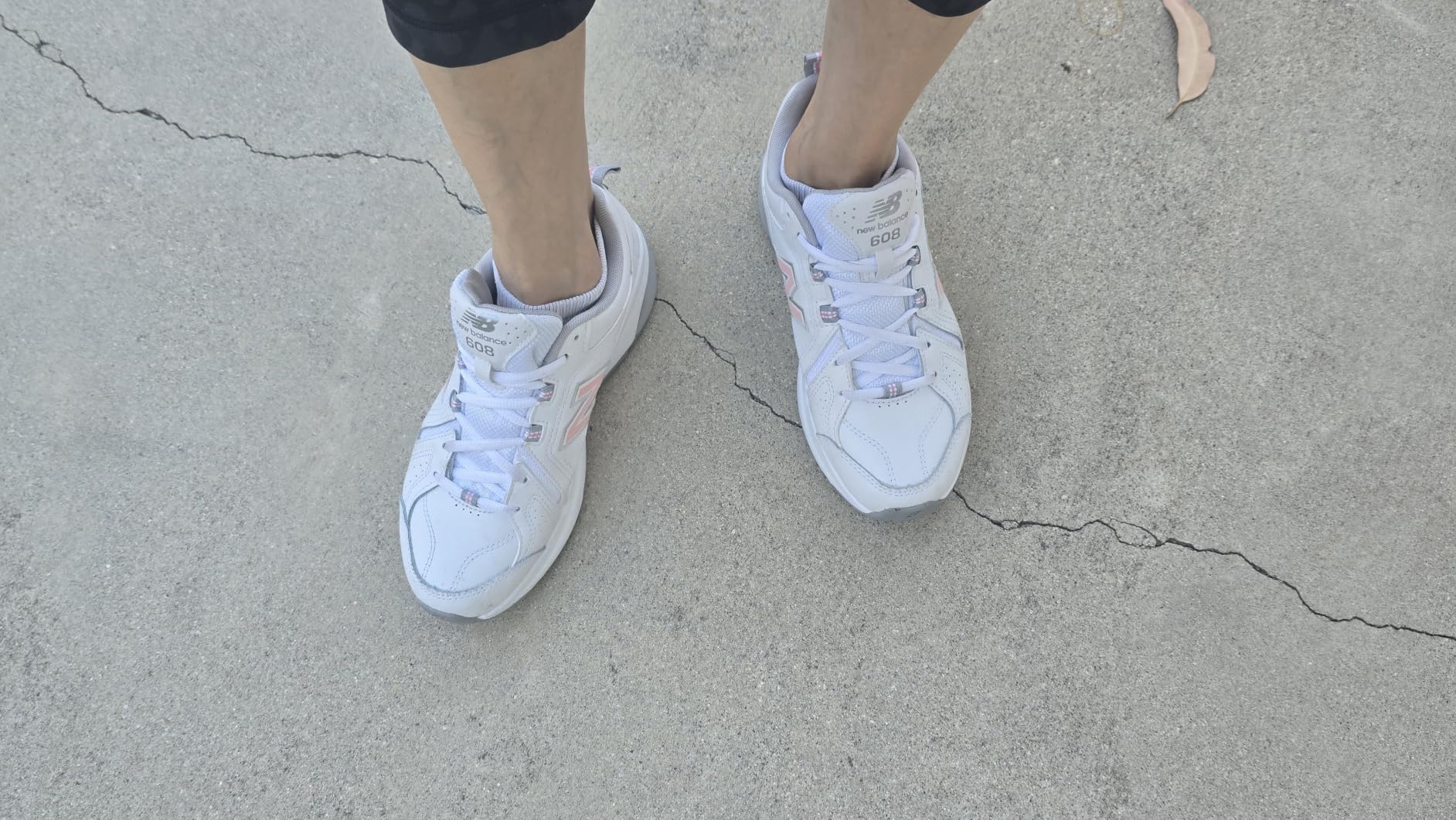
With more than forty-four thousand reviews behind it, the 608 V5 is the most thoroughly tested shoe in this roundup, and that matters for a long-term condition. When you have hip pain for a decade, you are not replacing your shoes every season. You want a pair that still works after two years.
The ABZORB heel cushioning sits inside an IMEVA midsole, and that combination is why reviewers describe it as supportive across the arch and at the heel without feeling rigid. The suede leather upper has real structure and molds to the foot over time, which is unusual at this level.
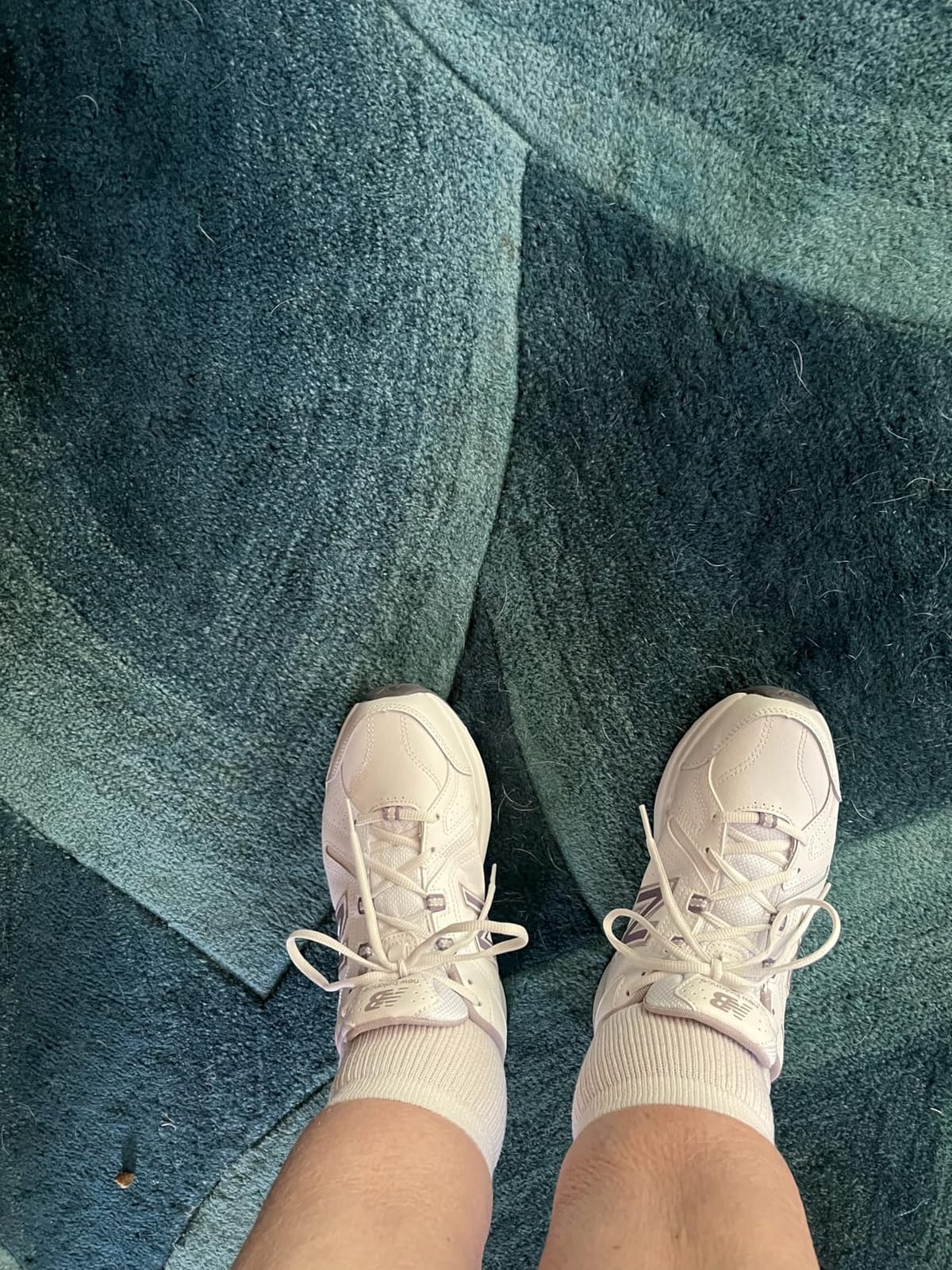
People on the BoneSmart hip replacement forum frequently name New Balance as the brand that helped them manage hip pain while preparing for surgery. One user reported that the cushioning made a real difference to a loss of cushion in both hips. That is the exact scenario this shoe is built for.
The rubber outsole is stable and durable, and the whole shoe handles strength training and long standing shifts without complaint, which reviewers mention often for a walking shoe.
Why this is the pick for all-day wear?
Nothing here is spectacular. It is simply well made, supportive, widely sized, and it holds up. For someone who walks several miles a day as part of their normal routine rather than as exercise, that combination beats a technically superior shoe that falls apart in eight months.
The no-break-in promise is a genuine advantage for arthritic hips. A stiff new shoe is a week of limping, and a week of limping is a week of using the hip in a way you are trying to avoid.
When to skip it?
Skip it if you want maximum cushioning or strong built-in arch support. Reviewers note the construction is firm, which is great for stability but means it will not feel as soft as a Fresh Foam or Hoka midsole. People who want a spa-like feel will find it plain.
Style is the other limitation. This is a utilitarian sneaker and it does not pretend otherwise. If you spend your day in something dressier, look at the Ryka Devotion Plus or the Brooks Addiction Walker with its full-grain leather upper.
We earn a commission, at no additional cost to you. CERTAIN CONTENT THAT APPEARS ON THIS SITE COMES FROM AMAZON. THIS CONTENT IS PROVIDED 'AS IS' AND IS SUBJECT TO CHANGE OR REMOVAL AT ANY TIME.
4. Hoka Bondi 9 – Maximum Cushioning, With a Durability Warning
Hoka Women’s Bondi 9 Black/White 7 Medium
★★★★★★★★★★Deep plush cushioning sole
Wide stable platform base
Engineered mesh upper
- Maximum cushioning for long days standing
- Reduces foot leg and joint fatigue
- Supportive for high arches and metatarsal pain
- Stable yet flexible on varied ground
- Foam can feel spongy after about four months of heavy use
- Bulkier silhouette than a standard walking shoe
- Less stable on very uneven ground
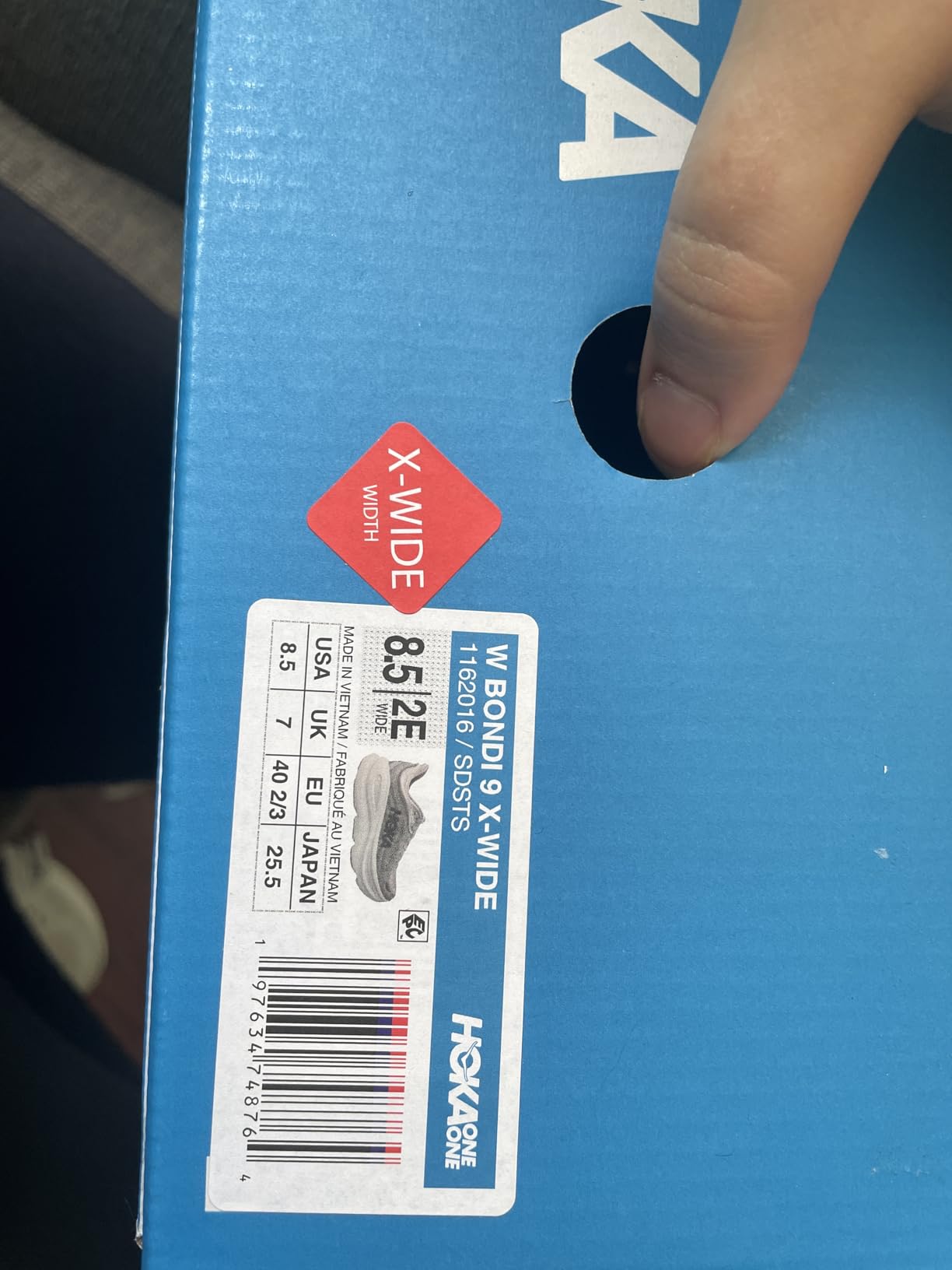
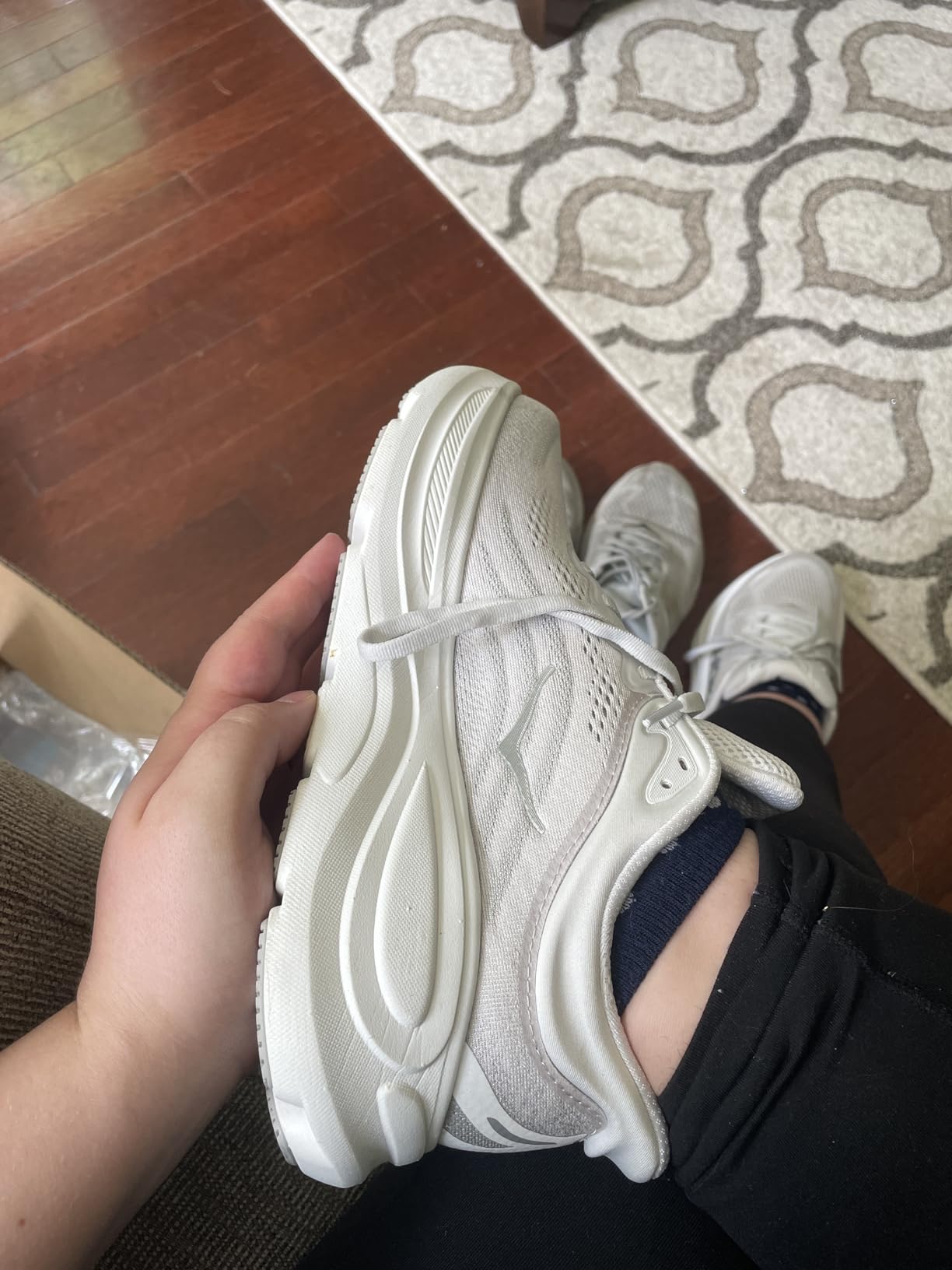
Yes, Hokas are good for hip pain, and the Bondi 9 is the specific answer. The deep plush cushioning sole is the thickest in this roundup, and reviewers describe the experience in terms like walking on a cloud with noticeably less foot and joint fatigue at the end of a long day.
What makes it work for hips specifically is the wide, stable platform base. Maximum cushioning without a wide base is a recipe for wobbling, and wobbling means your foot and knee are correcting on every step. The Bondi stacks height on width, which is why it stays stable.
It also comes up constantly in podiatrist-recommended contexts for people with high arches, supination, and metatarsal pain. If you are on the flatter-foot or high-arch end of the spectrum, the deep foam under a high arch is doing real work.
The honest trade-off is foam life. Multiple owners report the midsole breaking down and feeling spongy after roughly four months of heavy daily use, which for a hip patient is a shorter lifespan than the rest of this list offers. Budget for replacing it more often than you would a firmer walking shoe.
Why this wins for maximum cushioning?
If your day involves standing rather than walking, cushioning depth is the variable that moves the needle. A 608 V5 or a 877 V1 is built for the act of moving; the Bondi 9 is built for absorbing load while you stay put, which is a different job.
For a caregiver on a ward shift, a shopper on their feet for a long afternoon, or anyone who cannot shorten their standing time, that difference is the whole point. Buy two pairs if you can and rotate them so each recovers.
When to skip it?
Skip it if you need a secure, ground-feeling base or if you walk on uneven terrain, where some users find the deep sole less stable. It is also the bulkiest shoe here and will not disappear under trousers the way the Skechers or Ryka will.
If you are sensitive to foam breakdown, read the durability reports before committing. A softer midsole that loses its structure in four months may leave you worse off at month five than a firmer shoe that is still working.
We earn a commission, at no additional cost to you. CERTAIN CONTENT THAT APPEARS ON THIS SITE COMES FROM AMAZON. THIS CONTENT IS PROVIDED 'AS IS' AND IS SUBJECT TO CHANGE OR REMOVAL AT ANY TIME.
5. New Balance 877 V1 – The Widest Range of Widths Available
New Balance Women’s 877 V1 Walking Shoe , Silver, 5 Wide
★★★★★★★★★★Widths from Narrow through X-Wide
11 mm approximate drop
Suede and mesh upper
- Exceptionally broad width and size range
- Dependable everyday cushioning
- Medicare HCPCS A5500 coded
- Suede and mesh upper balances durability and breathability
- Less cushioned than dedicated orthopedic models
- Mesh upper wears out with heavy use
- Styling looks dated
- Dated break-in for the suede
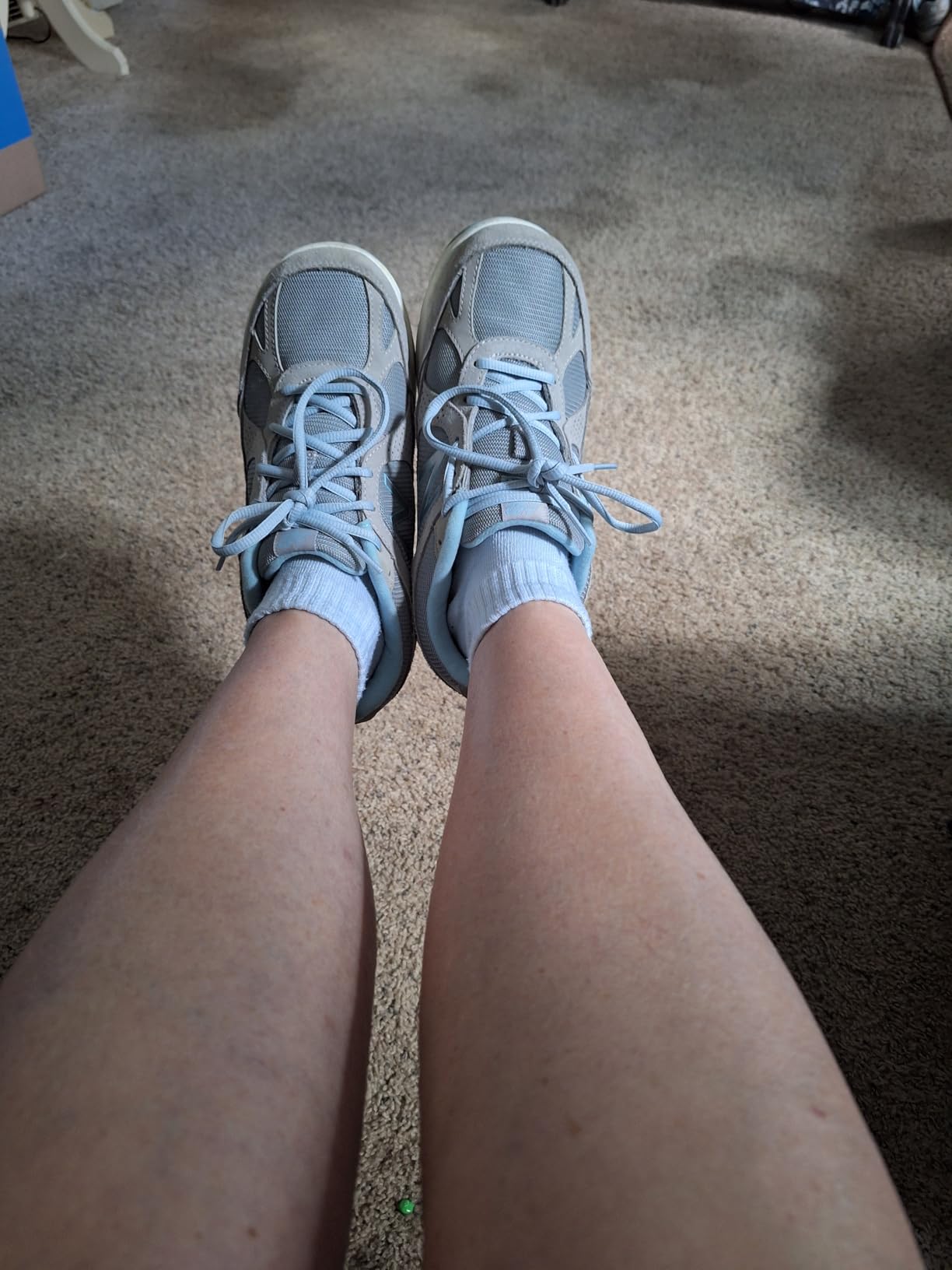
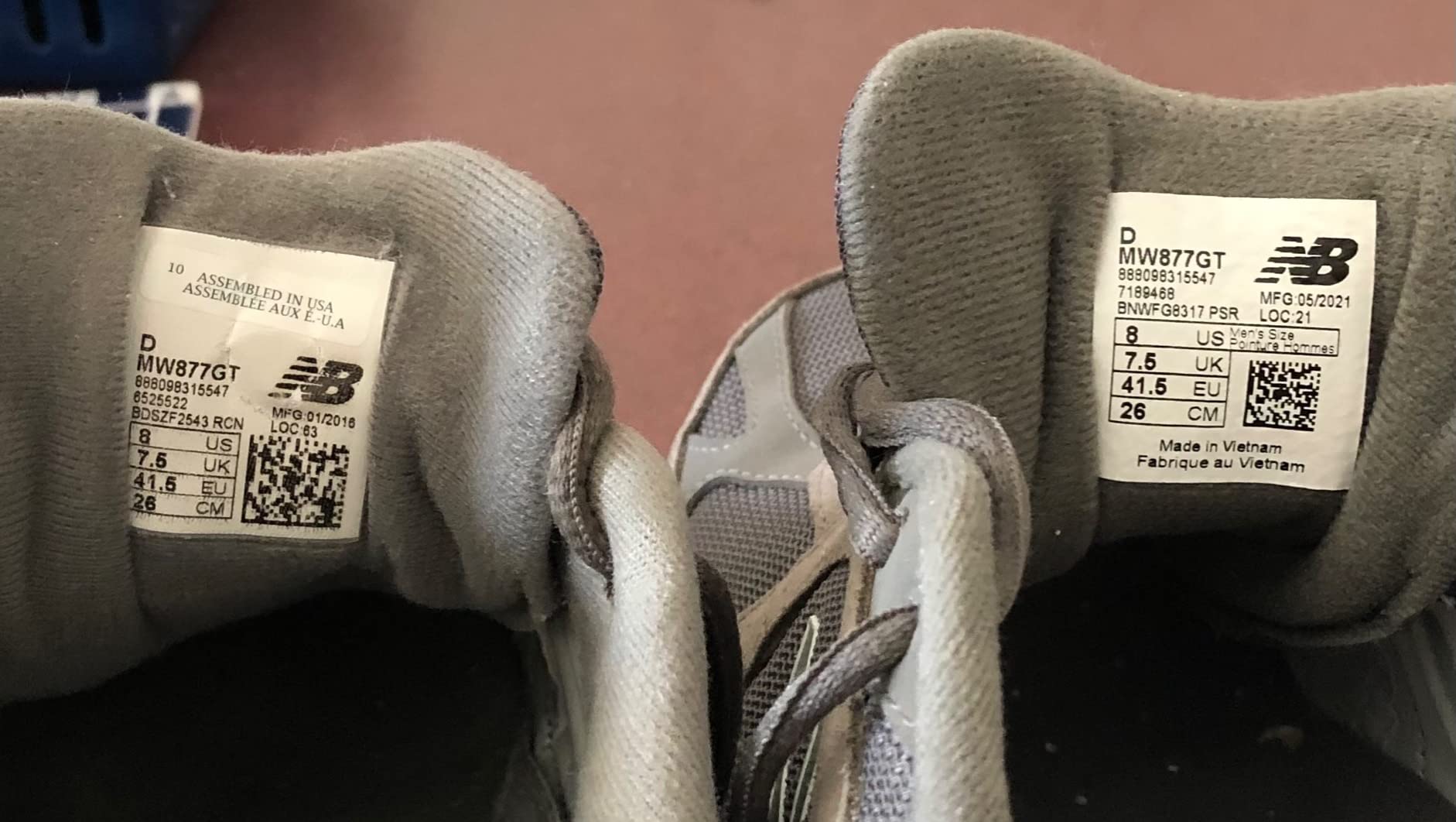
The 877 has been in continuous production for over a decade, and the reason is its width run. It is available from Narrow all the way to X-Wide, and for a woman with bunions, a wide forefoot, or two feet that do not match, that range is the entire selling point.
Mechanically it is a sensible choice for hips. The 11 mm approximate drop is low enough to keep your pelvis from tilting forward aggressively, the rubber outsole is stable on pavement, and the suede and mesh upper gives structure where it matters with some breathability.
One detail worth flagging: this model carries a Medicare and HCPCS code A5500 designation, meaning it may be eligible for reimbursement if your insurer covers diabetic footwear. If you qualify, that changes the calculation entirely. Check with your provider first.
The trade-offs are that it is less cushioned and less supportive than a dedicated orthopedic or motion-control model, and the styling has not moved with the times. Reviewers also note the suede needs a proper break-in.
Why width range is the deciding factor for many women?
A shoe that fits in the forefoot but pinches behind the bunion is worse than a plainer shoe that fits. Every hour of compression at the big toe joint changes how you stand, which changes how you load the hip. Wide width options are not a comfort nicety here, they are a treatment decision.
If you have spent years avoiding shoes because nothing accommodates your feet, this is the pair most likely to end the search. Pair it with a removable insole and you have a two-year solution with a long-established sizing system behind it.
When to skip it?
Skip it if cushioning depth is your priority or if you need real motion control, because this is a general-purpose walking shoe. If you overpronate significantly, the Brooks Addiction Walker 2 is built for that job specifically.
It is also a dated silhouette, and if you need something that reads as smart-casual in an office, keep looking. Finally, buy it a size up in width if you are between widths, and expect a few wears of break-in with the suede.
We earn a commission, at no additional cost to you. CERTAIN CONTENT THAT APPEARS ON THIS SITE COMES FROM AMAZON. THIS CONTENT IS PROVIDED 'AS IS' AND IS SUBJECT TO CHANGE OR REMOVAL AT ANY TIME.
6. Brooks Addiction Walker 2 – Stability Control With Medical Credentials
Brooks Women’s Addiction Walker 2 Walking Shoe – White/White – 8 Medium
★★★★★★★★★★Pronation and arch control
PDRB stability bar
Certified PDAC A5500 diabetic shoe
- Strong stable base for heavy walking and long shifts
- Pronation and arch control improves lower-body alignment
- APMA Seal of Acceptance and PDAC A5500 certified
- Full-grain leather looks work-ready
- Stiff sole that does not bend at the toes
- Tongue can press on the ankle
- Toe box narrow in standard widths
- Bulkier profile
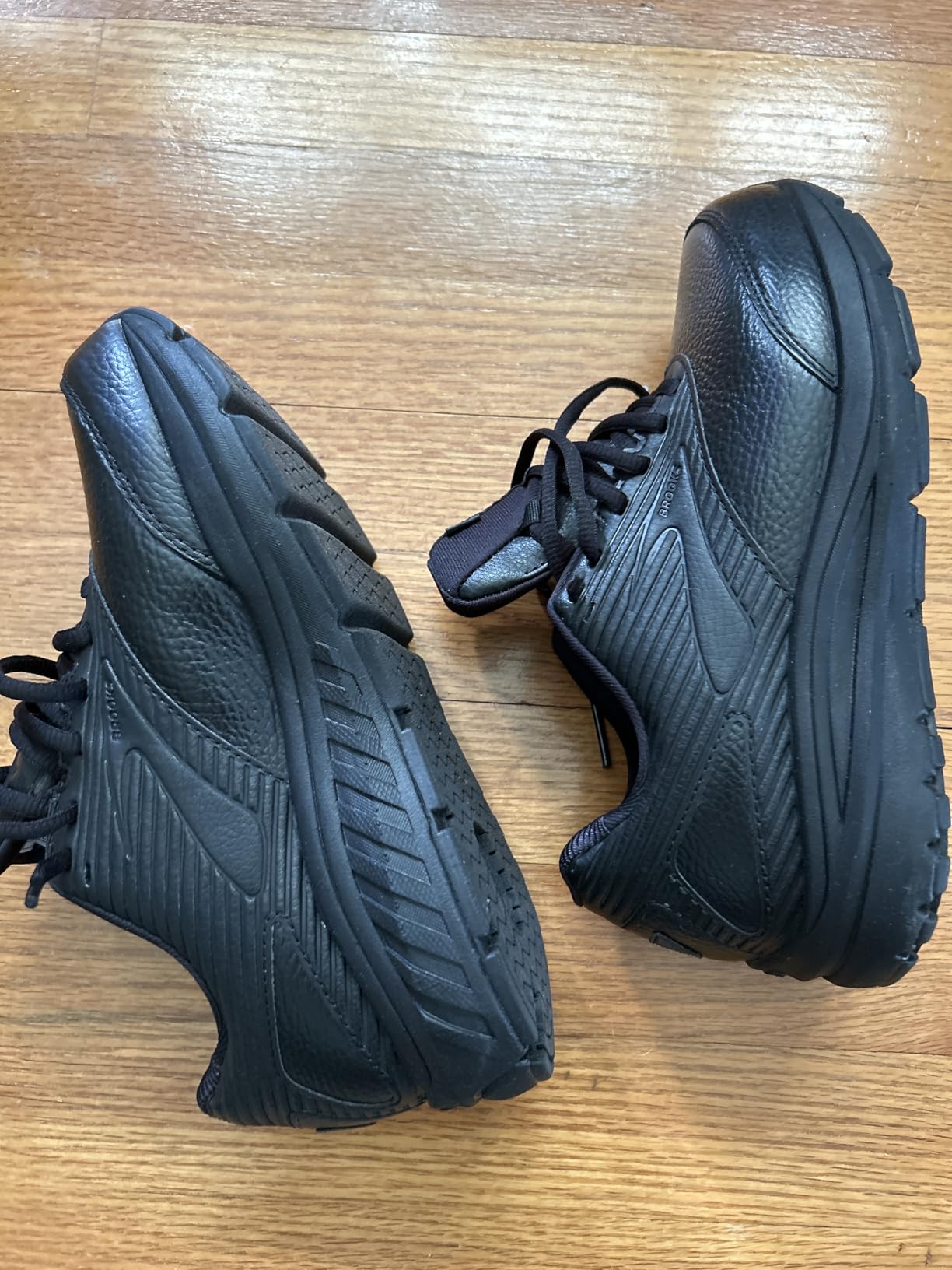
This is the shoe for the person whose pain is driven by overpronation rather than by impact. The Extended Progressive Diagonal Rollbar sits inside the midsole and resists the inward roll that carries the femur and the hip joint with it, which is the exact mechanism the biomechanics research points to.
It carries the strongest credentials in this roundup. The Addiction Walker 2 is a Certified PDAC A5500 diabetic shoe and carries the APMA Seal of Acceptance, which means it has been reviewed against medical standards for internal foot and ankle problems.
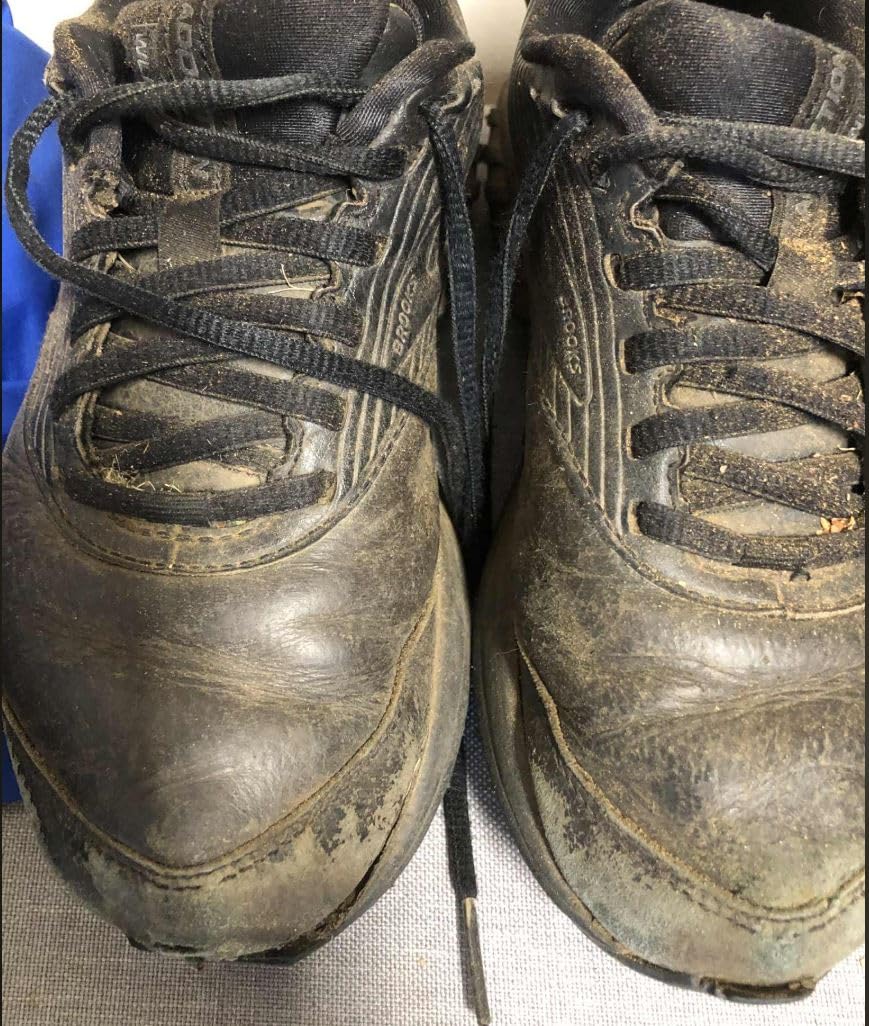
Reviewers who walk six to eight miles a day or stand through long shifts describe strong support and reduced end-of-day foot soreness, and people recovering from knee or ankle injury mention it by name. The full-grain leather upper is also the most presentable on this list if you work in an office that expects a shoe, not a trainer.
The cost of that stability is flexibility. The sole is stiff and does not bend much at the toes, which some arthritic feet find uncomfortable, and reviewers also report the tongue pressing against the ankle joint on longer walks. Fit it properly and pad the tongue if that happens.
Why this wins for overpronation and hip rotation?
If the mechanism of your pain is rotational rather than impact-driven, cushioning alone will not fix it. The PDRB and the firm heel cup in this shoe attack pronation directly, and that is a different intervention from adding foam.
It is also the shoe to go to if you work in a professional environment. Full-grain leather reads as a loafer-adjacent walking shoe, which is a genuine advantage over every mesh running shoe on this list.
When to skip it?
Skip it if you have arthritic feet as well as arthritic hips, because the rigid sole is a real complaint from that group. Also skip it in standard widths if you have bunions or a wide forefoot, as the toe box is not generous.
Because this is a motion-control shoe, do not expect it to feel soft. If you are used to cushioned sneakers, the first week can be an adjustment, and you should test it indoors before committing to a long walk.
We earn a commission, at no additional cost to you. CERTAIN CONTENT THAT APPEARS ON THIS SITE COMES FROM AMAZON. THIS CONTENT IS PROVIDED 'AS IS' AND IS SUBJECT TO CHANGE OR REMOVAL AT ANY TIME.
7. Ryka Devotion Plus 3 – Built on a Women’s Last
Ryka Women’s Devotion Plus 3 Walking Shoes Navy 10 W
★★★★★★★★★★Women's-specific last
Narrower heel and roomier toe
RE-ZORB responsive cushioning
- Lasted on a women's specific last
- Relieves joint pain in ankles knees and hips
- Grippy outsole for wet pavement
- Good ball-of-foot and arch support
- Runs about a half size short in this model
- Outsole wears in months for high-mileage walkers
- Less cushioned than some rivals
Roughly a hundred years of making women’s shoes shows up in the Devotion Plus 3. It is built on a women’s-specific last with a narrower heel and a roomier toe, which solves the exact fit problem that most brands do not solve: women’s heels are narrower, so a scaled-down men’s last leaves your heel sliding.
RE-ZORB responsive cushioning handles shock absorption, and reviewers repeatedly report relief for joint pain in the ankles, knees, and hips. Several people with autoimmune-related joint pain describe it as one of the few shoes they can tolerate for a full day.
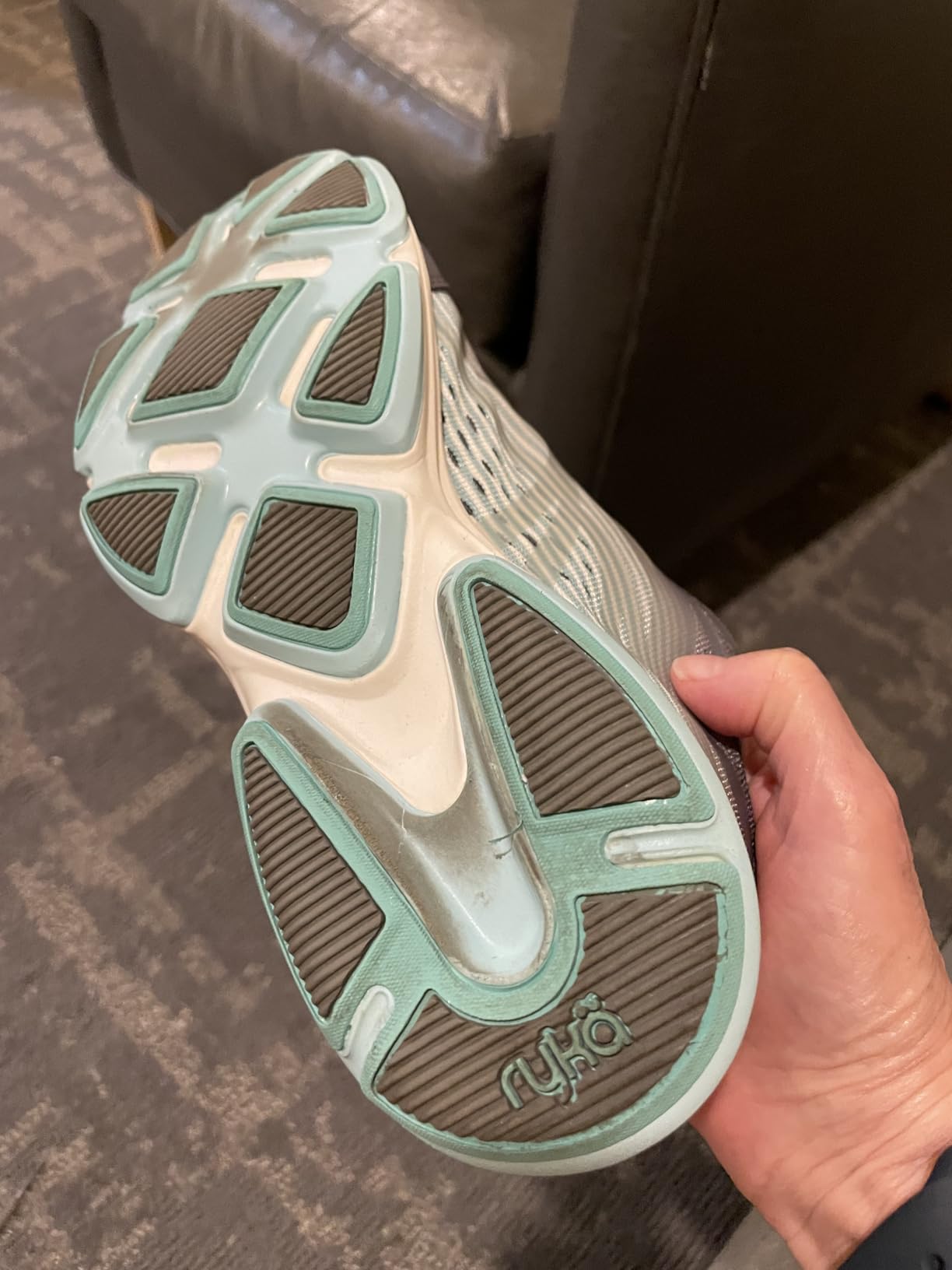
On the Mayo Connect arthritis board, a user with severe foot arthritis reported that only Ryka was tolerable, that the wide width was essential for bunions, and that the insoles needed replacing. That is a more useful real-world review than any star rating, because it names the failure mode: the shoe works, the footbed wears out.
Two cautions. This model runs about a half size short compared with other shoes in the same brand, and high-mileage daily walkers report the eight-piece rubber outsole wearing down within a few months.
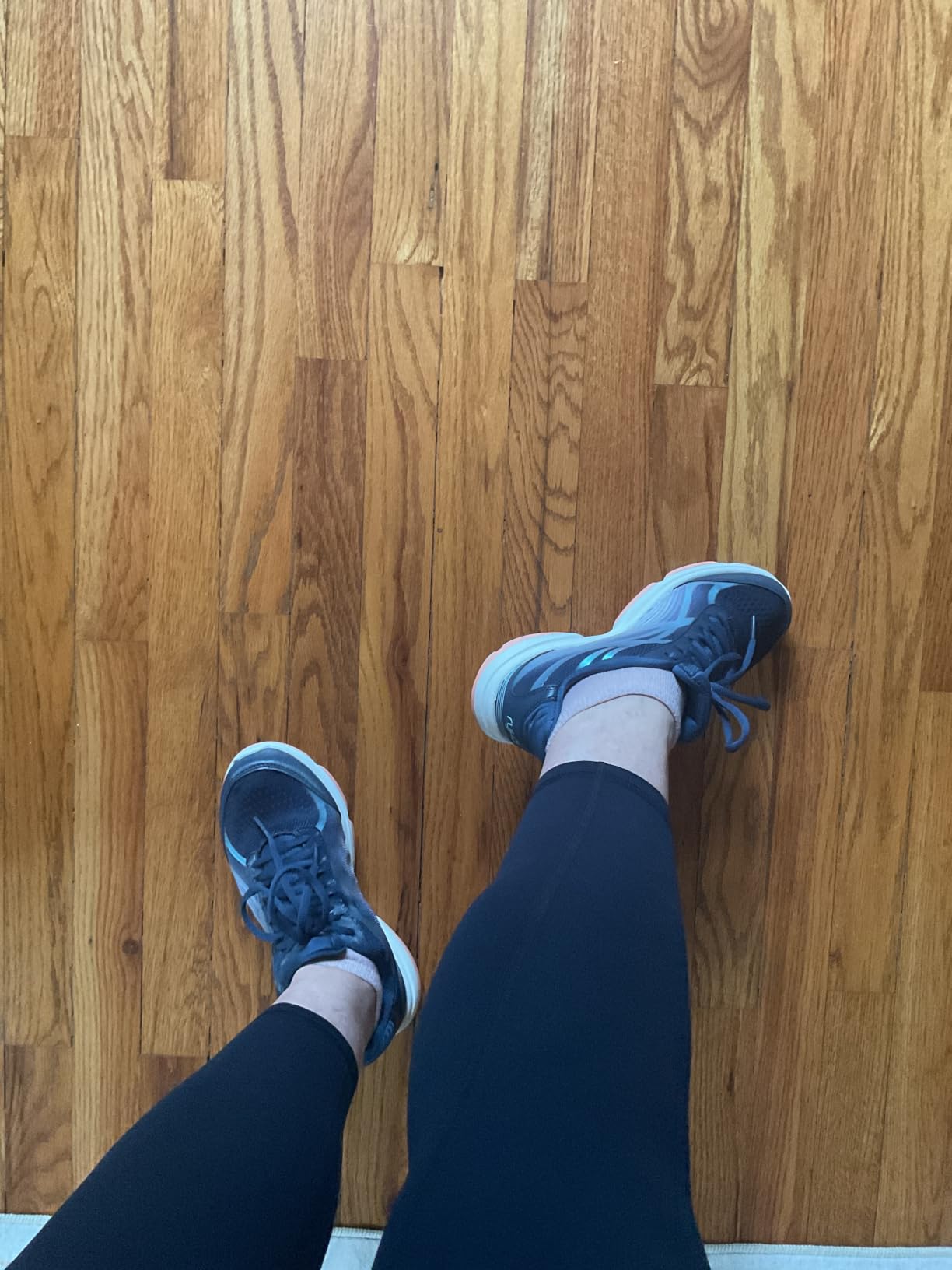
Why a women’s last actually matters for hip pain?
A heel that slips inside the shoe makes your foot slide on every step, and sliding makes your arch collapse late in the stride, which rotates the leg inward at exactly the wrong moment. The narrower heel on a women’s last removes that source of rotation, and that is a structural advantage no amount of cushioning can substitute for.
The roomier toe box is the other half. Bunions and mild swelling need forefoot space, and when you compress the forefoot, your arch tightens to compensate and your gait changes again.
When to skip it?
Skip it if you need maximum cushioning for long standing shifts, because it is less cushioned than several rivals here. And if you already own Ryka shoes, know that this model runs about a half size short of the rest of the brand, so do not order your usual size.
If you are a very high-mileage daily walker, the outsole durability reports are a legitimate reason to pick the grippier 608 V5 or the NDurance-equipped Roav instead.
We earn a commission, at no additional cost to you. CERTAIN CONTENT THAT APPEARS ON THIS SITE COMES FROM AMAZON. THIS CONTENT IS PROVIDED 'AS IS' AND IS SUBJECT TO CHANGE OR REMOVAL AT ANY TIME.
8. Orthofeet Coral – The Dedicated Orthopedic Pick
Orthofeet Coral Orthopedic Women Sneakers, Blue, Size 8 Wide
★★★★★★★★★★Removable adjustable arch insert
Wide toe box true to size
Seam-free padded interior lining
- Strongest reported pain relief in this roundup
- Removable arch booster can be tailored per foot
- Roomy toe box for bunions and swelling
- No break-in required
- Lowest average rating in the group
- Insoles can squeak
- Toe box snugger than expected for very wide feet
- Upper can lose structure early
The Coral is the only genuinely orthopedic-designed shoe in this group, and it carries the lowest average rating here while generating some of the strongest pain-relief reports in the data. That combination is unusual, and it is worth understanding why before you dismiss it.
The premium orthotic insole provides anatomical arch support and multilayer cushioning, and the arch support insert is both removable and adjustable. You can add lift on one foot and not the other, which matters if you have asymmetry. The stretch knit upper flexes with the foot, and the seam-free padded interior removes pressure points that lace-up and stitched uppers can create.
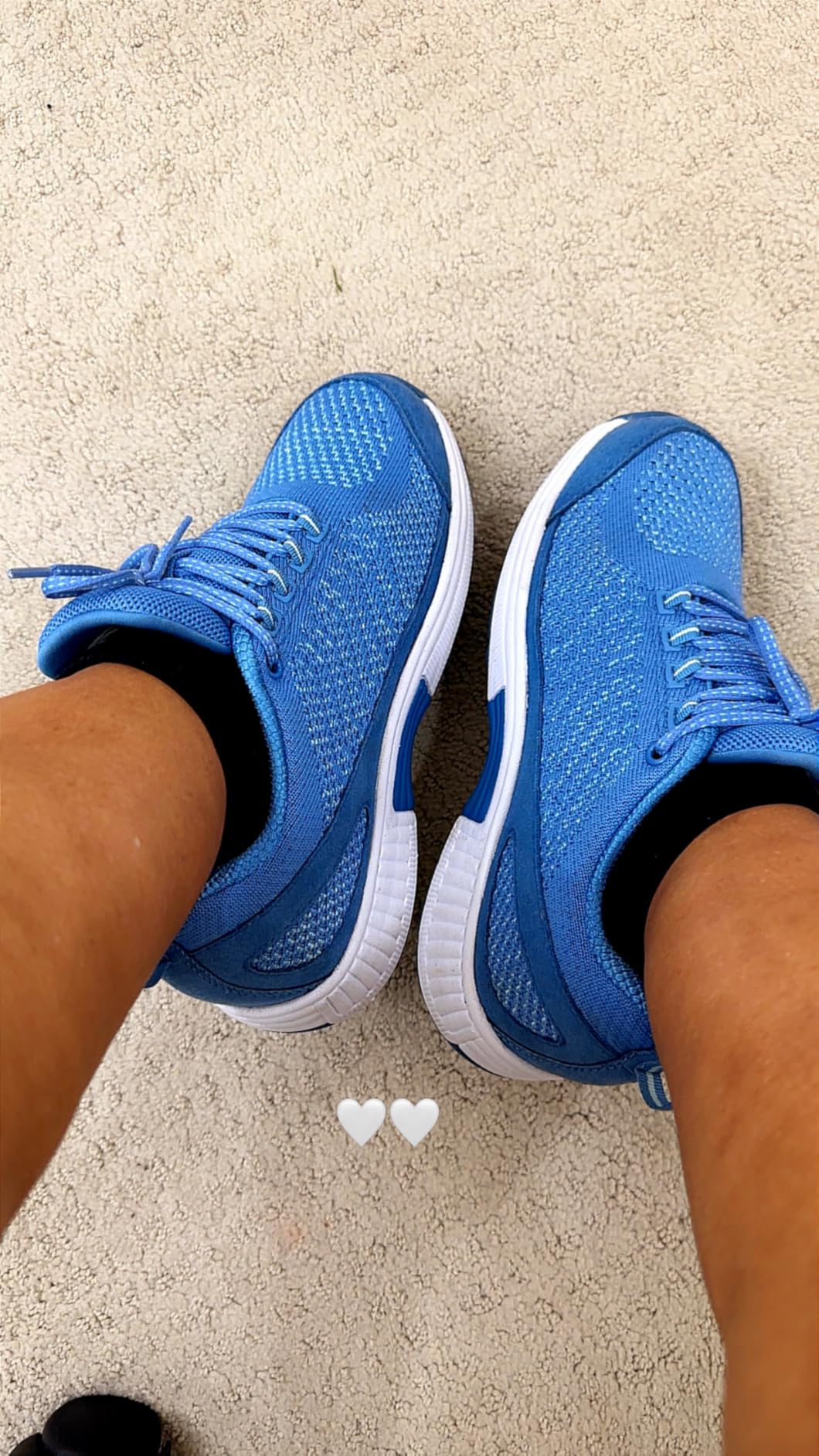
Owners with plantar fasciitis, bunions, overpronation, and arthritis describe relief they did not get from custom orthotics. The roomy wide toe box accommodates bunions, hammertoes, and swollen feet, and many buyers report no break-in at all.
The complaints are real: insoles can squeak with certain walking patterns, the toe box is snugger than the word wide implies for very wide feet, shoelaces fray quickly, and some users report the upper stretching out and losing stability with minimal wear. The 4.1 average reflects a shoe people are clearly using hard.
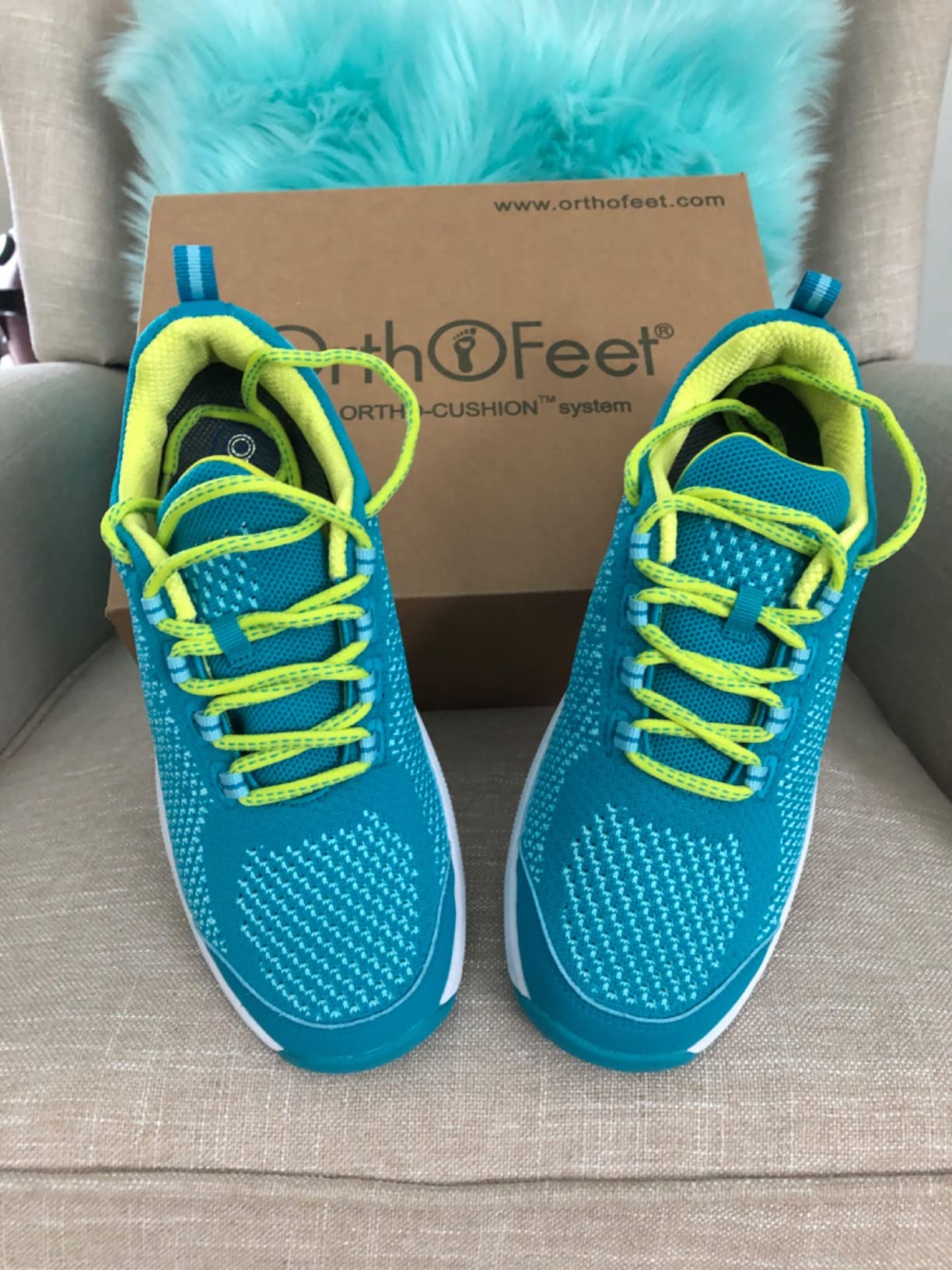
Why this wins for bunions and adjustable arch support?
The adjustable, removable arch insert is the feature no other shoe here has, and it directly addresses the two-differently-shaped-feet problem. You can set the insert higher on one side, and if your orthotic needs change after a podiatry visit, you swap the insert rather than the shoe.
The pressure-point-free interior also makes it a good option for anyone whose foot pain is concentrated in the toes and forefoot, because a hip patient who starts limping from forefoot pain will load the hip badly.
When to skip it?
Skip it if you need a dress-casual shoe, because the styling is plainly utilitarian, or if very long-term structure matters more than adjustability, since the stretch knit upper can lose its shape. If you have extremely wide feet, test the toe box carefully.
The squeaking insoles are cosmetic rather than a comfort problem, but the lower average rating means you should expect some trial and error. Return it if the insole does not agree with your gait.
We earn a commission, at no additional cost to you. CERTAIN CONTENT THAT APPEARS ON THIS SITE COMES FROM AMAZON. THIS CONTENT IS PROVIDED 'AS IS' AND IS SUBJECT TO CHANGE OR REMOVAL AT ANY TIME.
9. Brooks Ghost Max 3 – High Arches and Orthotic-Friendly Volume
Brooks Women Ghost Max 3 Navy/Peacoat/Clearwater 7 Medium
★★★★★★★★★★High-stack DNA LOFT v3 cushioning
Linear last for orthotics
GlideRoll Rocker for smooth transitions
- High stack cushioning reduces underfoot pressure
- Linear last accommodates varied foot shapes and orthotics
- Rocker geometry smooths the step cycle
- APMA Seal of Acceptance
- Large bulky profile
- Extra volume feels loose on narrow feet
- Running-shoe styling
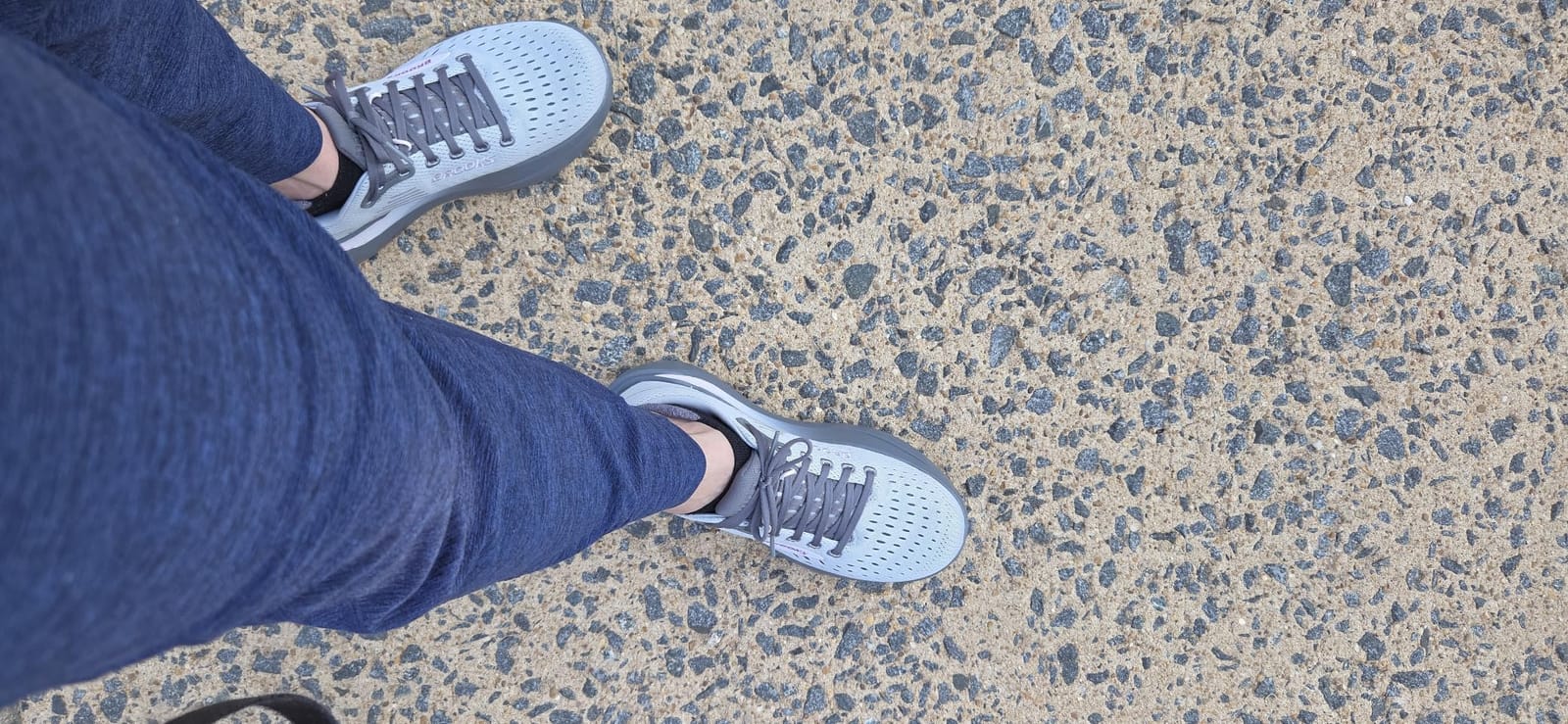
The Ghost Max 3 is a high-stack shoe with a wide base and raised sidewalls, and that combination is why it ranks near the top of the women’s road running category while being perfectly usable for long walks. The extra height spreads load across the whole foot rather than concentrating it under the metatarsal heads.
The linear last construction is the detail that separates it from other cushioned shoes. It adds volume across the shoe rather than just length, which means it can take a prescription orthotic and still close properly over the top. It also carries the APMA Seal of Acceptance and a carbon neutral certification.
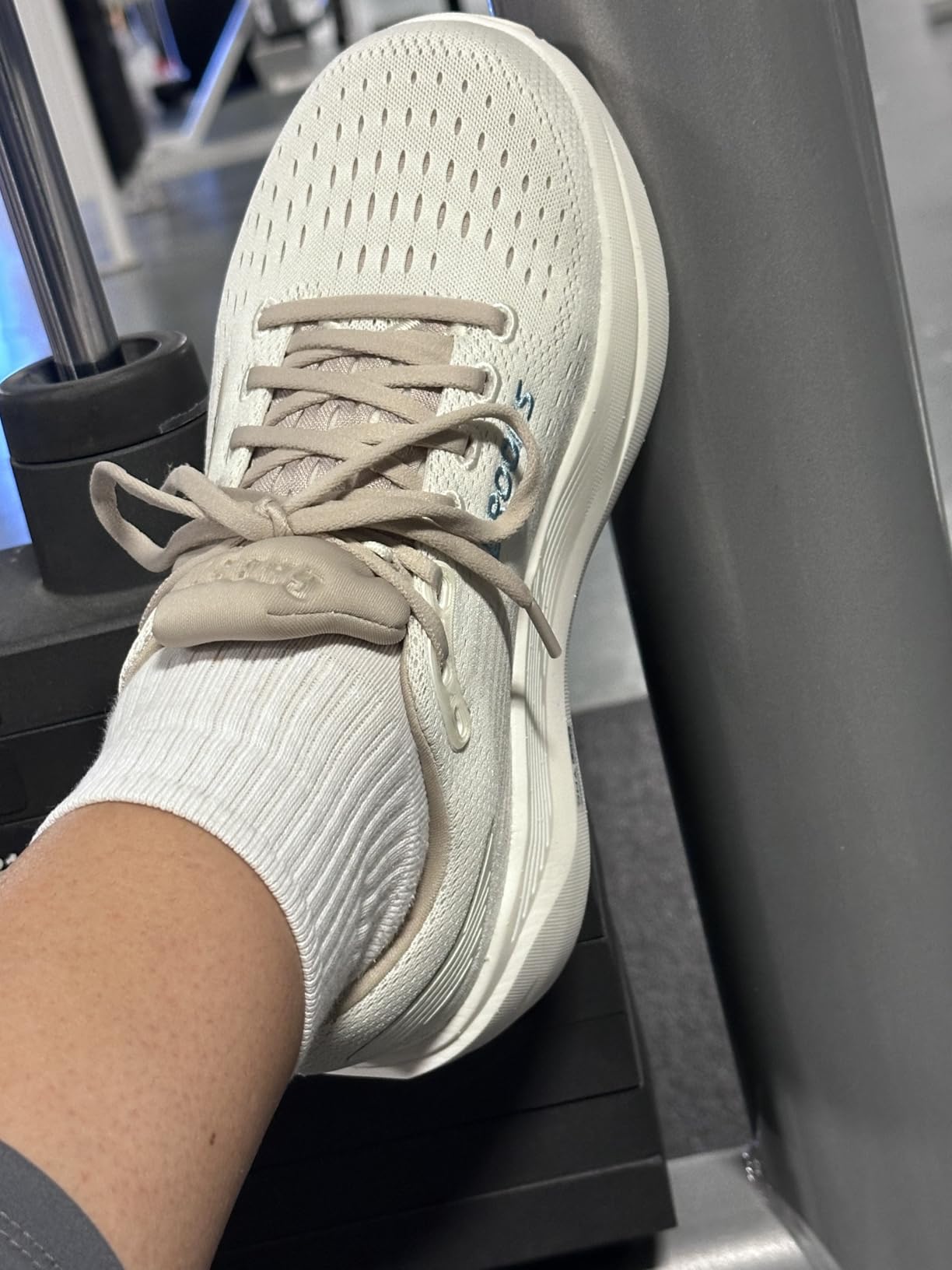
The GlideRoll Rocker puts a curve under the shoe so your heel rolls forward into the next step instead of planting flat. For a stiff hip joint, fewer abrupt transitions through range of motion is a genuine benefit, and buyers describe the heel-to-toe movement as effortless.
Reviewers position it as a viable walking shoe as much as a running shoe, which is a reasonable read of a shoe that balances cushioning depth with a stable, orthotics-friendly base. The catch is bulk, and narrow feet may find the extra volume loose unless you size carefully.
Why this wins for high arches and orthotic users?
If your foot is on the high-arch or supination end of the spectrum, you need volume under the arch without a hard edge pressing into it. The high stack and linear last deliver that, and the wide base keeps the height from turning into wobble.
It is the best of the cushioned shoes here for someone already using orthotics, because the shoe was designed to accept them rather than to fit on top of them. Check whether your orthotic fits under the stock insole before buying.
When to skip it?
Skip it if you have narrow feet, where the extra volume can feel loose, or if you want a low-profile shoe under trousers. Running-shoe styling also limits its office use.
Also consider that rocker geometry changes your stride. Some people adapt immediately and others find the roll slightly strange at first, so test it indoors before a long walk.
We earn a commission, at no additional cost to you. CERTAIN CONTENT THAT APPEARS ON THIS SITE COMES FROM AMAZON. THIS CONTENT IS PROVIDED 'AS IS' AND IS SUBJECT TO CHANGE OR REMOVAL AT ANY TIME.
10. Brooks Adrenaline GTS 25 – If You Still Run
Brooks Women’s Adrenaline GTS 25 Supportive Running & Walking Shoe – Black/Cyber Pink/Iced Aqua – 6.5 Medium
★★★★★★★★★★GuideRails holistic support system
Nitrogen-infused DNA LOFT v3 cushioning
Breathable engineered mesh upper
- Plush cushioning for long distances
- GuideRails support limits excess movement without over-correcting
- Works for both running and walking
- APMA Seal of Acceptance
- Heavier and bulkier than lighter road shoes
- Less casual than a dedicated walking shoe
- Stiffer platform than a plush walking shoe
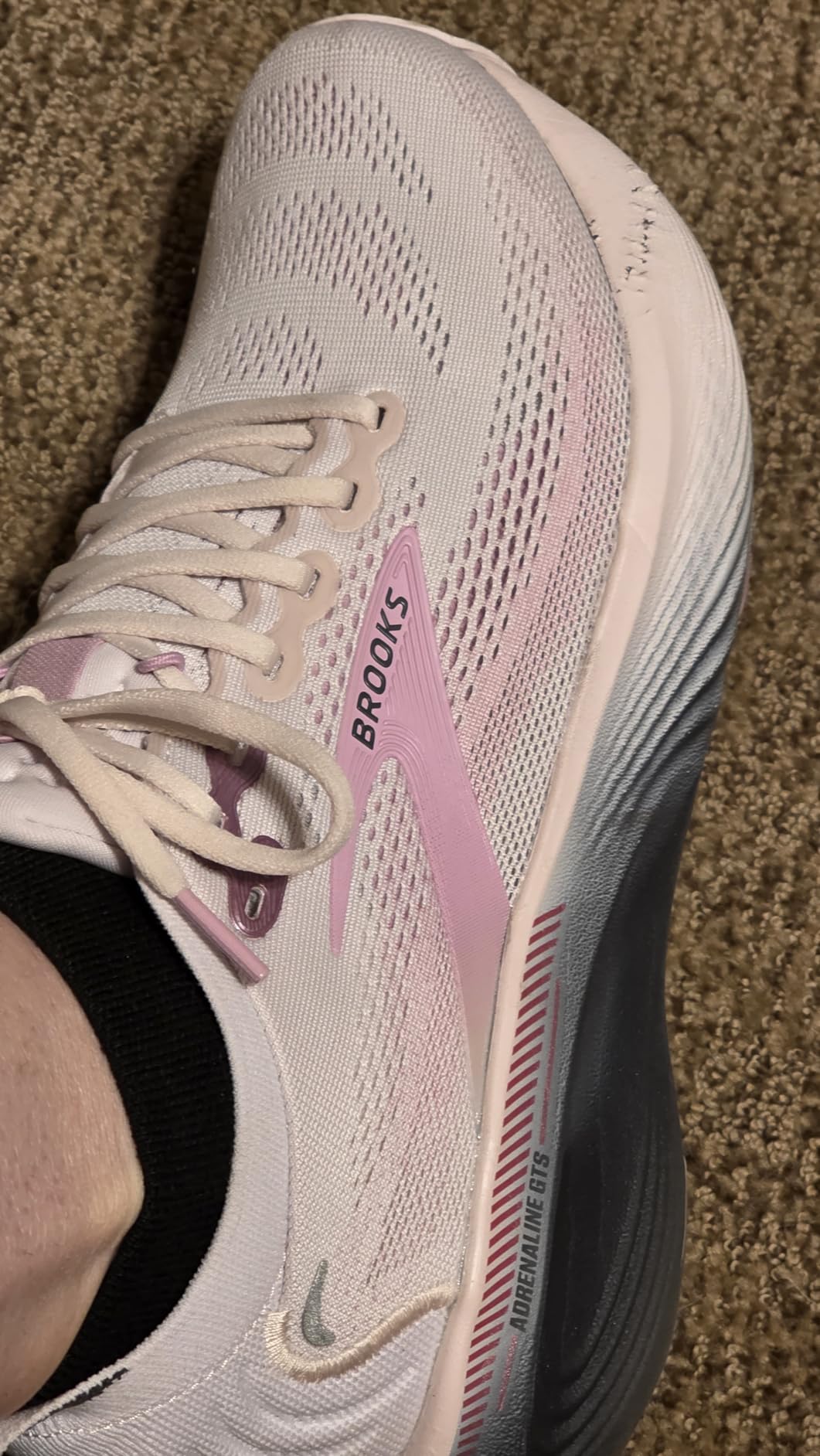
If your hip pain started in a running injury rather than from age, the Adrenaline GTS 25 is the one to look at. It is the current generation of a stability-focused shoe and it holds the top spot in the women’s road running category, which means a lot of people are putting serious mileage through it.
The GuideRails system is the key feature for hip pain specifically. Instead of a hard post under the arch that pushes you upright, GuideRails put a wall around the heel to limit excess movement without over-correcting your natural stride. That matters because over-correction is itself a source of hip rotation.
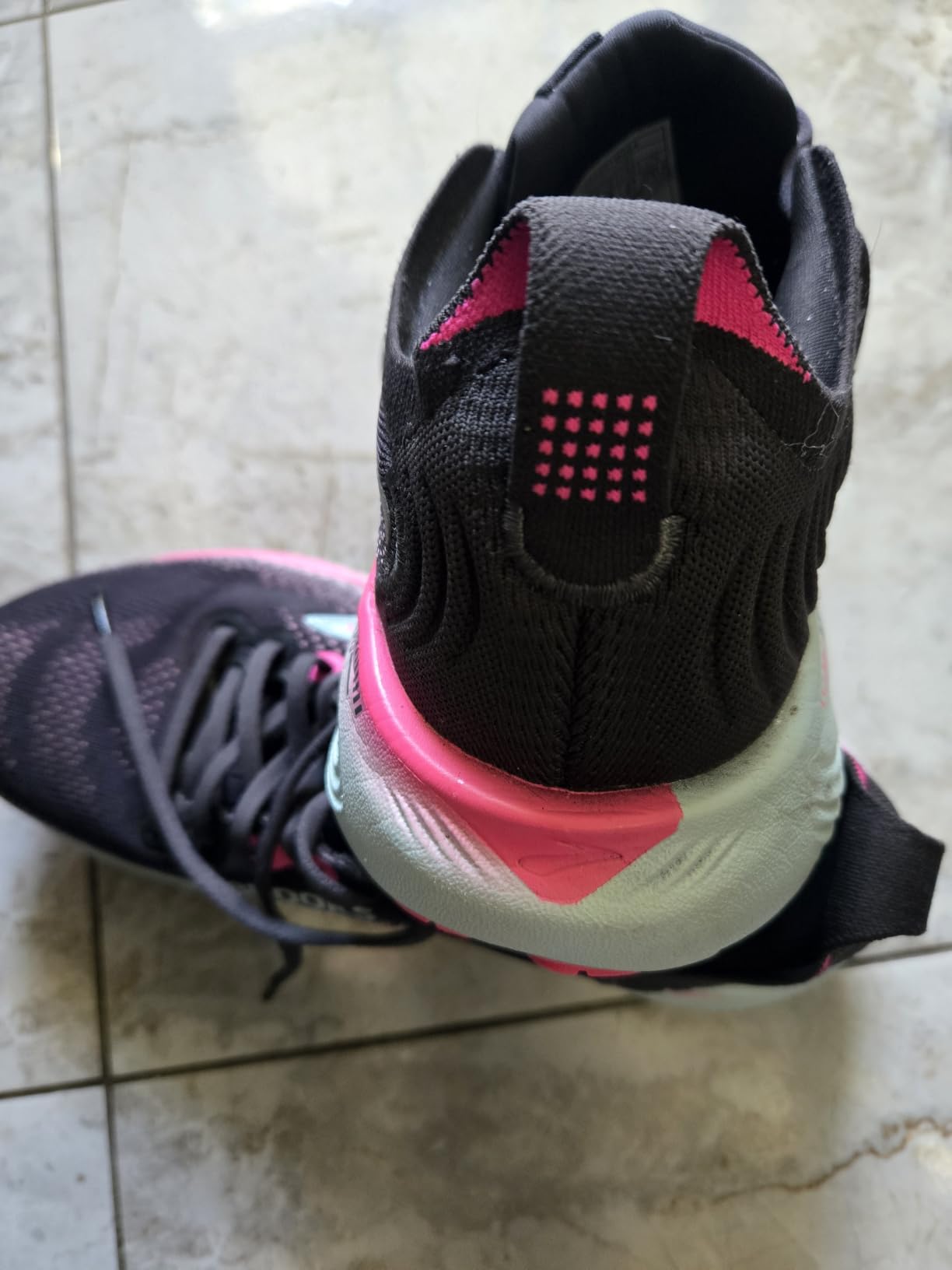
Underneath, nitrogen-infused DNA LOFT v3 gives you soft, dynamic cushioning that holds up over distance rather than flattening out, and the breathable engineered mesh with a flat-knit collar keeps it comfortable on long sessions. It also carries the APMA Seal of Acceptance.
The compromises are honest. It is heavier and bulkier than a lighter road shoe, the running-shoe profile is less casual than a dedicated walking shoe, and the platform is stiffer than a plush walking shoe would be.
Why this wins if you are still running?
There is no point in changing your running shoes to walking shoes and then going back to running in something unpadded. The Adrenaline gives you the running platform you need while adding the GuideRails support that limits the rotational component of hip loading.
Reviewers describe it as comfortable for both running and walking longer distances, and the transition between the two uses is seamless because the geometry is the same.
When to skip it?
Skip it if you only walk and never run, because a lighter dedicated walking shoe like the Fresh Foam Roav will feel better. Skip it if you need a dress-casual option or if you are bothered by a heavier, bulkier profile.
If your foot is very narrow, the bulk of this shoe can feel like too much shoe. And if you are only just starting to walk for exercise after a long layoff, a stability running shoe may be more control than you need.
We earn a commission, at no additional cost to you. CERTAIN CONTENT THAT APPEARS ON THIS SITE COMES FROM AMAZON. THIS CONTENT IS PROVIDED 'AS IS' AND IS SUBJECT TO CHANGE OR REMOVAL AT ANY TIME.
How to Choose: A Buying Guide for Hip Osteoarthritis?
Start by figuring out which of three jobs your main pair has to do, because the best shoe for each is different. Walking shoes are built for forward motion. Shoes for standing all day need a different cushioning profile, usually deeper and more protective under the metatarsals. A third category, stability shoes, exists for people whose pain is rotational.
For a runner or walker who also wants one pair that works in a professional setting, the leather-upper options here earn their place. Our broader guide to the best walking shoes for women covers general comfort picks for people who do not have a joint condition.
The five features that matter, in plain language
Heel counter. The rigid cup at the back of the heel. Firm is good, and it is the feature most easily tested at home without any expertise.
Heel-to-toe drop. The height difference between your heel and your forefoot. A high drop, meaning a raised heel, tilts your pelvis forward. A low drop spreads load more evenly across the joint. The 877 V1 sits at about 11 mm, which is a reasonable middle ground.
Rocker sole. A shoe with a curve built into the sole so your heel rocks forward into the next step. This reduces the abrupt loading that happens when a heel strikes flat, and it is why the Ghost Max 3 feels smooth on long walks.
Toe box width. The width across the toes. Women with bunions or swelling need a genuinely wide forefoot, and this is measured on a scale from 2A through 4E. Ask for the wide width rather than trying to cope in a standard one.
Removable insole. A footbed that lifts out. It means you can add or replace an orthotic without replacing the shoe, and swap in a thinner one on swollen days.
The Heel-Counter Pinch Test in 3 Steps
This test comes from patient forums and it is genuinely useful. It takes about ten seconds and tells you more than the box does.
Take the shoe out of the box and hold it with the toe pointing away from you.
Squeeze the two sides of the heel together with your thumb and forefinger. You are testing the cup at the back, not the sides of the shoe.
Judge the result. A firm heel counter resists compression and springs back, feeling solid and slightly difficult to squish. A soft one folds in easily and stays folded, and that is the heel that will let your foot roll inward all afternoon.
If a shoe fails this test, it will not become a hip-friendly shoe no matter how cushioned the midsole is. We use the same test on every pair that reaches the final list here.
Women’s Fit Problems Nobody Mentions
Two feet that are not the same. Asymmetric feet are one of the most common real complaints on arthritis forums and one of the least addressed by roundups. The practical answer is to buy the shoe for your larger or wider foot, then add a removable insole with extra volume on the smaller side. That is also why the adjustable insole on the Orthofeet Coral is worth paying attention to.
Bunions narrowing the forefoot. A wide toe box is not a luxury here. If a shoe forces your toes together, you will shorten your stride, and a shortened stride changes how your hip is loaded. The 877 V1, the Coral, and the Devotion Plus 3 all handle bunions better than the rest of this list.
Brands that run small. This is real and it is consistent across sources. A brand consistently recommended on arthritis forums requires sizing up one full size, and users report the Roav running small in standard widths. When a model runs small, do not fight it, order the next size and adjust with the insole.
Not being able to reach your feet. The single most-raised problem in the Quora and BoneSmart threads is difficulty bending to tie laces. Elastic laces, a bungee closure, or a true slip-on solve it completely, and the Skechers Go Walk Flex Grand is built specifically for that.
Shoes to Avoid With Hip Arthritis
The most common culprits are not subtle, and avoiding them usually does more than upgrading to a better walking shoe.
High heels and anything with a steep drop. This tilts the pelvis forward, pushes the hip joint into a compressed position, and shortens the calf and hip flexor muscles. It is the single most cited aggravator in patient forums.
Worn-out soles. BoneSmart staff make this point clearly: worn soles bake your old gait into the shoe, so you are walking in a shoe shaped like the person you were two years ago. Replace them, or resole them, before blaming your hip.
Flat, unsupportive shoes. Ballet flats, thin canvas, and flip-flops give your arch nothing to work against. There is no heel counter, no midsole, and no structure, so your foot collapses through every step.
Over-cushioned, very soft shoes. This one surprises people. A shoe that is soft and unstable lets your foot slop around, which means more rotation at the hip. Cushioning that is too soft reduces stability. Balance matters more than softness.
There is one dissenting view worth knowing about. At least one BoneSmart member reported being more comfortable in a heel and platform, which is a reminder that individual variation is real. Nobody is uniform, and this list is a starting point rather than a verdict.
Insoles, Rotation, and Surgery
When to add an orthotic. If your pain is concentrated under the heel at the start of each step, an insole that absorbs heel strike is worth trying. People on arthritis boards report that off-the-shelf insoles worked about as well as expensive podiatrist-made orthotics. Only buy a shoe with a removable insole, or this is a dead end.
Rotate two pairs. Nobody in the roundups mentions this and everyone should. Foam recovers between wears, and alternating pairs roughly extends the life of each one. It also gives your foot two different heel-toe geometries, which can reduce the repetitive loading that aggravates a hip in the first place.
Before hip replacement surgery. Staff advice from the BoneSmart pre-op forum is consistent: buy new shoes or resole your current ones before surgery, because worn soles replicate your old gait. But do not buy brand-new shoes in the week before your operation. The sudden change in sole height and wear pattern can temporarily make pain worse.
After surgery. Ask your surgeon or physical therapist what your weight-bearing status allows before you buy. You will want a stable, closed-toe, slip-resistant shoe with a firm heel counter, and a shoe you can get on without bending. Some patients report needing a shoe with a raised sole on the non-operated side, which is a question for your care team, not for us.
When a Shoe Is Not Enough?
Shoes are one of the few daily levers you control completely, but they are not the only one. If your pain is worsening week on week regardless of footwear, that is a signal to be assessed, not a signal to keep shopping.
If your hip pain makes getting outdoors difficult, a walking pad treadmill lets you keep low-impact steps up while limiting the distance that aggravates the joint.
Other levers worth raising with a clinician include shortening your walking sessions and splitting long walks into two, using a cane in the hand opposite the affected hip, working with a physical therapist on hip strength and gait retraining, and asking about pain management options. None of that replaces a good shoe. All of it compounds with one.
Where your walking is comfortable enough to add load, controlled strength work protects the hip better than more walking alone. Our picks for a beginner barbell setup for women cover glute and hip work you can progress at your own pace.
See a podiatrist if you have bunions, a significant leg-length difference, diabetes, or foot pain that changes how you walk. See a physical therapist if your hip is stiffening or if you are not sure how to adjust your activity. See an orthopedic surgeon if walking has become genuinely difficult, because a worn joint is a medical problem and shoes cannot solve it.
Frequently Asked Questions
What are the best walking shoes for hip arthritis?
For most women, the New Balance Fresh Foam Roav is the best overall pick because it combines a cushioned Fresh Foam midsole, a low heel, and a structured heel cup while staying light. The Skechers Go Walk Flex Grand is the best option if you cannot bend to tie laces, and the New Balance 608 V5 is the best durable all-day workhorse. The three features that matter most in any of them are a cushioned sole, a heel under one inch, and a firm heel counter.
Are Hokas good for hip pain?
Yes. The Hoka Bondi 9 is one of the strongest options for hip pain because of its deep cushioning combined with a wide, stable platform base. Maximum cushioning on a narrow base would make you wobble, but this pairing absorbs impact while keeping your foot aligned. The main drawback is foam durability, with owners reporting the midsole feeling spongy after roughly four months of heavy daily use.
What shoes do podiatrists recommend for arthritis?
The most common recommendations follow three principles. First, a well-cushioned sole that absorbs and returns less impact per step. Second, a low heel, ideally under one inch, so your pelvis is not tilted forward. Third, a firm heel counter, because that cup limits pronation, which limits how far the femur and hip rotate inward on each stride. The New Balance 608 V5, the Skechers Go Walk Flex, and the Orthofeet Coral all deliver at least two of the three.
Are my shoes causing my hip pain?
Possibly. High heels, very worn-out soles, and flat unsupportive shoes are frequently cited as aggravators on arthritis patient forums. BoneSmart staff note that worn soles bake your old gait into the shoe, so you are walking in a shoe shaped like the person you were years ago. You can check a shoe yourself in ten seconds with the heel-counter pinch test: squeeze the back of the shoe, and if it folds easily and stays folded, your foot will roll inward all day.
Which shoes are most likely to cause hip pain?
High heels and any steep heel-to-toe drop come first, because they tilt the pelvis forward and push the hip joint into a compressed position. Flat, unsupportive shoes such as ballet flats, thin canvas, and flip-flops come next, because there is no midsole, no arch support, and no heel counter at all. Worn-out soles are a close third, since they replicate your old gait. Finally, over-cushioned very soft shoes can do the opposite of what people expect, because an unstable foot slops around and rotates the hip more.
How often should I replace walking shoes?
Replace them when the midsole stops returning energy and the outsole tread is worn smooth, rather than on a fixed calendar. For a hip arthritis patient this can be sooner than for someone walking casually, and foam-heavy shoes like the Hoka Bondi 9 degrade faster than firmer walking shoes, with owners reporting a spongy feel after about four months of heavy use. A good rule is to have your insole checked at the same time, since a worn footbed changes the geometry of the whole shoe.
Bottom Line
For hip arthritis in 2026, the New Balance Fresh Foam Roav is the pick we would start with, because it delivers a cushioned sole, a low heel, and a firm heel counter without weighing your stride down. If tying laces is the barrier, the Skechers Go Walk Flex Grand removes it entirely. If you need something that survives a decade of daily walking, the New Balance 608 V5 does.
Whichever you choose, do the heel-counter pinch test before you commit, give the pair a fair break-in, and rotate it with a second pair. And if the pain keeps climbing no matter what you wear, that is a conversation for a podiatrist or physical therapist rather than another pair of shoes.