
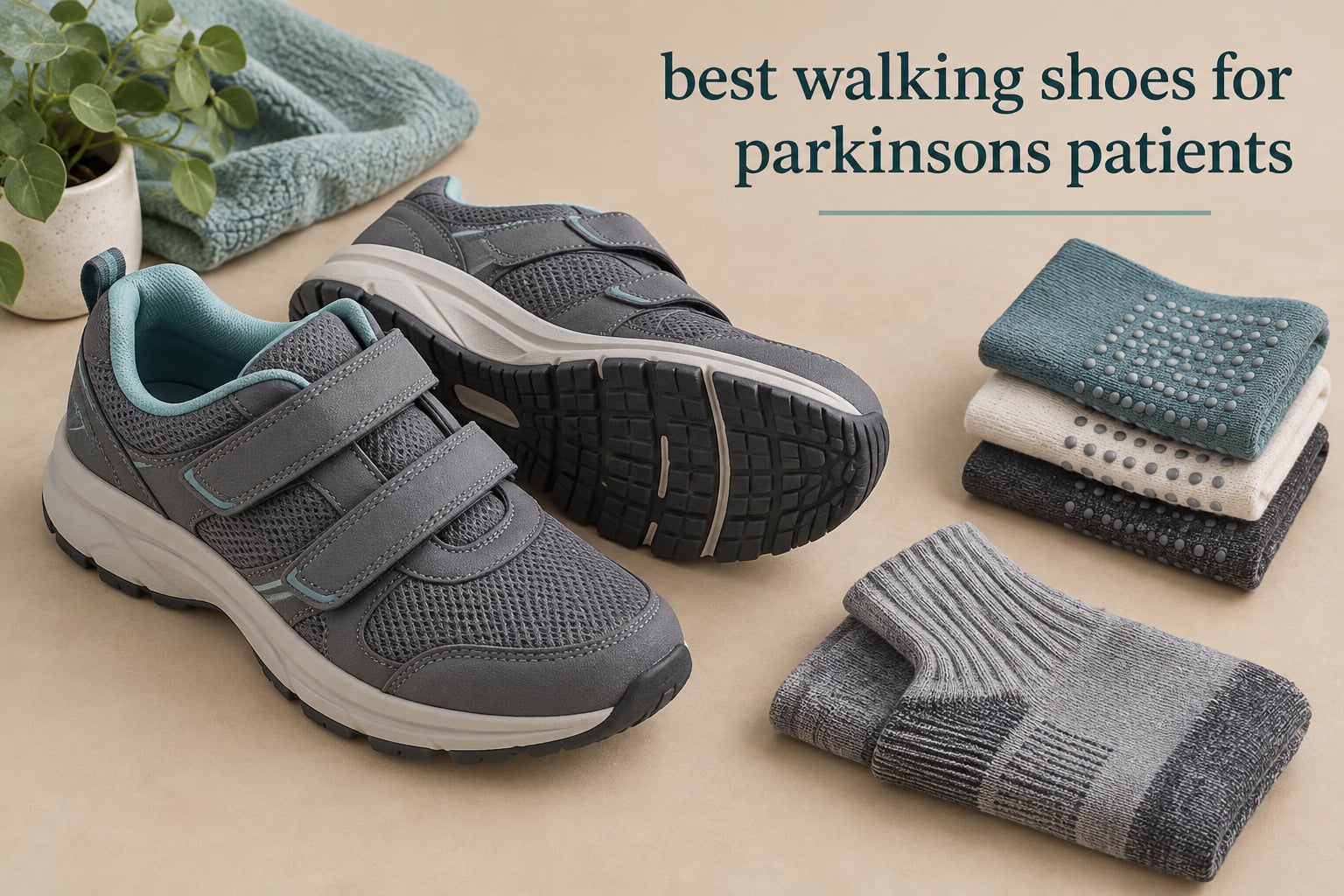
The best walking shoes for Parkinson’s patients are adaptive, hands-free or hook-and-loop shoes with a firm slip-resistant rubber sole, a wide toe box and a removable cushioned insole. That combination offsets the shuffling gait, reduced toe clearance, foot drop and freezing of gait that define the condition, and it removes the dexterity demand of tying laces.
That sentence is the whole buying guide. Nearly everything below expands on one of those four ideas, because Parkinson’s changes your feet in fairly predictable ways, and a shoe that ignores them makes walking harder rather than easier.
Our team spent several weeks working through adaptive footwear for this roundup, reading the customer reviews and specifications on every shoe in the list, and mapping each design choice back to the specific gait symptom it compensates for. What we found is that the medical-looking shoes and the ordinary-looking sneakers both work, but for very different problems. The buyer who works out which camp their feet belongs to will be far happier with the result than the buyer who just orders the most cushioned option.
A few things to say up front. Shoes support gait but they do not treat Parkinson’s disease, and nothing here is medical advice. If someone shuffles, freezes, has curling or sticky toes, a rolling-in arch or a genuine foot drop, a conversation with a podiatrist usually adds more than another pair of sneakers, and in the UK the route to made-to-measure footwear runs through your GP. We walk through that route later in the guide.
If you are shopping for a parent or partner rather than for yourself, the dynamics change. You are not buying comfort, you are buying a task that has to be completed reliably at 7am on a bad morning, so closure type and opening height matter more than cushioning depth. Our caregiver section covers that. For broader shoe guidance for other readers, our picks for the best walking shoes for women and our roundup of the best walking pad treadmills cover adjacent ground.
Table of Contents
- Why Parkinson’s Changes How You Walk?
- Top 3 Best Walking Shoes For Parkinsons Patients (October 2026)
- Quick Overview: All 10 Shoes Compared
- 1. New Balance Men’s 608 V5 – Our Most Stable Everyday Pick
- 2. New Balance Men’s 577 V1 – Best Hook and Loop Value
- 3. Skechers Women’s Slip-Ins Go Walk Flex Relish – Best All-Day Comfort
- 4. Propet LifeWalker Strap – Best for Wide Feet and Orthotics
- 5. Orthofeet Edgewater – Best for Arch Collapse and Standing Shifts
- 6. FitVille Extra Wide Slip-on – Best Budget Hands-Free Pick
- 7. Skechers Women’s Breathe-Easy Roll-With-Me – Best Indoors
- 8. Skechers Glide Step Caledonia – Best for Long Walks and Wet Ground
- 9. LEADER SHOW Casual Walking Shoe – Lightest Indoor and Casual Option
- 10. LOCFIR Wide Toe Box Slip-on – Best for Wide Women’s Feet
- How to Choose Walking Shoes for Parkinson’s Patients?
- When to See a Podiatrist and How the Referral Route Works?
- Indoor Shoes, Slippers and Grip Socks
- Laser-Guided Shoes and Freezing of Gait
- Frequently Asked Questions
- What are the best walking shoes for people with Parkinson’s disease?
- How do people with Parkinson’s typically walk?
- Why do people with Parkinson’s struggle to walk?
- What is the best walking aid for someone with Parkinson’s?
- Do Parkinson’s patients need special shoes?
- What are the best shoes for seniors to prevent falling?
- What precautions should people with Parkinson’s disease take?
- What activities are recommended for advanced Parkinson’s disease patients?
- Conclusion
Why Parkinson’s Changes How You Walk?
Parkinson’s is a movement disorder, and the part of the brain it affects is the basal ganglia, which handles the automatic, unconscious half of movement. Over time the dopamine it produces falls away, and movements that used to happen without thought start requiring conscious effort. Walking is a good example: the brain loses the ability to fire off the next step automatically, so the body compensates.
The compensation is usually shuffling. People shorten their stride because a shorter step is easier to initiate, and they drag the foot through the push-off instead of lifting it. This shortens toe clearance, which is the gap between the underside of the shoe and the floor during the swing phase. When that gap shrinks to a few millimetres, the toe of the shoe starts catching, scuffing and eventually tripping the wearer. On the Parkinson’s UK Forum, one user with hospital-made shoes reported that he simply stopped shuffling and scuffing his feet once the footwear changed. That is the single most common footwear complaint we came across.
The other gait changes map to shoe features in predictable ways. A list of the ones that matter when you shop:
Shuffling and scuffing comes from reduced toe clearance. You want a rounded or bevelled toe, a light shoe and a sole that does not catch on carpet and laminate.
Freezing of gait is the sudden inability to start, described as the feet feeling stuck to the floor. Traction matters here, because a foot that slips slightly is a foot that keeps moving.
Festination is the forward-leaning, accelerating shuffle that can end in a fall. A firm heel counter and a stable platform help because the foot cannot wobble under load.
Dystonia in the foot produces curled or sticky toes and a dropped arch rolling inward, sometimes called pes planovalgus. A wide toe box and a deep, supportive footbed stop the toes being forced into a position that damages skin.
Foot drop means the ankle cannot lift the foot clear, so the toe drags on every step. This is the one gait change that usually needs an orthotic or a specialist shoe rather than an off-the-shelf pick.
Reduced arm swing and stooped posture shift weight forward, which increases the load through the forefoot. Cushioning that stays in place under repeated push-off matters more than softness.
Two things follow from that list. First, closure is not a style preference in this context. Tremor and reduced dexterity make laces a genuine problem, and one user on the Parkinson’s UK Forum named velcro straps explicitly as the reason for their choice. Second, a narrow shoe is not a neutral choice: squeezing curled or sticky toes is how shoes end up taking skin off and turning a comfortable shoe into something a person takes off, which is worse than having no supportive shoe at all.
It is also worth saying that mainstream athletic brands work. On r/Parkinsons, a person shopping for a father with Parkinson’s who plays pickleball was pointed toward New Balance, Yonex and Mizuno rather than medical footwear. That is consistent with what we see in the review data: several of the shoes in this roundup are ordinary sneakers that happen to have the right closure and the right last.
Top 3 Best Walking Shoes For Parkinsons Patients (October 2026)
Our three standouts cover three different needs: a stable conventional shoe for someone whose hands still work, a genuinely hands-free slip-in for someone who cannot reach their feet, and a hook-and-loop walker for someone who can manage a strap but not a lace.

New Balance 608 V5
- ABZORB heel cushioning
- Structured suede upper
- Wide size run to 3X-Wide
- Dual density collar foam

Skechers Go Walk Flex Relish
- Truly hands-free slip-on
- Air-Cooled Memory Foam insole
- Flex Pillars for stability
- Machine washable

New Balance 577 V1 Hook and Loop
- Hook and loop closure
- ABZORB heel cushioning
- Leather upper
- Medicare HCPCS A5500 listed
Quick Overview: All 10 Shoes Compared
Every shoe below was assessed on the same five things: how the foot gets in, how much traction the outsole offers, whether the insole can be replaced, how wide the toe box is, and which specific gait problem the design addresses.
| Product | Key Specs | Pricing |
|---|---|---|
| New Balance 608 V5 |
|
Check Latest Price |
| New Balance 577 V1 Hook and Loop |
|
Check Latest Price |
| Skechers Go Walk Flex Relish |
|
Check Latest Price |
 Propet LifeWalker Strap Propet LifeWalker Strap |
|
Check Latest Price |
 Orthofeet Edgewater Orthofeet Edgewater |
|
Check Latest Price |
 FitVille Extra Wide Slip-on FitVille Extra Wide Slip-on |
|
Check Latest Price |
 Skechers Breathe-Easy Roll-With-Me Skechers Breathe-Easy Roll-With-Me |
|
Check Latest Price |
 Skechers Glide Step Caledonia Skechers Glide Step Caledonia |
|
Check Latest Price |
 LEADER SHOW Casual Walking Shoe LEADER SHOW Casual Walking Shoe |
|
Check Latest Price |
 LOCFIR Wide Toe Box Slip-on LOCFIR Wide Toe Box Slip-on |
|
Check Latest Price |
1. New Balance Men’s 608 V5 – Our Most Stable Everyday Pick
New Balance Men’s 608 V5 Casual Comfort Cross Trainer, White/Navy, 10.5 Wide
★★★★★★★★★★EVA midsole with internal shank
ABZORB heel with PU insert
Dual density collar foam
- All-day cushioning from ABZORB heel and molded PU insert
- Sturdy suede upper that breaks in over time
- Dual density collar foam aids stability
- Minimal-seaming interior reduces irritation
- Widest size range here with up to 3X-Wide
- Lace-up closure is hard for hands with tremor
- Suede upper needs care in wet conditions
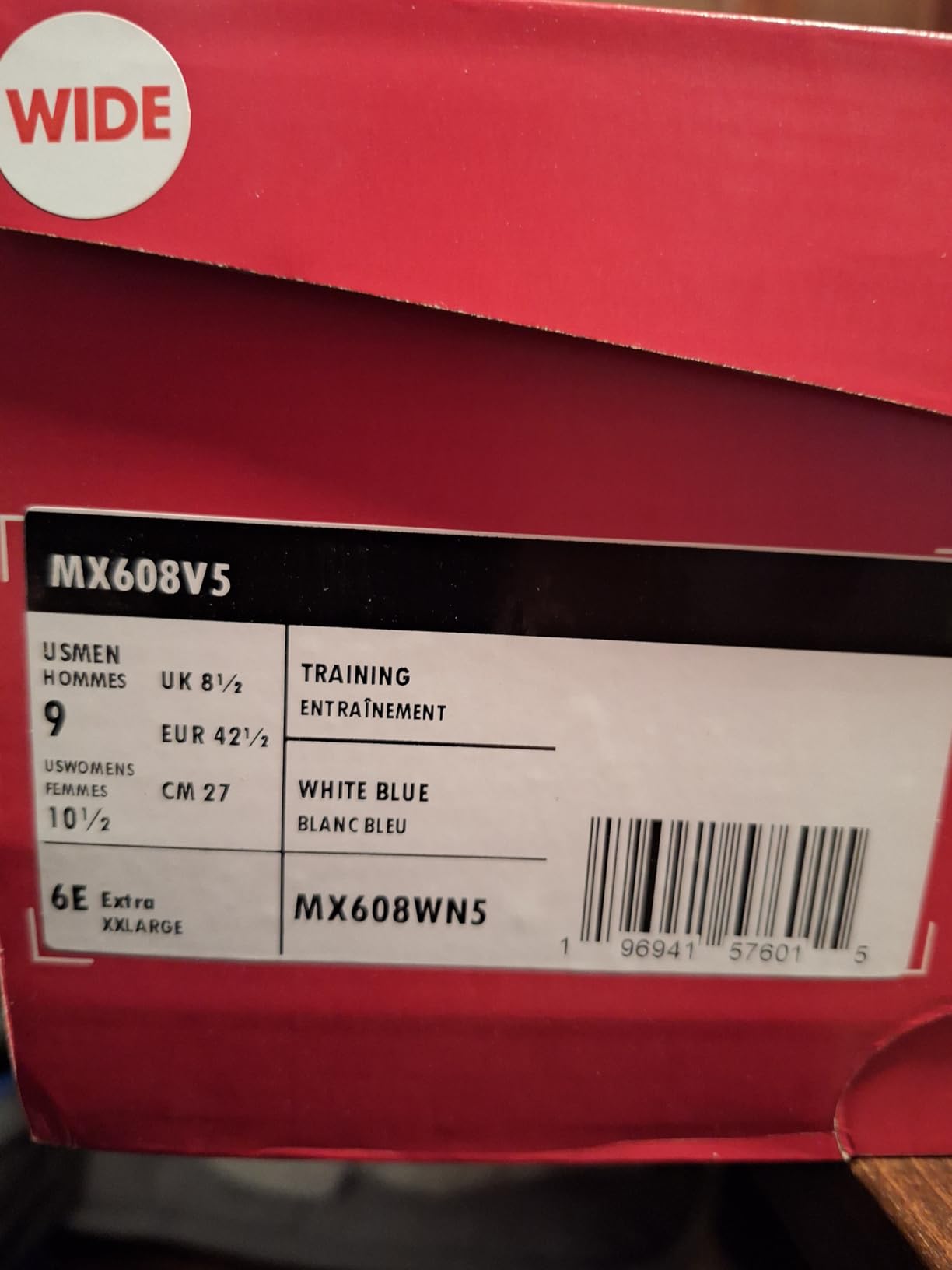
This is the shoe we recommend first, and the reason is unglamorous: it is the most heavily reviewed shoe in this roundup by a wide margin, with an average rating of 4.6 and 77% of reviews at five stars. When a category is thin on real-world data, that kind of volume matters more than any spec sheet.
The construction is what supports the rating. An EVA foam midsole with an internal shank gives midfoot stability without the slab-like feel of a rigid orthotic, and the ABZORB heel crash pad with a molded PU insert absorbs the heel strike that a festinating gait produces. The dual density collar foam does quiet work around the ankle, which is where a lot of balance wobble shows up first.
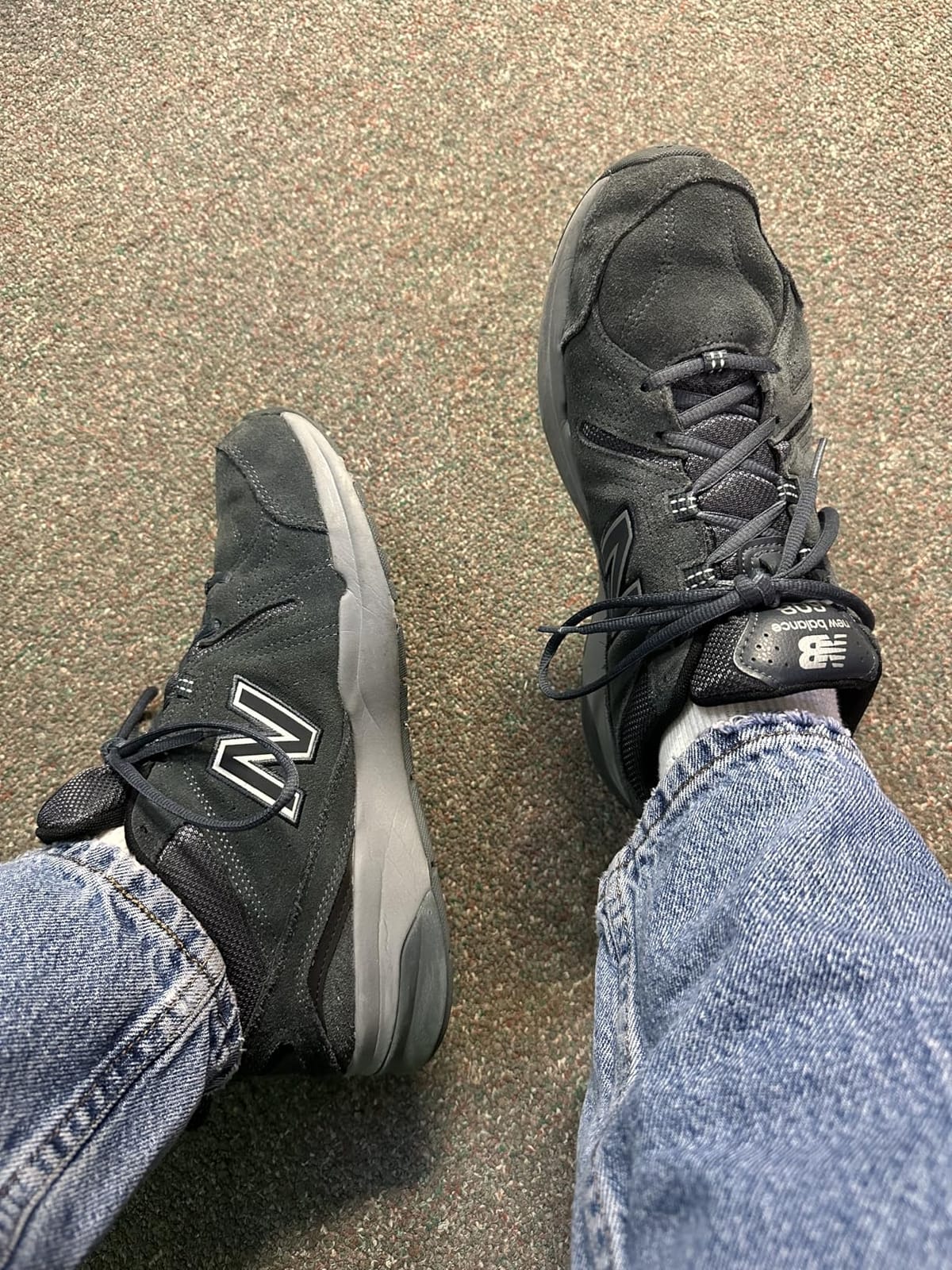
Where it fails is closure, and it fails completely. This is a conventional lace-up shoe, and for a person with tremor or reduced hand function that is not a minor inconvenience, it is the whole reason they go barefoot at home. We would only pick it where the person can manage laces reliably and the priority is stable all-day comfort and a wide size run.
The Phantom Liner interior with minimal seaming is worth a mention for anyone with sensory sensitivity or a tendency to skin breakdown. Fewer seams means fewer places for a shoe to rub, and for a person who shuffles, the inside of the toe box is exactly where rubbing happens.
When this shoe is the right call?
Pick the 608 V5 when the person can manage laces, has no significant foot drop, and spends hours on their feet. It is a genuinely supportive cross trainer with a wide fit, and for someone whose Parkinson’s symptoms are tremor-dominant rather than gait-dominant, it is hard to argue with.
The size run is the quiet advantage. Up to 3X-Wide matters for feet that swell through the day, and swelling plus a wide toe box is the difference between a shoe worn all day and a shoe removed at lunchtime.
When to choose something else?
If dexterity is limited, the closure alone rules it out, and there is no point compromising the rest of the shoe to work around it. We would also look elsewhere for genuine foot drop, because the internal shank supports the midfoot rather than lifting a dropped forefoot.
One practical note: suede needs a different care routine than mesh, and it marks easily. For someone whose footwear budget matters and who will scuff the toe while shuffling, that is worth factoring in before ordering a pair that looks worn after a month.
We earn a commission, at no additional cost to you. CERTAIN CONTENT THAT APPEARS ON THIS SITE COMES FROM AMAZON. THIS CONTENT IS PROVIDED 'AS IS' AND IS SUBJECT TO CHANGE OR REMOVAL AT ANY TIME.
2. New Balance Men’s 577 V1 – Best Hook and Loop Value
New Balance Men’s 577 V1 Hook and Loop Shoe, Bone, 11 Wide
★★★★★★★★★★Hook and loop closure
Leather upper
Polyurethane midsole
ABZORB heel cushioning
- Hook and loop strap means no laces to tie
- Leather upper is soft and presentable
- Very wide size run including X-Wide
- Medicare HCPCS code A5500 listed
- Reflective accents aid visibility
- Straps run short on very high or wide insteps
- Sole edge and footbed join wear after heavy daily use
- Can squeak on hard floors
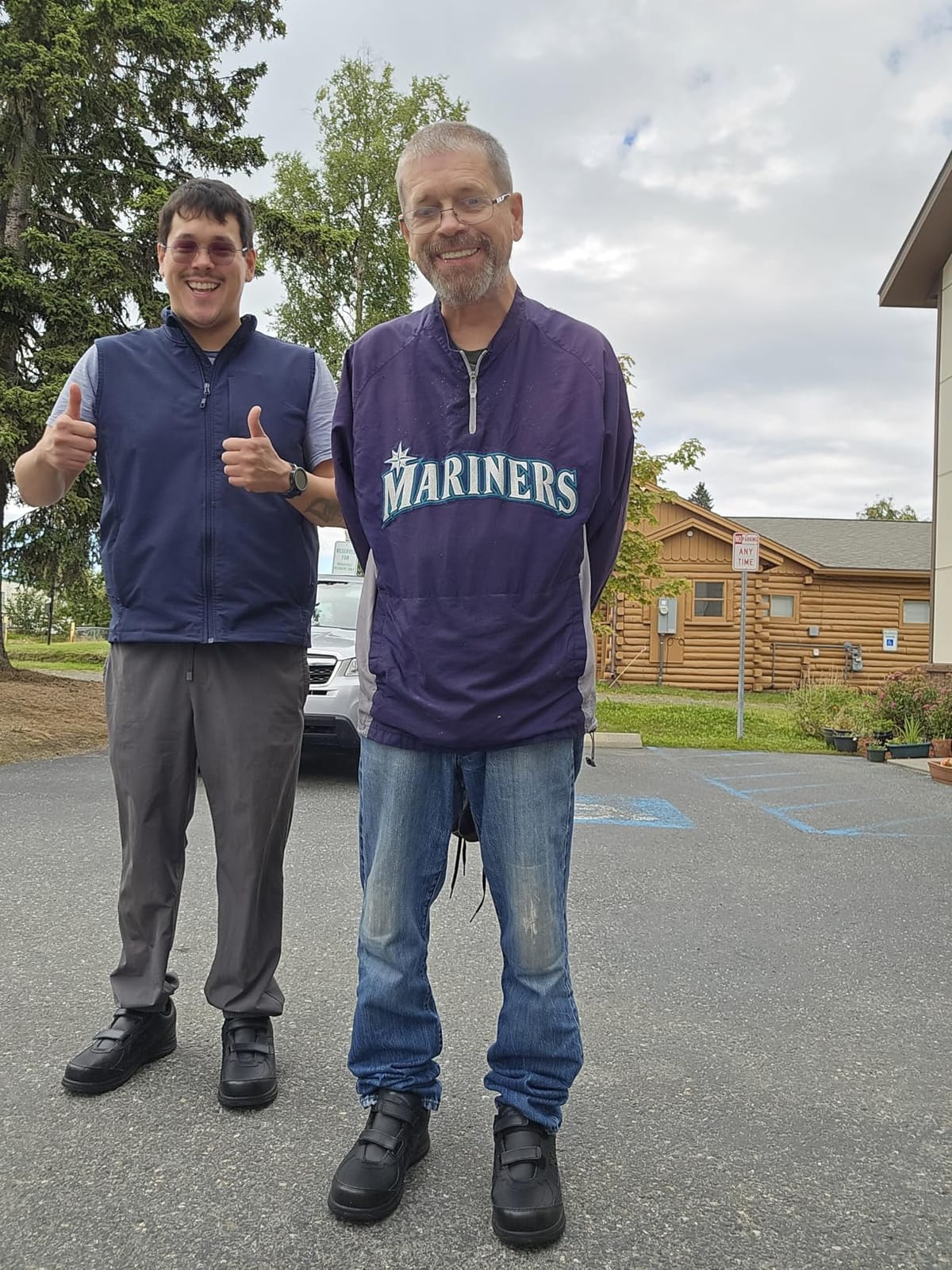
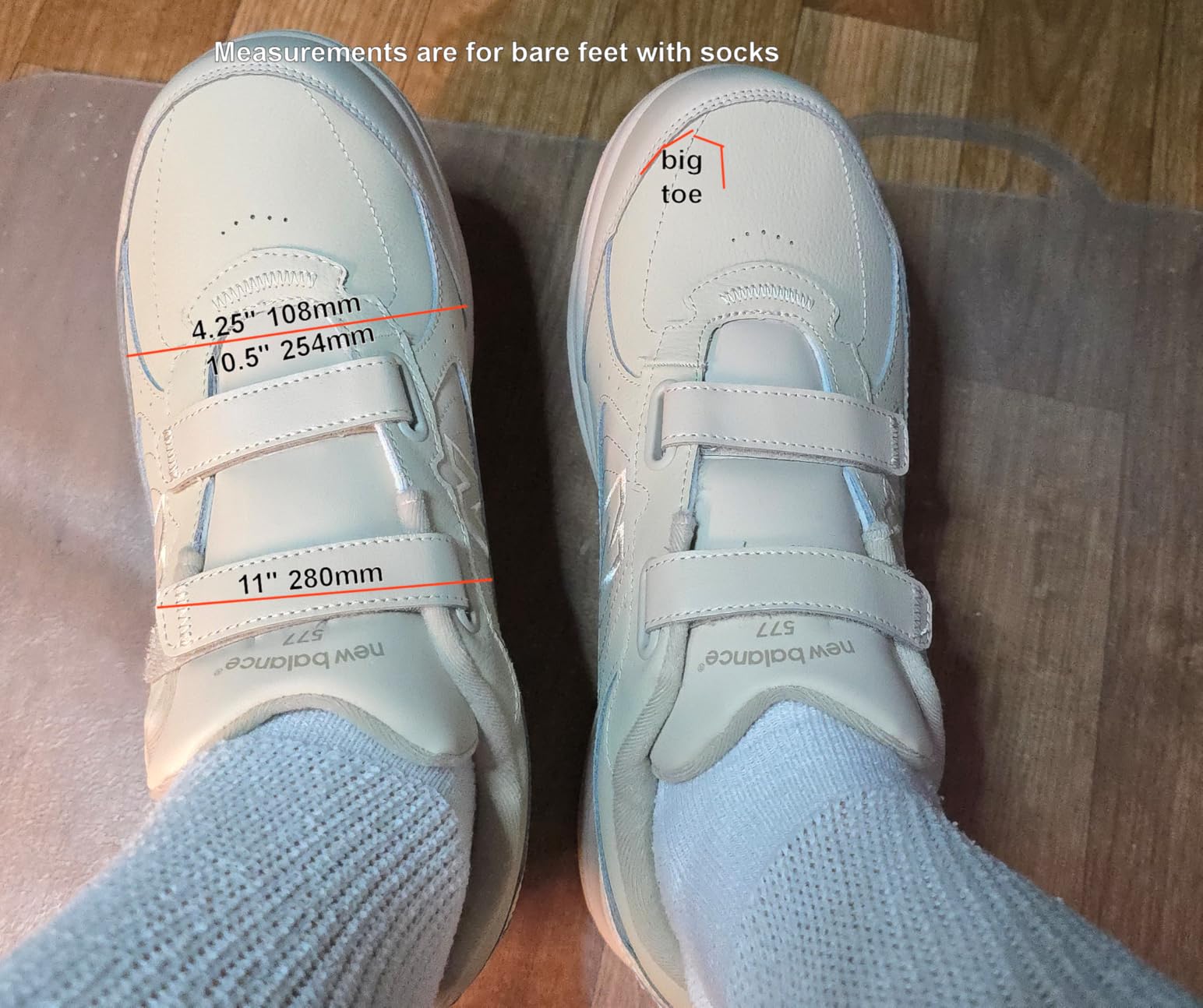
the 577 V1 has been on sale for years and has picked up more than 19k reviews, many of them from people who bought it for reasons that have nothing to do with sport. Buyers with arthritis, cerebral palsy, dementia and reduced hand function repeatedly single out the hook-and-loop closure as the reason they can put shoes on independently.
That is exactly the reason it works for Parkinson’s. A strap can be tensioned with one hand, undone with one hand, and adjusted by a carer without undoing anything else. A carer buying for a parent can check the fit in ten seconds and move on to the next task of the morning.
There is also a detail here that is easy to miss and occasionally decisive: the product listing carries Medicare HCPCS code A5500, meaning it may be eligible for reimbursement under that code. In the US that is worth checking before buying, and in the UK the equivalent question is whether a GP or a continuing healthcare assessment will fund adaptive footwear. We cover the UK route in a later section.
Durability is the honest drawback. The join between the sole edge and the footbed is reported to wear through after roughly 10-12 months of heavy daily use, and the elevated sole profile makes noise on hard floors, which matters in a hallway at night or in a care home.
Best for tremor and reduced dexterity
This is the shoe to shortlist for anyone whose main problem is hands rather than feet. The leather upper also means it looks like an ordinary shoe, which matters to a lot of people who do not want to be identified by their footwear.
The reflective accents are a quiet safety feature. A shuffle gait is hard to see from a distance in low light, and being visible is a small, free reduction in risk.
Watch the strap length on wide feet
The most common fit complaint is that the straps are short relative to a very high or very wide instep, so they cannot be pulled tight enough. If the person has a high instep or a swollen foot, size up a width before you assume the shoe is wrong.
Some buyers solve this themselves by adding extra hook-and-loop tape to extend the strap. It is a reasonable hack, but it is a sign that the stock configuration does not fit, and it is better solved with a different last or a different model.
We earn a commission, at no additional cost to you. CERTAIN CONTENT THAT APPEARS ON THIS SITE COMES FROM AMAZON. THIS CONTENT IS PROVIDED 'AS IS' AND IS SUBJECT TO CHANGE OR REMOVAL AT ANY TIME.
3. Skechers Women’s Slip-Ins Go Walk Flex Relish – Best All-Day Comfort
Skechers Women’s Hands Free Slip-Ins Go Walk Flex-Relish Sneaker, Taupe/Blue, 8.5
★★★★★★★★★★Air-Cooled Memory Foam insole
ULTRA GO cushioning midsole
Heel Pillow and Flex Pillars
Multi-surface traction outsole
- Truly hands-free laceless design that slips on without bending
- Deep cushioning described as soft underfoot
- Flex Pillars add stability on uneven ground
- Machine washable for daily wear
- Wide and Narrow widths available
- Sizing is inconsistent between production runs
- Toe box runs roomier than expected
- Heel bumpers catch on thin no-show socks
This is the shoe that comes up most often in patient forums, and in one long-running health discussion a user with Parkinson’s described Skechers Go Walk models as the lightest and most comfortable shoes they had ever owned, owning three pairs. That kind of repeat purchase is a real signal: people do not buy three pairs of a shoe that was merely adequate.
The mechanism is a genuinely laceless upper that grips the foot without a closure, and the Heel Pillow technology holds the foot in place so it does not slide out on the push-off. That matters for a shuffler, because a foot that slides forward in the shoe puts the toe in exactly the wrong place relative to the sole.
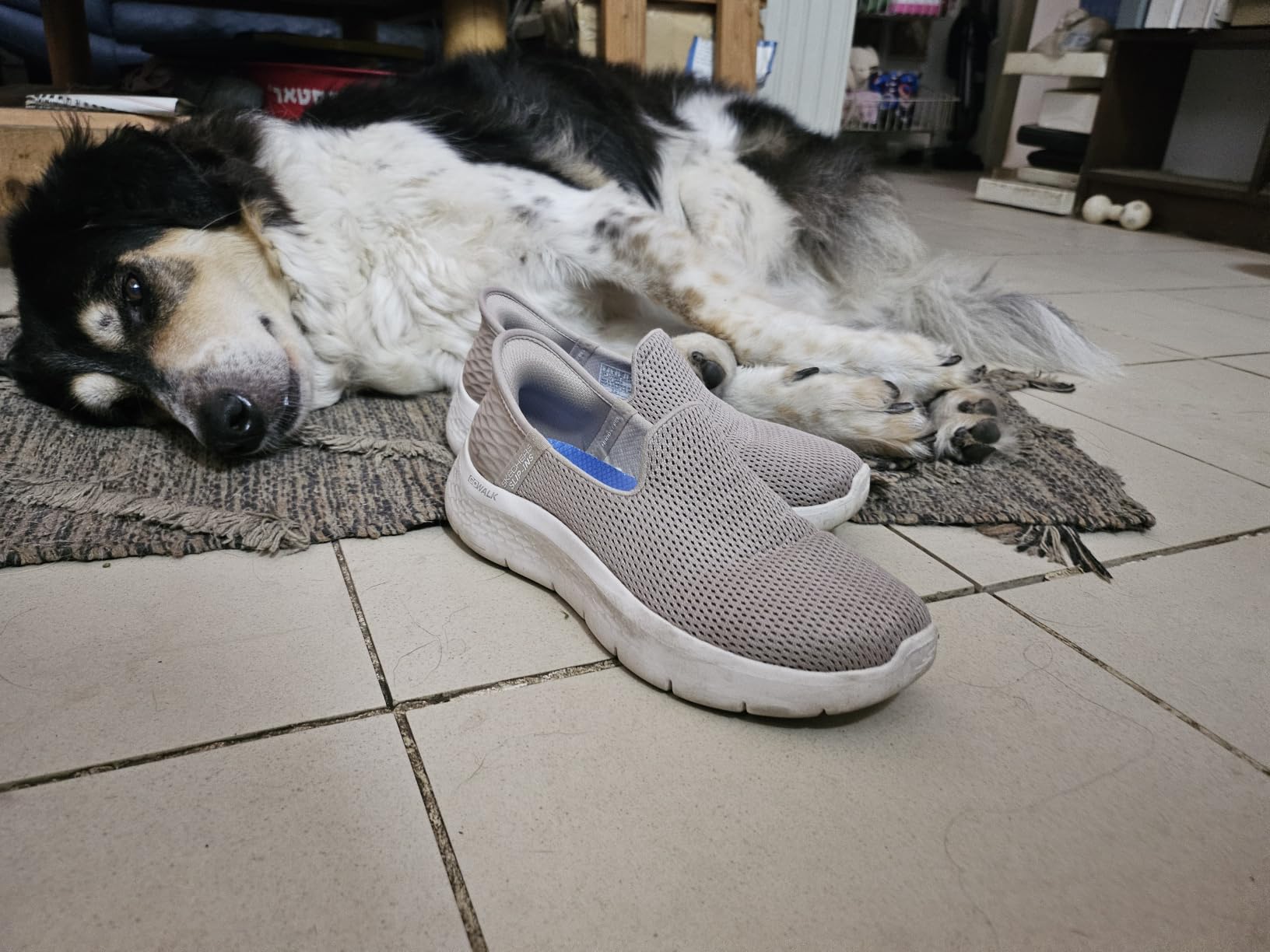
The Flex Pillars are the under-rated feature. They add lateral stability at the midfoot without making the shoe rigid, and several owners mention that they feel noticeably steadier on gravel paths, uneven pavements and grass, which is where most of the falls in this audience actually happen.
Machine washability is not a gimmick here. A shoe worn every single day in all weathers needs to be cleanable without a trip to a shoe repair shop, and very few shoes in this category are.
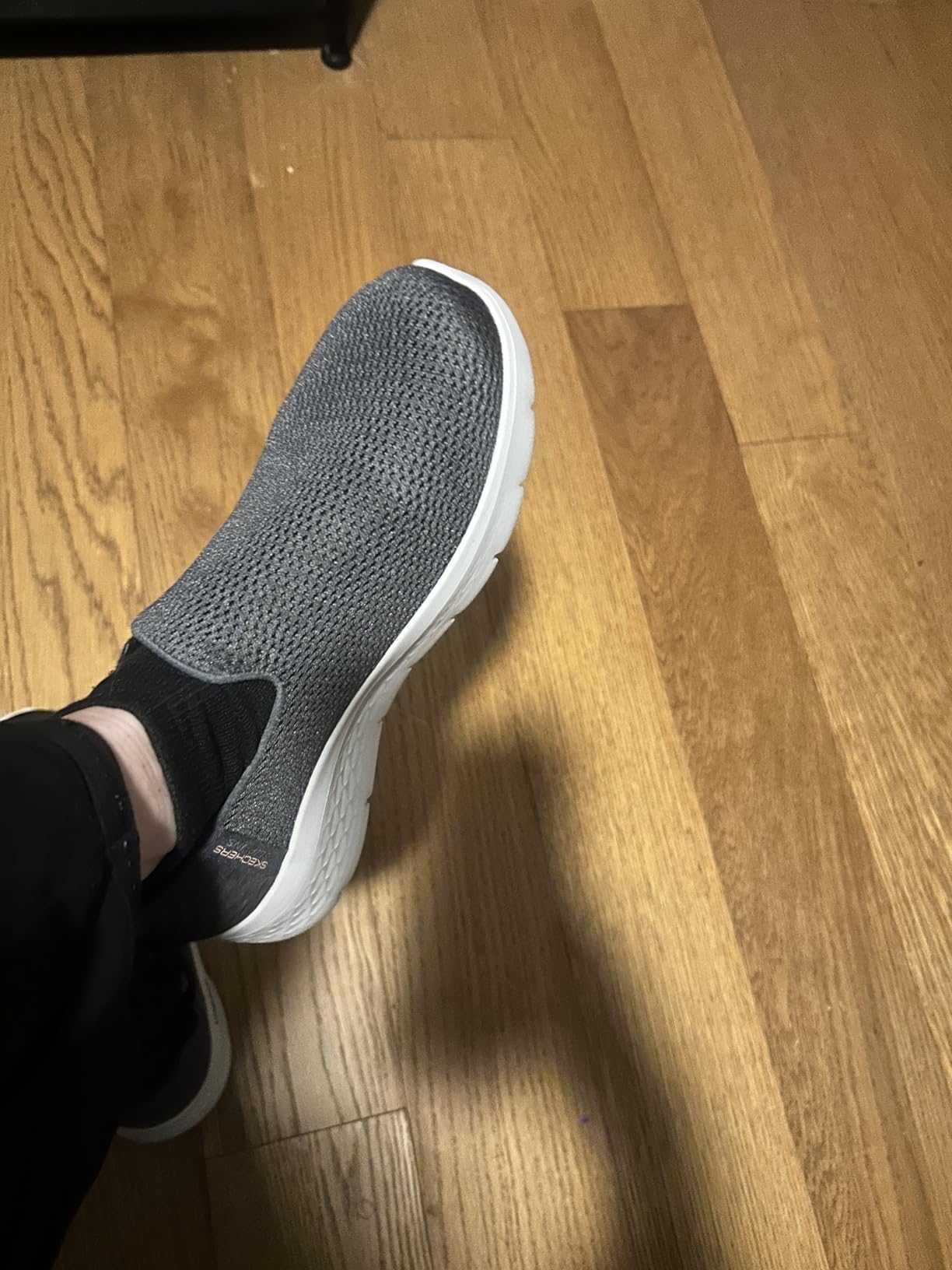
Why hands-free beats laces every time?
Zero dexterity demand is the headline, but the secondary benefit is equally useful: a person who cannot reach their feet can still put these on. That extends independent dressing, and independent dressing is one of the things people most want to keep as the condition progresses.
It also removes the failure mode where a shoe cannot be put on at all, so a carer does not have to dress the feet before the person can start the day. On a bad morning, that is the difference between a normal start and a difficult one.
The fit inconsistency problem
The genuine complaint here is consistency between production runs. Buyers report sizing up or down after a trial, and the toe box is wider than many people expect, so the Narrow width still feels roomy. If you can, order a pair and walk in them indoors before relying on them outdoors.
One smaller issue: the heel bumpers can catch on very thin no-show socks. Wear a proper sock liner and the problem disappears, but it is worth knowing before the first cold morning.
We earn a commission, at no additional cost to you. CERTAIN CONTENT THAT APPEARS ON THIS SITE COMES FROM AMAZON. THIS CONTENT IS PROVIDED 'AS IS' AND IS SUBJECT TO CHANGE OR REMOVAL AT ANY TIME.
4. Propet LifeWalker Strap – Best for Wide Feet and Orthotics
Propét Men’s Life Walker Strap Casual Orthopedic Walking Shoes, Brown
★★★★★★★★★★Adjustable dual hook-and-loop straps
Removable footbed for custom orthotics
Extra wide to 3X-Wide
Rubber sole
- Adjustable dual straps that snug down without laces
- Very wide toe box for swelling and lymphedema
- Removable footbed takes custom orthotics
- Large opening and high toe area ease entry
- Low profile that passes for a casual shoe
- Toe area can run narrow so size up a width
- Stocking strap is short for quick removal
- Some buyers add extra hook-and-loop to extend
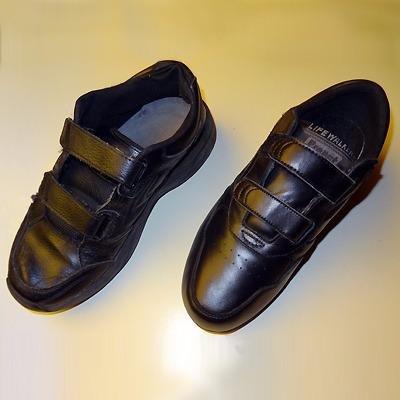
The LifeWalker has been on the market since the mid-2010s, which tells you something about whether it holds up. The review data shows repeat buyers ordering many pairs over years, and reviewers with limited hand function, arthritis and post-polio foot drop describe the straps as transformative rather than merely convenient.
Two features set it apart from the other hook-and-loop shoes here. The first is the removable footbed, which accepts custom orthotics, so a person who has been prescribed an insert does not have to buy a specialist shoe. The second is the extreme width run, going up to 3X-Wide, which is genuinely useful for feet that swell or for lymphoedema.
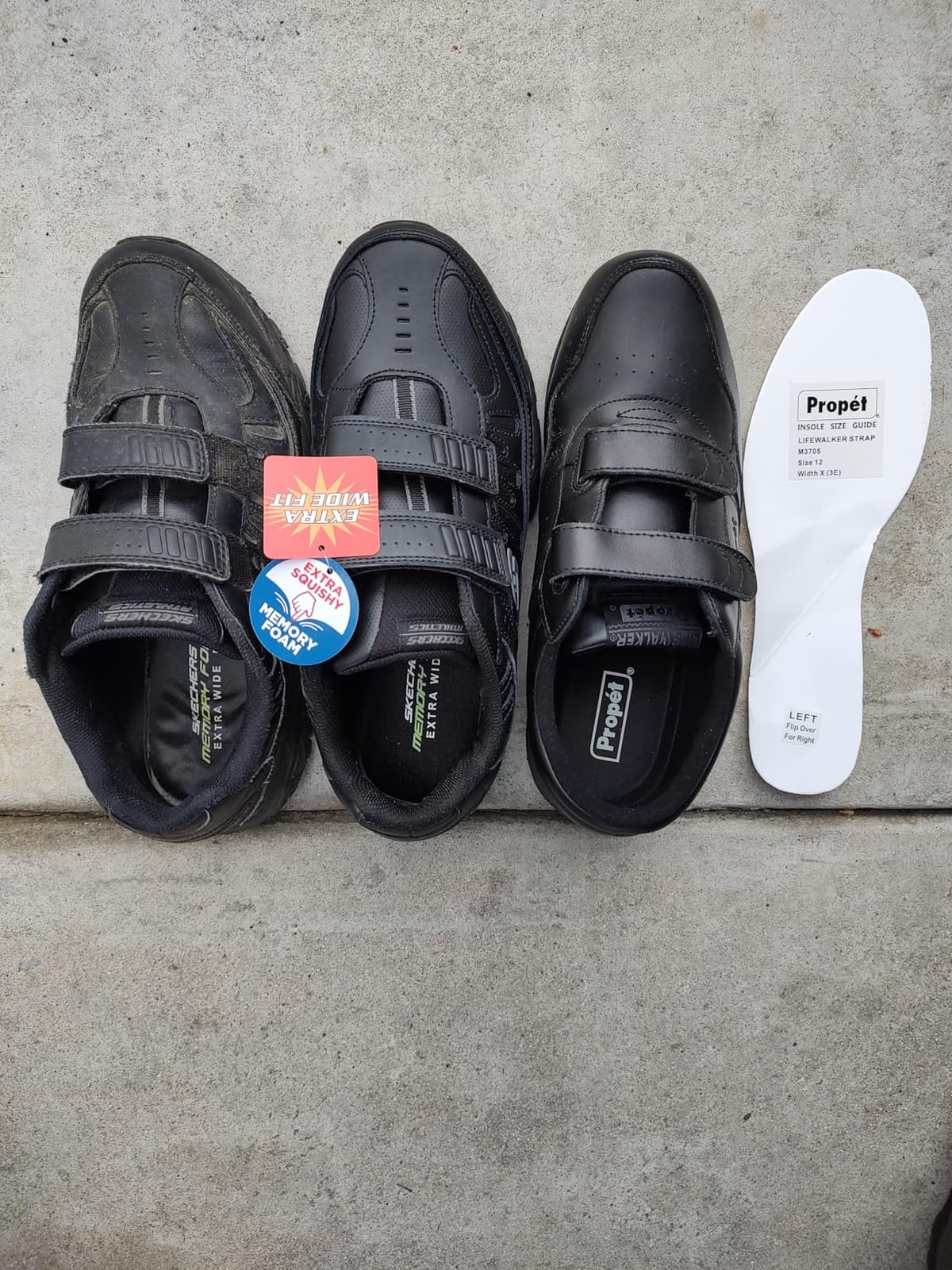
It is also marked diabetic friendly, and the large opening with a high toe area means the foot slides in rather than being pushed in. For someone with limited reach, that difference is larger than it sounds.
Fit runs a little narrow, so the common recommendation from owners is to size up a width. That is the same advice you will get from almost every experienced fitter and it applies to the whole Propet range.
Who this suits best?
Choose the LifeWalker when swelling, an existing orthotic, or a very wide foot is the main constraint. The removable footbed means it can be adapted later without replacing the shoe, which makes it a sensible long-term purchase as foot shape changes.
The heel-less pull-on design also means there is no rigid heel counter to crush a curled or dystonic foot, so for someone whose toes curl under, a slip-on profile is more forgiving than a closed counter.
The strap length catch
Some people find the stocking strap short, which can make the shoe hard to pull off quickly. That is the mirror image of the entry problem, and it is worth testing on a normal day before relying on it during a rushed morning.
If the straps cannot be tightened enough, several owners attach additional hook-and-loop to extend them. Workable, but also points to a last mismatch rather than a fault in the shoe.
We earn a commission, at no additional cost to you. CERTAIN CONTENT THAT APPEARS ON THIS SITE COMES FROM AMAZON. THIS CONTENT IS PROVIDED 'AS IS' AND IS SUBJECT TO CHANGE OR REMOVAL AT ANY TIME.
5. Orthofeet Edgewater – Best for Arch Collapse and Standing Shifts
Orthofeet Edgewater Orthopedic Men’s Walking Shoes, Black, Size 10
★★★★★★★★★★Premium orthotic insole with anatomical arch support
Stretch knit upper
Wide toe box
Extra shoe depth
- Built-in arch support spreads weight across the foot
- Stretch knit upper flexes and reduces pressure points
- Deep cushioned interior for flat feet and overpronation
- True to size with a wide toe box
- Lightweight and breathable on long walks
- Highest price point in this roundup
- Laceless closure still needs reaching and manipulation
- Stretch knit gives less lateral structure than leather
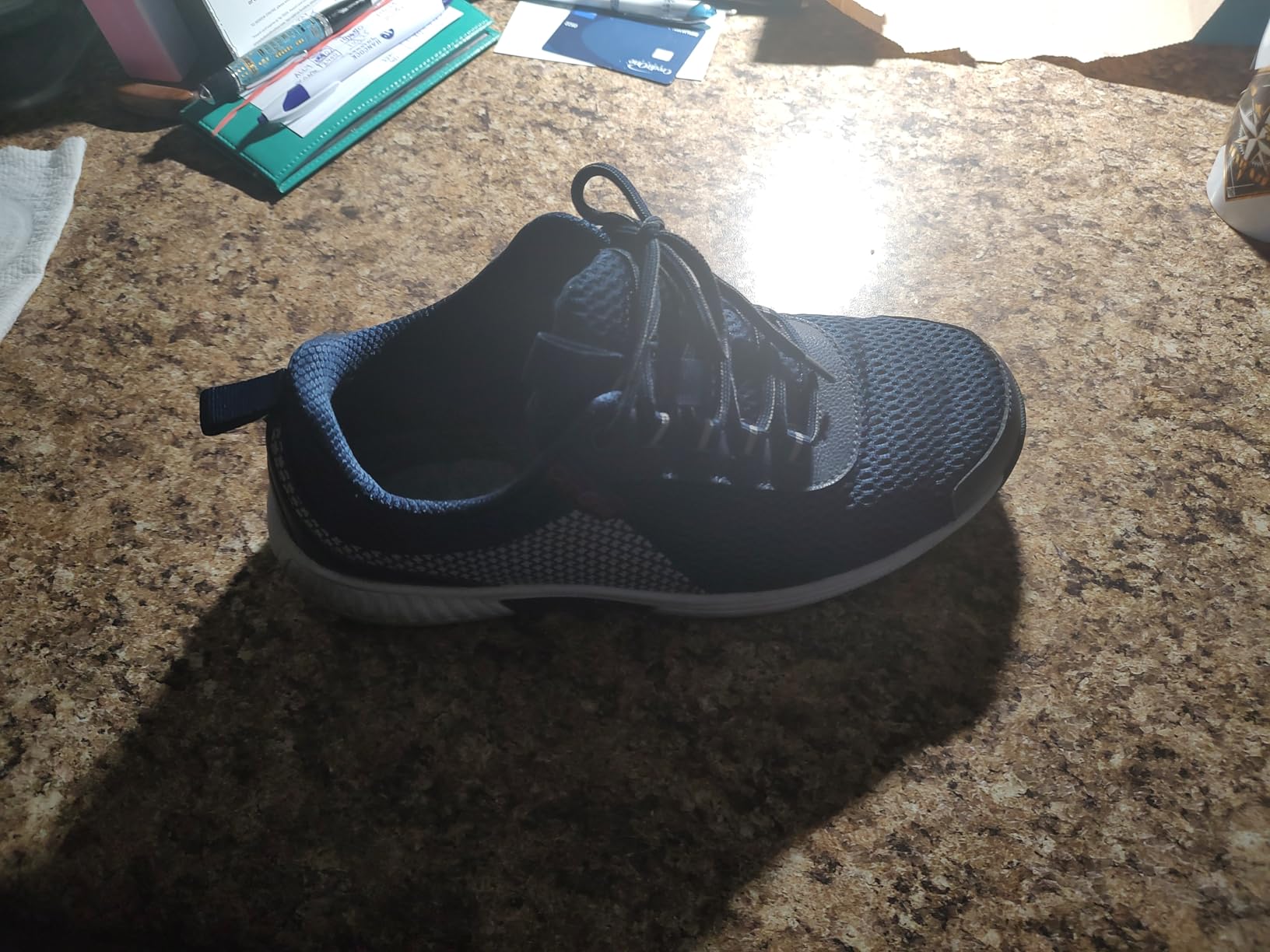
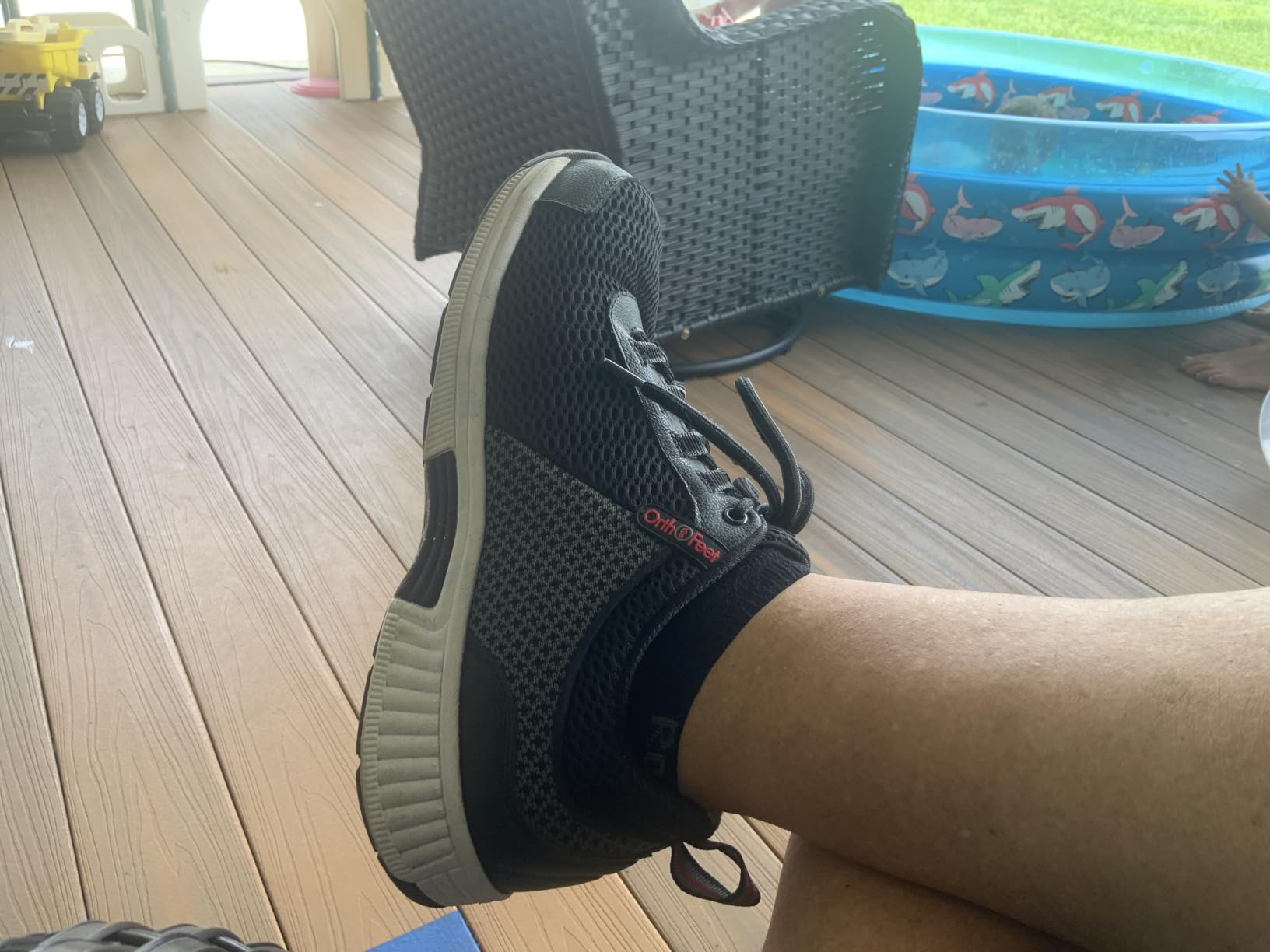
The Edgewater sits at the top of the price range here, and the reason is the insole. It is a premium orthotic insole with anatomical arch support and multilayered cushioning built into the shoe, which is why owners with plantar fasciitis, flat feet and overpronation report meaningful relief rather than simply comfort.
That matters for Parkinson’s specifically when the arch rolls inward. Dystonia in the foot is a recurring theme in patient accounts, and a dropped arch rolling inward changes how the whole foot loads at push-off. A shoe that resists that roll is doing something a cushioned sneaker does not.
On the Parkinson’s UK Forum, one member endorsed Orthofeet directly, and among podiatry professionals there is a separate conversation about which footwear category works for neurological gait change. We mention that thread because it explains why a medical-styled brand keeps appearing in Parkinson’s communities rather than in general running circles.
The extra shoe depth and soft interior are the sleeper features. A deep shoe with a wide toe box does not compress curled or sticky toes, and toe compression is one of the most common reasons patients abandon a shoe that was otherwise fine.
When built-in orthotics are worth paying for?
Buy the Edgewater when the problem is the arch rather than the closure. If someone is standing for long periods, working, or walking on hard surfaces and the foot rolls inward, the insole is the reason to choose this shoe over a cheaper cushioned option.
It is also a good option for a person who has already been told they need an arch support but has not yet been fitted for a custom orthotic, because the built-in version gives a real anatomical support without a prescription appointment.
Where it is not the answer?
It is laceless but not truly hands-free; the closure still has to be reached for and manipulated, so it does not solve severe dexterity problems. And the stretch knit upper provides less lateral structure than a leather or suede upper, which matters if balance is the primary concern.
It is also the most expensive shoe in the roundup, so it deserves a clear diagnosis behind it rather than being bought on a hunch.
We earn a commission, at no additional cost to you. CERTAIN CONTENT THAT APPEARS ON THIS SITE COMES FROM AMAZON. THIS CONTENT IS PROVIDED 'AS IS' AND IS SUBJECT TO CHANGE OR REMOVAL AT ANY TIME.
6. FitVille Extra Wide Slip-on – Best Budget Hands-Free Pick
FitVille Wide Mens Slip on Shoes for Standing All Day Men’s Extra Wide Slip on Walking Shoes for Foot Pain Relief-Stepease V2 (8.5 Wide, Nocturne Gray)
★★★★★★★★★★One-piece stretchable upper
Wide toe box with high instep
Wide Platform cushioned midsole
Anatomical ArchCore insole
- Genuinely hands-free entry with reinforced heel
- Very wide toe box fitting 2E and wider
- Lightweight enough to double as house footwear
- Rubber tread grips on greasy and wet surfaces
- Arch support helps with standing-related back pain
- Tongue is tall and stiff and can rub the instep
- Upper can be tight on very swollen feet
- Materials need several days to break in
The FitVille is a low-cost route to true hands-free entry in this list, and the one-piece stretchable upper is reinforced at the back so it does not collapse during the step-in. That reinforcement is what separates a real slip-on from a shoe that folds flat and has to be held open with one hand.
Owners with back injuries, mobility limitations and very wide feet rate it highly, and several use it as an indoor house shoe as well as an outdoor walking shoe, which makes it a two-for-one if indoor falls are the risk you are managing.
The ArchCore insole with a supportive heel cup is doing more here than the low price suggests, and the rubber tread has a reputation for gripping on greasy and wet surfaces, which is where indoor falls tend to happen in a kitchen or bathroom.
It also runs light enough to be worn for long standing shifts, and the breathable stretch mesh with a soft sponge collar lining avoids the heat problem that makes many wide shoes intolerable by mid-afternoon.
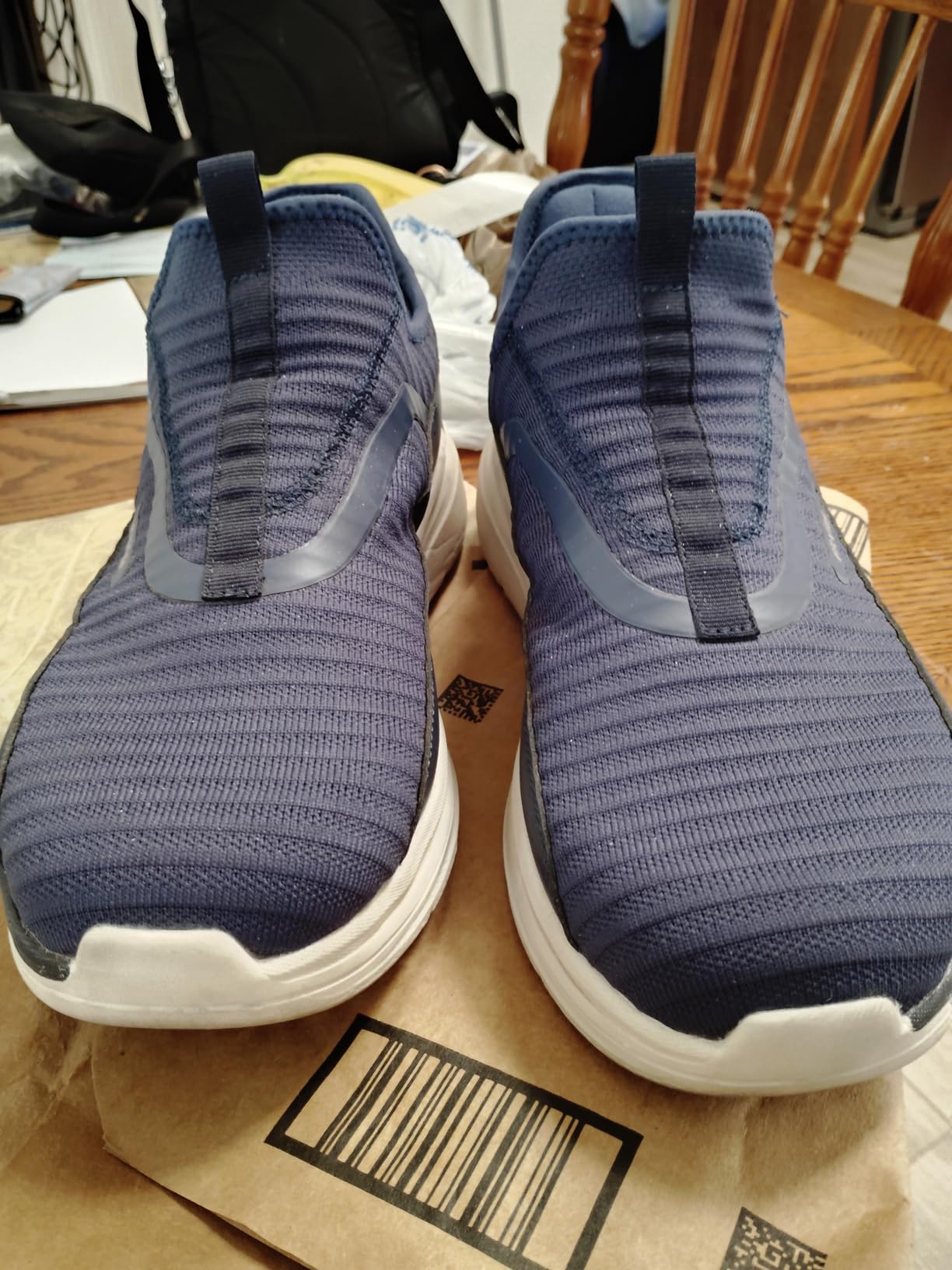
Good value for very wide feet
Choose the FitVille when the constraint is the width of the foot and the budget. A genuinely wide toe box with a high instep is hard to find at this price, and it is the feature that stops a swollen foot being forced into a compressed toe box.
Because it is so light and quick to put on, it is also a good first shoe for someone newly diagnosed who is not yet committed to a medical-footwear look.
The stiff tongue is a real complaint
The most repeated issue is the tall, stiff tongue, which some wearers feel against the top of the foot or the lower shin. On an instep that is already high, that rubbing can produce a sore that makes the shoe unusable, so it is worth testing.
Also expect a break-in period of several days. The materials are stiff out of the box, and for a person with reduced sensation there is a risk of not noticing early discomfort, so check the fit daily for the first week.
We earn a commission, at no additional cost to you. CERTAIN CONTENT THAT APPEARS ON THIS SITE COMES FROM AMAZON. THIS CONTENT IS PROVIDED 'AS IS' AND IS SUBJECT TO CHANGE OR REMOVAL AT ANY TIME.
7. Skechers Women’s Breathe-Easy Roll-With-Me – Best Indoors
Breathe Easy – ROLL with ME Hands Free Slip-INS
★★★★★★★★★★Collapsible heel for hands-free step-in
Air-Cooled Memory Foam insole
Heel Pillow technology
Machine washable
- Collapsible heel makes entry hands-free without bending
- Lightweight and comfortable for long indoor days
- Machine washable which suits a daily shoe
- Wide and standard widths in many colors
- Vegan construction
- Soft mesh upper gives less lateral stability
- Cushioning is moderate rather than substantial
The Breathe-Easy solves a specific problem that outdoor shoes often make worse: the heel collapses when the shoe is kicked off, and a person who cannot reach behind their heel then has to bend down to put it on. A collapsible heel removes that step entirely, so the shoe can be stepped into while standing.
That makes it the shoe we would put by a bedside chair or a chair in a living room, which is where a lot of Parkinson’s falls actually happen. Bare feet on a hard floor and socks on a polished surface are the highest-risk surfaces in the house.
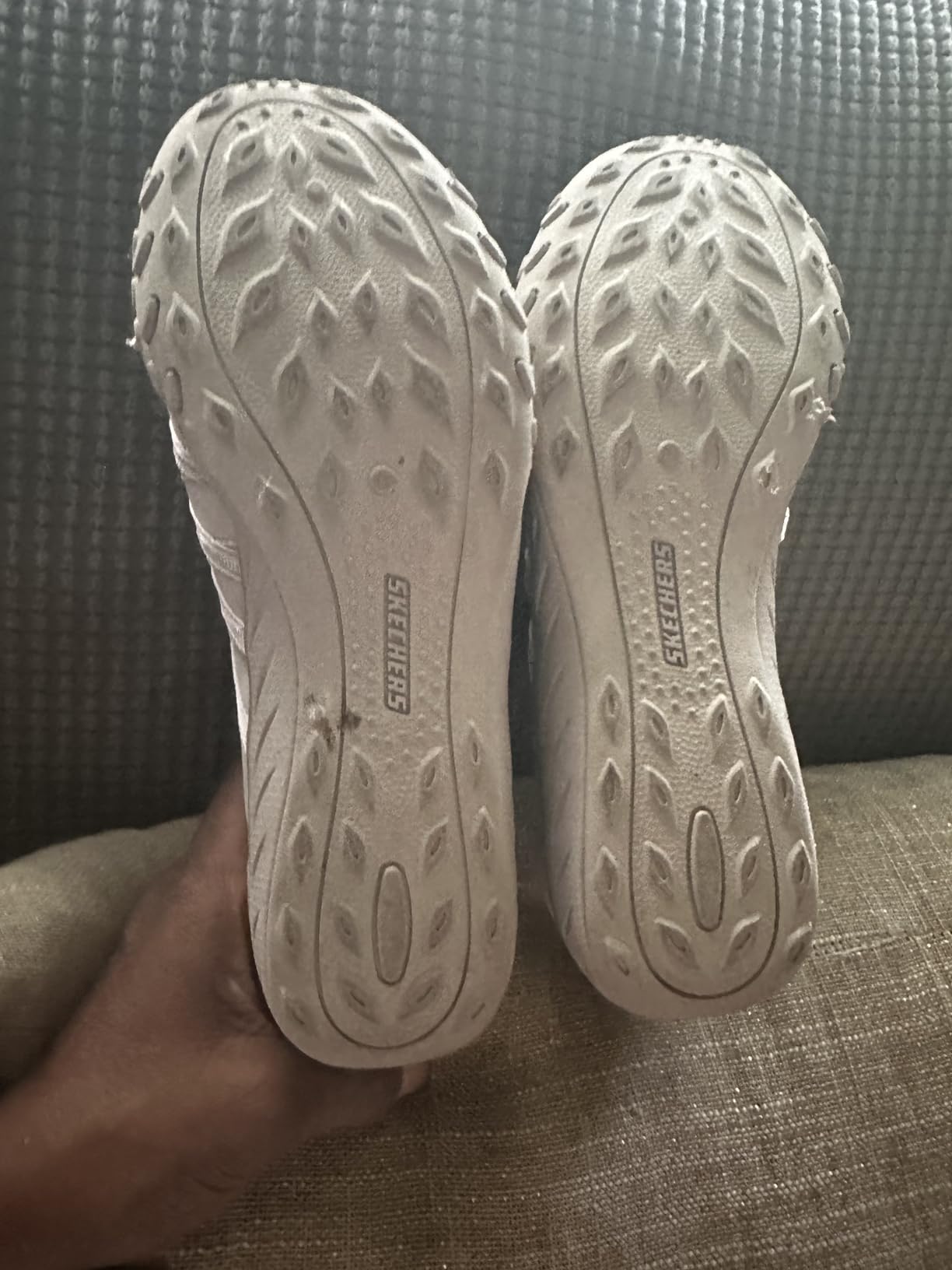
It weighs about 1.7 pounds and the Air-Cooled Memory Foam insole with Heel Pillow technology gives a soft, warm surface without the bulk of a full walking shoe. Vegan materials may also matter to some households, and the soft knit mesh with quarter webbing overlays is easy to keep clean.
At 1.7 pounds it is genuinely light, which reduces the effort of lifting a foot that does not want to lift. For a foot with toe-drag, every gram of sole weight is work the wearer does not have to do.
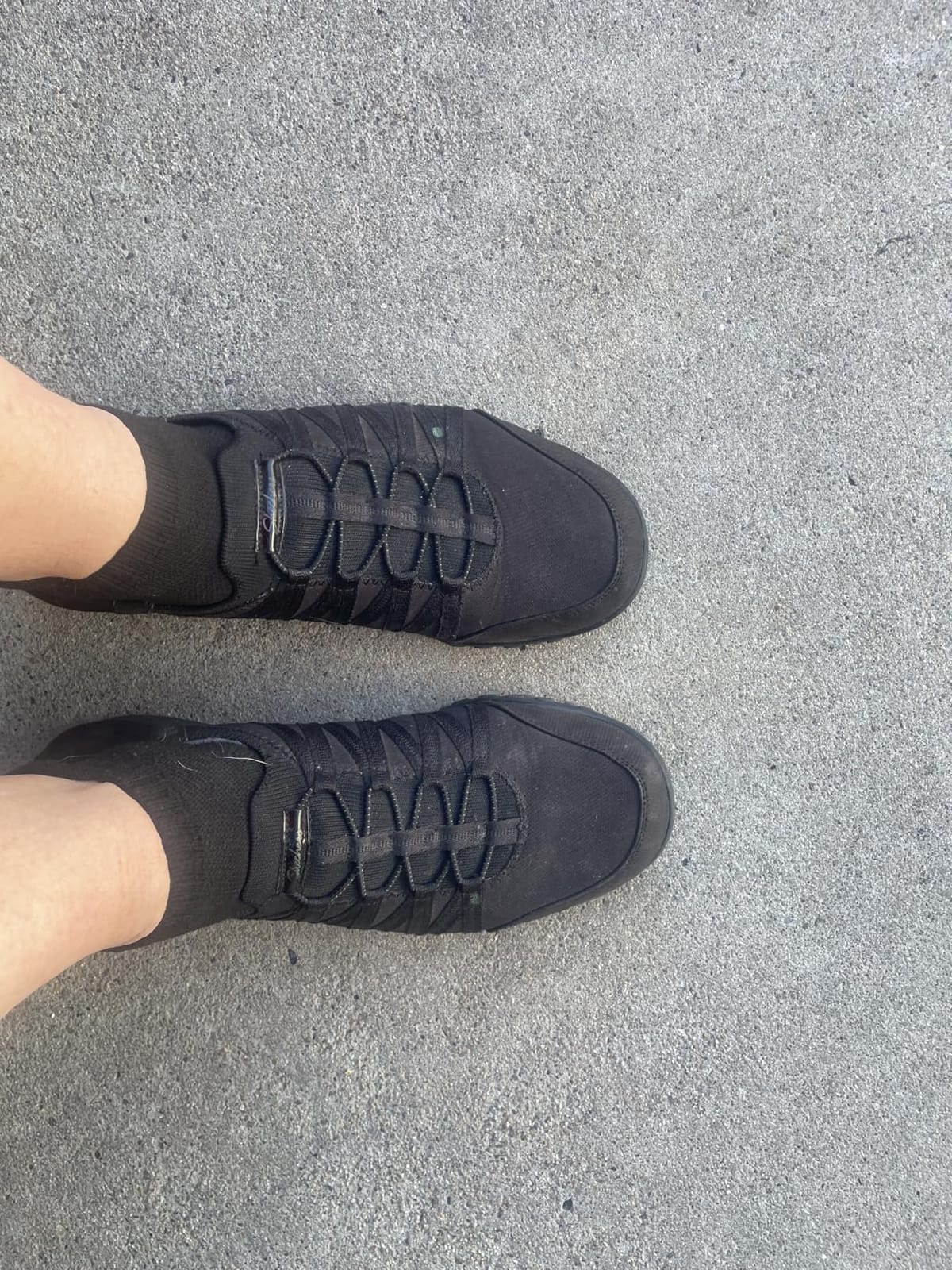
Best used as the house shoe
Buy the Breathe-Easy as a second shoe for indoor use, not as a replacement for a proper outdoor walking shoe. Its cushioning is moderate rather than substantial, and on gravel or a long route you would want more under the foot than it provides.
Machine washability is the reason it works as a house shoe. A shoe worn every day indoors gets dirty quickly, and one that survives a washing machine is one a carer does not have to worry about.
Where it stops short?
The soft knit mesh offers less lateral stability than a structured sneaker, so if balance on uneven ground is the main concern, this is the wrong tool. It is a comfort and convenience shoe, and the trade-off is stability.
We would pair it with an outdoor shoe from this list rather than choosing between them, keeping one pair by the chair and one pair by the door.
We earn a commission, at no additional cost to you. CERTAIN CONTENT THAT APPEARS ON THIS SITE COMES FROM AMAZON. THIS CONTENT IS PROVIDED 'AS IS' AND IS SUBJECT TO CHANGE OR REMOVAL AT ANY TIME.
8. Skechers Glide Step Caledonia – Best for Long Walks and Wet Ground
Skechers Women’s Max Cushioning Glide Step Caledonia Hands Free Slip-ins Sneaker, Slate, 6.5
★★★★★★★★★★ULTRA GO cushioning with Air-Cooled Goga Mat insole
Glide-Step with Natural Rocker geometry
Goodyear Rubber outsole
Machine washable
- Deep plush cushioning owners call the most comfortable they have worn
- Lightweight despite the thick sole
- Secure heel hold with hands-free entry
- Goodyear Rubber outsole grips wet and dry ground
- Stable on uneven surfaces
- Rocker geometry changes your stride and takes days to adapt
- Runs a little narrow so Wide is often better
- Upper can break down within about four months of heavy daily wear
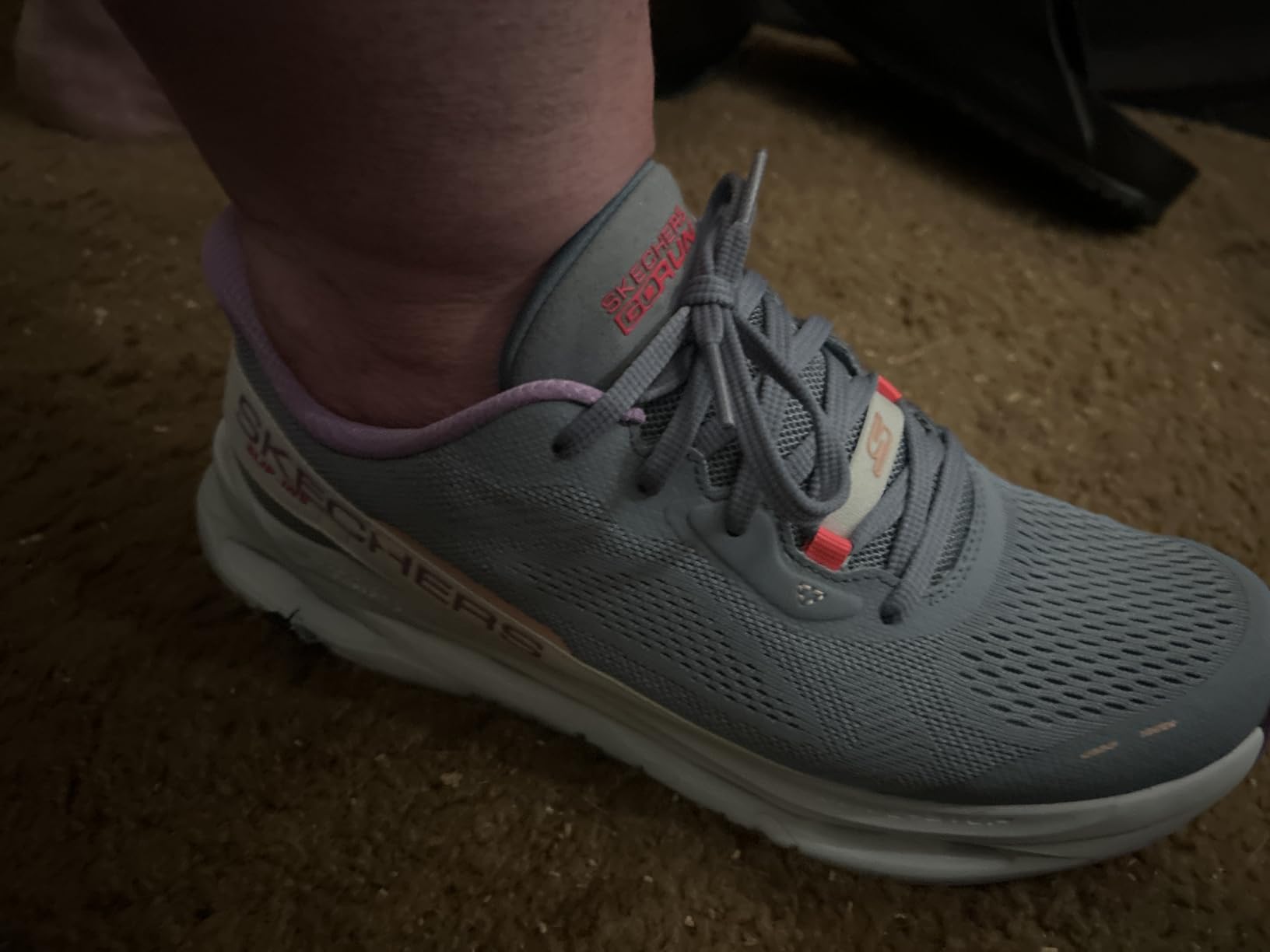
The Caledonia is the cushioned end of this list, and comfort is where its reviews land. Many owners call it the softest shoe they have ever worn and report no end-of-day foot pain, which for a person who shuffles and scuffs is a functional benefit rather than a luxury. The Air-Cooled Goga Mat insole sits inside ULTRA GO cushioning and the whole thing stays light despite the thick sole.
The Goodyear Rubber outsole is the feature we would point a wet-weather buyer at. Grip in wet and dry conditions is exactly the property that matters on a path, a wet patio or a station platform, and it is more consistently specified by this manufacturer than by several others in the roundup.
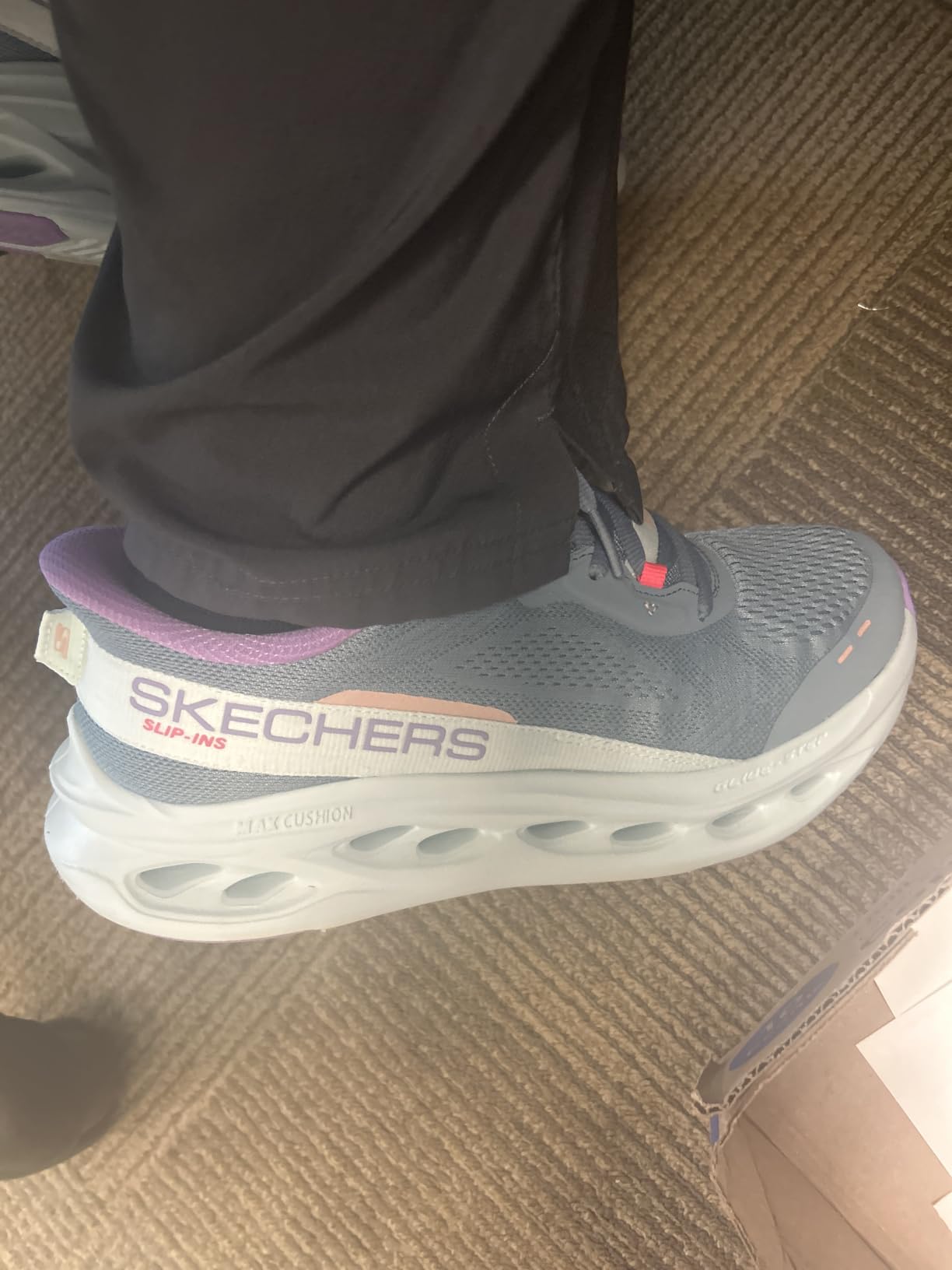
Glide-Step technology combined with Natural Rocker geometry curves the sole from heel to toe. In theory that helps a foot roll through without a hard push-off, which suits a weak or stiff push-off. In practice it changes your stride, and several owners describe a few days of adjustment.
For anyone with neuropathy or reduced sensation, the roomy unstructured fit is a genuine advantage, and this is the shoe several reviewers with nerve damage and flat wide feet chose for that reason.
Best for all-day and long-distance walking
Choose the Caledonia when the plan is a long route, a day out, or simply a person who will not tolerate a firmer shoe. The plush cushioning spreads load across the foot, and the secure heel hold means the foot does not slide forward over the course of a long day.
Hands-free entry plus a washable upper also means it suits a caregiver routine, since the shoe goes back in the machine rather than to a cobbler.
Durability and sizing
The consistent negative is durability. The liner and upper can start to break down within about four months of daily wear at 10k-plus steps, so a person who is walking a lot every day should expect a replacement cycle that is shorter than the price would suggest.
It also runs a little narrow, so the Wide version is often the better choice. And the rocker geometry needs a few days of adaptation, which is a bad thing to discover for the first time on a walk outside.
We earn a commission, at no additional cost to you. CERTAIN CONTENT THAT APPEARS ON THIS SITE COMES FROM AMAZON. THIS CONTENT IS PROVIDED 'AS IS' AND IS SUBJECT TO CHANGE OR REMOVAL AT ANY TIME.
9. LEADER SHOW Casual Walking Shoe – Lightest Indoor and Casual Option
LEADER SHOW Men’s Casual Comfortable Walking Shoes Fashion Ultralight Flats Hook & Loop Sneakers (10, Thick Black)
★★★★★★★★★★Hook and loop strap with no laces
Mesh fabric upper
Flexible arch-support midsole
Non-slip outsole
- Very light and comfortable enough to wear around the house
- Hook and loop closure is quick to fasten
- Non-slip sole adds grip and stability
- Spacious toe space for older wearers
- Lowest price in this roundup
- Cushioning is minimal with a flat unpadded footbed
- Runs narrow and snug across the top of the foot
- Tongue is oversized and sits awkwardly
- Strap can be too short to fully close
This is the simplest shoe in the list: a mesh upper, a lightly cushioned footbed, a flexible arch-support midsole and a non-slip outsole designed to increase ground friction. It is also the cheapest, and for someone who just needs something lace-free to move around the house in, that is a defensible brief.
The non-slip outsole is the one specification worth taking seriously. Ground grip is the property that prevents a slip on a hard floor, and the shoe is built around it, with a stable sole rather than a soft lounge sole.
We are going to be straight about the trade-offs, because a flat unpadded footbed and a 4.0 average rating tell you this is the least refined option here. Reviewers who need light, cheap, lace-free indoor shoes find it useful; reviewers looking for a long walk find the cushioning thin.
Where it does a decent job?
It is a reasonable second pair for indoor use, particularly if cost is the governing constraint for the household. It is light, a hook-and-loop closure is quick, and nothing about it requires a carer to help.
For a short trip to a clinic appointment or a short walk to the shops, it does the job adequately and the non-slip outsole reduces the most common indoor risk.
Fit is the problem, not the concept
It runs narrow and snug across the top of the foot, so ordering up a size is the standard advice, and the strap can be too short to close the shoe fully on a standard foot. The tongue is also oversized and does not sit neatly when the shoe is on.
Combined with the minimal cushioning, we would treat this as a house shoe rather than a walking shoe. Anyone with curled or sticky toes should be wary of the narrow instep, and anyone walking real distances should look elsewhere.
We earn a commission, at no additional cost to you. CERTAIN CONTENT THAT APPEARS ON THIS SITE COMES FROM AMAZON. THIS CONTENT IS PROVIDED 'AS IS' AND IS SUBJECT TO CHANGE OR REMOVAL AT ANY TIME.
10. LOCFIR Wide Toe Box Slip-on – Best for Wide Women’s Feet
LOCFIR Women’s Slip On Sneakers Wide Toe Box | Arch Support Walking Shoes for Plantar Fasciitis | Thick Cushion | Wide Width Comfort Tennis Gym Shoes Grey Size 8
★★★★★★★★★★High-resilience Phylon midsole
Zero-drop sole
Integrated arch support with air cushioning
Seamless knit interior
- Genuinely extra wide toe box that lets toes splay
- Rubber traction patterns on a flexible outsole
- Zero-drop sole encourages an even gait
- Seamless knit interior reduces blister friction
- Arch support aimed at plantar fasciitis and back pressure
- Zero-drop design needs a short adjustment period
- Knit upper gives less structure than leather
- Limited long-term track record with few reviews
Women’s shoes are the gap in this category, and the reason is mostly a sizing one. Most adaptive walking footwear is drawn on a men’s last, so women are pushed into either a narrow shoe or a men’s shape. This one is built with an extra wide toe box specifically, and buyers with wide feet and plantar fasciitis rate it well for exactly that reason.
The zero-drop sole keeps the heel and forefoot level, which some people find promotes a more even, natural gait. Healthcare workers mention comfort through long standing shifts, and the high-density knitted mesh with a seamless interior is breathable and free of internal seams that could cause blisters.
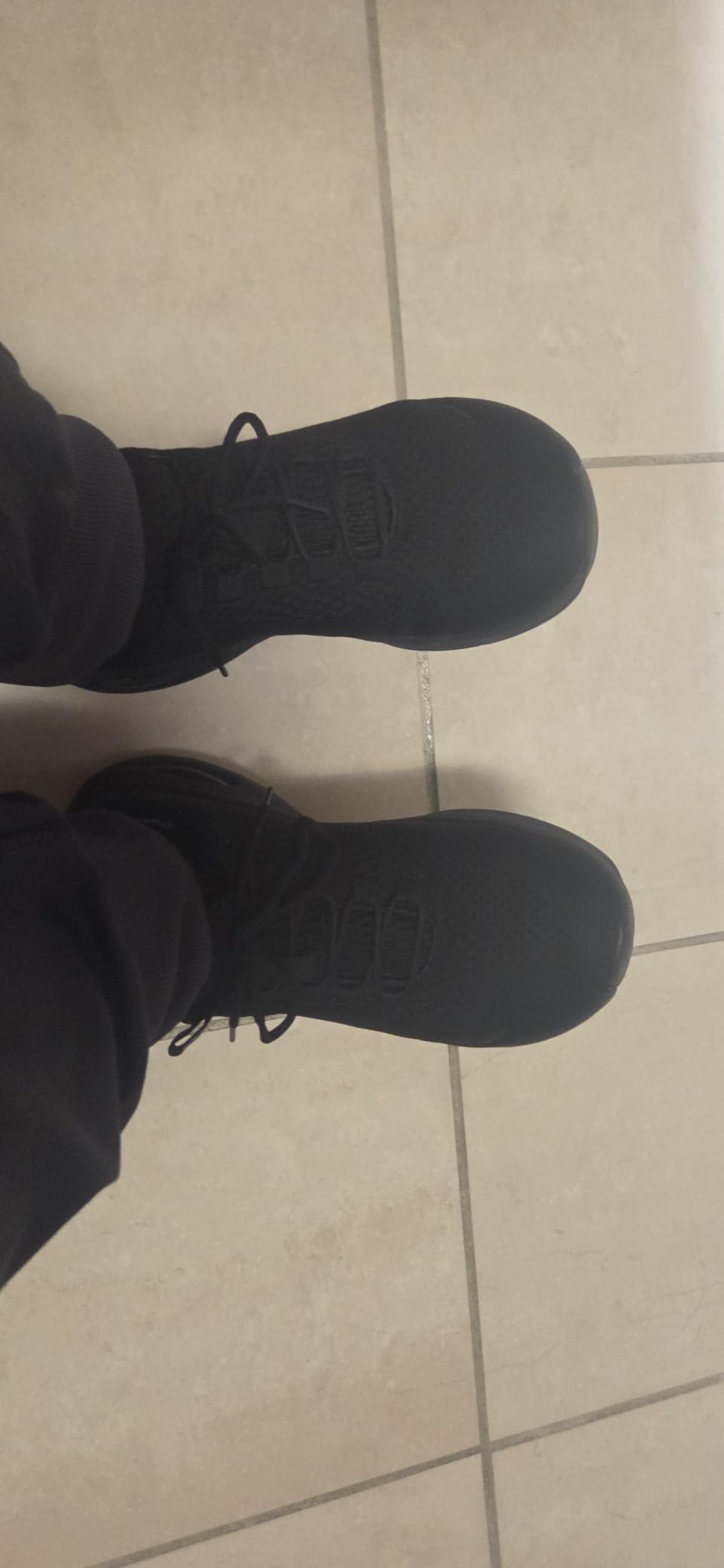
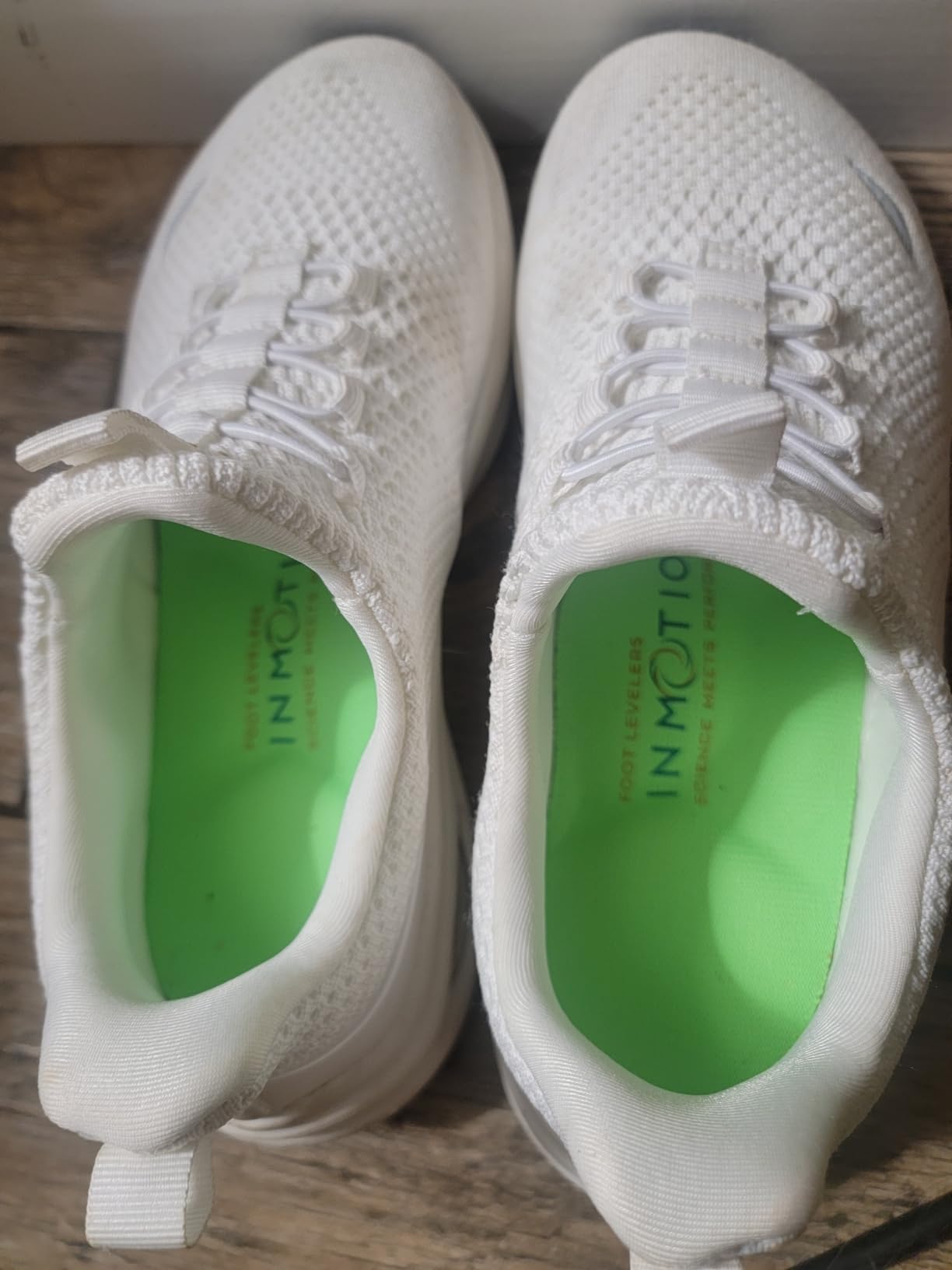
The Phylon midsole is described as lighter and more durable than standard EVA, with integrated arch support and thick air cushioning. It is aimed at plantar fasciitis and lower back pressure, and the slip-on construction means there are no laces or straps to manage at all.
It is also among the few shoes here with a genuinely seamless interior, which matters if the toe box is rubbing against curled or sticky toes. Fewer internal seams means fewer places for a shoe to wear a sore into the top of a toe.
A strong choice for wide and plantar foot pain
Choose this shoe when the person has wide feet, a plantar fasciitis history, or back pain that worsens with standing, and when a completely lace-free entry is wanted. The wide platform and zero-drop geometry also help a person who feels unsteady on a heel-to-toe roll.
For a woman who cannot find a wide width in a mainstream walking shoe, the combination of a genuine extra wide toe box and a slip-on upper is hard to find elsewhere in this list.
The zero-drop adjustment and the thin track record
A zero-drop sole feels unfamiliar at first and needs a short adjustment period, so it is not ideal as a sudden change for someone with a history of falls. The knit upper also gives less lateral structure than leather or suede if balance on uneven ground is the main concern.
It has around 600 reviews, so there is less long-term evidence behind it than the shoes above it. That is worth factoring in for a purchase expected to last, and it is why it sits at the end of the list despite good features.
We earn a commission, at no additional cost to you. CERTAIN CONTENT THAT APPEARS ON THIS SITE COMES FROM AMAZON. THIS CONTENT IS PROVIDED 'AS IS' AND IS SUBJECT TO CHANGE OR REMOVAL AT ANY TIME.
How to Choose Walking Shoes for Parkinson’s Patients?
Closure comes first, before any other feature. The single most common complaint in patient forums is fumbling with laces due to reduced dexterity and tremor, and the number of people who describe velcro or hands-free entry as transformative is large. Work down this list in order.
1. Closure type. There are three useful categories. Lace-up gives the best security and is fine if hands work reliably. Hook-and-loop straps can be tensioned and released with one hand and can be adjusted by a carer, and they are the practical middle ground. True hands-free slip-ons have no closure at all and are the only category that works when the wearer cannot reach their feet at all.
2. Sole and traction. Look for a rubber outsole with a defined tread pattern rather than a soft or smooth sole, and check whether the manufacturer claims wet-surface grip. The FitVille-style rubber tread and the Goodyear Rubber outsole on the Caledonia are the two clearest grip specifications in this list. A rounded or bevelled heel helps the foot roll through without catching.
3. Toe box and width. This is a health decision, not a comfort one. Curling or sticky toes, whether from dystonia or from long-standing foot problems, get damaged in a narrow toe box, and damaged skin is a route to infection. A shoe that has to be taken off because it hurts will be walked in barefoot, which is worse than the shoe you were trying to fix.
4. Weight and sole profile. A shuffling or foot-drop gait lifts the foot less and pays the weight of the shoe every step. Light, low-profile shoes reduce that effort. The Breathe-Easy at about 1.7 pounds is one of the lightest here, and the FitVille is light enough to double as a house shoe.
5. Removable insole. Feet change shape as the condition progresses and as feet swell. A removable footbed, like the one on the Propet LifeWalker, means a prescribed orthotic can be fitted later without replacing the shoe. A shoe with a fixed insole is a one-time decision.
6. Washing and care. A shoe worn every day in all weathers needs to be cleanable. Machine washability appears on three of the Skechers models in this roundup and is genuinely rare elsewhere. For a person with limited dexterity, a shoe that has to be hand-cleaned is a shoe that does not get cleaned.
Men’s versus women’s fit. This is worth its own paragraph because the gap is real. Most adaptive walking shoes are drawn on a men’s last, so a woman with a narrow heel and a wide forefoot often has to choose between a shoe that fits her heel and one that fits her toes. The Skechers women’s models in this list address that by offering Wide and Narrow widths in the same style, which is the most practical solution available.
Buying for someone else. If you are a spouse, child or carer, your priorities should be closure type, opening height and how the shoe looks, in that order. A person is far more likely to keep wearing a shoe that looks ordinary and opens wide than one that looks medical and has a low opening. Test the fit yourself on a calm day, because Parkinson symptoms are not constant and a shoe that works on a good day may not on a bad one.
One more piece of advice from the forums that we would repeat: buy a second pair of whatever works. Several users report sticking to a single brand and style because it is the only comfortable option they have found, and having a spare pair avoids the situation where the sole separates and there is no immediate replacement.
When to See a Podiatrist and How the Referral Route Works?
Off-the-shelf adaptive footwear is enough when the problem is comfort, closure and general support. It is not enough in several specific situations, and the difference is worth being clear about because a podiatry appointment costs time and a shortlist of five warning signs makes the referral decision easy.
Someone is scuffing or dragging the toe of the shoe every step, which suggests real foot drop rather than reduced arm swing.
Toes curl under, stick to the shoe, or the arch is visibly rolling inward, which points to dystonia or a structural change.
Shoes repeatedly take skin off, blister or become unmanageable, no matter which model is tried.
Feet are unusually small or unusually shaped and standard size runs never fit. One user on the Parkinson’s UK Forum described a husband with very small feet and sticky up big toes who had searched for years for a maker of smaller sizes.
Falls are happening regularly, or the person has stopped walking independently out of fear.
In the UK, the documented route runs through your GP. Ask for a referral to the hospital orthotics department, where an orthotist assesses the feet, takes a foam impression and arranges made-to-measure footwear, with a wait of a couple of months for the finished shoes. That is exactly the route described in the most-engaged thread in this search, the made-to-measure shoes discussion on the Parkinson’s UK Forum, which drew a large volume of replies. In the US, the Medicare HCPCS code A5500 listed on one of the shoes in this roundup may make you eligible for reimbursement, so it is worth checking with a supplier before buying.
Getting bespoke made-to-measure shoes with velcro straps was reported by one user as the change that stopped them shuffling and scuffing, and another in the same thread reported that their legs stopped aching. That is the level of outcome that ordinary shoes rarely produce, and it is the reason to go through the referral rather than ordering a third pair from a shop.
Indoor Shoes, Slippers and Grip Socks
Most falls happen at home, and the floor a person walks on barefoot or in socks is the highest-risk surface in the house. The only dedicated competitor page we found covers indoor slippers and socks, and the users in the forums ask about them constantly, so it is worth a short section.
What to look for indoors is the same shortlist, reduced: a rubber grip sole, a heel that does not slide, and a back. Backless slippers are a specific risk for a shuffling gait because nothing stops the foot sliding forward out of the shoe. A house shoe that can be stepped into, such as a collapsible-heel design, removes the heel-sliding problem entirely.
Grip socks are a useful middle ground for people who will not wear a shoe indoors at all. They add traction to a sock rather than constraining the foot, and several of the least clinical items on the dedicated competitor’s list are grip socks. The question on the forums about what people wear at home gets answered with soft canvas shoes and sandals in summer, and one user noted that almost everything else took the skin off their toes while also being hot and sweaty. Breathability and room are the two features that solve that, and both appear in our indoor picks.
Adding low-impact indoor movement to a daily routine helps more than any single pair of shoes, and our guide to the best walking pad treadmills covers machines built for short, steady sessions at home where balance work matters most.
Laser-Guided Shoes and Freezing of Gait
Freezing of gait is the sudden inability to start walking, and it is the symptom that most often gets discussed alongside shoes, so it deserves an honest paragraph. There is a technology called laser-guided shoes, in which shoe-mounted laser emitters project step cues onto the floor in front of the wearer, intended to break a freezing episode by giving the brain an external rhythm to follow. Patients and caregivers do ask about these shoes in Parkinson communities, and the technology has been covered in the mainstream press.
Our view is that this belongs in the awareness category rather than the buying category. It is not something we can recommend, we have not tested it, and the clinical literature on it is not settled enough for us to tell a reader to spend money on it. What is clear is that for a person who freezes, traction under a slipping foot matters, and that is a specification you can act on today. Mentioning it here is useful mainly so readers know the category exists and are not embarrassed to ask their clinician about it.
Frequently Asked Questions
What are the best walking shoes for people with Parkinson’s disease?
The best walking shoes for Parkinson’s patients are hands-free or hook-and-loop shoes with a firm slip-resistant rubber sole, a wide toe box, a removable cushioned insole and a secure heel hold. Closure type matters most, because tremor and reduced dexterity make laces a barrier. A grippy outsole matters for freezing of gait, a wide toe box stops curled or sticky toes being damaged, and a firm heel counter and rounded heel improve rollover so a shuffling foot does not catch and trip.
How do people with Parkinson’s typically walk?
People with Parkinson’s typically walk with a shorter, shuffling stride, reduced arm swing and a forward-leaning posture. Reduced toe clearance, the gap between the shoe and the floor during the swing phase, is the key change, and it causes the toe to scuff, catch and sometimes trip the wearer. Other changes include freezing of gait, festination where the steps accelerate, dystonia causing curled or sticky toes, and a dropped arch rolling inward.
Why do people with Parkinson’s struggle to walk?
Parkinson’s disease reduces dopamine production in the basal ganglia, the part of the brain that controls automatic, unconscious movement. As that declines, actions that once happened without thought, such as initiating the next step, require conscious effort. The result is a shorter, hesitant stride. Exercise and physiotherapy help, and supportive footwear reduces the mechanical risk that comes with that changed gait, but shoes do not treat the condition itself.
What is the best walking aid for someone with Parkinson’s?
The best walking aid depends on the person. Common options include a walking stick, a four-wheeled rollator with a brake, or a frame if balance is the main limitation. Whatever the aid, the footwear has to work with it: a wider stance needs a wide stable base, and a frame means the hands are occupied so hands-free or hook-and-loop shoes become essential rather than a preference. A podiatrist or physiotherapist can match the aid to the gait.
Do Parkinson’s patients need special shoes?
Many do not need medical-grade footwear, but almost everyone benefits from adaptive design. Special shoes matter most when there is real foot drop, curling or sticky toes, a rolling-in arch, or repeated falls. For mild symptoms, an ordinary sneaker with a wide fit, a grippy rubber sole and a hook-and-loop or hands-free closure is usually enough. The features that matter are the same ones that make shoes comfortable for anyone with a wide foot or poor dexterity.
What are the best shoes for seniors to prevent falling?
For fall prevention, look for a non-slip rubber sole with defined tread, a firm heel counter for stability, a low profile and a wide base, and a secure closure that cannot work loose mid-step. A rounded or bevelled heel helps the foot roll through rather than catching. Avoid smooth leather soles, backless slippers, high heels and worn-out footwear with flattened tread. Indoor grip socks or a house shoe with a rubber sole add protection on smooth floors.
What precautions should people with Parkinson’s disease take?
Wear supportive, correctly fitted footwear with good grip, and check the sole for wear regularly. Remove loose rugs, keep walkways clear of clutter and cables, and add grab rails or a second banister on stairs. Rise slowly from sitting to reduce the risk of postural dizziness, and treat dizziness or a new change in walking as a medical matter rather than a footwear matter. Speaking to a podiatrist is worthwhile if falls are recurring.
What activities are recommended for advanced Parkinson’s disease patients?
Tai chi, dance, boxing classes adapted for Parkinson’s, seated strengthening and regular supervised walking are commonly recommended because they work on balance, rhythm and mobility. Walking aids such as a frame or rollator let someone stay active for longer. Whatever the activity, the footwear should match it: a supportive outdoor walking shoe for a walk, and a light grippy house shoe with a non-slip sole for indoor exercise, since most falls happen at home.
Conclusion
Start with closure. If the person can manage laces reliably, the New Balance 608 V5 is the most stable, most reviewed and most comfortable conventional shoe here. If hands are the problem, the New Balance 577 V1 hook-and-loop and the Propet LifeWalker cover reduced dexterity and wide feet, while the Skechers Slip-Ins and the FitVille remove the need to reach your feet at all.
Then match the shoe to the foot. Arch support and a deep interior for a rolling-in arch, a wide toe box and high instep for swelling or curled toes, a firm cushioned rocker for long routes, and a light grippy house shoe for the floor that causes most falls. If the toes drag, if the skin breaks down, or if the shape of the foot does not match any standard size, stop shopping and ask your GP about a referral to an orthotics department.
For anyone comparing footwear more broadly, our 2026 guides to the best walking shoes for women and the best walking pad treadmills cover the surrounding categories. And the reminder that matters most: supportive footwear reduces fall risk, it does not treat Parkinson’s, so keep appointments with your neurology and podiatry teams.