
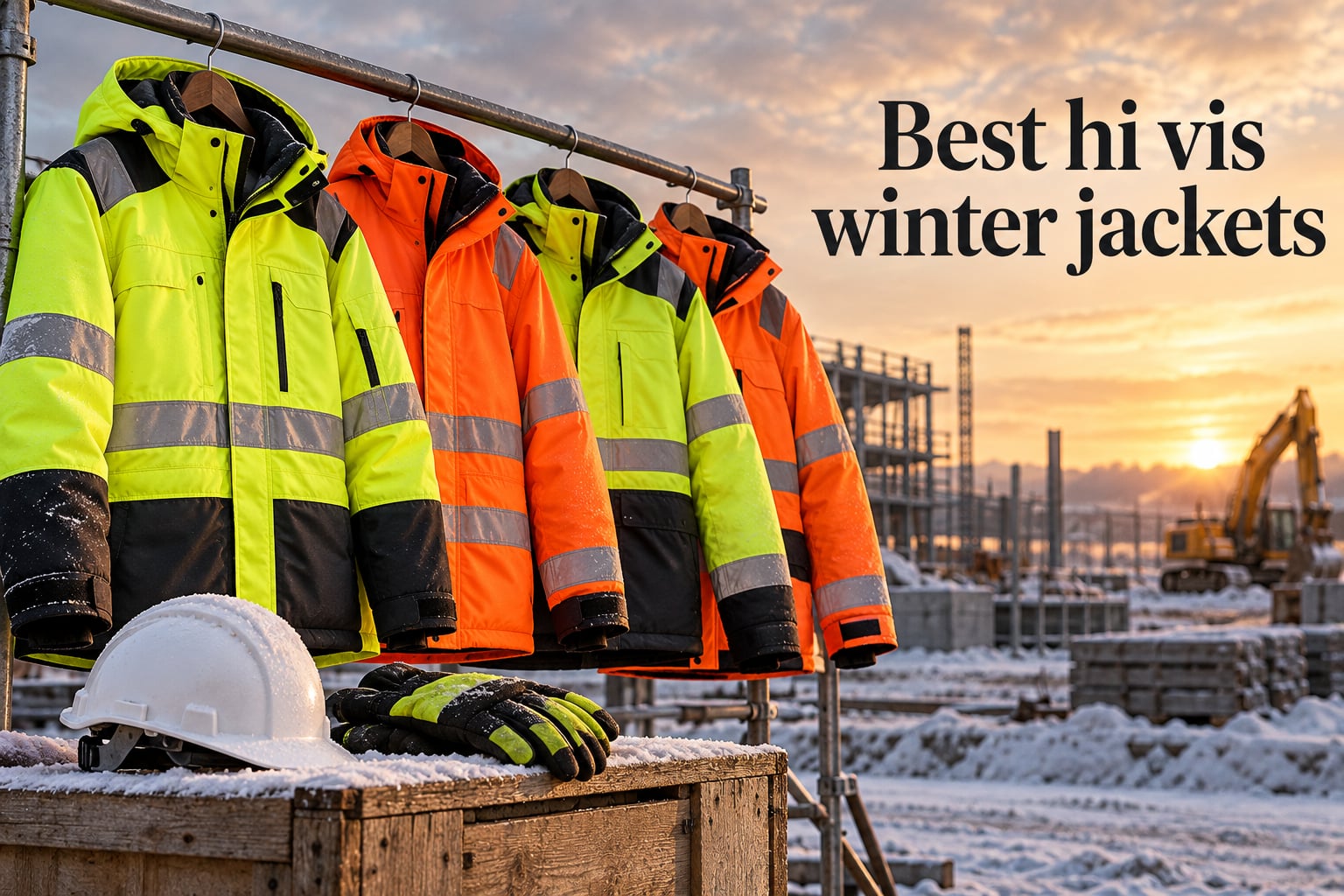
Most jackets sold online as winter hi vis are not winter jackets. They are bright shells with a thin wadding layer that stops working the moment the temperature drops below freezing, and a poster in r/Construction put it plainly when asking the group for something that is actually a winter jacket for a North American crew. We pulled 12 of the most-reviewed high visibility winter jackets on the market and sorted them by the numbers that matter on a cold site: stated temperature ratings, insulation weights, waterproofing specs, ANSI/ISEA 107 class, and how the pockets and closures hold up. Our best overall pick is the Pyramex RJ32 waterproof bomber, because it carries the largest review base in the group, a stated Class 3 rating, a quilted lining, and five outer pockets. For genuinely extreme cold, the Ergodyne 8384 thermal parka is the only jacket here with a printed -55°F / -48°C rating. For people who need real waterproofing rather than water resistance, the Portwest PW3 and the heated Pioneer bomber are the two to look at first.
We are not going to pretend we logged temperature readings in a wind tunnel. What we did was read the engineering data, the care labels, and thousands of owner reviews looking for the same failure points: sizing that will not layer over a hoodie, hoods that snap loose, tape that dulls after a few washes, and jackets that turn into an oven the moment you step inside a truck. Everything below is grounded in what the manufacturers publish and what buyers actually report back.
If you are outfitting a crew rather than yourself, scroll to the storage and pocket pick first, because a jacket that cannot carry a phone, a radio, and a pair of gloves fails on shift no matter how good the shell is. We also cover how to confirm a jacket really carries ANSI certification, and how to wash one without destroying the reflective tape. For anyone comparing hi vis to other outerwear layers, our guides to insulated jackets and hardshell jackets cover the same weather-versus-warmth tradeoff in a non-PPE context.
Everything here was reviewed for the 2026 season, and the standards referenced are the current published versions.
Table of Contents
- Top 3 Best Hi Vis Winter Jackets (October 2026)
- All 12 Hi Vis Winter Jackets at a Glance
- How We Picked These Jackets?
- 1. Pyramex RJ32 Waterproof Hi-Vis Bomber Jacket – Best Overall
- 2. Ergodyne 8384 Type R Class 3 Thermal Parka – Best for Extreme Cold
- 3. Pyramex RJ31 Waterproof Bomber With Fleece – Best 3-in-1 System
- 4. SKSAFETY 300D Oxford Hi Vis Safety Bomber – Best for Storage and Pockets
- 5. KwikSafety Class 3 ANSI Hi Vis Bomber – Top Rated for Reflective Quality
- 6. FONIRRA High Visibility Bomber With Fleece Liner – Best for Radio Crews
- 7. Pioneer Heated Hi Vis Safety Bomber – Best for Motorcycle Couriers
- 8. TICONN Fleece-Lined Hi Vis Bomber – Budget Pick
- 9. Portwest PW3 Hi-Vis Winter Jacket – Best for Dual-Standard Compliance
- 10. DPSAFETY ANSI Class 3 Hi Vis Parka – Best for Dirty Job Sites
- 11. VENDACE Polar Fleece Hi Vis Winter Bomber – Best Lightweight Shell
- 12. Portwest T400 Hi-Vis Winter Jacket – Best for Wet Climates
- How to Choose a Hi Vis Winter Jacket That Is Actually Winter Rated?
- Look for a stated temperature rating or a published insulation weight
- Check the ANSI class, and check the tag
- Decide between waterproof and water-resistant, and read the millimetre figure
- Size up if you layer, and test it with the layers you will actually wear
- Match the jacket to the weather, not to the season
- How to Wash a Hi Vis Winter Jacket Without Ruining the Reflective Tape?
- Frequently Asked Questions
- What ANSI class do I need for winter road work?
- Is a Class 2 hi vis jacket good enough for highway work?
- How do I keep reflective tape from fading or peeling in the washer?
- Is hi vis clothing required by OSHA?
- What insulation is warm enough for sub-zero weather?
- Should I size up to layer a hoodie or fleece underneath?
- Are hi vis winter jackets waterproof or just water resistant?
- How long does a hi vis jacket last before it needs replacing?
- Conclusion: Which Hi Vis Winter Jacket Should You Buy?
Top 3 Best Hi Vis Winter Jackets (October 2026)
The three below cover the most common winter situations: an all-round daily jacket, a serious-cold parka, and a convertible system for crews who move between indoor and outdoor shifts.

All 12 Hi Vis Winter Jackets at a Glance
Every jacket below carries a stated ANSI/ISEA 107 rating. The summary below gives you the two or three specs that actually separate them, and each review that follows expands on the situation that jacket is built for.
How We Picked These Jackets?
We scored every jacket on four things, in this order: certified visibility performance first, then weather protection, then warmth and layering behaviour, then durability and value. Visibility comes first because a jacket that fails the compliance requirement is not a winter jacket at all, it is just a bright coat.
We also weighted the review record heavily. A jacket rated well by a few hundred owners tells you less than one rated well by several thousand, and it is worth saying plainly that a r/BuyItForLife thread asking which hi vis jacket survives multiple winters is really asking about the seam and zipper construction more than the shell fabric. None of the 12 here advertise a multi-winter durability figure, so treat that as an open question and buy the one with the strongest warranty or the easiest replacement policy.
1. Pyramex RJ32 Waterproof Hi-Vis Bomber Jacket – Best Overall

Pyramex Safety RJ3210L RJ32 Series Jackets Hi-Vis Lime Bomber Jacket with Quilted Lining – Size Large
★★★★★★★★★★Weatherproof polyester shell
Quilted lining
2 inch silver tape
5 outer pockets
- Largest review base in the group at more than 7800 ratings
- Stated Class 3 and Level 2 hi-vis rating
- Quilted lining that owners call warm enough for cold winters
- Cell phone and radio chest pocket with a clear panel
- Easy to get on and off
- Runs small so reviewers recommend sizing up one or two
- Hood is thin and not insulated
- Reflective tape is not 3M Scotchlite
This is the jacket we kept coming back to. The RJ32 has more owner ratings than anything else in the group by a wide margin, and when a product survives that many people in cold weather the weak points are already known rather than theoretical. Buyers consistently describe it as warm enough through a normal winter and as genuinely water repellent rather than merely splash-proof.
The five outer pockets matter more than they sound. There is a dedicated chest pocket sized for a phone or radio with a clear panel over it, and the shell includes a concealed hood that stows away rather than hanging off your neck when you are not using it.

Quilted lining is the difference between this and a three-season shell. It is not the thickest fill in this roundup, but it is the fill most people actually need, and it is the reason owners describe the jacket as usable in cold weather without a full parka underneath.
The honest drawback is fit. It runs small, and the most common piece of advice across thousands of reviews is to order one or two sizes up, particularly if you plan to wear a hoodie or fleece under it. If you size up for layering, you are also solving the motion problem, because the extra room across the shoulders is what lets you reach overhead without the hem riding up.
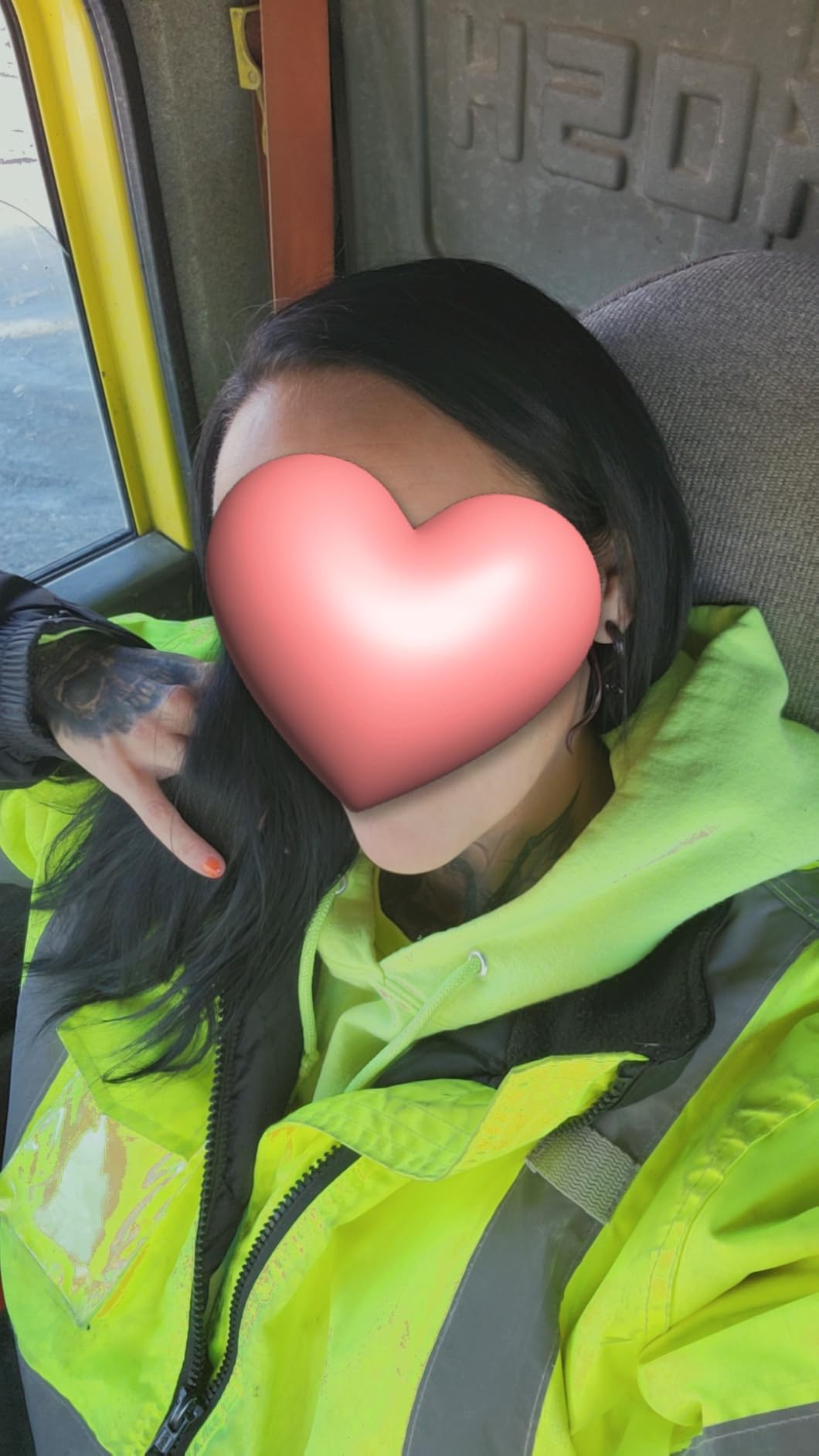
Is the RJ32 warm enough for a full winter shift?
For most cold-weather work in temperate climates, yes. Buyers in northern states and Canada describe it as warm enough for cold winters with a base layer, and the weatherproof polyester shell keeps wind off, which is often the bigger factor on a windy site. It is not the answer for a January morning at -30°F standing still on a highway ramp, and the quilted lining will not out-warm a 160g thermal parka.
The other thing worth knowing is that this jacket can run warm once you are inside. Several reviewers report overheating in a vehicle or an office, which is a fair trade for a crew that spends the whole shift outside and then has to sit in a car to drive home.
Where the RJ32 falls short?
The hood is the first thing people criticise. It is thin, it is not insulated, and in sustained rain or wind it stops contributing much. Treat it as a light layer over the collar rather than a real hood, and buy a separate insulated hood or balaclava if you are out in genuinely bad weather.
The second issue is the reflective tape. It is silver 2 inch tape and it is genuinely visible, but it is not 3M Scotchlite, and buyers who have used premium 3M tape on other jackets notice the difference in how cleanly it returns light. That is a real consideration if your compliance paperwork specifies a particular tape brand.
We earn a commission, at no additional cost to you. CERTAIN CONTENT THAT APPEARS ON THIS SITE COMES FROM AMAZON. THIS CONTENT IS PROVIDED 'AS IS' AND IS SUBJECT TO CHANGE OR REMOVAL AT ANY TIME.
2. Ergodyne 8384 Type R Class 3 Thermal Parka – Best for Extreme Cold
High Visibility Reflective Winter Safety Jacket, Insulated Parka, ANSI Compliant, Ergodyne GloWear 8384,Lime,Large
★★★★★★★★★★Rated -55F / -48C
300D oxford with PU coating
160g quilted insulation
Type R Class 3
- Only jacket here with a printed -55F temperature rating
- 300D oxford shell with PU coating
- 160g thermal quilted insulation
- Chest pocket with ID holder plus dual mic tabs
- Long length that covers the hips
- Stiff high collar can bump into a hard hat
- Runs large so some buyers size down
- Hood is not insulated
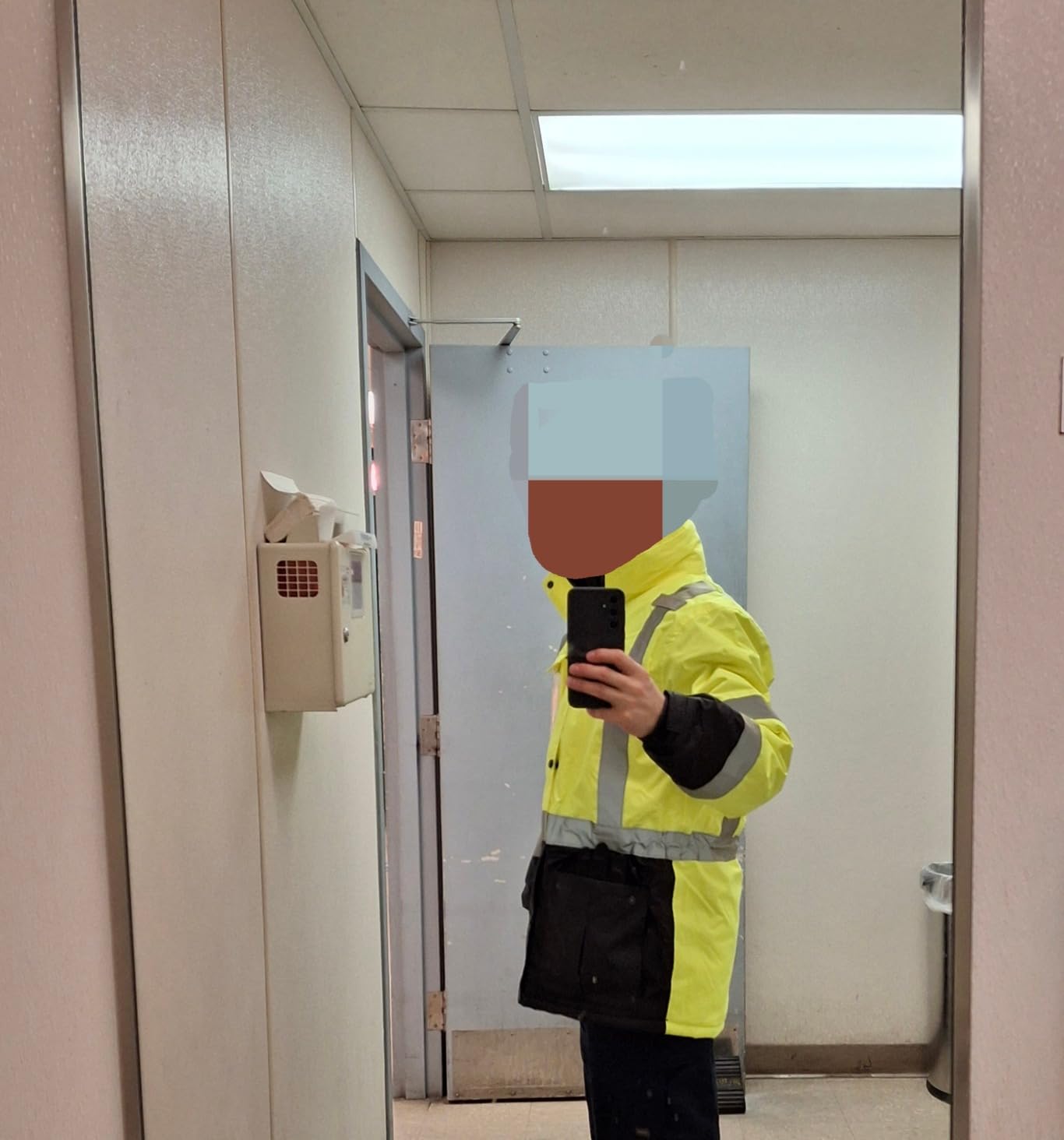
Most listings say winter-ready. This one says -55°F / -48°C on the spec, and that single number is why it tops the extreme cold list. It is the only jacket in this roundup with a manufacturer temperature rating, which is exactly the kind of stated figure the r/Construction crowd is asking for when they say they want something that is actually a winter jacket.
The build is a 300 denier oxford outer with a PU coating, filled with 160g of thermal quilted insulation and marked ANSI/ISEA 107-2020 Type R Class 3. That is a proper parka profile: heavier shell than a bomber, more fill, and a longer cut that keeps the lower back covered when you are kneeling or bracing on a ladder.
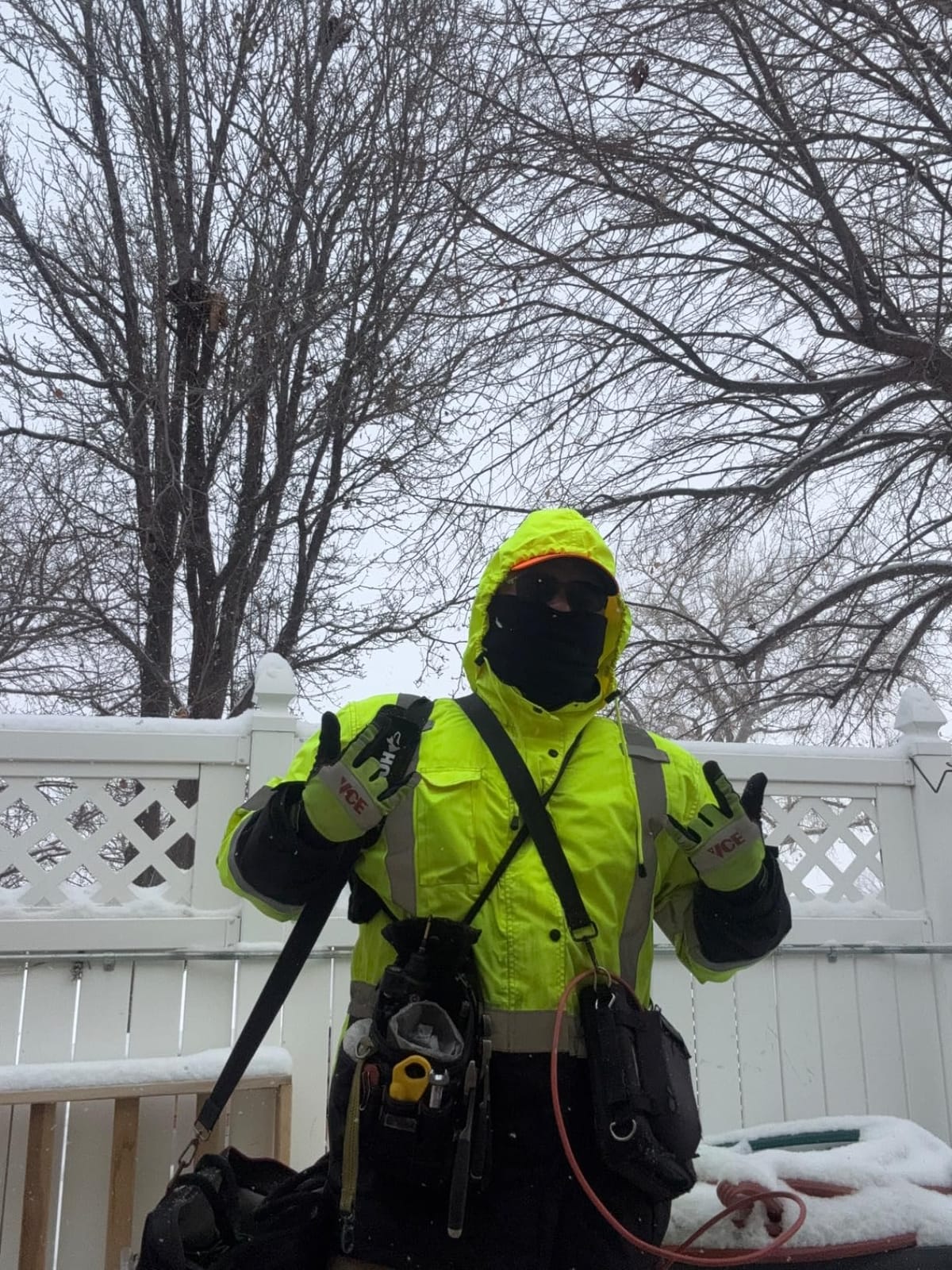
For the pocket layout, the internal waist cord, a chest pocket with an ID holder, a dual-slot pen pocket, and dual mic tabs give you a place for a radio, a badge, and a pen without using up the outer shell. Reviewers rate the zipper and storm flap as durable, which is where cheaper parkas usually fail first.
Owners describe it as genuinely warm and as effectively waterproof and windproof, and the value for money is repeatedly called out given what the temperature rating claims. The trade-off is breathability. Several reviewers mention sweating during heavy activity, which is the classic downside of a 160g quilted fill on a warm day of hard labour.
Does the -55°F rating hold up in daily work?
A stated rating like this is a laboratory figure for a stationary wearer in a defined wind condition, not a promise that you will be comfortable at that temperature while swinging a shovel. What it does give you is something concrete to plan against, and nothing else in this roundup does. For a crew doing extended outdoor shifts in subzero wind chill, that is the number you budget around.
For most temperate winters you would be overspecced and probably over-warm in it, which is precisely why the insulation is quilted rather than a full down construction. It still vents when you are moving, which is where cheaper heavy parkas trap you.
Where the 8384 is the wrong choice?
The collar is the recurring complaint. It is stiff enough that wearers in hard hats report it hitting the brim and forcing the hat to sit forward, which is a genuine problem for anyone in a site hard hat rather than a beanie. If you wear a hard hat all shift, test the collar against your specific model before committing.
Fit runs large, so if you are between sizes or layering over thick insulation, size down rather than buying your usual. The hood is also not insulated, which is a slightly odd gap in a parka with a -55°F rating, so plan on a separate layer for your head and neck in severe cold.
We earn a commission, at no additional cost to you. CERTAIN CONTENT THAT APPEARS ON THIS SITE COMES FROM AMAZON. THIS CONTENT IS PROVIDED 'AS IS' AND IS SUBJECT TO CHANGE OR REMOVAL AT ANY TIME.
3. Pyramex RJ31 Waterproof Bomber With Fleece – Best 3-in-1 System
Pyramex RJ31 Series Waterproof Class 3 Fleece Bomber Safety Jacket, Lime, X-Large
★★★★★★★★★★Waterproof polyester shell
Removable fleece liner
Detachable hood
2 inch silver tape
- Removable fleece liner so you get two coats in one
- Waterproof shell with quilted backing
- Five outer pockets plus radio chest pocket
- Detachable hood that rolls into the collar
- Mic tabs and pencil pockets inside
- Hood snaps are weak and pop undone
- Runs small so size up one or two
- Not warm enough for hard cold with the liner in
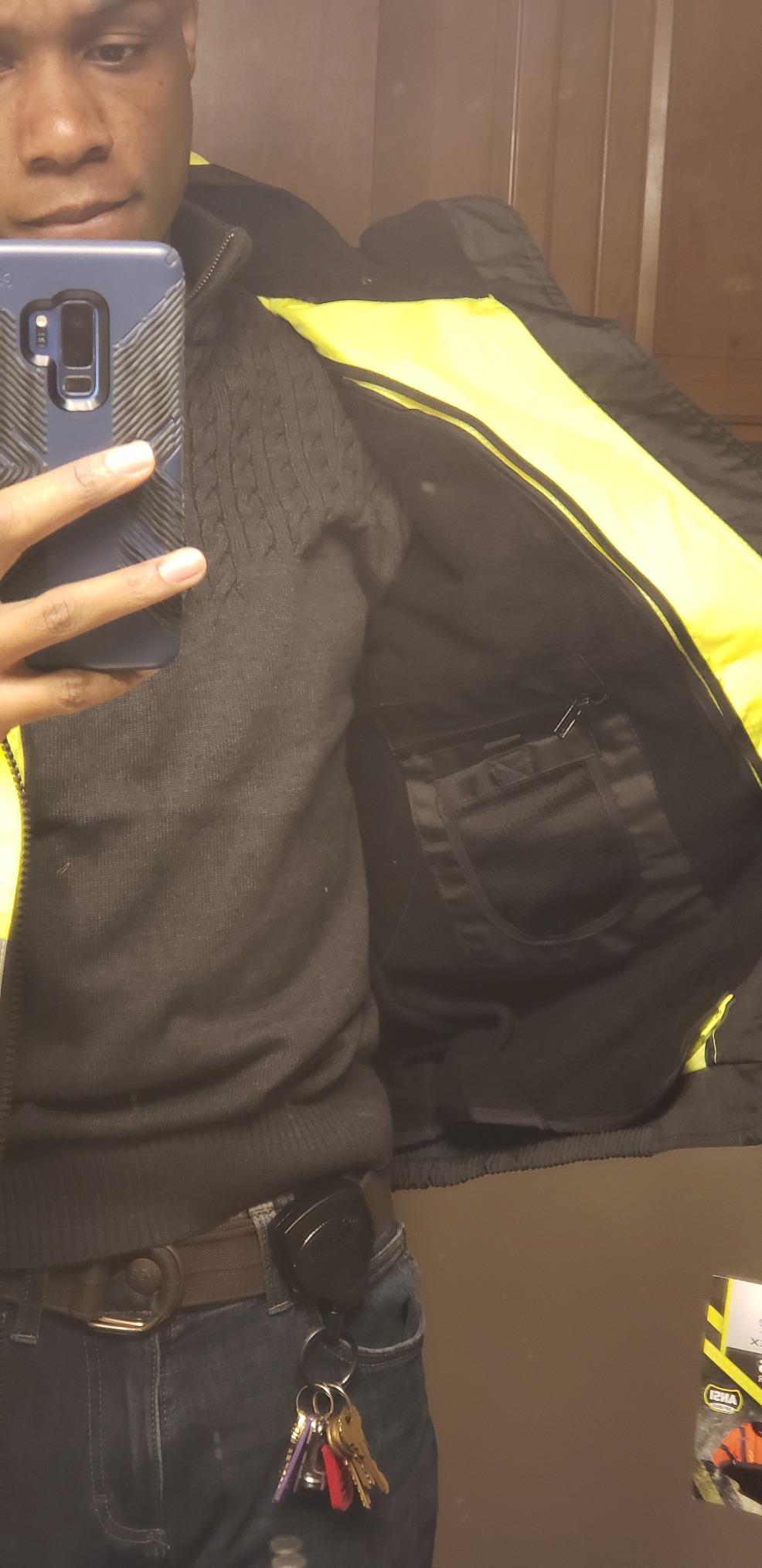
The RJ31 solves a problem the fixed-fill jackets cannot: it changes with the shift. The fleece liner zips out, so in October you wear it as a full jacket, and in January you wear the shell over your own insulated layer for the walk to the truck. For crews that move between a warm site trailer and a cold yard, that flexibility is worth more than raw fill weight.
It is a waterproof polyester shell with a quilted backing and 2 inch silver reflective tape, rated Class 3 and Level 2 hi-vis. Reviewers describe the shell as waterproof and wind resistant, and the liner as the reason the jacket works in genuinely cold weather rather than merely cool weather.
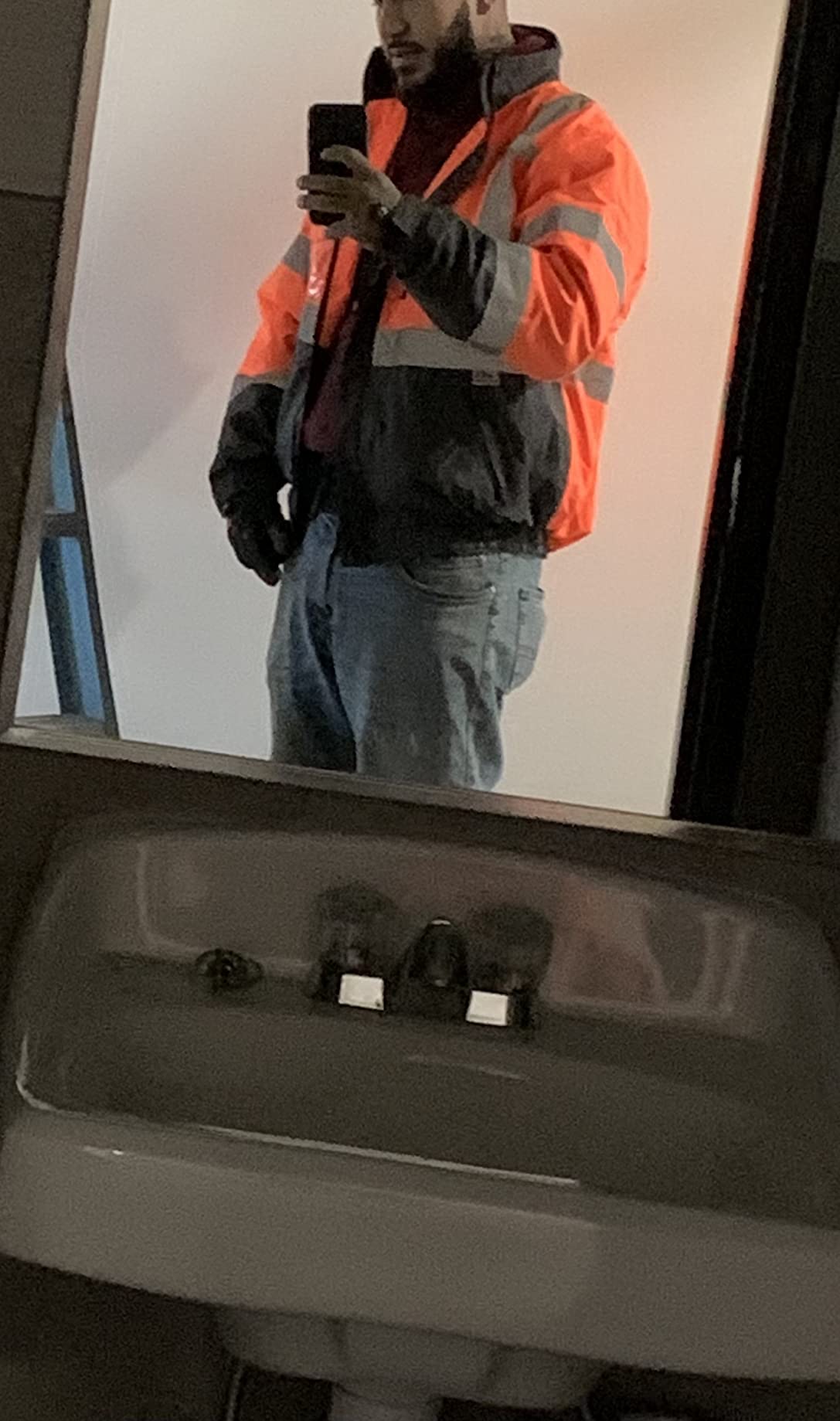
The hood is concealed and detachable, stowing inside the collar when you do not need it. The five outer pockets follow the same layout as the RJ32, with a cell phone and radio chest pocket that has a clear panel so you can read a screen without pulling your phone out in the rain.
As with the RJ32, the most common sizing advice is to go up one or two sizes, and here it is more pressing because a fleece liner plus a hoodie underneath needs real room across the chest. Buy for the layers you will actually wear, not the layers you might wear.
When is a removable liner better than fixed insulation?
When your day has two very different halves. If you are outside continuously in hard cold, fixed fill is simpler and warmer because there is no zip gap to lose heat through. If your day is half inside a warm vehicle, half outside, or you share a jacket across a crew with different tolerances, the liner system wins every time.
It is also the cheaper answer to seasonal variation. You can wear the shell alone across autumn and spring, add the fleece when the temperature drops, and keep the jacket in service far longer than a single-season fill would last.
Where the RJ31 is the wrong choice?
Two things. First, the hood attachment snaps are repeatedly described as weak and prone to coming undone, which matters if you are working in wind or rain and expect to keep the hood up for hours. Second, reviewers are direct that the jacket is not sufficient for very cold weather with the liner in, so treat it as a shoulder-season-to-mid-winter garment rather than an extreme cold one.
Some wearers also find the liner attachment tabs work loose over time. If you have had one, check them at the start of a season rather than discovering the problem halfway across a yard.
We earn a commission, at no additional cost to you. CERTAIN CONTENT THAT APPEARS ON THIS SITE COMES FROM AMAZON. THIS CONTENT IS PROVIDED 'AS IS' AND IS SUBJECT TO CHANGE OR REMOVAL AT ANY TIME.
4. SKSAFETY 300D Oxford Hi Vis Safety Bomber – Best for Storage and Pockets
SKSAFETY Hi Vis Safety Bomber Jacket for Men, High Visibility Winter Coat
★★★★★★★★★★300D oxford polyester
6000mm waterproof rating
Fleece lined
Type R Class 3
- Eight working pockets including a clear ID holder
- A stated 6000mm waterproof rating
- True to size classic fit
- Removable hood
- Manufacturer rates it for 50 machine washes
- Arms can run oversized
- Elastic waistband lets the hem ride up
- No published weight for the fleece lining
Storage is the reason to look at this one. The pocket list is unusual for a jacket at this tier: an inner chest pocket, two lower slant pockets, two mic tabs, a cell phone pocket, a clear ID holder, and two pen holder pockets on the sleeves. That last detail, pen holders on the sleeves, is the kind of thing that tells you the jacket was specced with a real job in mind rather than a product photo.
The shell is 300 denier oxford polyester with a stated 6000mm waterproof rating and a fleece lining, and it carries ANSI/ISEA 107-2020 Type R Class 3 marking with 2 inch reflective strips for 360 degree visibility. A stated millimetre rating is more useful than a vague waterproof claim, and 6000mm is a genuine wet-weather figure rather than a splash rating.
Owners describe it as warm for cold weather, genuinely waterproof over time rather than only at first, and durable. The fit is reported as true to size with a classic cut, which means you are not fighting the sizing the way you are with the Pyramex models, though some wearers find the arms long.
The 50-wash figure is worth noting for anyone who works in this jacket daily. It is a stated ceiling rather than a guarantee, but it is a materially longer service life than jackets whose care instructions cap out much lower, and reflective tape that has been washed 50 times and still passes is the real test of a hi vis jacket.
Is a 6000mm rating enough for real rain?
For sustained rain on a job site, yes, for most situations. Waterproof ratings are measured as a column of water the fabric holds back, and 6000mm is well past the point where a jacket stops feeling wet. What the rating does not tell you is whether the seams are sealed, and this jacket is described as water resistant and waterproof in different places across the listing, so treat the seams as the weak point rather than the face fabric.
For standing water, freezing rain, or a road crew working in a downpour for hours, our advice is to move up to a jacket with heat-sealed seams, such as the heated Pioneer bomber, which is built for that specific job.
Where the SKSAFETY falls short?
Two fit complaints recur. The arms can run oversized, which is annoying if you are layering and want the sleeve to stay put with gloves on. And the elastic waistband can allow the jacket to ride up when you are bent forward, which is a common posture on a construction site and can expose the lower back to cold air.
There is also no published insulation weight for the fleece, so you cannot compare it numerically against the 160g fleece in the TICONN or the 170g wadding in the Portwest PW3. If you are outfitting a crew and want consistent warmth across the whole order, that missing figure is worth asking the supplier about before you commit to a size run.
We earn a commission, at no additional cost to you. CERTAIN CONTENT THAT APPEARS ON THIS SITE COMES FROM AMAZON. THIS CONTENT IS PROVIDED 'AS IS' AND IS SUBJECT TO CHANGE OR REMOVAL AT ANY TIME.
5. KwikSafety Class 3 ANSI Hi Vis Bomber – Top Rated for Reflective Quality

KwikSafety MARSHAL Bomber Safety Jacket Class 3 / Yellow Large
★★★★★★★★★★3M 2 inch silver tape
Insulated quilt interior
Foldable hideaway hood
Ansi Class 3 Type R
- Uses 3M reflective tape rather than generic film
- Reviewers report warmth tested to -10F
- Heavy duty double snap zipper over the main zip
- Adjustable elastic wrist cuffs
- Comfortable fit owners rate highly
- Pockets are small and sit awkwardly
- Zipper can be hard to start when cold
- Cuffs and glove pockets are unlined
This is the one to buy if tape quality is the deciding factor. It uses 2 inch 3M reflective tape, and that is a real specification rather than a marketing adjective, because 3M is the tape most compliance documentation names when it specifies a material at all. Buyers who have used generic tape on cheaper jackets consistently rate this tape higher for how it reads back at distance.
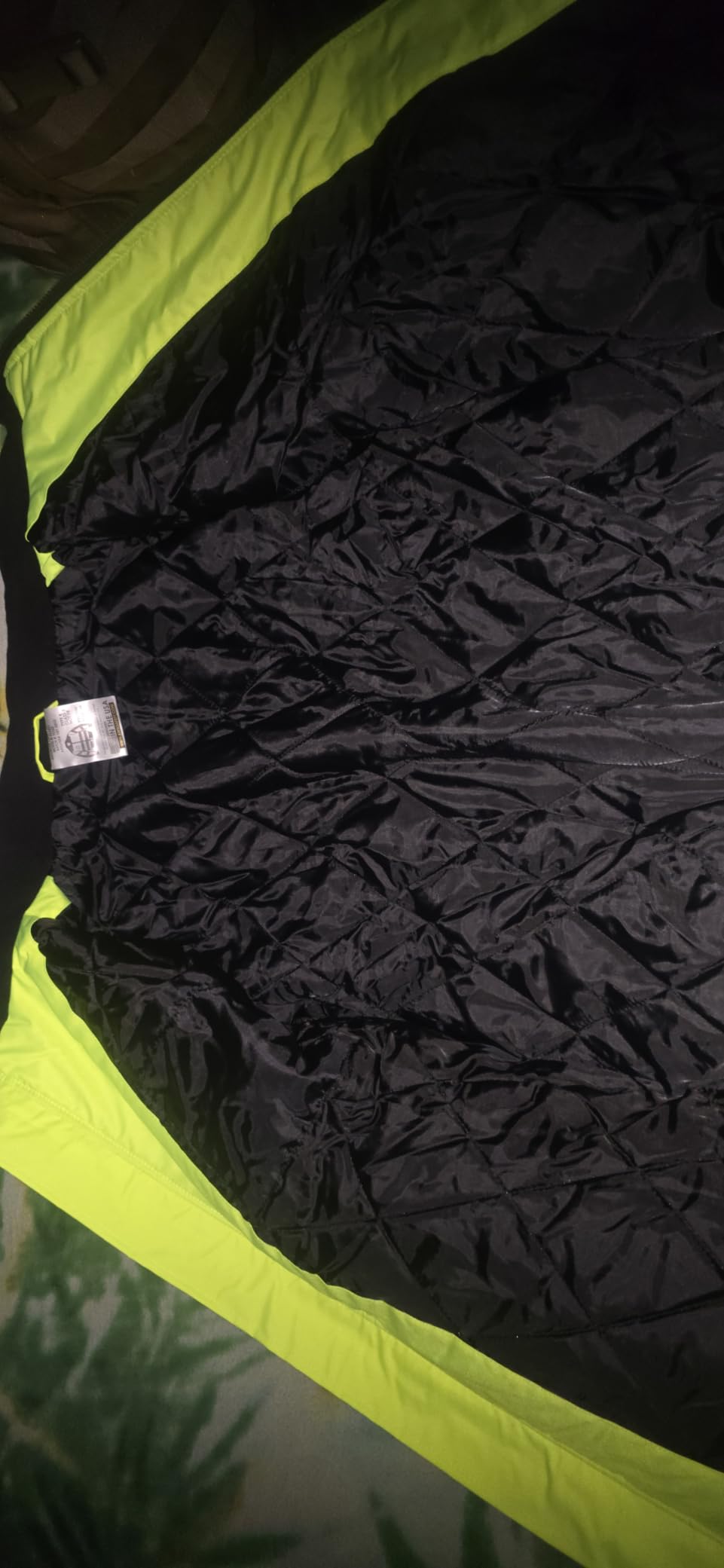
The construction is a soft synthetic exterior over an insulated quilt interior, with a foldable hideaway hood, a heavy duty double snap zipper, and adjustable elastic wrist cuffs. The cuff adjustment is more useful than it sounds because it lets you seal the wrist over a glove rather than letting cold air run down the forearm.
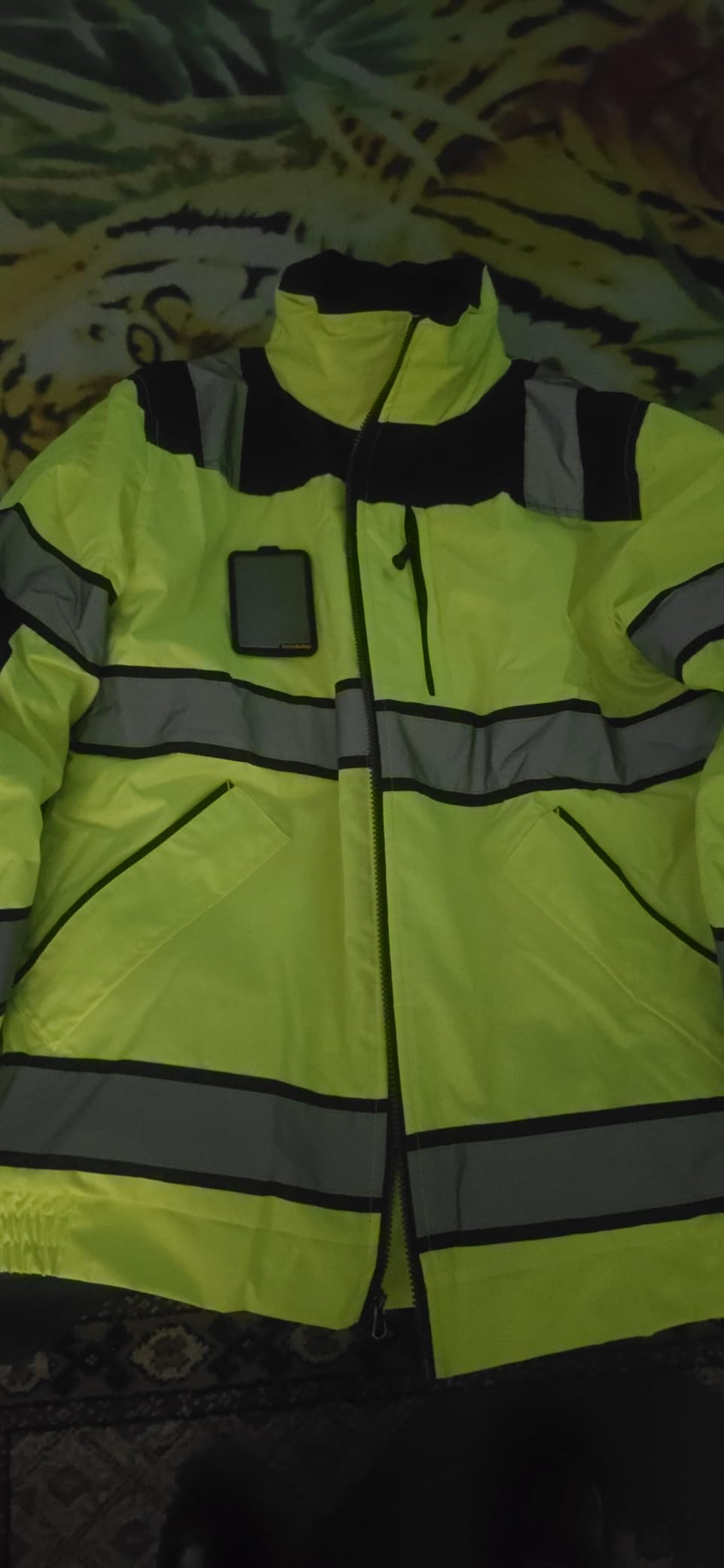
Warmth is the other strength. Reviewers report testing it to -10°F, which is not a manufacturer rating but is a real owner-reported figure, and they rate the fit as comfortable and the zipper and seams as durable. Several describe it as looking better than expected on the job, which matters more than it should when you are wearing something all day.
One clarification worth making: the listing describes the shell as water resistant rather than waterproof, so this is not the jacket for a crew that works in heavy rain every shift. It handles wind and drizzle well. If your exposure is genuinely wet, look at the Portwest PW3 or the Pioneer heated model instead.
Does 3M tape actually make a safety difference?
On the road, yes, and the reason is physics rather than brand. Retroreflective tape bounces light from a headlight back along the path it arrived, so what matters is how efficiently the material returns that light. Premium 3M tape returns it more consistently across its full width and degrades more slowly, which means a driver picks you up earlier and keeps picking you up as the tape ages.
The practical implication is that tape specification should matter more to a highway or railway crew than the jacket fabric. The fabric keeps you alive in the cold; the tape is what makes a driver react in time. If your site paperwork names a tape brand, buy the jacket that names it too.
Where the KwikSafety falls short?
The pockets are the most common complaint. They are small and positioned awkwardly enough that several buyers describe them as a problem when wearing gloves, which is precisely when you need to reach into one. If you carry tools or a phone for most of the shift, the SKSAFETY layout is a better fit for your work.
Second, the main zipper can be tough to start when your hands are cold, and the cuffs and glove pockets are not lined, so bare skin in contact with them feels rough over a long shift. Neither is serious on its own; both are annoying in the exact conditions the jacket is designed for.
We earn a commission, at no additional cost to you. CERTAIN CONTENT THAT APPEARS ON THIS SITE COMES FROM AMAZON. THIS CONTENT IS PROVIDED 'AS IS' AND IS SUBJECT TO CHANGE OR REMOVAL AT ANY TIME.
6. FONIRRA High Visibility Bomber With Fleece Liner – Best for Radio Crews

FONIRRA High Visibility Safety Jackets for Men with Fleece Liner, ANSI Class 1 Reflective Waterproof Bomber Jacket
★★★★★★★★★★300D oxford with PU coating
Polar fleece lining
Wide 2 inch tape at 360 degrees
Ansi Class 3
- Built-in microphone holders on both sides
- 360 degree coverage on a wide 2 inch tape band
- Detachable hood that stows behind the neck
- Dedicated phone pocket plus transparent card slot
- Elastic waistband and cuffs
- No long-term durability record yet
- Sizing can run large so check the chart
- Water repellent rather than rated for heavy rain
The differentiator here is the pair of built-in microphone holders, one on each side, combined with a dedicated cell phone pocket and a transparent card slot. If you are a lineman, a surveyor, or anyone wearing a two-way radio on a shoulder all day, you will appreciate not having to improvise a mic clip on every shift. Many other jackets offer mic tabs as an optional add-on; here it is part of the base design.
The shell is 100 percent polyester 300 denier oxford with a PU-coated finish, lined with soft inner polar fleece, and marked ANSI Class 3 with wide 2 inch reflective tape rated for 360 degree visibility. The detachable hood stows behind the neck, which keeps the profile flat when you are not wearing it.
Owners rate the warmth as good for the fleece class, the reflectivity as genuinely visible from every angle, and the pocket layout as practical. It is also described as wind-proof and water-repellent, which is the honest description, and good value for the money.
The package weighs 2.2 pounds, which is worth noting if you are ordering a dozen at a time or handing jackets out to a crew at shift change. It is a light garment relative to the parka options, and that cuts both ways.
Is fleece lining enough for real winter work?
It depends entirely on your climate and how static your work is. Polar fleece handles a cold, dry day with intermittent activity well, because it breathes and it dries fast. It is less convincing during a long, still, sub-zero shift, where synthetic or quilted fill with a windproof outer holds core heat better.
For shoulder season through a normal winter in temperate regions, it is the right amount of warmth and it is the layer most people will actually keep wearing. For extreme cold, pair it with a thin base layer rather than trying to make the jacket do the work of a parka.
Where the FONIRRA falls short?
The main limitation is the record. With fewer than a thousand ratings and a recent introduction, there is no multi-season durability evidence, and the r/BuyItForLife question of which jacket holds up over years is one this one simply cannot answer yet. If you are buying for a crew that will wear the same jacket for five winters, choose a model with a longer history instead.
Sizing can also run large, so check the size chart rather than ordering your usual. And while the shell is PU coated, it is described as water-repellent rather than carrying a millimetre rating, so plan for wind and drizzle rather than sustained rain.
We earn a commission, at no additional cost to you. CERTAIN CONTENT THAT APPEARS ON THIS SITE COMES FROM AMAZON. THIS CONTENT IS PROVIDED 'AS IS' AND IS SUBJECT TO CHANGE OR REMOVAL AT ANY TIME.
7. Pioneer Heated Hi Vis Safety Bomber – Best for Motorcycle Couriers

Pioneer Hi Vis Waterproof Heated Safety Bomber Jacket – Class 3 Winter Rain Gear for Men – Reflective Tape – Detachable Hood
★★★★★★★★★★Three panel heating with 4 settings
Up to 18 hours
Heat sealed seams
Ansi Class 3 Type P and R
- Three panel heating element with four settings
- Runtime of up to 18 hours per charge
- Heat sealed seams and waterproof zippers
- Carries both Type P and Type R marks
- Black bottom conceals road soiling
- Power bank is not included
- Heating elements add bulk
- Rating sits below the rest of this group at 4.3
This is the one to consider if you are on a bike or spending hours in a cold vehicle. The heating is a three-panel element across the core and back with four heat settings, and it runs for up to 18 hours off a rechargeable power bank connected through the built-in USB port. The power bank is not included, which is the single most important thing to know before you plan on it.
As a jacket it is genuinely well built. The shell is 100 percent waterproof and windproof PU-coated 300 denier oxford polyester with heat-sealed seams and waterproof zippers, filled with 120 GSM insulated material under a taffeta lining, and it is marked ANSI/ISEA 107-2020 Class 3 Type P and R.
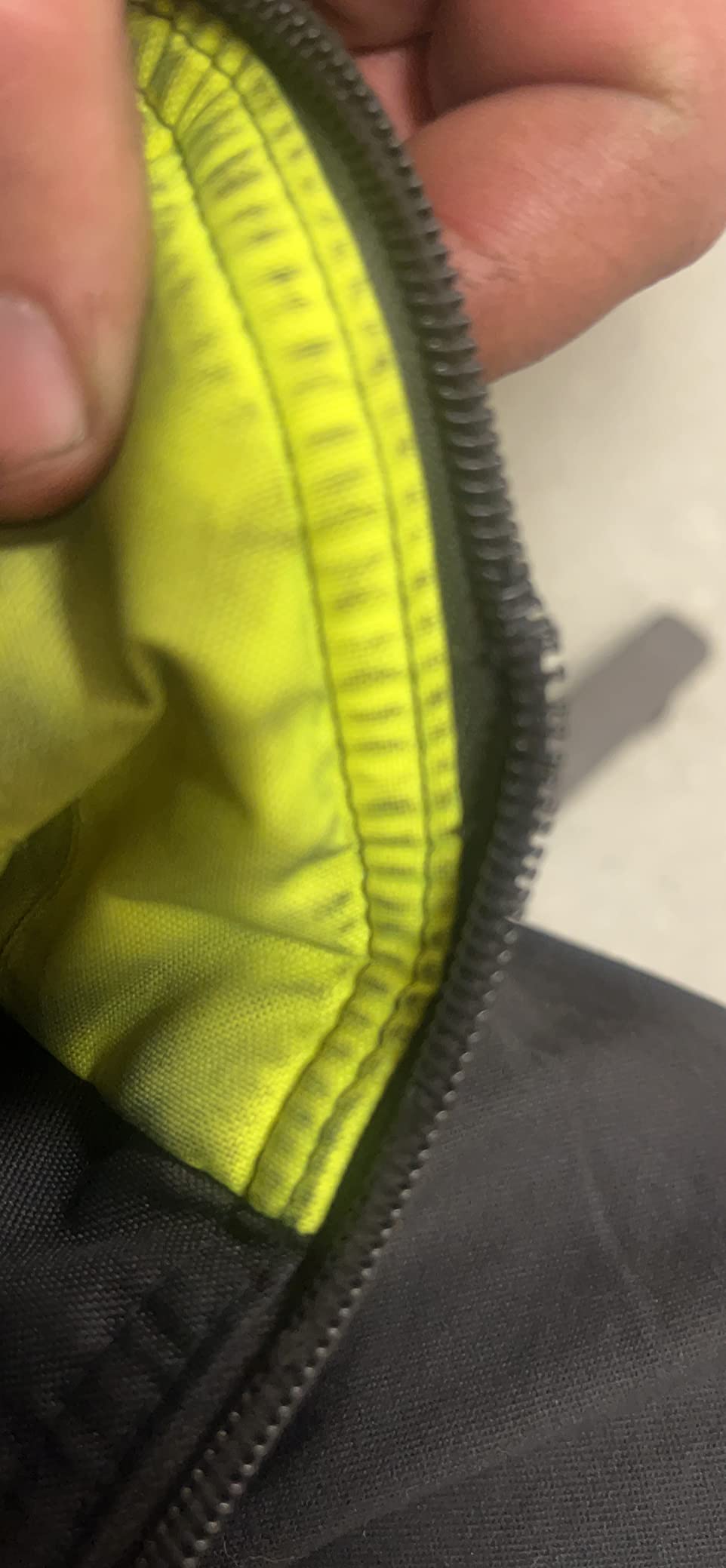
Those dual Type P and Type R marks are notable. Type R is for road and infrastructure work, Type P is for public safety and police functions, and a jacket carrying both gives you one garment that fits either requirement, which simplifies a crew order considerably.
The pockets are all zipped and water resistant: two lower slash pockets with waterproof zippers, an interior zip pocket, a chest zip pocket, and two radiophone clip straps. The black bottom is a practical inclusion for anyone who rides or works near traffic, because road spray marks the lower panel and not the fluorescent chest.
For a courier, the heated core means you can stay warm without burying a thick liner under a jacket that then restricts your arms on the bars. That is a genuine safety argument as much as a comfort one, because cold hands and cold forearms degrade reaction time.
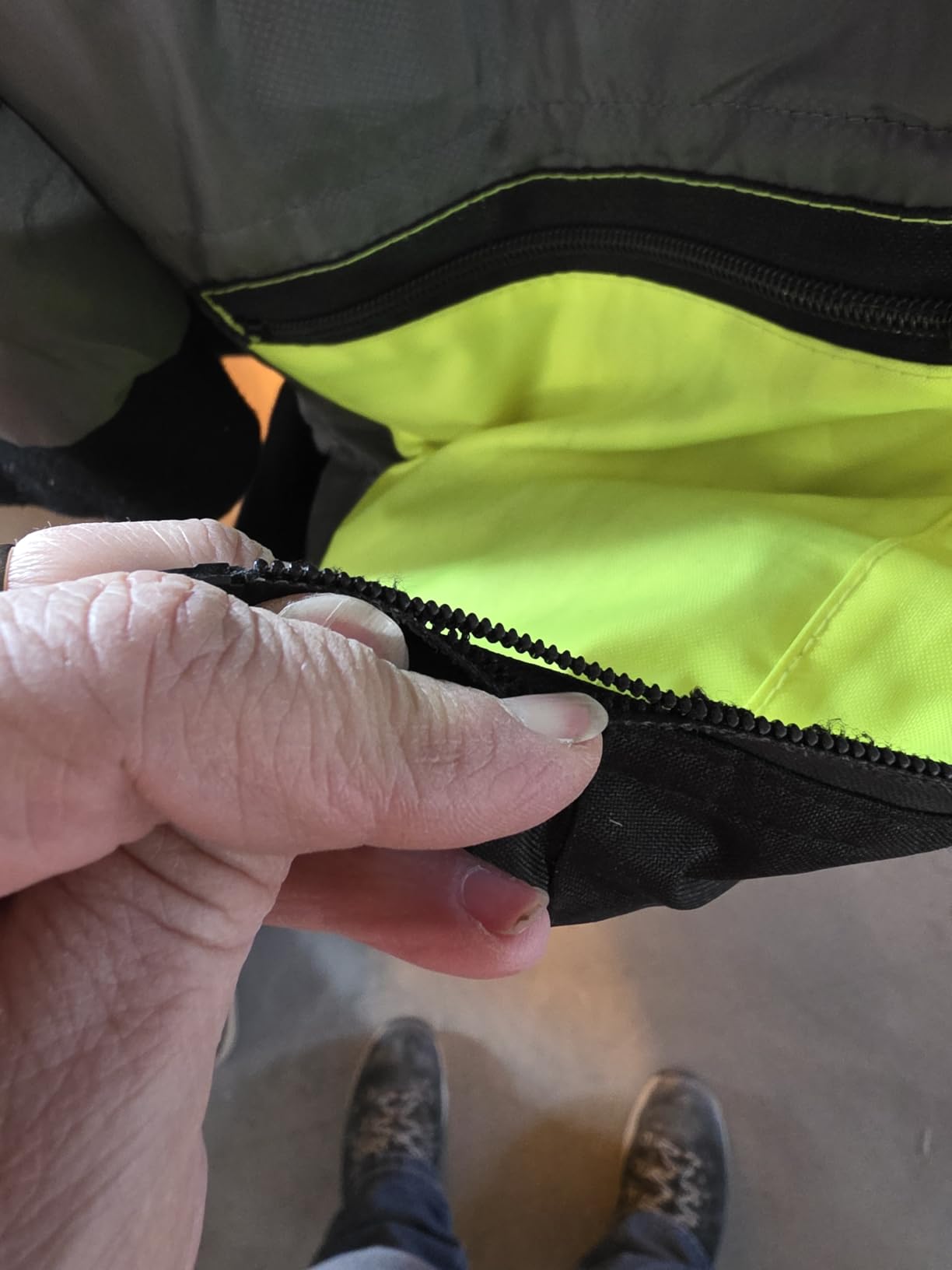
Is battery heating worth the extra complexity?
If you are stationary at a fixed post, no, a good parka will beat it. If you are moving between a vehicle, a site, and a roadside in serious cold, yes, because the heating lets you regulate rather than choose between a jacket that is too warm and one that is not warm enough. Four settings matter more than they sound, because you can drop to a lower setting indoors rather than stripping the jacket off.
The 18 hour figure is the maximum on the lowest setting with a suitable power bank, and it is a manufacturer claim, so treat it as an upper bound. The real question for a buyer is whether you already carry a power bank for your phone, because you will want a second one for the jacket.
Where the Pioneer falls short?
Three things. The power bank is not included, which adds a cost you cannot see in the jacket spec. The heating elements add bulk, so it is heavier to move in than a fleece-lined bomber. And its 4.3 rating sits below every other jacket in this roundup, so while the feature set is the most advanced here, the owner satisfaction is not the highest, and that is worth weighing against the specification.
It is also a 120 GSM fill, which is light for a parka. The heating does the work, but if the battery dies you are left with a lighter jacket than the 160g options in this list.
We earn a commission, at no additional cost to you. CERTAIN CONTENT THAT APPEARS ON THIS SITE COMES FROM AMAZON. THIS CONTENT IS PROVIDED 'AS IS' AND IS SUBJECT TO CHANGE OR REMOVAL AT ANY TIME.
8. TICONN Fleece-Lined Hi Vis Bomber – Budget Pick
TICONN Hi Vis Safety Bomber Jacket, Fleece-Lined Waterproof ANSI Class 3
★★★★★★★★★★300D oxford with PU coating
160g fleece lining
Sewn-on 2 inch Class 3 tape
Kangaroo pocket
- 160g fleece is a real published weight for the tier
- Reflective strips are sewn on rather than glued
- Heavy duty zipper with a storm flap
- Zippered kangaroo pocket plus transparent card slot
- Elastic hem and cuffs keep drafts out
- Can run warm and cause sweating above freezing
- No long-term durability record yet
- Size up if layering a hoodie
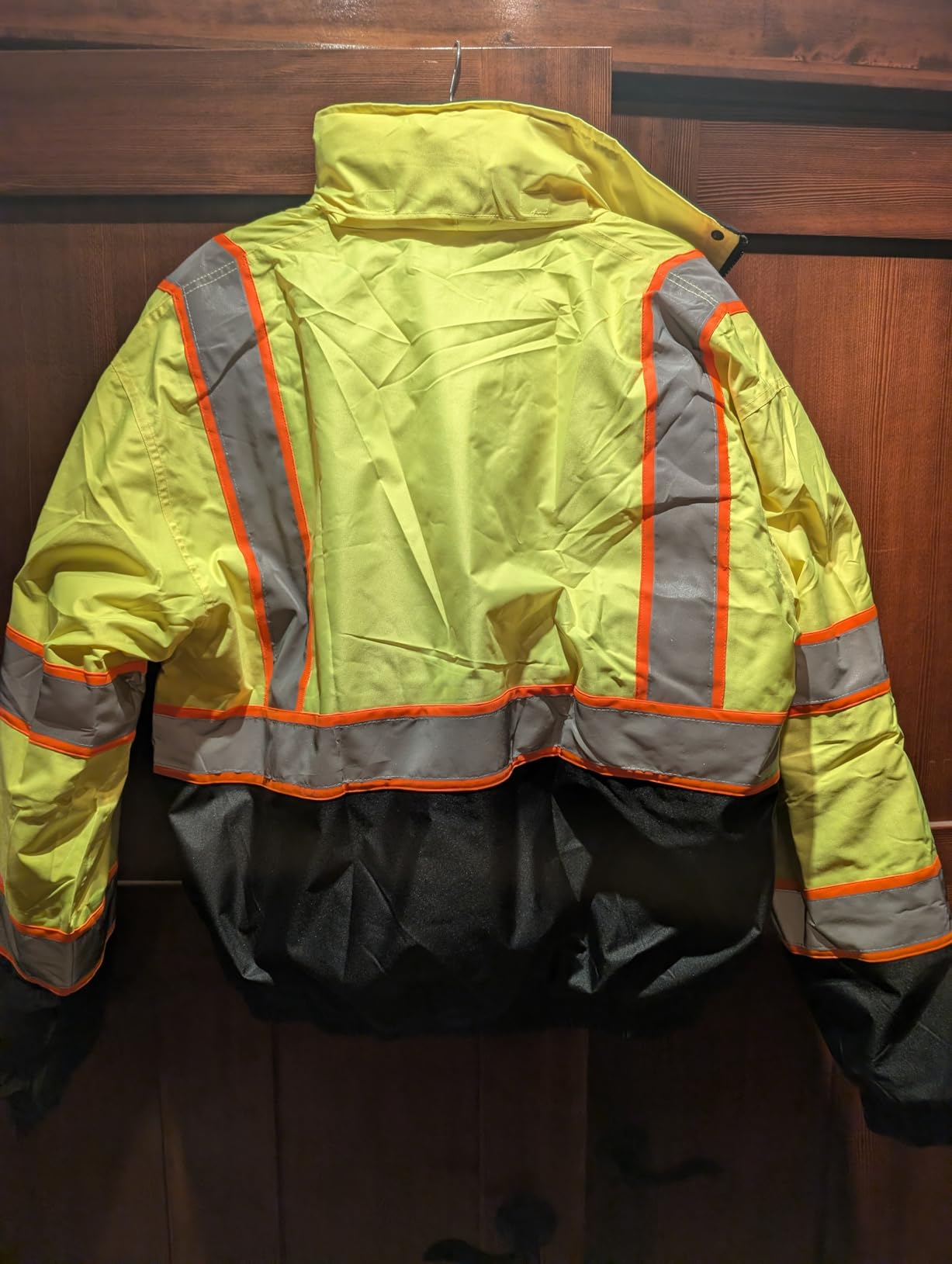
This is the pick if the budget line is a hard constraint, because the specification it gives up is minimal. You get 300 denier oxford polyester with a PU coating, a 160g soft fleece lining, sewn-on 2 inch high-visibility reflective strips carrying an ANSI Class 3 marking, and a heavy-duty zipper under a storm flap. The fleece weight is actually published, which puts it on the same footing for comparison as the parka options.
It ranks highly in Safety Jackets and carries a 4.6 rating, so it is not a token budget option. Owners describe it as well insulated for winter, waterproof and windproof, true to size, and good value. The sewn-on tape is worth noting because glued or adhesive tape is the first thing to lift on a cheaper garment.
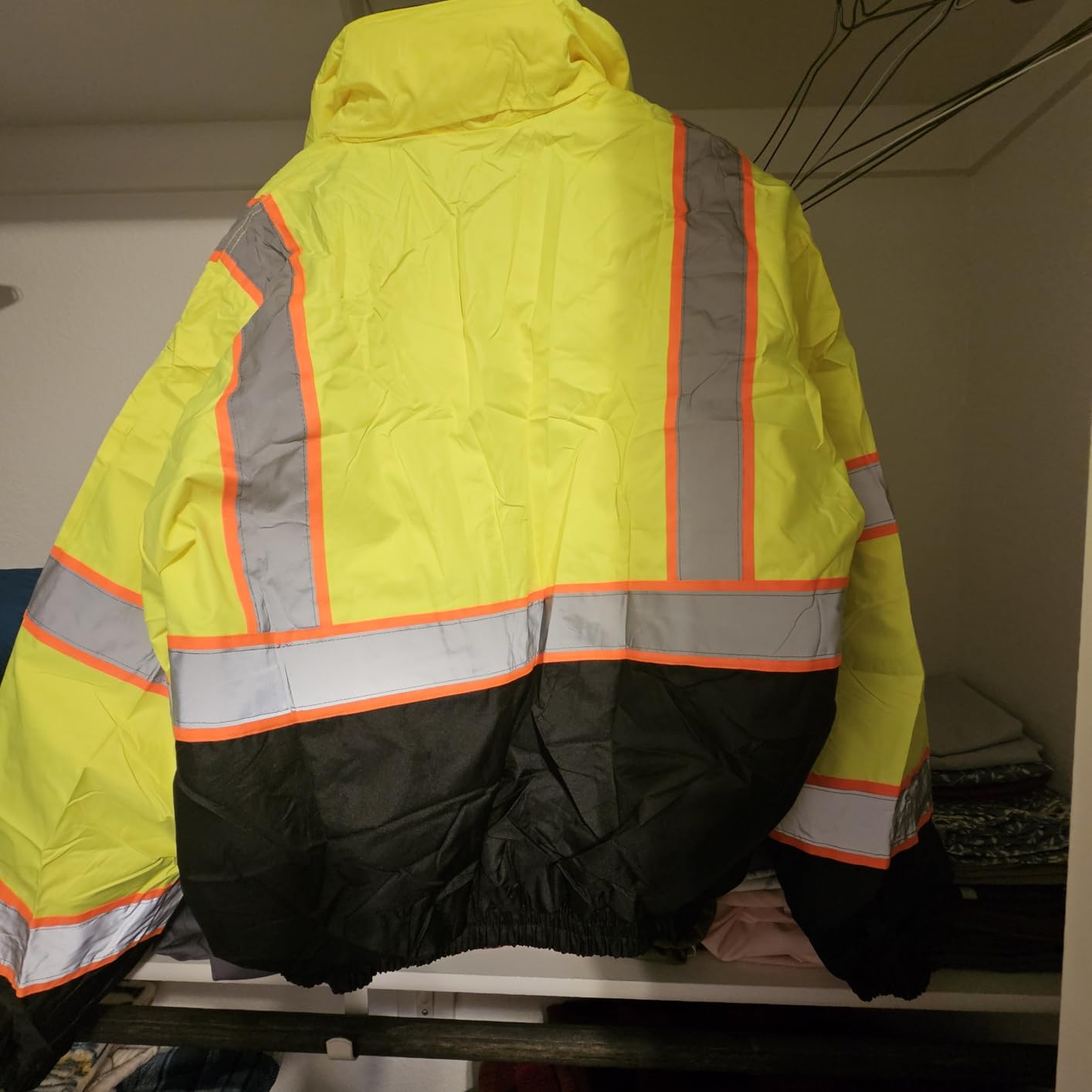
Pocket-wise it is a zippered kangaroo pocket, a transparent card slot, a discreet chest compartment, and a D-ring for keys or gear, plus elastic at the hem and cuffs to seal out drafts. That is a sensible working layout for someone who does not need radio storage.
The one consistent warmth complaint is that it can run hot. Several owners mention sweating above freezing, which follows logically from a 160g fleece under a windproof shell with no venting. In deep winter that is a feature. In a shoulder-season month it is a jacket you unzip and open within minutes of starting work.
Can a budget jacket be genuinely winter rated?
Yes, as long as you understand what you are getting. A 160g fleece lining under a PU-coated 300D oxford shell is a real winter configuration, not a marketing label, and the same fill weight appears in jackets costing several times more. The differences at the lower end tend to be in seam sealing, tape specification, and hardware longevity rather than in the insulation itself.
Where budget jackets cut corners is usually the details you only notice in month eight: zip sliders that grit up, storm flaps that flap, and elastic that loses its recovery. If you are buying one jacket for personal use, this is a reasonable trade. If you are outfitting eight people who will all wear the same model, the budget maths changes quickly.
Where the TICONN falls short?
Two limits and one warning. The overheating issue above is real above freezing. The product is newer, so like the FONIRRA it has no multi-winter durability record. And owners recommend sizing up for heavy layers, which means that if you need to layer a hoodie underneath, the effective price per usable jacket goes up as you buy a larger size.
There is also no stated millimetre waterproof rating, so treat the shell as water-resistant in steady rain. It is a bomber, not a rain shell, and pairing it with a separate waterproof outer is the sensible move for all-day rain work.
We earn a commission, at no additional cost to you. CERTAIN CONTENT THAT APPEARS ON THIS SITE COMES FROM AMAZON. THIS CONTENT IS PROVIDED 'AS IS' AND IS SUBJECT TO CHANGE OR REMOVAL AT ANY TIME.
9. Portwest PW3 Hi-Vis Winter Jacket – Best for Dual-Standard Compliance

Portwest PW3 Hi-Vis Winter Jacket Work Safety Protective Reflective Waterproof Coat ANSI 3, Large
★★★★★★★★★★300D oxford PU coated
170g polyester wadding
EN 343 15000mm
EN ISO 20471 Class 3
- Carries EN ISO 20471 and ANSI/ISEA 107 markings together
- Insulatex heat-reflective lining panel
- HiVisTex Pro segmented reflective tape
- Texpel stain resistant finish
- Five pockets including a concealed phone pocket
- Rated 4.0 which is the lowest in this group
- Water resistant to EN 343 rather than fully waterproof
- Care limited to 25 washes
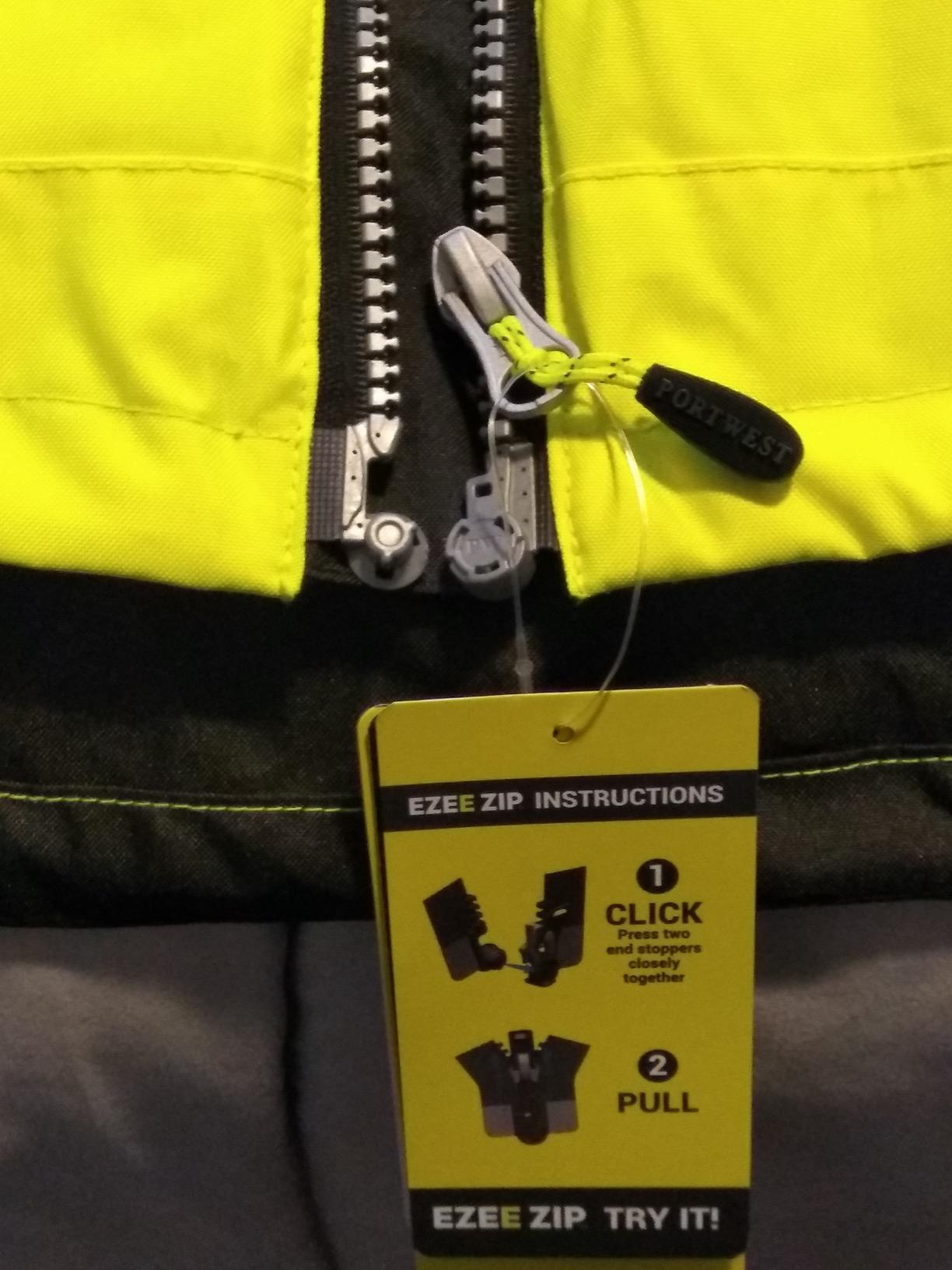
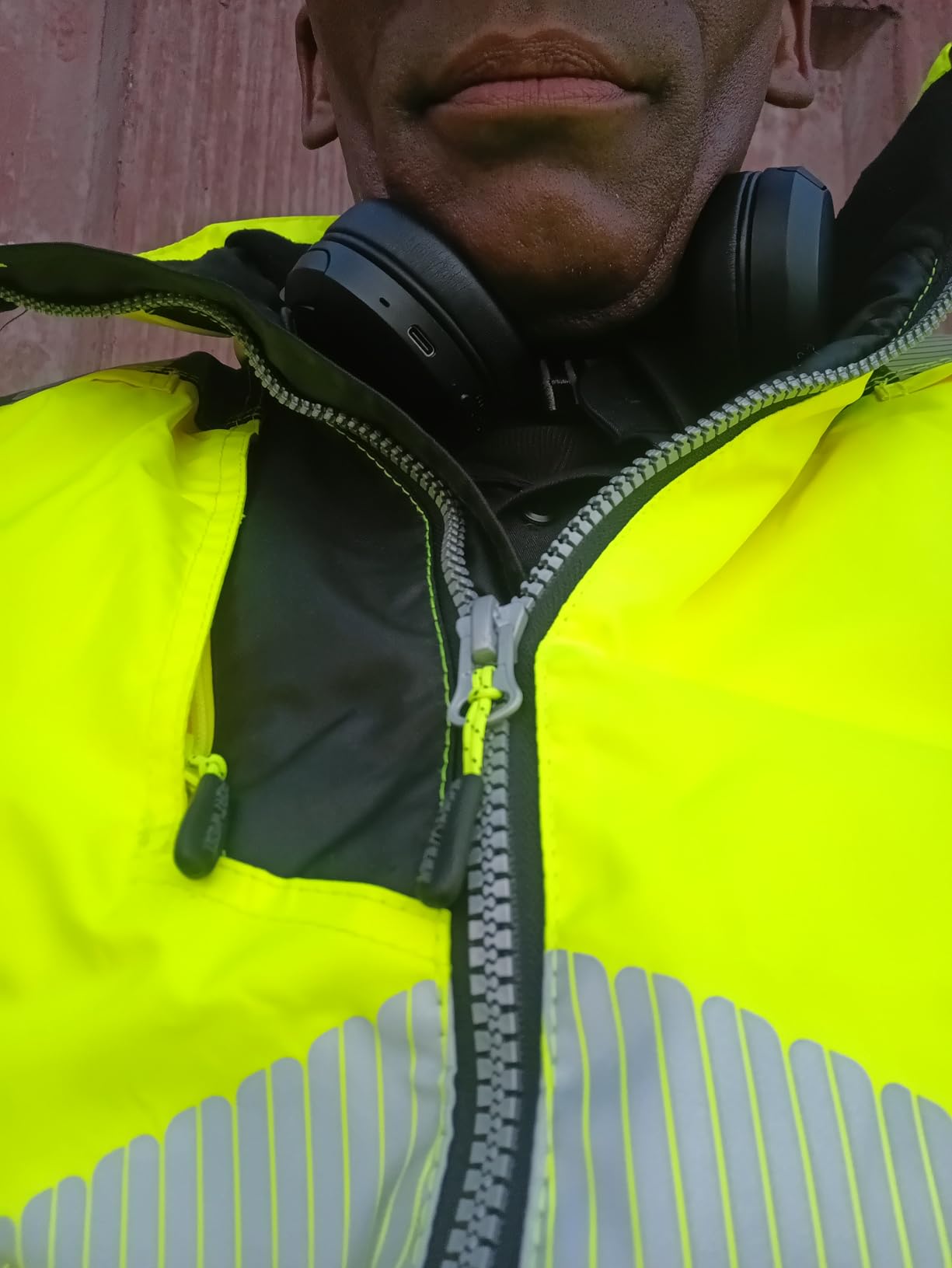
Portwest is a European safety brand, and this is the only jacket here that carries a full stack of international certifications on one garment: EN ISO 20471 Class 3, ANSI/ISEA 107:2015 Type R Class 3, and EN 343 Class 3:1 with a WP 15,000mm rating. If your organisation operates across both sides of the Atlantic, or your paperwork follows EN standards, that dual marking removes an entire category of compliance friction.
The build is 300 denier oxford weave polyester, PU coated, 190g with a stain-resistant finish, with 100 percent polyester 60g lining and 170g of polyester wadding as the fill. That is the heaviest stated fill in this roundup, and it is what makes it read as a proper winter coat rather than an insulated shell.
The Insulatex heat-reflective lining panel is an interesting piece of engineering. Rather than adding more insulation, it reflects body heat back toward you, which buys warmth without the bulk and weight of additional fill. Buyers single it out as a feature that works.
The HiVisTex Pro segmented tape is a higher specification than generic silver tape, and the Texpel finish means oil and grime wipe off rather than soaking in, which is the difference between a jacket that looks presentable in month six and one that does not. Five pockets include a concealed mobile phone pocket and quick-dry knitted cuffs.
The 4.0 rating is the lowest in this group and we would not paper over that. It sits alongside a stated care limit of 25 washes and an EN 343 classification of water resistant rather than fully waterproof, so if you are choosing on owner satisfaction alone, several jackets here outrank it.
Do I need the European certification if I work in North America?
Probably not, but the EN ratings still tell you something useful. EN 343 is a weather-protection standard with a published water penetration figure, so the WP 15,000mm mark is a concrete waterproofing number attached to a named test, which is more than most listings give you. EN ISO 20471 Class 3 is broadly equivalent in intent to ANSI Class 3.
The practical value is for multinational crews, contractors working on European-funded infrastructure, and anyone whose health and safety documentation was written against EN standards. In those situations, having both markings on the same garment is simpler than maintaining two jacket types.
Where the Portwest PW3 falls short?
The care instruction is the biggest practical limit: a maximum of 25 washes, and no bleaching, tumble drying, ironing, or dry cleaning. For a jacket worn daily on a winter site, 25 cycles is a short life, and the water-repellent finish will degrade before the fabric does. This is the strongest argument in the roundup for buying two jackets and rotating them, or for choosing a model with a higher wash allowance.
Its 4.0 rating, the lowest of the twelve, is the other one. Owners are generally positive about the build, but the consensus is less enthusiastic than the specification sheet suggests, and the sizing sits regular rather than generous.
We earn a commission, at no additional cost to you. CERTAIN CONTENT THAT APPEARS ON THIS SITE COMES FROM AMAZON. THIS CONTENT IS PROVIDED 'AS IS' AND IS SUBJECT TO CHANGE OR REMOVAL AT ANY TIME.
10. DPSAFETY ANSI Class 3 Hi Vis Parka – Best for Dirty Job Sites

DPSAFETY Hi Vis Safety Jacket, High Visibility Parka ANSI Class 3 (Lime,L)
★★★★★★★★★★300D rip-proof polyester shell
Wool lining
H-back 2 inch tape
Ansi Class 3
- Black lower panels and cuffs conceal soiling
- Eight pockets including ID and phone slots
- Wool lining for genuine warmth
- H-back reflective pattern for full body coverage
- Waterproof plus oil and grease resistant
- Loose fit will not suit everyone
- Newer brand with a shorter review record
- Only 252 owner ratings to judge from
For anyone working somewhere genuinely filthy, the black lower half and black cuffs are the feature that decides this one. Fluorescent yellow shows every splash of mud, and a jacket that looks ruined by week three changes how carefully people treat it. Contrast panels solve that, and this jacket pairs them with a wool lining, which is an unusual and genuinely warm choice.
The shell is 300 denier rip-proof polyester, described as waterproof, oil-resistant, and grease-resistant, which is a meaningful combination for automotive, maintenance, and workshop environments. Reflective coverage is 2 inch silver stripes in an H-back pattern running across the arms, chest, waist, and back, giving you continuous bands rather than isolated patches.
Eight pockets is a strong count for a parka, split across two inner chest pockets, two lower slant pockets, a right chest pocket, a cell phone pocket, a clear ID pocket, and two sleeve pen holders. The ID and phone separation is the part that matters on a site where you are constantly getting in and out of a vehicle.
It is offered as a loose fit and a long length, with an elastic waistband for warmth. Owners rate the wool lining, the black bottom, and the H-back reflectivity highly, and the brand backs the jacket with 60 days of free returns, which is helpful when you are buying a size run for a crew and fit consistency is the main risk.
Is a wool lining a good idea on a wet site?
Wool is excellent at holding warmth and it naturally resists odour, which on a long shift matters more than most buyers expect. It also absorbs moisture rather than wicking it, so a soaked wool lining will stay damp for a long time. If your exposure is heavy rain rather than mud and grime, a synthetic quilted or fleece liner dries far faster.
For the use case this jacket is actually specced for, dirt, oil, and slush, wool works well. It is worth knowing the trade-off before you commit to it for a rainy coastal site.
Where the DPSAFETY falls short?
Fit is the issue. A loose cut that works over a fleece or hoodie will swing on somebody who is wearing only a tee, and the listing does not offer a fitted option. If you are buying for a mixed crew, check the sizing on one person before ordering a run.
Second, the review base is 252 ratings, which is the thinnest evidence in this roundup against a 4.6 average. The rating is good, but it rests on fewer owners than the others here, so treat the score as encouraging rather than proven. We would want a second winter with it before recommending it for a full crew order.
We earn a commission, at no additional cost to you. CERTAIN CONTENT THAT APPEARS ON THIS SITE COMES FROM AMAZON. THIS CONTENT IS PROVIDED 'AS IS' AND IS SUBJECT TO CHANGE OR REMOVAL AT ANY TIME.
11. VENDACE Polar Fleece Hi Vis Winter Bomber – Best Lightweight Shell
VENDACE High Visibility Reflective Safety Jackets for Men Polar Fleece Lining ANSI Class 3 Hi Vis Winter Bomber Jacket Hoodie(Yellow,3XL)
★★★★★★★★★★300D oxford with PU coating
Polar fleece lining
H-back 2 inch tape
Ansi/ISEA 107-2020 Class 3
- Black lower half for contrast and stain protection
- PU coated 300D oxford resists wind and water
- Machine washable in cold water
- Runs true to size
- Black options available for low-light work
- Only two front pockets
- No stretch in the fabric limits mobility
- Lighter build than the parka options
The logic of this jacket is that not every winter shift needs a parka. Some days are cold and dry, you are walking rather than climbing, and a heavy coat makes you overheat within twenty minutes of moving. This one is a 100 percent polyester 300 denier oxford outer with a PU coating, a polar fleece lining, and 2 inch silver reflective stripes in an H-back pattern, carrying full ANSI/ISEA 107-2020 Class 3 and Level 3 compliance.
It is classified as a lightweight fabric class, and the reviews are unusually consistent: 80 percent five-star and 14 percent four-star feedback, with only 2 percent one-star. That consistency is what you want from a garment whose main risk is that it is not warm enough, and the reviewers say it handles frigid conditions well for its weight.
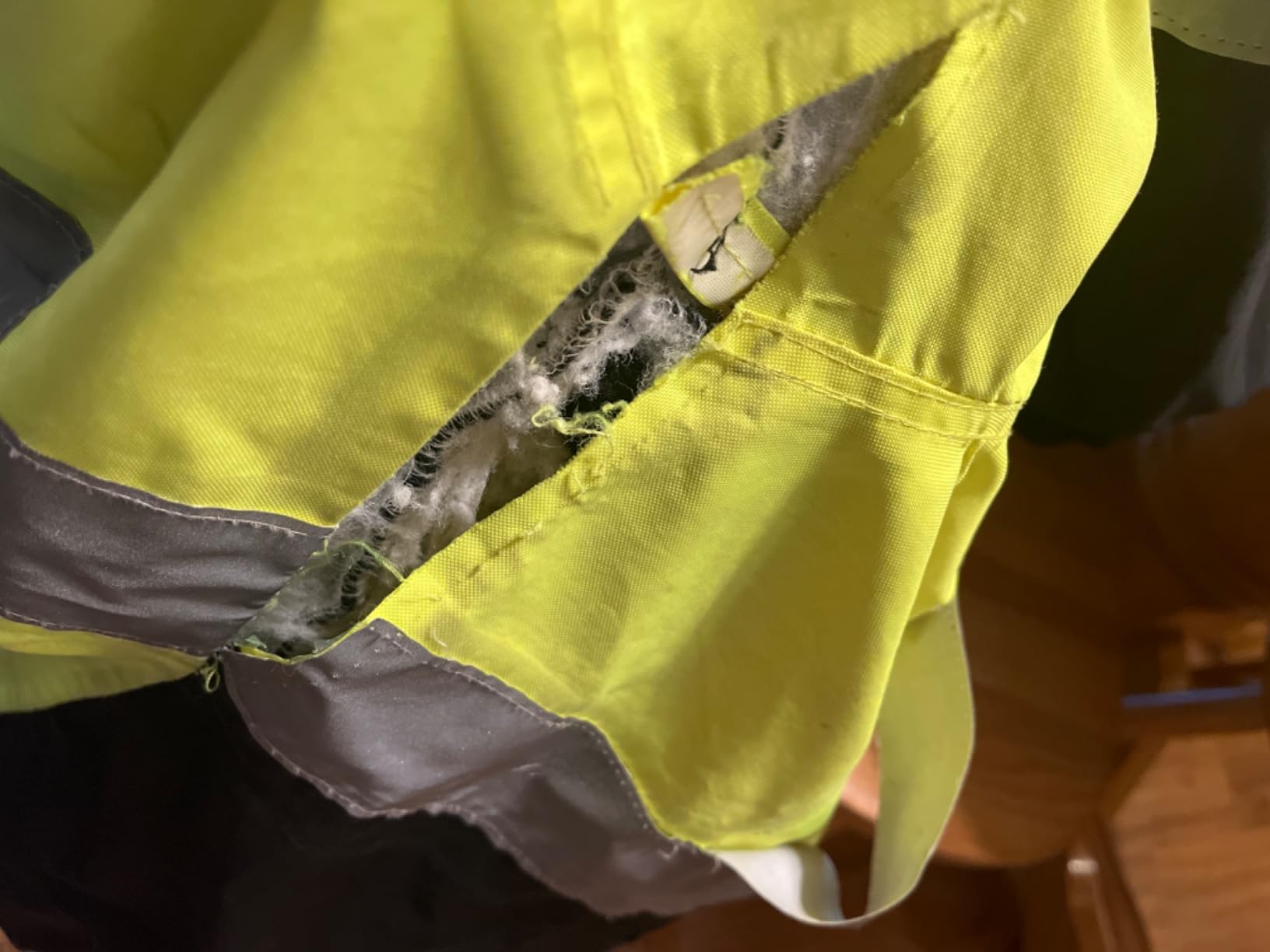
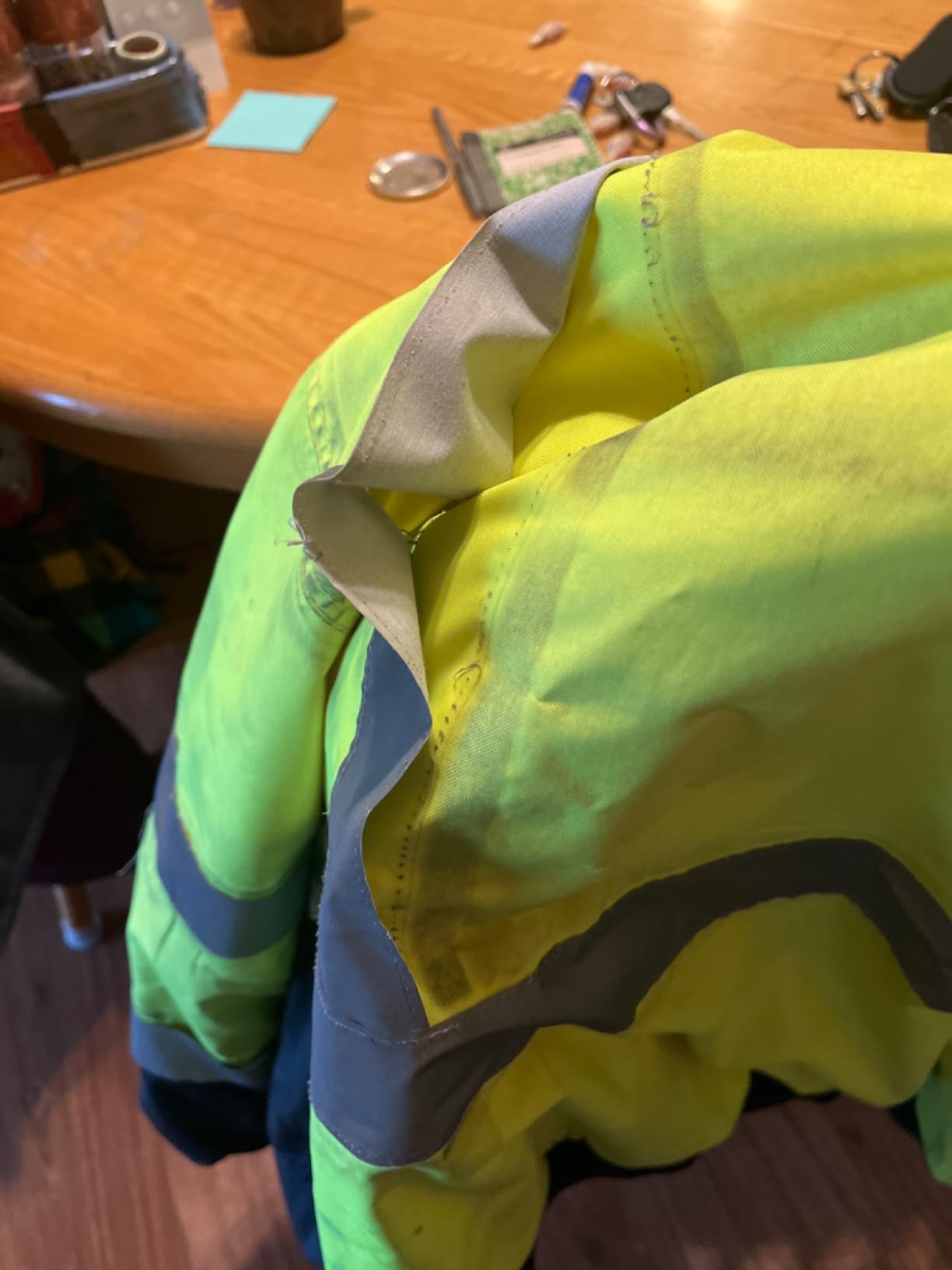
The black lower half does double duty as stain protection and as a contrast panel, which improves how the wearer reads against a dark background at night. Machine wash cold water care is a genuine advantage over the hand-wash-only models, and it means you can rotate a jacket through a normal laundry routine rather than dedicating a person to it.
The stated use list runs from construction, survey, and contractors through emergency responders, forestry, police, security, and traffic attendants, to cycling, hunting, running, and motorcycle use. That range is credible for a jacket with this specification rather than marketing filler, and it makes the model a reasonable crossover if you wear the same garment on and off site.
When is a lightweight Class 3 jacket the right call?
When you are active rather than stationary, and when the weather is cold but dry. A PU-coated 300D shell with a fleece lining handles wind well and sheds light rain, and because the fabric is light you can put it on over a mid layer without the bulk that slows you down. It is also the easiest of the twelve to wear in a vehicle, which matters if you are in and out all day.
It is the wrong call for a still, windy, subzero shift where heat loss is driven by wind exposure rather than activity, and for anyone who needs the garment to double as outerwear in sustained rain, since there is no stated millimetre rating.
Where the VENDACE falls short?
Two front pockets is all you get, and there is no ID pocket, no mic tab, and no radio storage mentioned. If you carry a phone and a radio on a shift, that single fact disqualifies it for your use no matter how well it performs otherwise.
The fabric has no stretch, and reviewers point out that this limits movement compared with a softer shell. It runs true to size, which is welcome, but combined with no give in the material it is a jacket that fits precisely once and does not accommodate a layer change underneath.
We earn a commission, at no additional cost to you. CERTAIN CONTENT THAT APPEARS ON THIS SITE COMES FROM AMAZON. THIS CONTENT IS PROVIDED 'AS IS' AND IS SUBJECT TO CHANGE OR REMOVAL AT ANY TIME.
12. Portwest T400 Hi-Vis Winter Jacket – Best for Wet Climates

Portwest Hi-Vis Winter Jacket T400
★★★★★★★★★★Double PU coated 300D oxford
Seven pockets
Hand wash only
50 wash maximum
- Double PU coating sheds heavy rain
- Seven pockets for tool and phone storage
- Two tone orange and dark navy colourway
- True to size with a modern fit
- Buyers report durable wear resistant construction
- Lining is thinner than a true parka warrants
- Hand wash only with no tumble dry or iron
- Sizing runs slightly large for some
The T400 is the rain answer. Its shell fabric is 300 denier oxford weave in 100 percent polyester with a stain-resistant finish and, critically, a double PU coating, which is the most aggressive waterproofing treatment specified on any jacket in this roundup. It is rated waterproof rather than water resistant, and European buyers describe it as genuinely effective at keeping out heavy rain.
Seven pockets make it the most storage-capable jacket here, and the two-tone orange and dark navy colourway improves contrast against both light and dark backgrounds, which is why road crews and railway workers like it. Buyers also comment that the build holds up to harsh work conditions and that several of them rate it above what the photographs suggest.
Fit is reported as true to size with a modern cut, and the weight is 1.34 kg, which is substantial for a jacket and consistent with a double-coated shell and a full pocket load. Expect it to feel like workwear rather than a lightweight layer, which is appropriate given how it is meant to be used.
Its 4.4 rating sits in the middle of this group, and the reason is clear from the reviews. People like how rugged and weatherproof it is, and a minority describe the lining as thinner than they expected for a jacket of this type, calling it a regular winter jacket rather than a heavy parka.
Does double PU coating actually matter?
It is a second layer of polyurethane on the face of the fabric, and it pushes the water resistance of the shell well past what a single coating gives you. For a crew working in coastal rain, on a highway through a winter storm, or anywhere the jacket will be genuinely wet rather than damp, that extra layer is the difference between staying dry and being wet from the shoulders down.
PU coatings do have a downside, which is why the care instruction here is strict: hand wash only, no tumble drying, no ironing, no dry cleaning, drip line dry, with a maximum of 50 washes. Heat and solvents attack the coating, so the jacket stays in excellent condition if you respect that and degrades quickly if you do not.
Where the Portwest T400 falls short?
The lining. Multiple buyers specifically note that it is thinner than expected for what is positioned as a winter parka, and that is the main reason the rating is not higher. If you are in sustained cold as well as rain, you will want to layer a fleece underneath, and you should expect to do so regularly.
Sizing also runs slightly large for a portion of buyers, and the hand-wash-only care is a real operational constraint for a crew that washes jackets weekly. Neither is a dealbreaker, but both are worth knowing before you standardise on it across a team.
We earn a commission, at no additional cost to you. CERTAIN CONTENT THAT APPEARS ON THIS SITE COMES FROM AMAZON. THIS CONTENT IS PROVIDED 'AS IS' AND IS SUBJECT TO CHANGE OR REMOVAL AT ANY TIME.
How to Choose a Hi Vis Winter Jacket That Is Actually Winter Rated?
Most of the disappointment in this category comes from buying on colour and the word winter. Here is how to read a listing like a spec sheet instead of a catalogue entry.
Look for a stated temperature rating or a published insulation weight
A real winter jacket gives you one of two things: a manufacturer temperature rating, like the -55°F / -48°C figure printed on the Ergodyne 8384, or a published fill weight, like the 170g wadding in the Portwest PW3 or the 160g fleece in the TICONN. If a listing offers neither, you are being asked to guess, and the r/Construction poster asking for something that is actually a winter jacket was reacting to exactly that gap.
As a rough guide for planning: light quilted or thin fleece suits roughly to 14°F, a mid-weight quilted or full fleece layer to around 0°F, and a heavy fill or down construction below that. If you work in one climate all winter, match the jacket to your actual low, not to the coldest day anyone in your crew has ever complained about.
Check the ANSI class, and check the tag
ANSI/ISEA 107 sets three classes. Class 1 is for indoor work and low-risk conditions. Class 2 covers roads with traffic up to roughly 45 miles per hour and requires at least 1,000 square inches of background fabric. Class 3 is for high-speed roads above 45 miles per hour and requires at least 1,240 square inches of fluorescent background material plus 2 inch retroreflective bands on arms, torso, and legs.
If your work touches a highway, a railway, or a high-speed road, you need Class 3. Class 2 is not sufficient for highway work regardless of how bright the garment looks in a photograph, and this is the single most common compliance mistake we see in listings that claim high visibility without naming a class.
To verify a jacket before you buy it, check five things. First, look for a printed ANSI/ISEA 107 class marking on the product, not just a description. Second, look for the Type R or Type P mark, which tells you the garment is rated for road work or public safety. Third, confirm the reflective tape is 2 inch wide and runs continuously around the torso and both arms. Fourth, count the background fabric area against the 1,000 or 1,240 square inch threshold for the class. Fifth, for international work, check whether EN ISO 20471 is also marked. A jacket that is only bright yellow and has no class marking is not a certified garment, however good the photograph looks.
Decide between waterproof and water-resistant, and read the millimetre figure
Waterproofing is measured as a water column in millimetres that the fabric holds before it leaks. Anything around 3,000mm handles drizzle and brief showers. 6,000mm, as specified on the SKSAFETY, handles sustained rain. The EN 343 WP 15,000mm figure on the Portwest PW3 is a serious rain specification, and the double PU coat on the Portwest T400 is in the same category. A jacket with no stated figure should be assumed to be water-resistant only, regardless of how waterproof the description claims it is.
Seams matter as much as the face fabric. A 6,000mm shell with unseamed shoulders will leak through the stitching before it leaks through the cloth, so look for taped or heat-sealed seams, which is a specification the heated Pioneer bomber makes explicitly.
Size up if you layer, and test it with the layers you will actually wear
Most hi vis winter jackets are cut close so the reflective tape sits in the right place, which is the opposite of what you want when you plan to wear a hoodie underneath. Buy for the layers you will genuinely wear, and if you are between sizes, take the larger one. Over-sizing the chest and arms is a much smaller problem than a jacket that will not close over a fleece.
Pay attention to shoulder mobility rather than chest measurement. If you cannot reach overhead without the hem lifting, the jacket is too small for real work, regardless of what the size chart says. A jacket that rides up at the waist also opens a cold gap at the lower back when you are bent forward, which is where several of the jackets in this roundup lose points.
For a crew, the layering question also becomes a consistency question. Pick one model, order a proper size run, and test it on the person with the most and the least clothing under it. Jackets that fit a medium with a tee will not fit a medium with a fleece, and a mismatched team is a compliance problem as much as a comfort one.
Match the jacket to the weather, not to the season
For cold and dry conditions, a bomber with a fleece or mid-weight quilted fill is the right tool, and the VENDACE or the SKSAFETY cover it well. For wet and mild conditions, waterproofing beats insulation, and the double-coated Portwest T400 or the heated Pioneer bomber are the ones to shortlist. For extreme cold with long stationary shifts, a stated temperature rating matters more than anything else, which puts the Ergodyne 8384 at the front.
For crews moving between indoor and outdoor, a removable liner is the efficient answer because one jacket covers a wider temperature band. The Pyramex RJ31 is built exactly for that. And for anyone splitting shifts between a bike and a site, heated panels change the equation in a way that fixed insulation cannot, provided you already carry a power bank.
If you are building a full winter system rather than a single jacket, our guides to cycling jackets and motorcycle jackets cover the outer layers that go over or under a hi vis piece, and pairing a jacket with matching hi vis trousers and headwear is what makes a winter system work rather than just a warm torso.
How to Wash a Hi Vis Winter Jacket Without Ruining the Reflective Tape?
Reflective tape is the most fragile part of the entire garment, and it is the part you cannot replace without replacing the jacket. Washing it badly shortens the service life of the whole coat, and the wash limits printed on the Portwest PW3 and the Portwest T400 are not marketing conservatism. Here is the sequence we would follow.
Five steps that keep the tape intact
1. Read the care label first and follow it literally. The two Portwest jackets in this roundup specify 40°C mild process, no bleaching, no tumble drying, no ironing, and no dry cleaning, with wash ceilings of 25 and 50 cycles respectively. Those limits are calculated to protect the coating and the tape, and exceeding them is the most common way a good jacket is ruined.
2. Close every velcro tab and zip every zip before washing. A velcro tab left open will catch the reflective tape and peel its edges during the wash cycle. This is the most common and most preventable cause of tape damage we see.
3. Use a mild detergent and skip the bleach entirely. Bleach attacks the fluorescent pigment, which is what makes the fabric visible in daylight, and it dulls the retroreflective layer. If a jacket has come out of a job covered in oil or road grime, spot-clean it instead of soaking the whole garment.
4. Wash cool and skip the dryer and the iron. Heat is the enemy of both the tape and any PU coating. Line dry or drip dry, ideally in shade, since direct sun degrades fluorescent pigment over time. If a jacket is genuinely too big to dry without a tumble dryer, use a no-heat or air-only setting on a gentle cycle.
5. Inspect the tape dry, every single time. Once the jacket is dry, run a finger along each reflective band. Edges lifting, a cloudy or milky surface, or a band that no longer returns light are all signs the tape is done. Replace the jacket before it fails an inspection rather than after.
Know when the jacket has to go, not just when it looks old
Fluorescent fabric fades before reflective tape fails, and the fade is gradual enough that you stop noticing. A practical rule is to check the colour against a new jacket in daylight every few months, and to treat any measurable fading on the chest and shoulders as a replacement trigger rather than something to wait out.
For tape, the test is at night. Stand at a distance in headlights, or use a phone flashlight at a low angle from where a driver would be. If a band reads dull, patchy, or inconsistent compared with the rest, treat that band as failed. Replace the jacket if two or more bands are affected, since partial replacement is not possible.
Washing frequency matters too. A jacket worn daily on a wet site should be washed far less often than one worn occasionally, and spot-cleaning between washes extends both the tape and the PU coating. For most crews, alternating two jackets and washing each weekly extends the life of both considerably compared with washing one jacket daily.
Frequently Asked Questions
What ANSI class do I need for winter road work?
For highway work or any road with traffic above roughly 45 miles per hour, you need ANSI/ISEA 107 Class 3. Class 3 requires at least 1,240 square inches of fluorescent background fabric plus 2 inch retroreflective bands on the arms, torso and legs. Class 2 covers lower-speed roads and requires 1,000 square inches of background fabric. Class 1 is intended for indoor and low-risk settings. Winter weather does not change the class requirement, but it does make the class more important, because drivers have less stopping distance in the wet and dark.
Is a Class 2 hi vis jacket good enough for highway work?
No. Class 2 is designed for roads with traffic up to roughly 45 miles per hour and does not meet the requirements for high-speed highway work. If your work is on or beside a highway, you need a Class 3 garment carrying at least 1,240 square inches of fluorescent background material and 2 inch retroreflective bands providing 360-degree visibility. Many site safety policies go further and require Class 3 for all site personnel regardless of proximity to traffic.
How do I keep reflective tape from fading or peeling in the washer?
Close every velcro tab and zip every zip before washing, use a mild detergent, and never use bleach, a tumble dryer, or a hot iron. Wash at 30 to 40 degrees on a mild cycle and line dry in shade, because heat and bleach degrade both the fluorescent pigment and the retroreflective layer. If you notice a band lifting at the edge, stop washing that jacket and replace it, because peeling tape will worsen with every cycle and there is no way to repair it in the field.
Is hi vis clothing required by OSHA?
Yes. Under OSHA’s personal protective equipment standards, employers are required to assess whether workplace hazards require high-visibility clothing and to provide it at no cost to the employee. In practice, the specific class required is usually set by the site, the client, or the state rather than by OSHA itself, which is why road and construction sites typically specify ANSI/ISEA 107 Class 3 in their safety plan. If you are unsure what your site requires, ask for the written requirement rather than assuming.
What insulation is warm enough for sub-zero weather?
For stationary outdoor work in sub-zero conditions, look for a stated manufacturer temperature rating or a published fill weight of around 160g of quilted insulation or more. The Ergodyne 8384 in this roundup carries a printed -55F rating with 160g of thermal quilted fill, and the Portwest PW3 uses 170g of polyester wadding with a heat-reflective lining panel. Fleece or heated panels are better suited to active work where you generate your own heat than to standing still in wind.
Should I size up to layer a hoodie or fleece underneath?
Yes, if you plan to wear a hoodie or fleece under your hi vis winter jacket. Most safety jackets are cut close so the reflective tape sits in the correct place on the body, which leaves no room for layers. If you are between sizes, take the larger one and check that you can reach overhead without the hem lifting, because a jacket that rides up at the waist opens a cold gap at the lower back when you are bent forward. Over-sizing the chest and arms is far less of a problem than a jacket that will not close over a fleece.
Are hi vis winter jackets waterproof or just water resistant?
Both exist in this category, and the difference matters in sustained rain. Water resistance is a surface treatment that sheds drizzle and brief showers, while waterproof shells are specified with a water column rating measured in millimetres. Around 3,000mm handles light rain, 6,000mm as on the SKSAFETY handles sustained rain, and 15,000mm under EN 343 as on the Portwest PW3 is a serious specification. If a listing gives no millimetre figure, assume water-resistant and check whether the seams are taped or heat-sealed.
How long does a hi vis jacket last before it needs replacing?
It depends on wash frequency, exposure, and how you care for it rather than on any fixed date. The most useful published figures are wash ceilings: the Portwest PW3 is rated for a maximum of 25 washes and the Portwest T400 for 50, so a jacket washed weekly in a harsh environment will be near the end of its tape life within a year. In practice, replace a jacket when the fluorescent colour has visibly faded or when two or more reflective bands read dull or patchy at night, because partial tape replacement is not possible.
Conclusion: Which Hi Vis Winter Jacket Should You Buy?
If you want one jacket that covers most cold-weather jobs, take the Pyramex RJ32, and size up one or two sizes if you plan to layer underneath it. If you are working at genuinely extreme cold and need a figure you can plan against, the Ergodyne 8384 is the only one here with a printed temperature rating. If you spend your shift in the rain, the double-coated Portwest T400 or the heat-sealed Pioneer heated bomber will keep you drier than anything else in the group.
For crews, standardise on one model rather than mixing, test the fit on your warmest and coldest layering, and remember that the best hi vis winter jacket is the one you can still see at 200 metres on a wet night in three years. The softshell jacket comparison is worth a look if you need something lighter for shoulder season while you keep the hi vis layer for compliance days.