
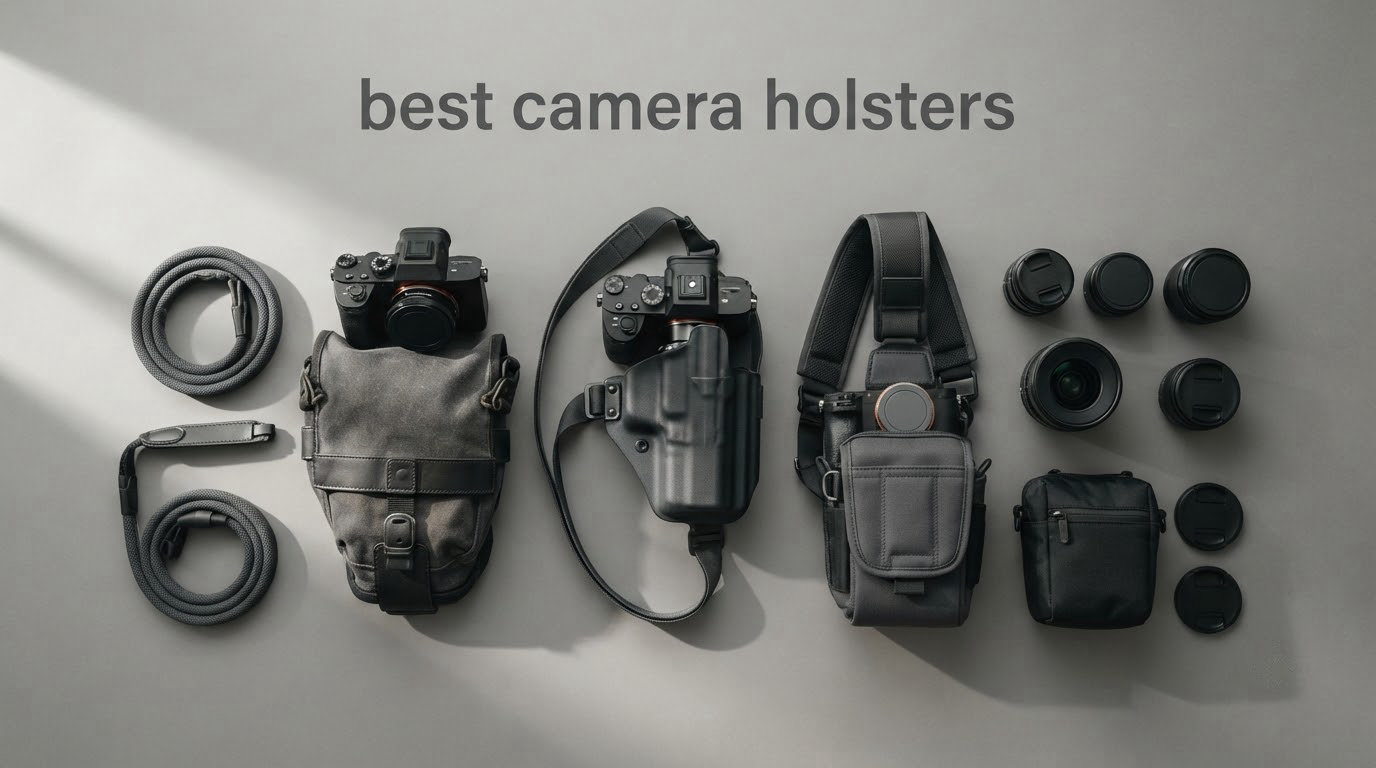
A camera holster looks like a trivial purchase until you load your actual kit into it. Then you find out the body does not clear the grip, the strap you planned to hang it on is too narrow for the clamp, or the whole thing swings into a wall every time you turn. Those are the three failures that show up again and again in photographer forums, and they are the reason most holster roundups disappoint.
So this guide treats the best camera holsters as a fit problem rather than a brand problem. We looked at six carries that each solve a different version of the problem, from a rigid strap clip that mounts to an existing backpack or belt, to padded toploader slings for travel, to a chest harness for two-body work. Every pick below comes with its published weight, dimensions, capacity figure and mounting standard, because those are the numbers that tell you whether your body and lens will actually fit before you spend an afternoon returning something.
We also weighed the questions the forums keep asking and the editorial pages keep skipping: does the holster take an Arca-Swiss plate, what is really in the box, and what happens when your heaviest lens is a 200-500mm class telephoto rather than a pancake. Short answer on that last one: payload math beats brand loyalty every time. For a starting point on which body you are carrying, our [mirrorless camera guide](https://bansocialism.com/best-mirrorless-cameras/) is worth a look before you size anything.
Table of Contents
- What Is a Camera Holster?
- Top 3 Best Camera Holsters (October 2026)
- Best Camera Holsters at a Glance in 2026
- How We Picked?
- Top Camera Holsters by Type
- 1. Peak Design Capture Clip V3 – The Best All-Around Camera Holster
- 2. USA Gear Top-Loading DSLR Sling – Best Value
- 3. PGYTECH Beetle Camera Clip – Premium Pick Clip
- 4. Ape Case Small SLR Holster Bag – Best for Hiking
- 5. VidPro TL-35 Top-Load Holster Case – Best Street Toploader
- 6. FOMITO Dual Camera Chest Harness – Best for Two Bodies
- How to Choose a Camera Holster?
- Arca-Swiss Plate Compatibility
- Holsters for Heavy Telephoto and Gripped Bodies
- Frequently Asked Questions
- Final Verdict
What Is a Camera Holster?
A camera holster is a belt, strap or chest-mounted carrier that holds a camera body so it can be drawn and holstered in one motion, taking weight off your neck and shoulders and giving faster access than digging through a bag. The body usually screws onto a small mounting plate or clips into a ball-and-socket connector, and the holster arm locks that connector in place so a single lever or pin pull releases it one-handed.
The term covers four quite different products, and confusing them is the source of most bad buys:
Strap or belt clip – an open frame that grips an existing shoulder strap, backpack strap or belt, and carries the body in mid-air. Fastest to load, least protective.
Padded toploader sling – a closed bag that hangs from a strap and belt loop. The most protective option, and the only one that shields the body from rain and knocks.
Belt holster – a closed case with a belt loop that sits flat against the hip. Discreet, stable, and slow to draw from.
Chest harness – a vest with two mounts that carries bodies in front of the torso. Best for two bodies, awkward to load in a car.
Top 3 Best Camera Holsters (October 2026)
These three cover the widest spread of real shooting situations, and between them they handle everything from a hiking day to a wedding floor. Details for every pick are below.

Peak Design Capture Clip V3
- Holds over 200 lbs of force
- All-metal body at 5.1 oz
- Straps up to 2.5 inch wide
- Includes Arca-compatible plate

USA Gear Top-Loading Sling
- Top-load camera access
- 7.5 x 6.25 x 5.5 inch interior
- Belt loop and shoulder strap
- Rain cover included

PGYTECH Beetle Camera Clip
- 93 g aluminum body
- 25 kg max capacity
- Arca-Swiss compatible plate
- Fits straps to 2.95 inch
Best Camera Holsters at a Glance in 2026
All six carries in this guide, side by side. Use the capacity and mounting columns first; the fit failures almost always come down to one of those two.
| Product | Key Specs | Pricing |
|---|---|---|
| Peak Design Capture Clip V3 |
|
Check Latest Price |
| USA Gear Top-Loading DSLR Sling |
|
Check Latest Price |
| PGYTECH Beetle Camera Clip |
|
Check Latest Price |
 Ape Case Small SLR Holster Bag Ape Case Small SLR Holster Bag |
|
Check Latest Price |
 VidPro TL-35 Top-Load Holster Case VidPro TL-35 Top-Load Holster Case |
|
Check Latest Price |
 FOMITO Dual Camera Chest Harness FOMITO Dual Camera Chest Harness |
|
Check Latest Price |
How We Picked?
Six products survived our filters, and we kept the list short on purpose. A twelve-item roundup in this category is mostly padding, because the genuine decision is which architecture fits your kit, not which brand is newest. Here is what we judged, in the order we judged it.
Payload against rated load. A holster’s stated capacity is a force or weight figure; your actual load is body plus lens plus battery. We only recommended clips and holsters whose published rating clearly exceeds the kits they are advertised for, and we called out the ones whose interior dimensions will not clear a long zoom.
Mounting standard. An Arca-compatible plate is the closest thing the photo world has to a universal standard, and it decides whether a holster plays nicely with the rest of your kit. Two of the six picks ship with one.
Access speed and re-holster security. A carrier that is quick to draw but fiddly to put back is worse than useless on a wedding floor. We favoured single-motion mechanisms, and we noted where drop security is a positive lock rather than a friction fit.
Protection and weather. Open clips are fast but expose the body. Padded bags cost you a few seconds. That trade is fine for hiking and bad for a crowded venue, so we flagged it rather than picking a winner.
What is actually in the box. Several systems in this category are incomplete purchases unless you add a plate, a pin and a belt. We note the extras so the total system is clear.
A note on method: this is a research-based guide built from published specifications, manufacturer documentation and owner feedback in photography forums. We have not measured each product in a lab, and we do not claim to have. Where owners report long-term behaviour, we say so and name the source thread.
Top Camera Holsters by Type
Matching the holster to the carry is faster than comparing brands. Here is how the six split by type.
Strap and backpack clips
The Peak Design Capture Clip V3 wins the clip category because it is the only open-frame carry here that ships an Arca-compatible tripod plate, holds over 200 lbs of force, and weighs 5.1 ounces. The PGYTECH Beetle is the alternative if you want a wider strap range, since its clamp takes straps up to 2.95 inches wide and 15 mm thick, and its 25 kg maximum capacity is plenty for a mirrorless kit.
Padded toploader slings
The USA Gear top-load sling is the pick here for travel, with a padded interior, a 7.5 x 6.25 x 5.5 inch compartment, a belt loop as well as a shoulder strap, and a rain cover in the box. For a body with a medium-to-long zoom already attached, the VidPro TL-35 is the more honest fit, because its 6.5 x 8.5 x 5 inch interior and molded hard base were built for exactly that shape.
Belt holsters
The Ape Case small SLR holster wins the belt-holster slot because it is one of the few closed cases here that is genuinely small enough to sit inside a daypack while still having a belt loop and a retractable rain cover. It is a one-lens carry, and that limitation is the reason it sits lower in this list rather than higher.
Chest harnesses
The FOMITO dual camera harness is the only chest rig in this lineup, and it takes two bodies on 1/4 inch screw mounts with a locking quick release. It spreads weight across the chest and stops the swinging that ruins frames, which is the specific complaint that drives people off neck straps in the first place.
1. Peak Design Capture Clip V3 – The Best All-Around Camera Holster
Peak Design Capture Camera Clip V3, Black with Plate, Holds DSLR, Compact and Point and Shoot Bodies, Secure, Stable and Accessible, Attaches to Straps and Belts, Quick Release, 200 lb Capacity
★★★★★★★★★★Holds over 200 lbs of force
5.1 oz all-metal body
Arca-compatible plate included
- Rigid stable hold on backpacks belts and straps
- Holds over 200 lbs of force
- All-metal build at only 5.1 ounces
- Lockable quick-release button
- Includes an Arca-compatible tripod plate
- Strap clamp limited to 2.5 inch width
- Needs an existing strap or belt to mount to
- No storage of its own for accessories
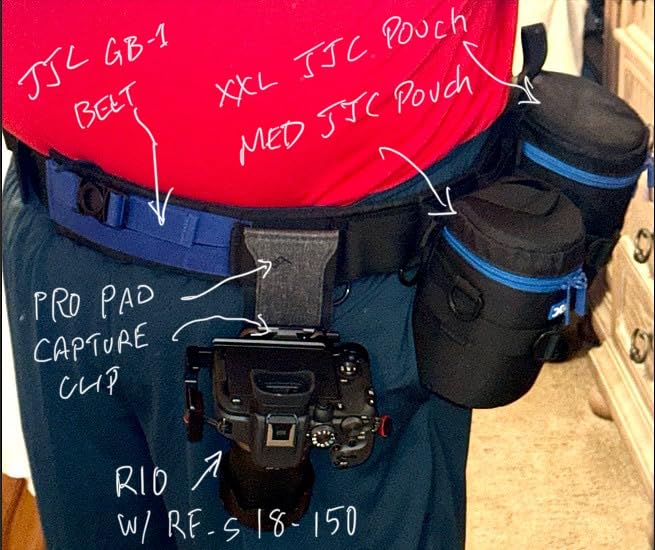
This is the carry we end up recommending to people who ask for one answer. It does not protect the camera from weather and it does not hold a second lens, but it solves the thing most people are actually complaining about, which is weight on the neck and slow access. At 5.1 ounces the clip itself disappears, and the published hold figure of over 200 lbs of force is far more headroom than any mirrorless kit needs.
The mechanism is the part that matters. A single quick-release button pops the camera off the plate, and that button can be locked, so a squeeze in a crowd does not dump a body on the pavement. Forum owners consistently describe the hold as rigid rather than merely secure, which is the difference between a clip that stays put and one that slowly rotates while you walk.
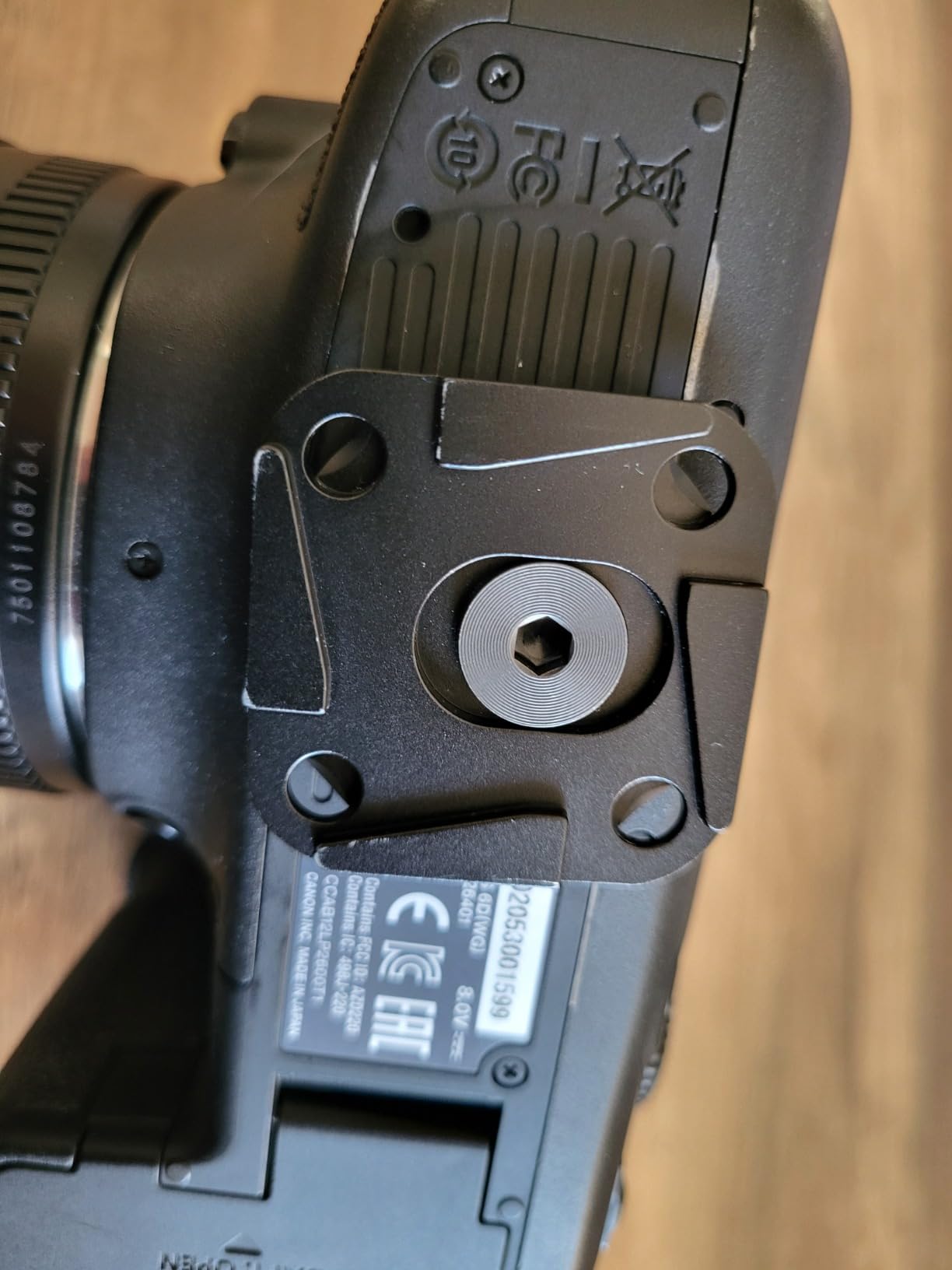
It comes with an Arca-compatible tripod plate in the box, which is genuinely rare in a clip at any level and saves you a second purchase. The body can also mount into other Peak Design systems, so if you later add a lens or accessory mount you are not starting over.
Two constraints are worth knowing before you commit. The clamp fits straps up to 2.5 inches wide, so a narrow camera strap is out unless you change it, and the clip has no storage of its own, which means cards and batteries still live in a pocket or a pouch. Neither is a dealbreaker; both are planning items.
Who the Capture Clip suits?
It suits anyone already wearing a backpack or a belt, which in practice is most working photographers. The flat mounting position means the camera does not swing into walls or other people, so it works at crowded events and on trails. It is also the easiest option to pair with a second body if you own two clips.
Who should skip it?
Skip it if you shoot in rain without a rain shell on the body, or if you need somewhere to put spare batteries and cards. If your only carry is a bare shoulder strap narrower than 2.5 inches, you will need a wider strap or a different system entirely. For our full comparison of entry-level bodies worth pairing with it, see our [backup camera picks](https://bansocialism.com/best-backup-cameras/).
We earn a commission, at no additional cost to you. CERTAIN CONTENT THAT APPEARS ON THIS SITE COMES FROM AMAZON. THIS CONTENT IS PROVIDED 'AS IS' AND IS SUBJECT TO CHANGE OR REMOVAL AT ANY TIME.
2. USA Gear Top-Loading DSLR Sling – Best Value
USA Gear DSLR Camera Case for Men and Women with Top Loading Accessibility, Adjustable Shoulder, Small Camera Sling Bag, Travel Padded Handle – Camera Holster Bag for Nikon, Canon, Panasonic (Black)
★★★★★★★★★★Top-load camera access
7.5 x 6.25 x 5.5 inch interior
10.08 oz body
Belt loop and shoulder strap
- Top-loading design for fast retrieval
- Padded interior with adjustable divider
- Adjustable shoulder strap plus belt loop
- Netted exterior pockets for small gear
- Rain cover and 3-year warranty included
- Interior is snug for larger long-zoom kits
- Top accessory sleeve does not close securely
- Rain cover is bulky to fit over the bag
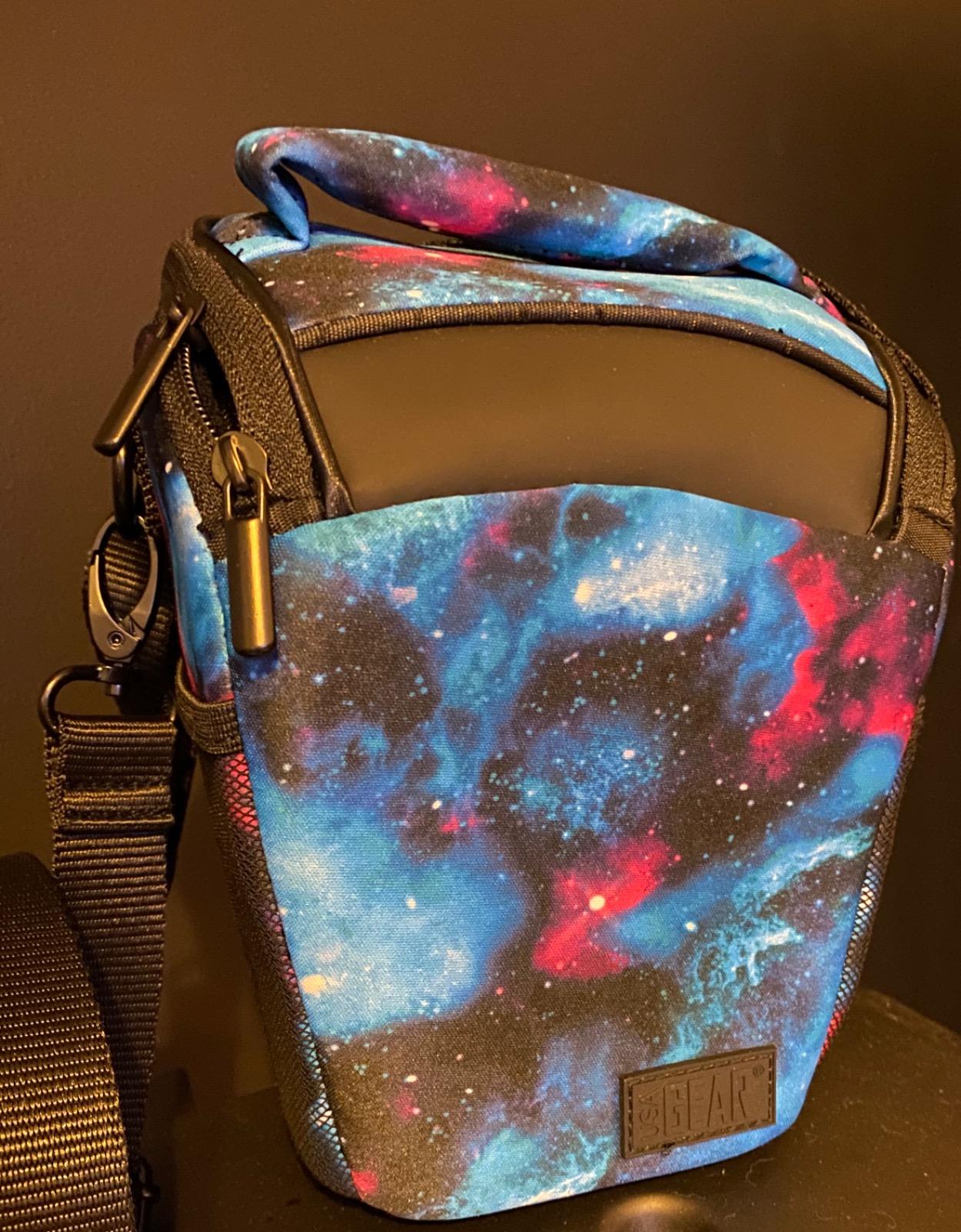
This is the option to take on an aeroplane. The top-loading design means you open the flap and the camera is in your hands, rather than digging to the bottom of a closed compartment, and the padded interior with an adjustable divider holds a body plus a moderate zoom without rattling around. It weighs 10.08 ounces and measures 8 x 7.25 x 6 inches, which is small enough to count as personal item on most carriers.
Carrying options are unusually flexible for a bag this size. There is an adjustable shoulder strap, a padded hand strap, and an integrated belt loop, so you can switch from crossbody for walking to belt-mounted for queues without unpacking anything. Two stretchy netted exterior pockets take lens caps, a phone or a cleaning cloth.
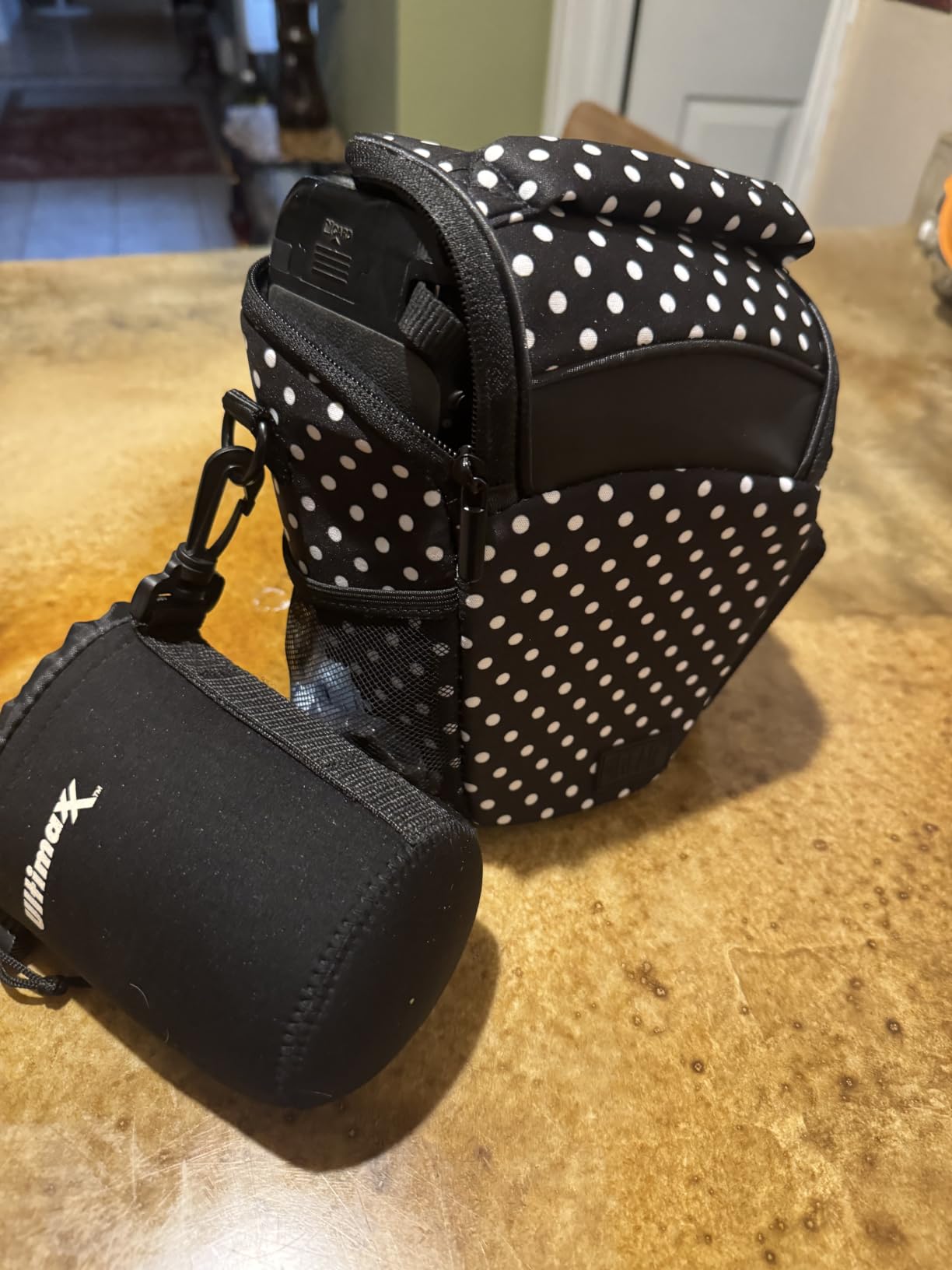
The protection is real rather than nominal, and that is the reason it beats a bare clip on a trip. It is water resistant, it includes a rain cover, and the 3-year manufacturer’s warranty is longer than most bags in this category offer.
The recurring complaint is fit, and it is worth planning around. Reviewers report the interior is snug, and a body with a long zoom attached will not clear the 7.5 x 6.25 x 5.5 inch compartment. Measure your lens before you order, and if you are packing a telephoto, look at a larger toploader instead. The top accessory sleeve also does not close reliably, so keep anything important in your bag rather than in it.
Who the USA Gear sling suits?
It suits travel, street work and anyone shooting where weather is a factor. The belt loop makes it practical for walking tours, and the top-load access suits street photography where the frame is decided in a couple of seconds. It also works as a secondary bag inside a larger pack.
Who should skip it?
Skip it if your everyday lens is a 70-200mm or a 100-400mm class zoom, because the interior will not clear them. It is also a single-lens carry with no room for a second body or a flash, so two-body shooters should look at the harness further down. Our [vlogging camera guide](https://bansocialism.com/best-vlogging-cameras/) covers the lightweight bodies that pair well with a bag this size.
We earn a commission, at no additional cost to you. CERTAIN CONTENT THAT APPEARS ON THIS SITE COMES FROM AMAZON. THIS CONTENT IS PROVIDED 'AS IS' AND IS SUBJECT TO CHANGE OR REMOVAL AT ANY TIME.
3. PGYTECH Beetle Camera Clip – Premium Pick Clip
PGYTECH Beetle Camera Clip with Plate Quick Release System Backpack Clip
★★★★★★★★★★93 g aluminum body
25 kg max weight capacity
Fits straps to 2.95 inch
Arca-Swiss compatible plate
- Aluminum alloy body at just 93 g
- Arca-Swiss compatible mounting plate
- Camera mounts in any orientation
- Anti-slip rubber lining grips the strap
- Quick lock and release with no buttons to press
- Not water resistant
- Strap width limited to 75 mm and thickness to 15 mm
- Single camera with no accessory storage
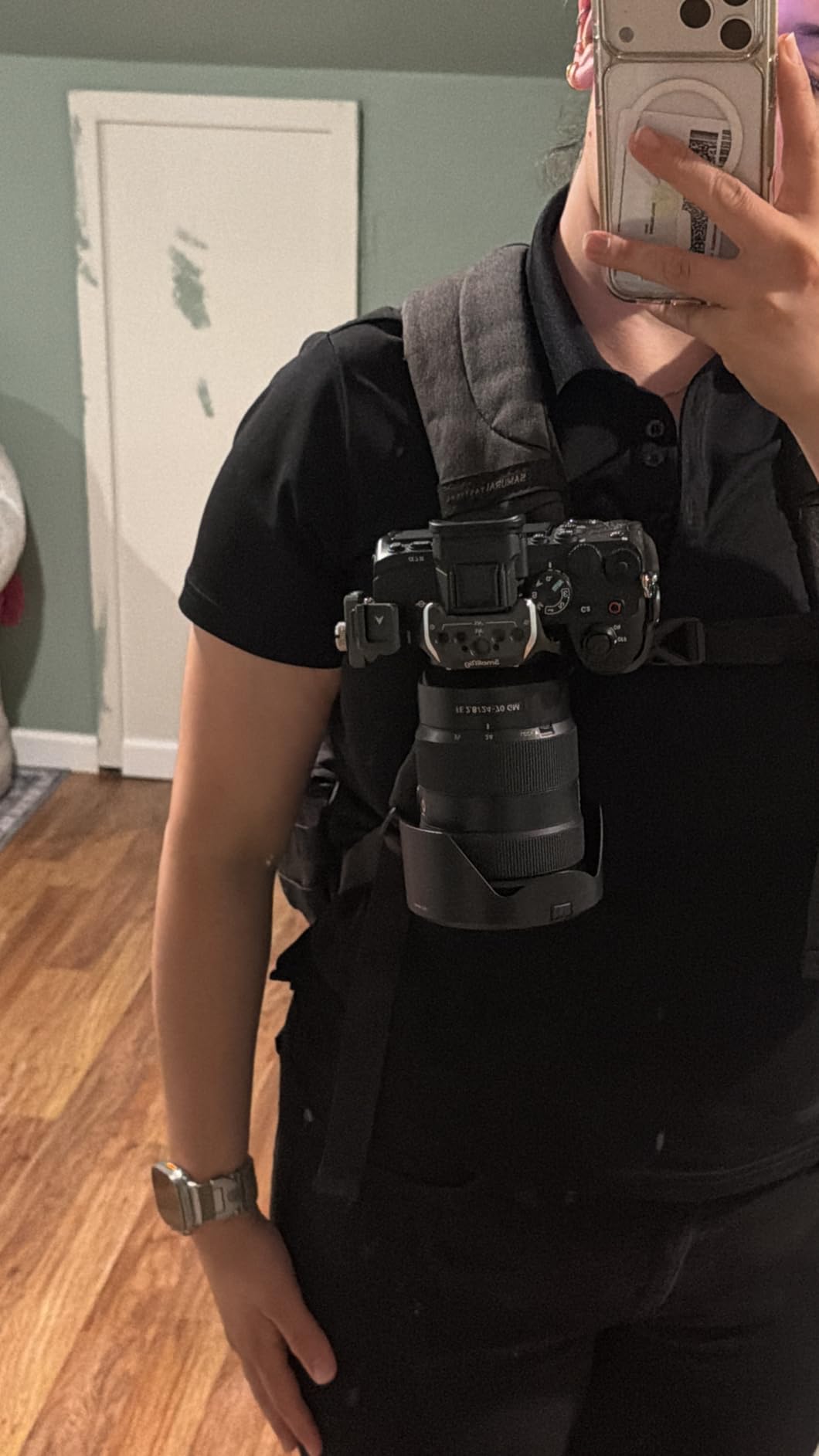
The Beetle does the same job as a premium capture clip for a fraction of the outlay, and the reason is visible in the spec sheet: an aluminum alloy body weighing 93 g with a listed maximum capacity of 25 kg. That is far more headroom than a mirrorless body and kit, so the weak point is not strength, it is weather sealing and access speed.
There is no button to press. The mounting plate uses a patented tight-fitting screw with a thrust needle roller bearing, so the camera locks by pushing it in and releases by pulling it out, and the whole mount can be rotated so a horizontal lens improves stability. That orientation flexibility is genuinely useful with a zoom attached.
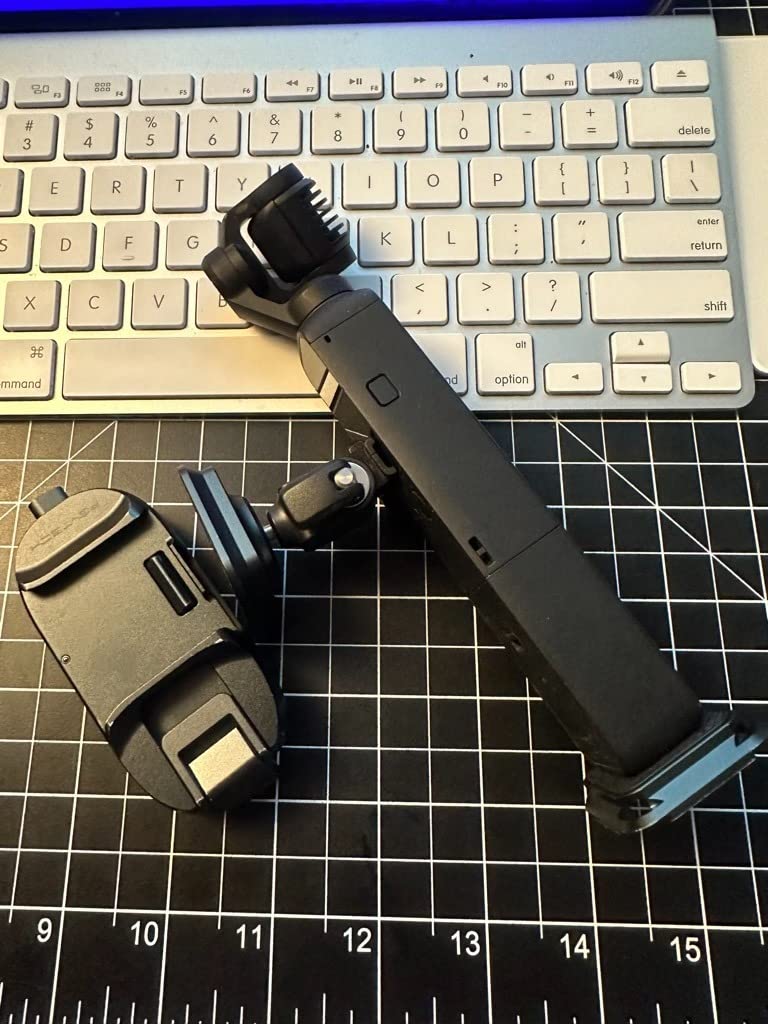
Arca-Swiss compatibility is the standout feature at this level. Because the plate is Arca-compatible, the camera can move between this clip, a tripod head or any other Arca-type rig without swapping hardware, which answers the question that comes up constantly on photography forums.
Two limits to plan around. It is not water resistant, so keep it for dry-weather work or pair it with a camera in a rain sleeve. And the clamp takes straps up to 75 mm wide with a thickness between 1 mm and 15 mm, so very padded hiking straps can be too thick. The anti-slip rubber lining is what keeps it from sliding down the strap once fitted, and it is the reason the mount stays put in a way friction alone would not manage.
Who the Beetle suits?
It suits hikers, cyclists and run-and-gun shooters who want their camera on an existing strap and nothing else. At 93 g it adds almost nothing to a pack, and the open frame keeps the body cool and easy to reach. It is also a sensible second clip if you already run one system and want a spare.
Who should skip it?
Skip it in rain, and skip it if you need anywhere to put cards or batteries. It carries exactly one camera with no storage, and there is no padding between the body and the outside world, so it is not the choice for a crowded reception or a dusty site. A sling bag is the better call there.
We earn a commission, at no additional cost to you. CERTAIN CONTENT THAT APPEARS ON THIS SITE COMES FROM AMAZON. THIS CONTENT IS PROVIDED 'AS IS' AND IS SUBJECT TO CHANGE OR REMOVAL AT ANY TIME.
4. Ape Case Small SLR Holster Bag – Best for Hiking
Ape Case Small SLR Holster Camera Bag
★★★★★★★★★★Fits a body plus one short lens
0.15 kg bag
Retractable rain cover
Integrated belt loop
- Rugged well-padded build with reinforced stress points
- Retractable rain protection built into the front pocket
- Hi-Vis yellow interior makes gear easy to find
- Integrated belt loop plus removable shoulder strap
- Small enough to pack inside a daypack
- Fits only a body and one short lens
- Belt loop sits low and tips the bag forward
- Shoulder strap runs short for crossbody wear
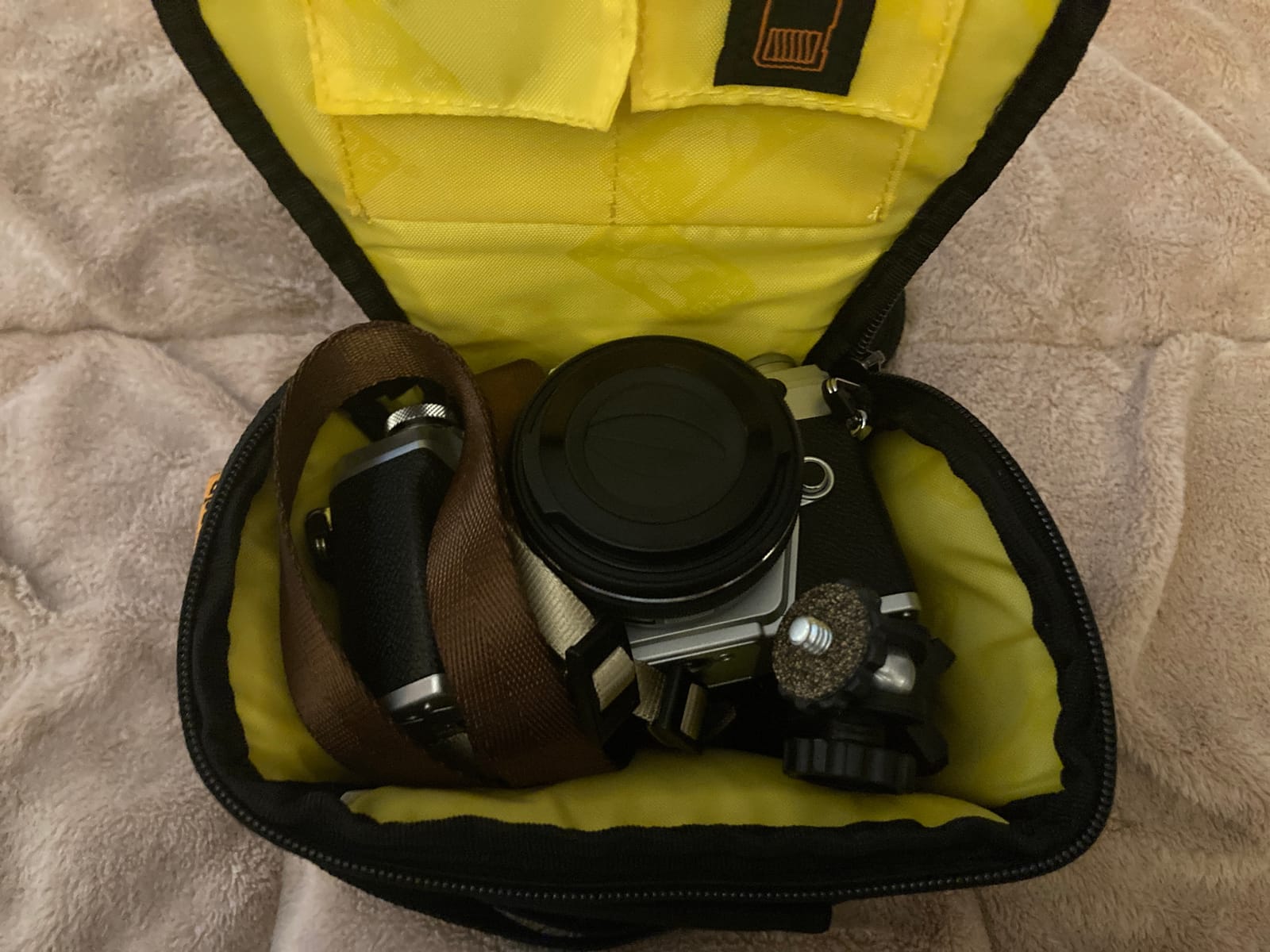
This is the pick for someone who wants a holster that is a passenger rather than the main bag. At 0.15 kg and 6.5 x 4.3 x 6.5 inches it takes up almost no room, so you can belt it on for a short stretch of trail and then stow it inside your pack for the rest of the walk. That flexibility is what separates it from the bigger toploaders.
Protection is better than the price suggests. The bag is well padded with reinforced stress points, and the front pocket contains a retractable any-weather rain cover that pulls out when the weather turns. The interior is lined in hi-vis yellow, which sounds like a gimmick until you are fumbling for a body in low light and can actually see it.
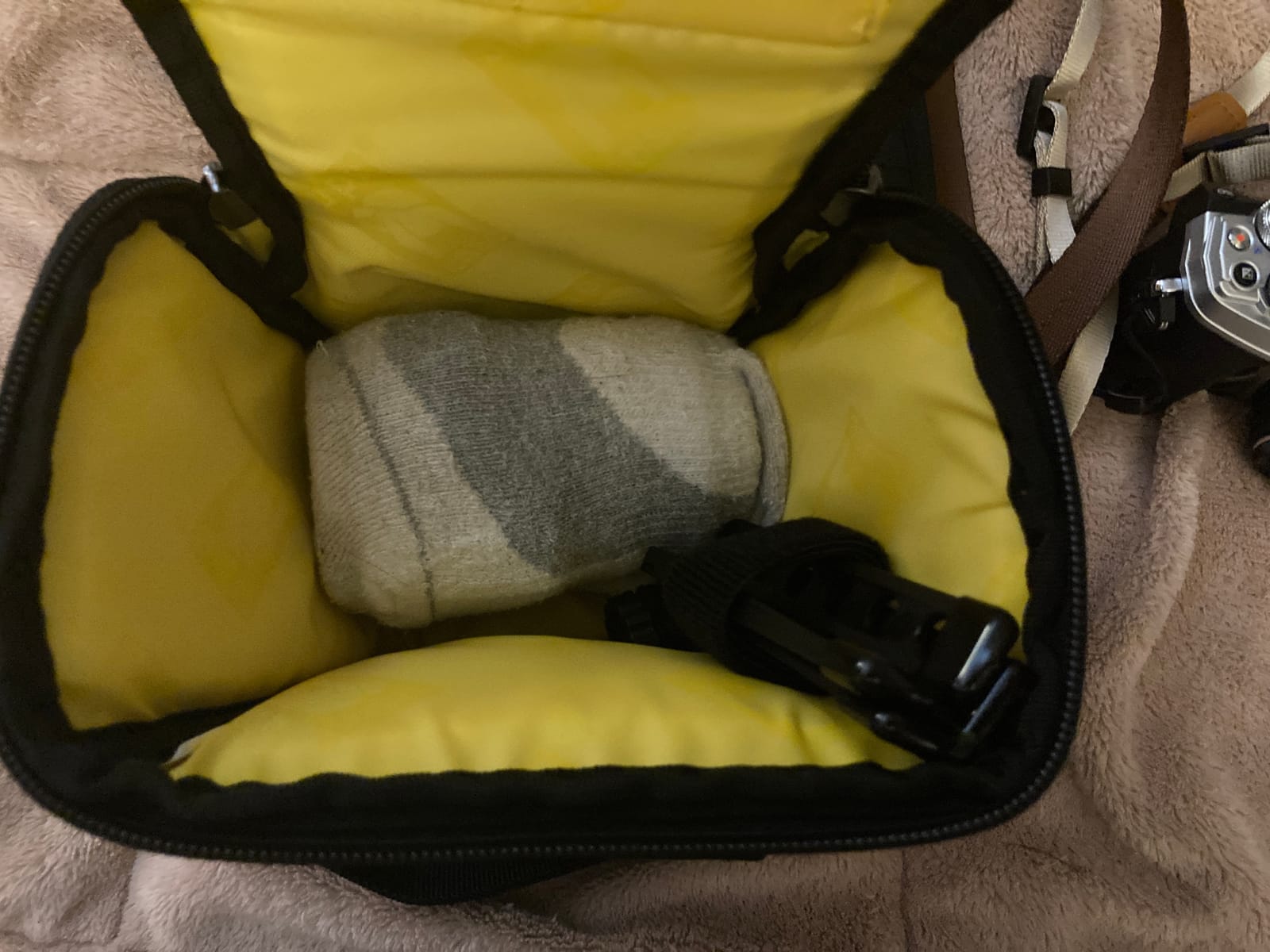
Access is via a large top-access flap with dual zipper pulls, so the draw is a two-hand unzip rather than a one-motion holster. That is the honest trade in this category: a closed bag protects the camera, an open clip is faster. Ten compartments including front and interior pockets handle media and small accessories.
It is a one-lens bag. Reviewers are clear that the small size takes a body and one short lens and nothing more, which rules it out for a zoom-heavy kit. The belt loop also sits low and tends to tip the bag forward when worn, and the removable shoulder strap runs short for crossbody wear, so plan on using the belt loop as the primary mount and packing a proper strap for long walks.
Who the Ape Case holster suits?
It suits hikers, bird photographers and street walkers who carry one body and one small lens. The hi-vis interior and the top flap make it fast enough for opportunistic frames, and the packability means it never becomes dead weight. The retractable rain cover is the detail that keeps it working in real weather.
Who should skip it?
Skip it if you carry more than one lens, if you need a telephoto, or if you want a one-handed draw at a client event. The low, forward-tipping belt loop is also a genuine annoyance for anyone who spends hours on their hip, so try it with your normal clothing before committing.
We earn a commission, at no additional cost to you. CERTAIN CONTENT THAT APPEARS ON THIS SITE COMES FROM AMAZON. THIS CONTENT IS PROVIDED 'AS IS' AND IS SUBJECT TO CHANGE OR REMOVAL AT ANY TIME.
5. VidPro TL-35 Top-Load Holster Case – Best Street Toploader
Vidpro TL-35 Top-Load DSLR Camera Holster Case (Large)
★★★★★★★★★★Fits a DSLR with zoom attached
6.5 x 8.5 x 5 inch interior
Molded hard base
- Accurate interior sizing for a body with medium-to-long zoom
- Molded hard base gives real drop protection
- Three external pockets for cards and batteries
- Lightweight and compact for street outings
- Detachable adjustable padded shoulder strap
- Included shoulder strap is thin and lacks padding
- Side and front pockets are shallow
- Only fits a body and one lens with no room for a flash or a second lens
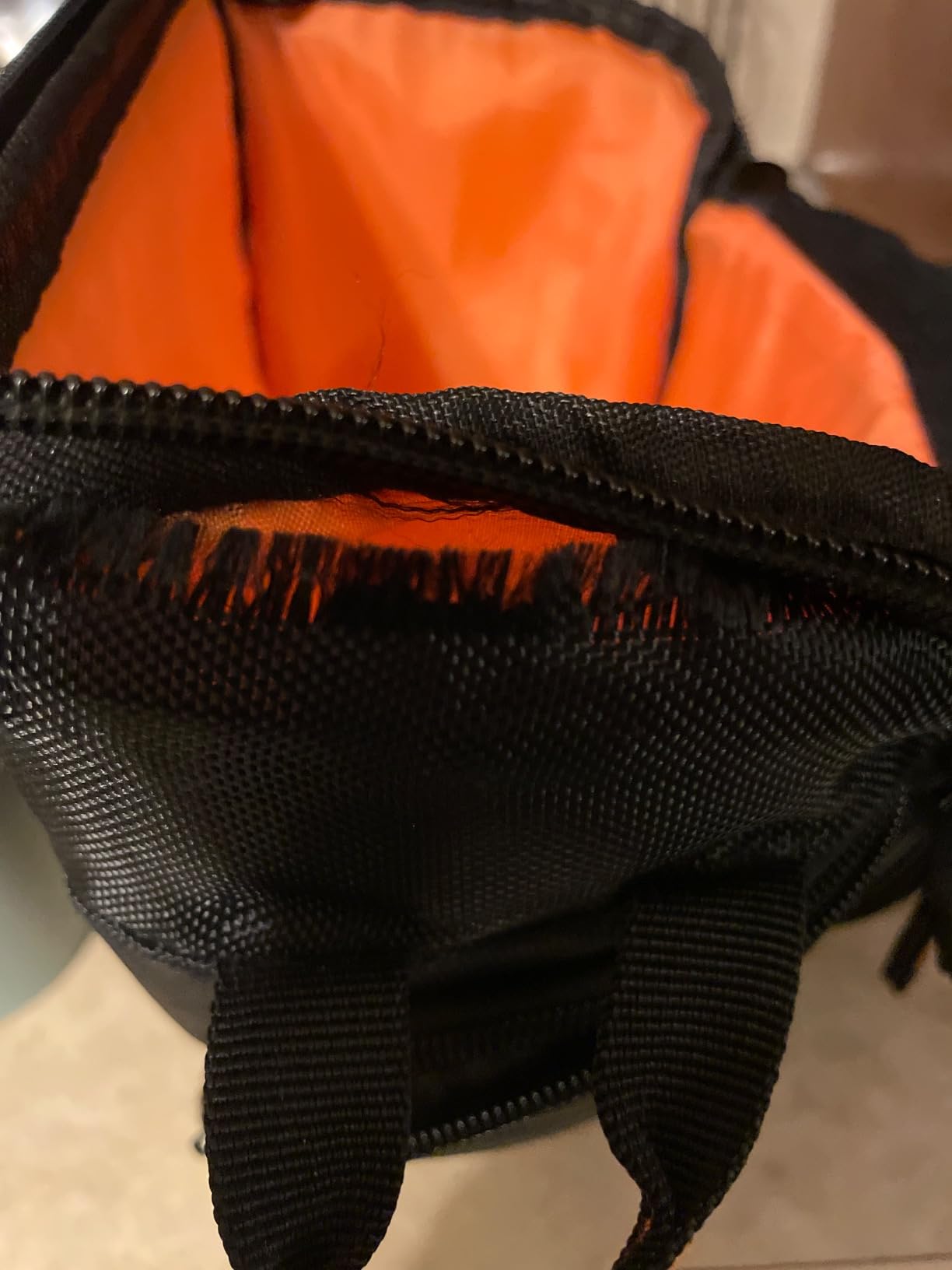
The TL-35 is the most accurately sized holster in this list for a specific and common job: a DSLR with a medium-to-long zoom already attached. The interior measures 6.5 x 8.5 x 5 inches, which is a meaningful step up from the compact slings, and reviewers single out the sizing as the reason the bag fits their kit without a fight. That is the whole reason it earns a place here.
The molded hard plastic base is the feature nobody expects at this level. It gives genuine drop protection, and it lets the bag stand upright on a pavement or a café table instead of collapsing sideways, which matters when you are changing lenses in the street. The outer shell is water-resistant nylon with heavy-duty zippers.
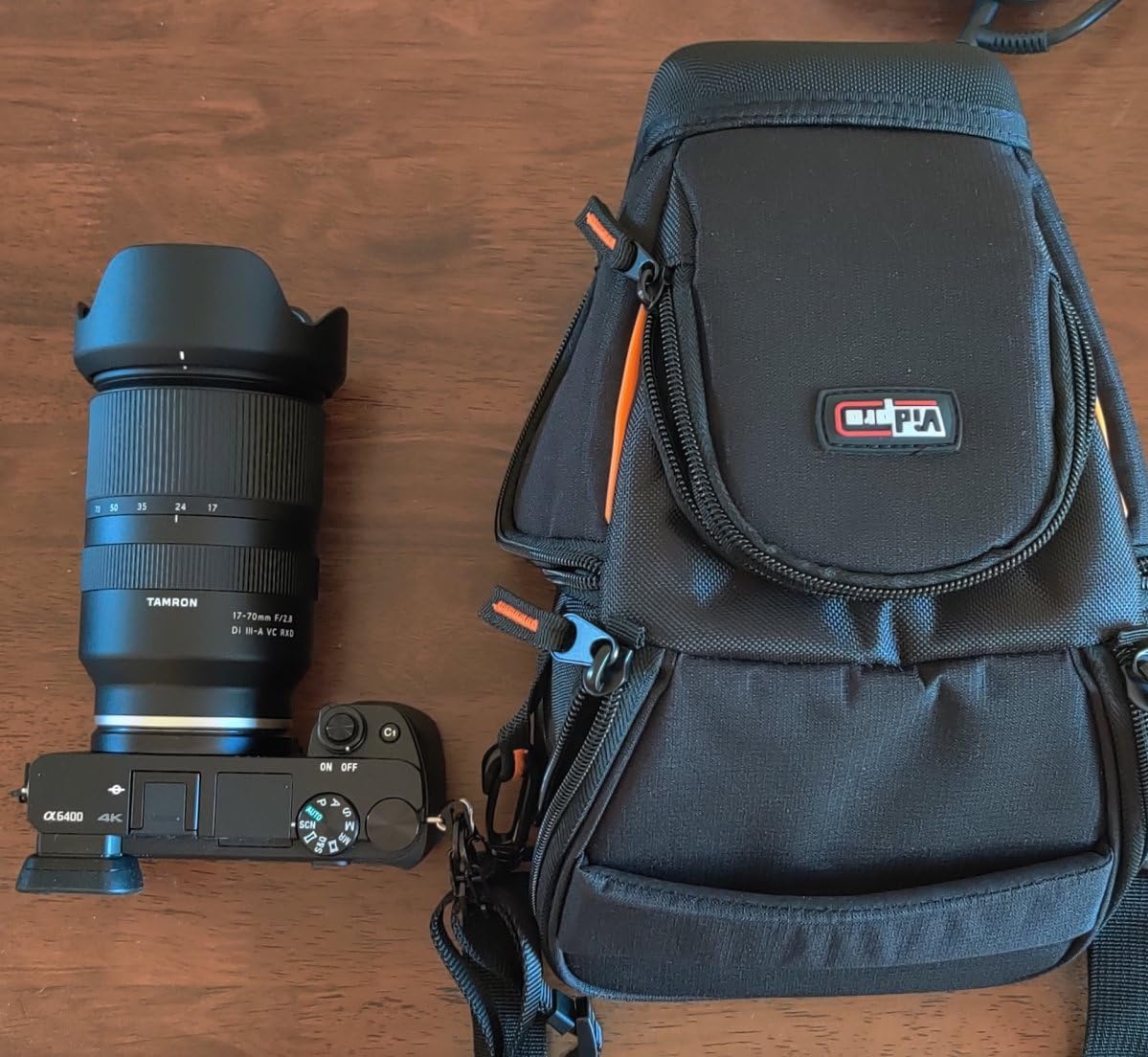
Carry options are a soft top handle plus a detachable, adjustable padded shoulder strap, and there are two side accessory pockets and a zippered front pocket for cards, batteries and a cloth. Compact enough for a walk-around, and the whole thing is easy to load one-handed from a standing position.
Two complaints recur. The supplied shoulder strap is thin and light on padding, so a long day on it will bother your shoulder sooner than the bag itself does. And the side and front pockets are shallow, which means small items only. It also takes a body and one lens, with no room for a flash or a second zoom.
Who the TL-35 suits?
It suits street, travel and documentary photographers who work with one body and a zoom and want the body protected without a full backpack. The standing base is a quiet quality-of-life win when you are shooting at ground level, and the size keeps it manageable on public transport.
Who should skip it?
Skip it for all-day strap wear, because the supplied strap is thin, and for anyone carrying two lenses. It is also a DSLR-sized bag, so a compact fixed-lens shooter may find it more volume than needed, in which case the smaller sling is the better fit.
We earn a commission, at no additional cost to you. CERTAIN CONTENT THAT APPEARS ON THIS SITE COMES FROM AMAZON. THIS CONTENT IS PROVIDED 'AS IS' AND IS SUBJECT TO CHANGE OR REMOVAL AT ANY TIME.
6. FOMITO Dual Camera Chest Harness – Best for Two Bodies
FOMITO Multi Camera Carrying Chest Harness System Vest with Side Holster for Canon 6D 600D 5D2 5D3 Nikon D800 D600 D300 D7000 D90 Sony A7S A7R A7S2 Panasonic Olympus DSLR
★★★★★★★★★★Dual camera chest carry
1/4 inch screw camera mount
Locking quick release
- Distributes weight across the chest instead of the neck
- Prevents the swinging that ruins frames while walking
- Fits a wide range of DSLR and mirrorless bodies
- Locking system with a clean quick release
- Well suited to weddings sports and journalism
- Open mesh offers no weather protection for gear
- Fit varies by torso and needs adjusting
- No storage for lenses or accessories
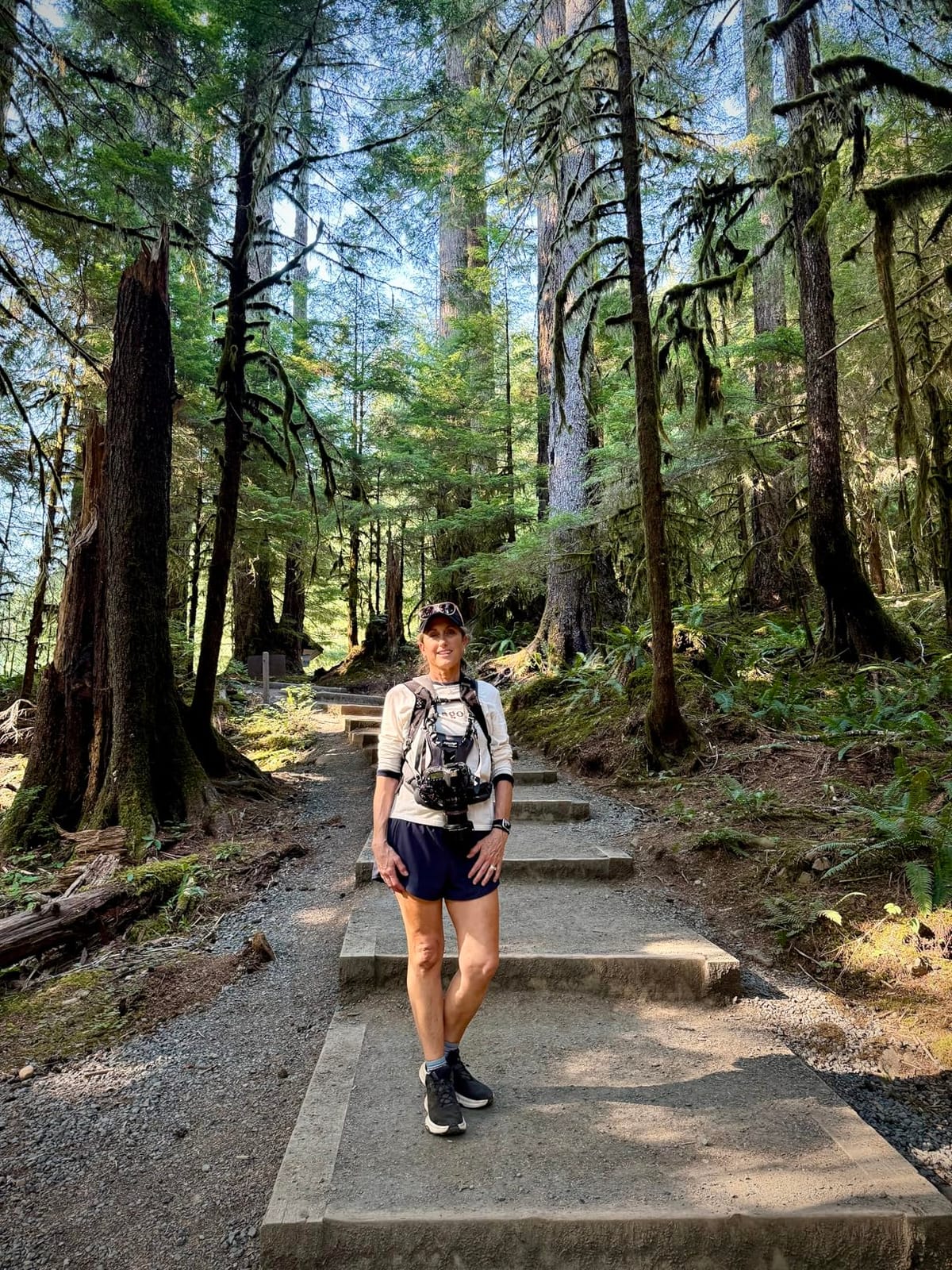
Everything else in this guide puts one camera on a belt, a strap or a harness clip. This one puts two on your chest, and that is the whole argument. Both bodies sit in front of the torso where you can see them, swap between them without looking, and the weight comes off your neck entirely. For a photographer moving between a ceremony, a cocktail hour and a dance floor, the two-body access is worth more than any individual holster feature.
It uses a 1/4 inch screw camera mount, which is effectively universal across DSLR and mirrorless bodies, so one rig covers a lot of kits. The locking system has a clean quick release, which matters because a chest-mounted camera that fumbles loose is a camera on the pavement. The build is denier polypropylene and mesh with a snap fastener.

The swing problem is what this solves best. Forum complaints about neck and shoulder straps almost always come down to a body bouncing against your chest or back as you walk, which is uncomfortable and produces soft, blurred frames. Held close and high, the bodies barely move.
The compromises are real. Open mesh and denier fabric give the gear no weather protection, so this is an indoor and fair-weather rig. Fit varies with torso shape and needs adjusting, and there is no storage for lenses, batteries or cards, so a separate bag is still required. Reviewers also note it can read as visually heavy in a client-facing room, which is worth weighing if discretion matters more than access.
Who the FOMITO harness suits?
It suits wedding, sports, PR and journalism shooters who need two bodies instantly and want nothing on their neck. It also suits anyone who has traded a strap for a hip carry to fix shoulder pain after long days, since the load moves to the chest. Our [streaming camera picks](https://bansocialism.com/best-streaming-cameras/) cover the compact bodies that sit well on a rig this size.
Who should skip it?
Skip it if you shoot outdoors in rain, if you need to carry lenses, or if you work at events where a chest rig would be conspicuous. It is also awkward to load and unload in a car, so it is a working rig rather than a travel one.
We earn a commission, at no additional cost to you. CERTAIN CONTENT THAT APPEARS ON THIS SITE COMES FROM AMAZON. THIS CONTENT IS PROVIDED 'AS IS' AND IS SUBJECT TO CHANGE OR REMOVAL AT ANY TIME.
How to Choose a Camera Holster?
Work through these in order. Each step eliminates options faster than comparing brands does.
1. Decide the architecture first. Clip, toploader sling, belt holster or chest harness. Clip if speed and low weight matter and the camera is already protected by a jacket. Sling or belt holster if weather and impact matter. Harness if you carry two bodies. Nothing later in this list changes that decision.
2. Do the payload math. Add body weight, lens weight and a battery, then compare against the published capacity. A clip rated over 200 lbs of force and a clip rated to 25 kg both clear a typical mirrorless kit comfortably, so capacity is rarely the deciding factor. Interior dimensions are the number that actually decides fit, and they are the one people skip.
3. Check the mounting standard. Arca-compatible is the standard to look for, and it is covered in more detail below. Strap width and thickness matter just as much, because a clamp that will not take your strap is a wasted purchase.
4. Test access speed in the position you will use. A holster that is fast when you are standing still can be awkward when you are sitting at a dinner table or climbing into a car. Draw it and re-holster it a few times before you commit.
5. Price comfort over a full day. The forums on this topic are full of people who got the hardware right and still ended up with shoulder pain. A rigid clip places the load on the belt; a padded sling spreads it across the hip; a harness spreads it across the chest. Match the architecture to how long you will be wearing it.
6. Add up the whole system. A clip is a component, not a complete carry. You may also need a strap or belt, a mounting plate, and somewhere for batteries and cards. Budget for the full set rather than discovering the extras after the first shoot.
On travel specifically, the pattern that works is a small padded sling for the body you use most, worn crossbody or on the belt, with a second body left in the bag. That avoids the swing and the neck load entirely, and it is the reason the compact slings in this guide pair so well with the lightweight bodies in our [instant camera guide](https://bansocialism.com/best-instant-cameras/).
Finally, the strap-versus-holster question. Straps are simpler, cheaper and better for a body with no grip. Holsters are better once you are carrying more than one lens, working long days, or moving through crowds. If shoulder pain is already your problem, that is the point at which switching architecture beats shopping for a better strap.
Arca-Swiss Plate Compatibility
A recurring question on r/AskPhotography and other photography forums is which holster will accept an Arca-Swiss tripod plate, and the honest answer is that very few do out of the box. Arca-Swiss, now usually called Arca-compatible, is the dovetail standard used by most tripod heads, so a body on an Arca plate can move between a tripod, a gimbal and a holster without swapping hardware.
In this lineup, two of the six ship with an Arca-compatible plate. The Peak Design Capture Clip V3 includes one in the box, and the PGYTECH Beetle uses an Arca-Swiss compatible plate with a patented tight-fitting screw so it can also carry other Arca-type equipment. The remaining four are closed bags or a harness that attach to a strap or the body directly, so plate compatibility does not apply to them.
What this means in practice: if you already own Arca-Swiss tripod plates, buy one of the two clips above and you can reuse the plate across your whole kit. If you do not, the included plate is one less accessory to source, which is a real saving in total system cost. Just confirm the plate is genuinely Arca-compatible rather than simply described as universal.
Holsters for Heavy Telephoto and Gripped Bodies
The most common fit failure in this category is not strength, it is volume. A 200-500mm or 100-400mm class lens changes the shape of the kit completely, and a holster that happily takes the bare body will not take the body with that glass on it. A DPReview forum poster put it plainly about harness-style rigs: not good for gripped cameras or long lenses. That complaint is about size, not weight.
Here is what the dimensions in this guide actually allow. The VidPro TL-35, with a 6.5 x 8.5 x 5 inch interior, is the only bag here built around a body with a medium-to-long zoom attached. The USA Gear sling, at 7.5 x 6.25 x 5.5 inches, is tighter still, and reviewers confirm that some long zoom combinations will not fit. The Ape Case is a body-plus-one-short-lens carry and nothing more.
For gripped bodies, the same rule applies in miniature. A vertical battery grip or a cage adds width and height to a body, and the compact slings here are dimensioned for a bare body. The open clips avoid the problem entirely because they hold the plate rather than the body, which is one more reason the clip category is the answer for anyone with unusual hardware.
The rule of thumb that survives contact with real kits: check the holster’s interior dimensions against the longest dimension of your assembled body plus lens, and add the grip to the height if you use one. Anything that does not clear that number will not be fixed by padding, and it is far easier to measure before buying than to return afterwards.
Frequently Asked Questions
What camera strap do professionals use?
It depends on the work. Event and wedding photographers mostly use a hip holster or chest harness so the load comes off the neck and the camera is instantly accessible. Wildlife and sports shooters working with heavy telephotos usually add a chest or harness mount to distribute the weight across both shoulders. For a single body with a small lens, many professionals still prefer a simple neck or shoulder strap because it is the fastest option to raise and frame from.
What is the best camera holder?
The best camera holder is the one that matches your kit and your day. A strap-mounted clip such as the Peak Design Capture Clip V3 suits anyone already wearing a backpack or belt and wants fast one-button access. A padded toploader sling such as the USA Gear model is the safer choice for travel and weather. A chest harness is the right answer if you carry two bodies and want them off your neck entirely.
Is a camera harness worth it?
A harness is worth it if you carry two bodies, work long days, or have already had shoulder pain from a neck strap. It spreads weight across the chest and stops the swinging that softens frames while walking. It is less useful if you carry one small camera, and mesh-style harnesses offer no weather protection, so they are mainly an indoor and fair-weather tool.
How do I carry my camera while traveling?
Use a padded toploader sling worn crossbody or on a belt loop, sized so the body and your everyday lens clear the interior dimensions. Keep a second body in your pack rather than on your body. Choose a bag with a belt loop so you can shift the load off your shoulders in queues and on long walks, and check that the material is water resistant or that a rain cover is included.
What is the best camera strap for heavy lenses?
For heavy lenses the answer is usually not a strap at all. Move the load to a hip holster or a chest harness so the weight sits on your belt or chest instead of one shoulder, and pick a carrier whose interior dimensions clear your longest assembled body and lens. A 200-500mm class zoom needs a large toploader or an open plate clip, because most compact slings are dimensioned for a bare body with a short lens.
Can I use a camera holster with an Arca-Swiss plate?
Yes, with the right holster. An Arca-compatible plate is the dovetail standard used by most tripod heads, so a body on one can move between a tripod, a gimbal and a compatible holster without swapping hardware. In this guide the Peak Design Capture Clip V3 includes an Arca-compatible plate in the box and the PGYTECH Beetle uses an Arca-Swiss compatible plate. Most padded holsters and belts attach to a strap or the body directly, so plate compatibility does not apply to them.
Final Verdict
The Peak Design Capture Clip V3 takes the top spot for a simple reason: it is the carry in this group that most people can actually use every day. It weighs 5.1 ounces, holds over 200 lbs of force, mounts to a strap or belt you already own, and includes an Arca-compatible plate so it works with the rest of your kit. Take the PGYTECH Beetle instead if you want a wider strap range or need to spend less.
Match the architecture to the job: the USA Gear sling for travel, the VidPro TL-35 when a zoom stays attached, the Ape Case holster for hiking days where pack space matters, and the FOMITO harness for two-body event work. Whatever you choose, measure your assembled body and lens against the interior dimensions before you order, because that single check prevents nearly every return in this category.
Those are the best camera holsters we would carry in 2026. Open the product buttons above to see current availability and pricing for each.