
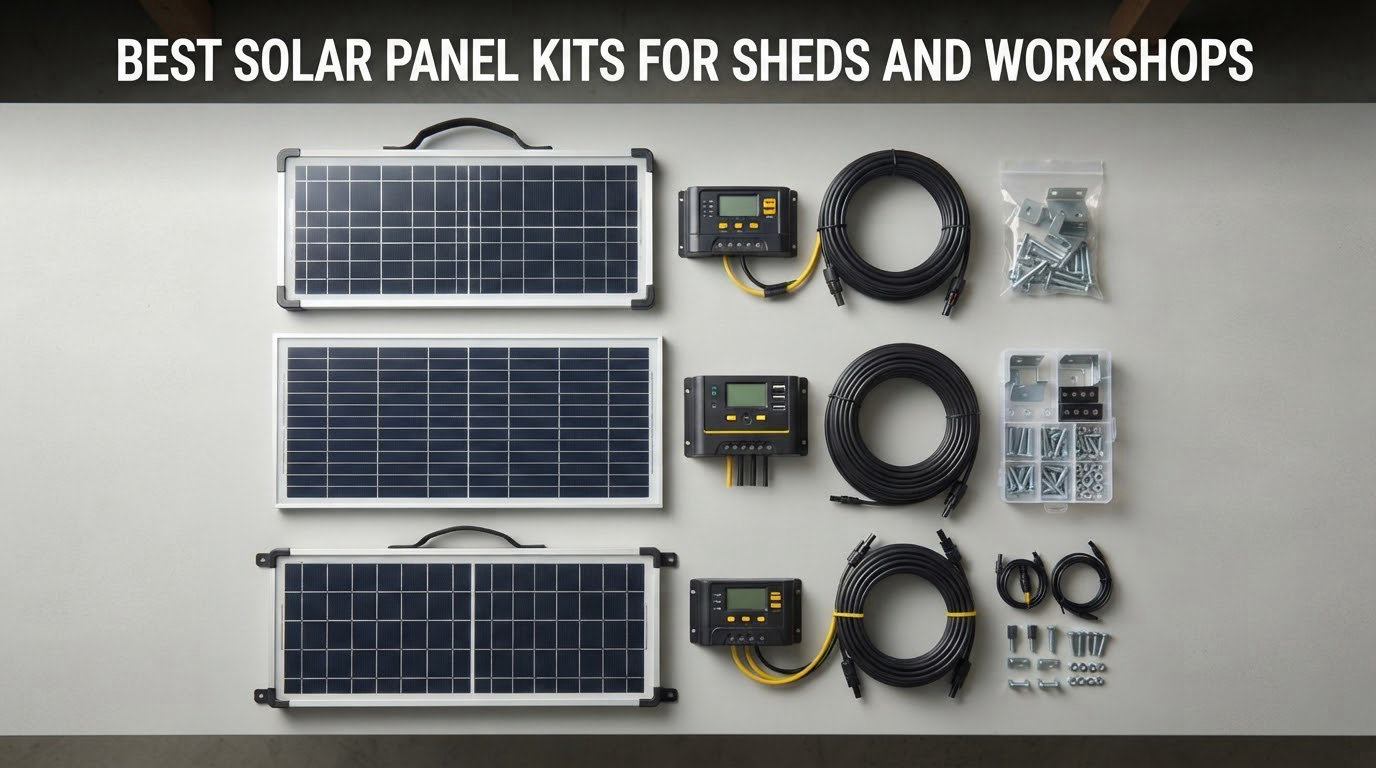
The reason most people never put power in a shed is the trench. Running grid cable out to an outbuilding is commonly billed at a steep per-foot rate before any electrical work is added, and by the time a contractor quotes a detached workshop connection the number is often higher than the entire off-grid solar kit it would replace. A solar panel kit for a shed sidesteps that entirely: a matched set of panel, charge controller, battery and inverter that makes real 120V power on demand.
So which of the best solar panel kits for sheds and workshops should you actually buy? For most people the Renogy 100W 12V Starter Kit is the answer, because it is the smallest system that reliably runs LED lighting, phone charging and small USB devices over a long weekend without a generator. If you intend to run power tools, skip straight to a portable power station pairing such as the Anker SOLIX C1000 Gen 2 with its 200W panel, because a panel-only kit has no inverter and no AC outlets.
This guide breaks the category into three load tiers, then works through twelve kits in detail. Tier one covers lighting, charging and security devices. Tier two covers tool batteries, laptops and a mini fridge. Tier three covers continuous AC loads such as a table saw or air compressor, where only a power station with pure sine wave output will behave. We also cover the sizing math, the PWM versus MPPT decision, system voltage, and the breakers, disconnects and cable that most “complete” kits leave out of the box.
One note before we start. Several kits below are panel-and-controller bundles with no battery and no inverter. Those are excellent as the front end of a system you build yourself, and useless as a plug-and-play answer unless you already own both. We label every one of them so you do not find out after delivery.
Table of Contents
- Top 3 Solar Panel Kits for Sheds and Workshops (October 2026)
- All 12 Kits Compared Side by Side in 2026
- 1. Renogy 100W 12V Starter Kit with 30A PWM Controller – Best Overall for Most Sheds
- 2. Anker SOLIX C1000 Gen 2 with 200W Solar Panel – Best for Power Tools
- 3. BLUETTI Solar Generator Elite 100 V2 with 200W Panel – Best for Small Appliances
- 4. Renogy 200W 12V Monocrystalline Kit – Best Value Expansion Path
- 5. ECO-WORTHY 200W 12V/24V Kit with Two 100W Panels – Best for 24V Builds
- 6. Voltset 100W Kit with 20A Smart Charge Controller – Most Versatile
- 7. SOLPERK 20W 12V Maintainer Kit – Best for Battery Maintenance
- 8. Jackery Solar Generator 1000 v2 with 200W Panel – Best for Mobile Setups
- 9. Renogy 400W Premium Kit with 40A MPPT Controller – Best for Maximum Harvest
- 10. GVSHINE 30W Kit with 115Wh Battery and LED Bulbs – Best for Shed Lighting Only
- 11. MARBERO 237Wh Solar Generator with 60W Panel – Best for Light Duty Backup
- 12. Anker SOLIX C300 with 60W Solar Panel – Best for Quiet Indoor Workshop Use
- How to Size a Solar Kit for Your Shed?
- PWM vs MPPT: Which Charge Controller You Actually Need?
- 12V, 24V or 48V: Choosing a System Voltage
- What to Buy Separately From the Kit?
- Mounting Panels on a Shed Roof, Tilt and Orientation
- Frequently Asked Questions
- Final Verdict: Best Solar Panel Kits by Scenario in 2026
Top 3 Solar Panel Kits for Sheds and Workshops (October 2026)
These three cover the most common outcomes. The Renogy leads for a typical shed, the Anker leads for tool work, and the BLUETTI is the strongest middle option for mixed loads.

Renogy 100W 12V Starter Kit
- 100W monocrystalline panel
- 500Wh per day
- 30A PWM controller
- Expandable to 400W
Anker SOLIX C1000 Gen 2 + 200W Panel
- 2000W continuous output
- 1024Wh LiFePO4 battery
- 3000W surge
- 1.8 hour solar recharge

BLUETTI Elite 100 V2 + 200W Panel
- 1800W rated AC output
- 1024Wh LiFePO4
- Power Lifting mode
- 11 ports
All 12 Kits Compared Side by Side in 2026
The full lineup at a glance. Note that the panel-and-controller kits at the lower end have no battery or inverter included, while the power stations bundle both.
| Product | Key Specs | Pricing |
|---|---|---|
| Renogy 100W 12V Starter Kit |
|
Check Latest Price |
| Anker SOLIX C1000 Gen 2 with 200W Panel |
|
Check Latest Price |
| BLUETTI Elite 100 V2 with 200W Panel |
|
Check Latest Price |
 Renogy 200W 12V Monocrystalline Kit Renogy 200W 12V Monocrystalline Kit |
|
Check Latest Price |
 ECO-WORTHY 200W 12V/24V Kit ECO-WORTHY 200W 12V/24V Kit |
|
Check Latest Price |
 Voltset 100W Kit with 20A Smart Controller Voltset 100W Kit with 20A Smart Controller |
|
Check Latest Price |
 SOLPERK 20W Maintainer Kit SOLPERK 20W Maintainer Kit |
|
Check Latest Price |
 Jackery Solar Generator 1000 v2 with 200W Panel Jackery Solar Generator 1000 v2 with 200W Panel |
|
Check Latest Price |
 Renogy 400W Premium Kit with 40A MPPT Renogy 400W Premium Kit with 40A MPPT |
|
Check Latest Price |
 GVSHINE 30W Kit with 115Wh Battery GVSHINE 30W Kit with 115Wh Battery |
|
Check Latest Price |
 MARBERO 237Wh Solar Generator with 60W Panel MARBERO 237Wh Solar Generator with 60W Panel |
|
Check Latest Price |
 Anker SOLIX C300 with 60W Solar Panel Anker SOLIX C300 with 60W Solar Panel |
|
Check Latest Price |
Two patterns are worth calling out before the individual reviews. First, the panel-only kits cluster between 100W and 400W and rely on PWM controllers, while every power station pairs a lithium battery with a built-in inverter. Second, the daily production figures printed on listings assume generous sun, so treat them as a ceiling rather than a promise. If you are still choosing a shed first, our [storage shed guide](https://bansocialism.com/best-storage-sheds/) covers sizing and roof pitch, which both affect panel mounting.
1. Renogy 100W 12V Starter Kit with 30A PWM Controller – Best Overall for Most Sheds
Renogy 100W 12V Solar Panel Starter Kit with 30A PWM Controller
★★★★★★★★★★100W mono panel
30A PWM controller
500Wh per day
Expands to 400W
- Complete kit with panel
- controller
- cables and Z-brackets
- 22.5% cell efficiency with full EL testing
- Expands to 400W as needs grow
- Works with AGM
- Gel
- Flooded and lithium batteries
- PWM controller harvests less in variable light
- Bluetooth monitoring needs a separate module
- Slow charging in low-light conditions
This is the kit we return to most often. With more than 4,000 reviews at 4.7 stars, it has the deepest proven track record in the lineup, and the engineering is conservative in the right places: monocrystalline cells at 22.5% efficiency, every panel EL tested before it ships, and a 10-year material warranty backed by a 25-year output warranty.
Output is around 500Wh per day in good sun. That is enough for two LED shop lights for four hours, a phone charger, a WiFi camera and a small fan. It is not enough for a table saw, and no amount of extra battery changes that, because the panel is the bottleneck.
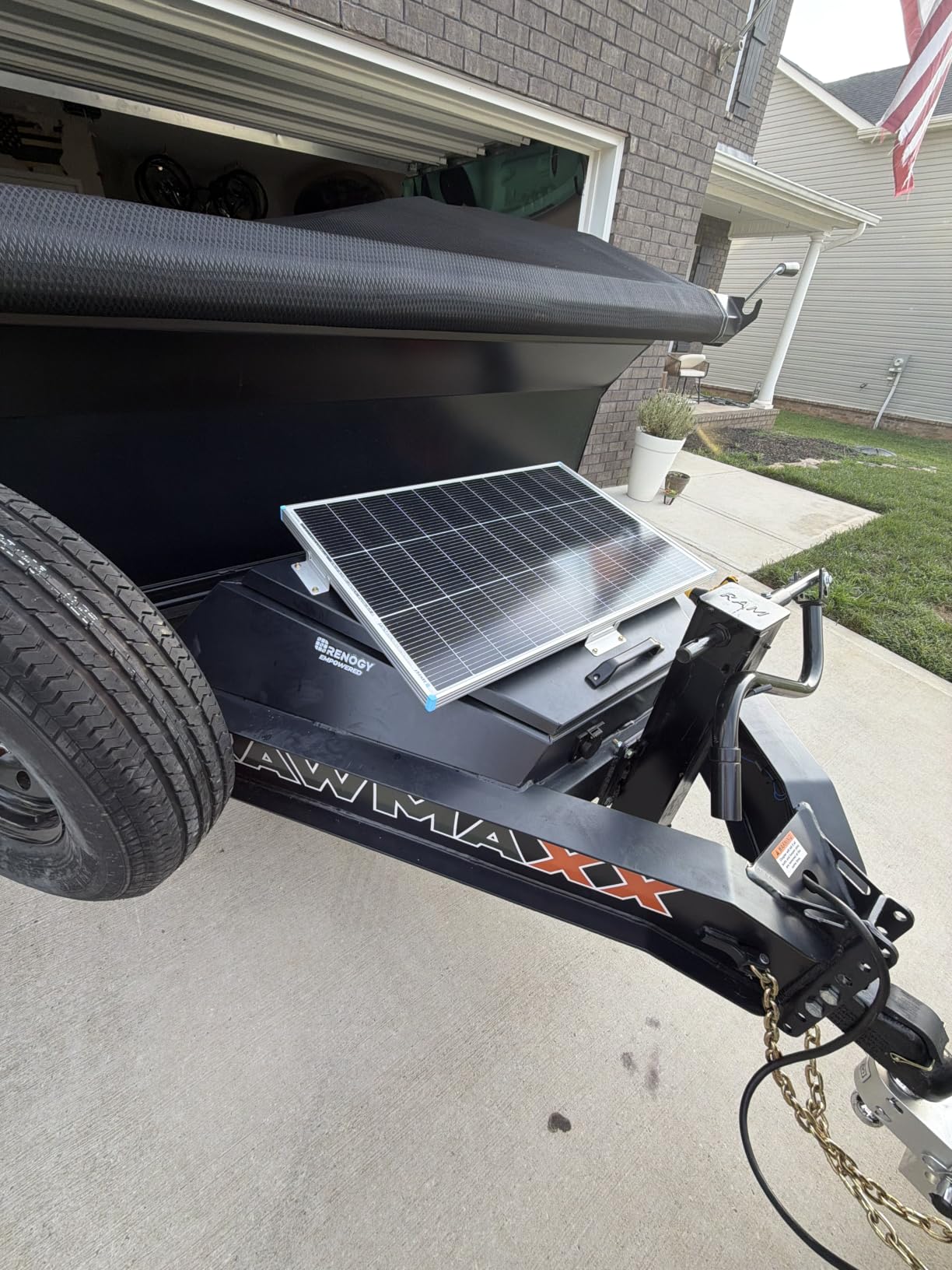
The Wanderer 30A PWM controller is the component most often criticised and the one we defend. PWM is less efficient than MPPT, particularly under variable light, but at 100W the absolute difference in harvest is measured in tens of watt-hours rather than the whole day’s output. You give up a monitoring port unless you add the BT-1 module, which is the piece we would skip and read the LCD instead.
What you get for your effort is a genuinely complete install. Cables, Z-brackets and pre-drilled frames are in the box, the controller handles sealed, gel, flooded and lithium chemistries, and the panel is certified to UL 61730 and IEC 61215 with 2400Pa wind and 5400Pa snow load ratings. At 14.1 pounds it is a one-person roof job.
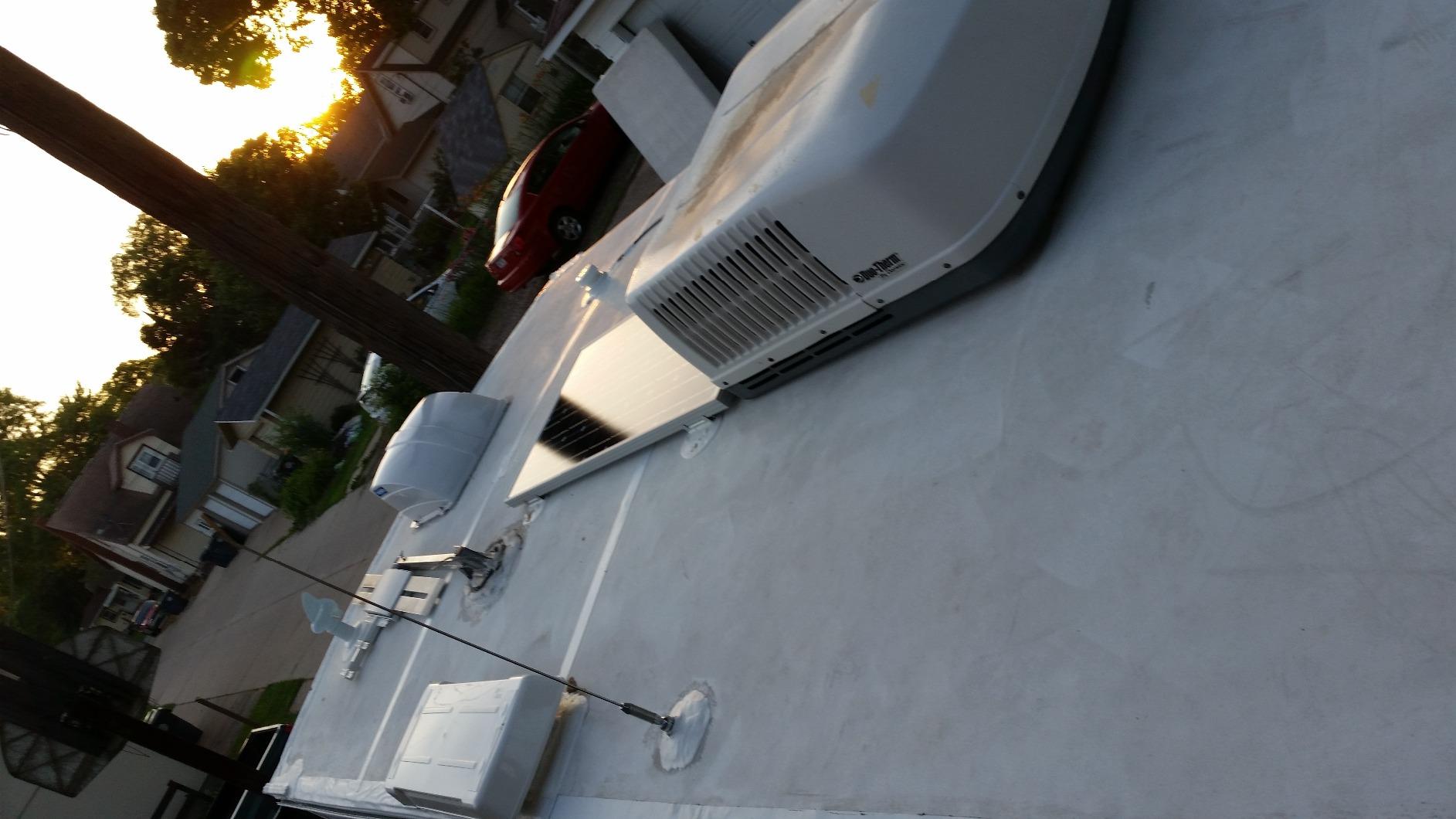
What 100W Actually Runs in a Shed?
Budget roughly 500Wh per day. That covers LED lighting, phone and laptop charging, a router, security cameras and trickle maintenance of a battery bank. It also covers a weekend of intermittent use, which is how most garden sheds actually get used.
The limit arrives quickly with anything that spins. A power tool charging at 60W draws roughly 480Wh for a full battery, so one charge a day is realistic and two is not. Plan the same size system with a larger battery if you want reserve for a cloudy stretch.
When to Buy Something Else?
If your list includes a mini fridge, a power tool and a laptop on the same day, 100W will not keep up. Move up to a power station, where the battery absorbs midday surplus and carries the evening load after sunset.
If you plan to grow into a 400W array, this panel is a reasonable first step because the controller supports expansion. Just remember it is PWM, so a later 400W build on this controller wastes meaningful energy that an MPPT unit would recover.
We earn a commission, at no additional cost to you. CERTAIN CONTENT THAT APPEARS ON THIS SITE COMES FROM AMAZON. THIS CONTENT IS PROVIDED 'AS IS' AND IS SUBJECT TO CHANGE OR REMOVAL AT ANY TIME.
2. Anker SOLIX C1000 Gen 2 with 200W Solar Panel – Best for Power Tools
Anker SOLIX C1000 Gen 2 Portable Power Station with 200W Solar Panel
★★★★★★★★★★2000W output,3000W surge
1024Wh LiFePO4
200W panel
10ms UPS
- Very fast recharge from wall
- solar or vehicle
- 2000W continuous handles fridges
- laptops and tools
- 10ms UPS protects routers and medical devices
- Compact enough to move between rooms
- Gen 2 removed the battery expansion option from Gen 1
- Accessories add up and no protective case is included
- Solar input is slower than wall charging
Where the Renogy stops, this starts. The C1000 Gen 2 puts 2,000W of continuous output and 3,000W of surge behind a 1,024Wh lithium iron phosphate battery, with nine ports covering AC, USB and 12V DC. Surge headroom matters more than raw wattage in a workshop, because compressors and saws draw in spikes that trip lesser inverters.
Recharge speed is the headline. A full solar recharge takes 1.8 hours with up to 600W of panel input, and a wall recharge takes 49 minutes at 1,600W. For a shed owner that means a mostly-charged unit between visits rather than a two-day recovery.
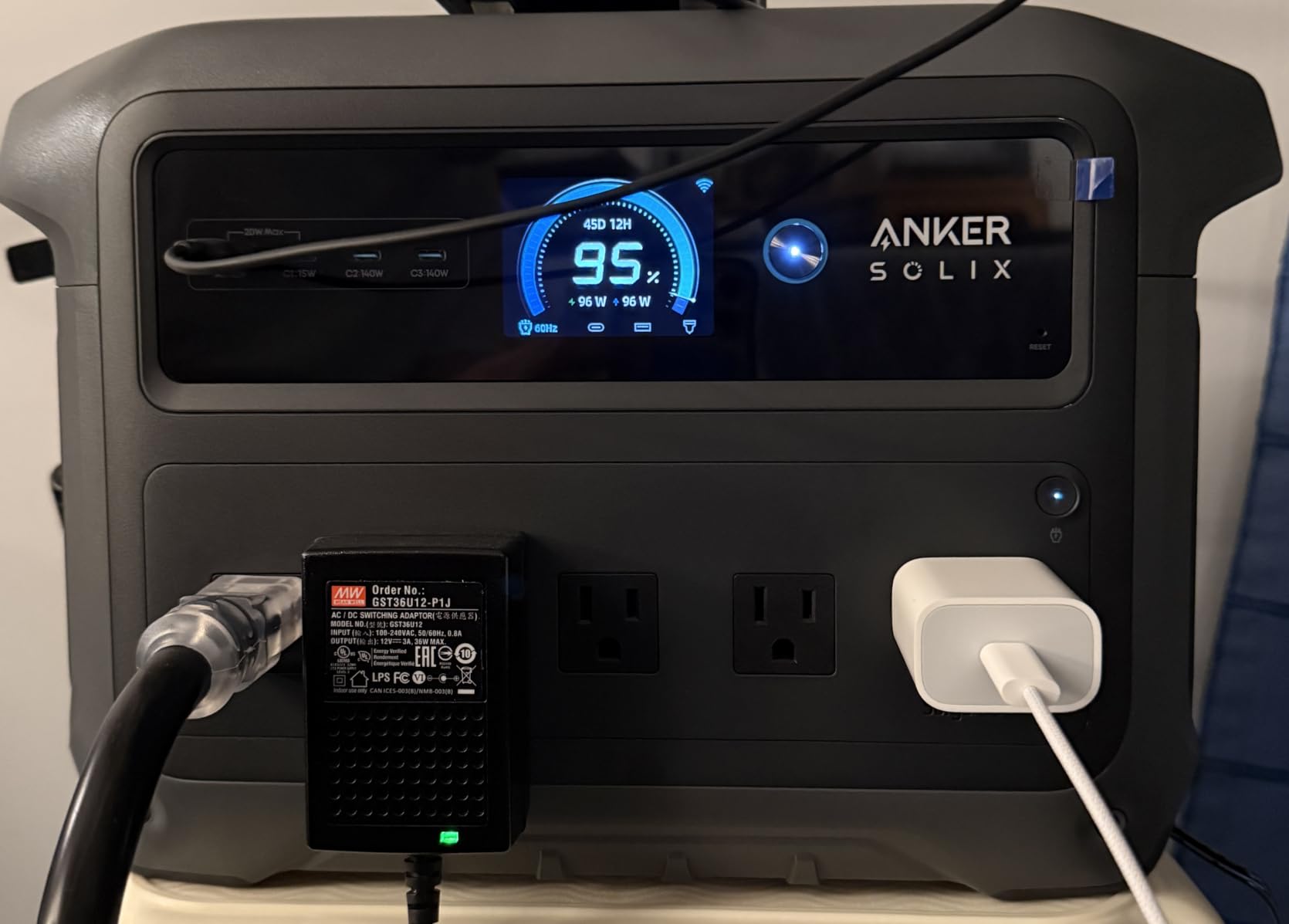
The 10ms UPS switchover is the sleeper feature. If you plan to hang a router, a NAS or a CPAP machine off this unit, sensitive electronics never see the gap during a grid failure. Reviewers consistently describe using it to ride out multi-day outages, which is exactly the resilience a workshop needs.
Battery longevity is credible rather than marketing. The LiFePO4 pack retains at least 80% of capacity after 4,000 cycles, and Anker backs that with 10 years of InfiniPower coverage. Long-horizon reliability is the trust signal buyers cite most, and this is where the chemistry earns its cost.
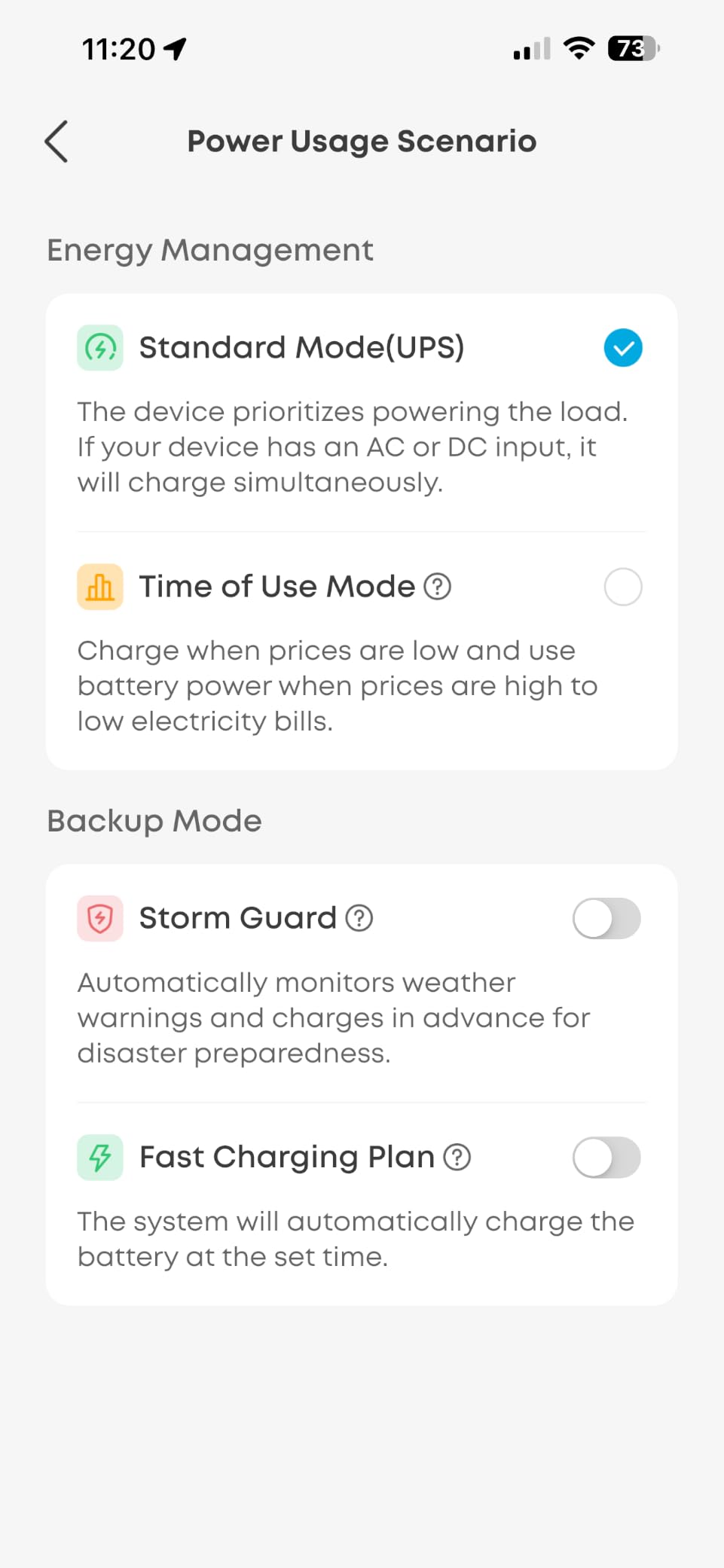
How It Handles Tool Loads?
Because the output is a full inverter rather than a DC panel, anything with a plug works. A shop vacuum, a fan, a sander and a battery charger can run at the same time, within the 2,000W ceiling. The 3,000W peak covers the inrush of a compressor or a saw on startup.
The limitation is duration, not power. 1,024Wh covers roughly a couple of hours of moderate continuous draw. Heavy tool days still need the wall or the panel, which is why the fast recharge figure matters as much as the wattage.
Where It Falls Short?
Gen 2 dropped the expansion battery port that the first generation offered. If you expect your storage to grow past 1,024Wh, that decision is permanent and it is the most common regret reported by owners who bought expecting more headroom.
Some reviewers also report harmonic distortion on microwave loads, and the accessories list is where costs creep up. Budget for a case, extra cable and a proper stand before the unit lives outside permanently.
We earn a commission, at no additional cost to you. CERTAIN CONTENT THAT APPEARS ON THIS SITE COMES FROM AMAZON. THIS CONTENT IS PROVIDED 'AS IS' AND IS SUBJECT TO CHANGE OR REMOVAL AT ANY TIME.
3. BLUETTI Solar Generator Elite 100 V2 with 200W Panel – Best for Small Appliances
BLUETTI Solar Generator Elite 100 V2 with 200W Solar Panel Included, 1024Wh
★★★★★★★★★★1800W rated output
1024Wh LiFePO4
11 ports
Power Lifting mode
- Fast charging from AC
- solar and car sources
- LiFePO4 rated for 4000+ cycles
- Power Lifting runs higher-draw resistive appliances
- Display shows input and output watts clearly
- Weighs 25 pounds
- limiting portability
- Display omits separate amp and volt readings
- Panel and unit arrive in separate boxes
The Elite 100 V2 sits between the two Anker units in size but edges ahead on outlet count and on the inverter. Rated output is 1,800W with a 3,600W surge figure, and the 1,024Wh LiFePO4 battery is rated for more than 4,000 cycles to 80% capacity, roughly a ten-year service life.
Power Lifting mode is the feature that changes what you can cook or heat. It momentarily overdrives resistive loads such as kettles and coffee makers beyond the continuous rating, which is a small thing that removes a surprising amount of frustration in a workshop break room.
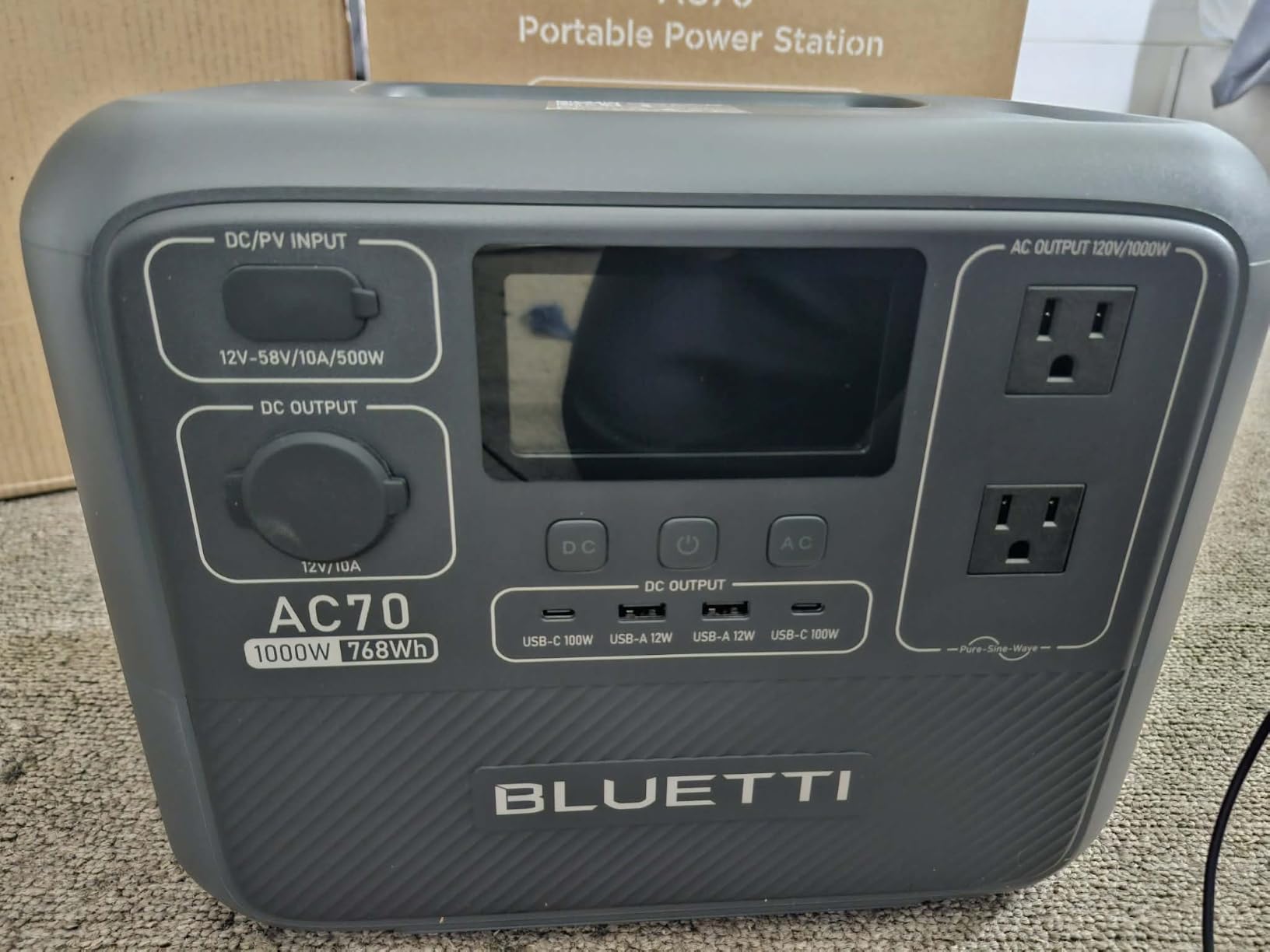
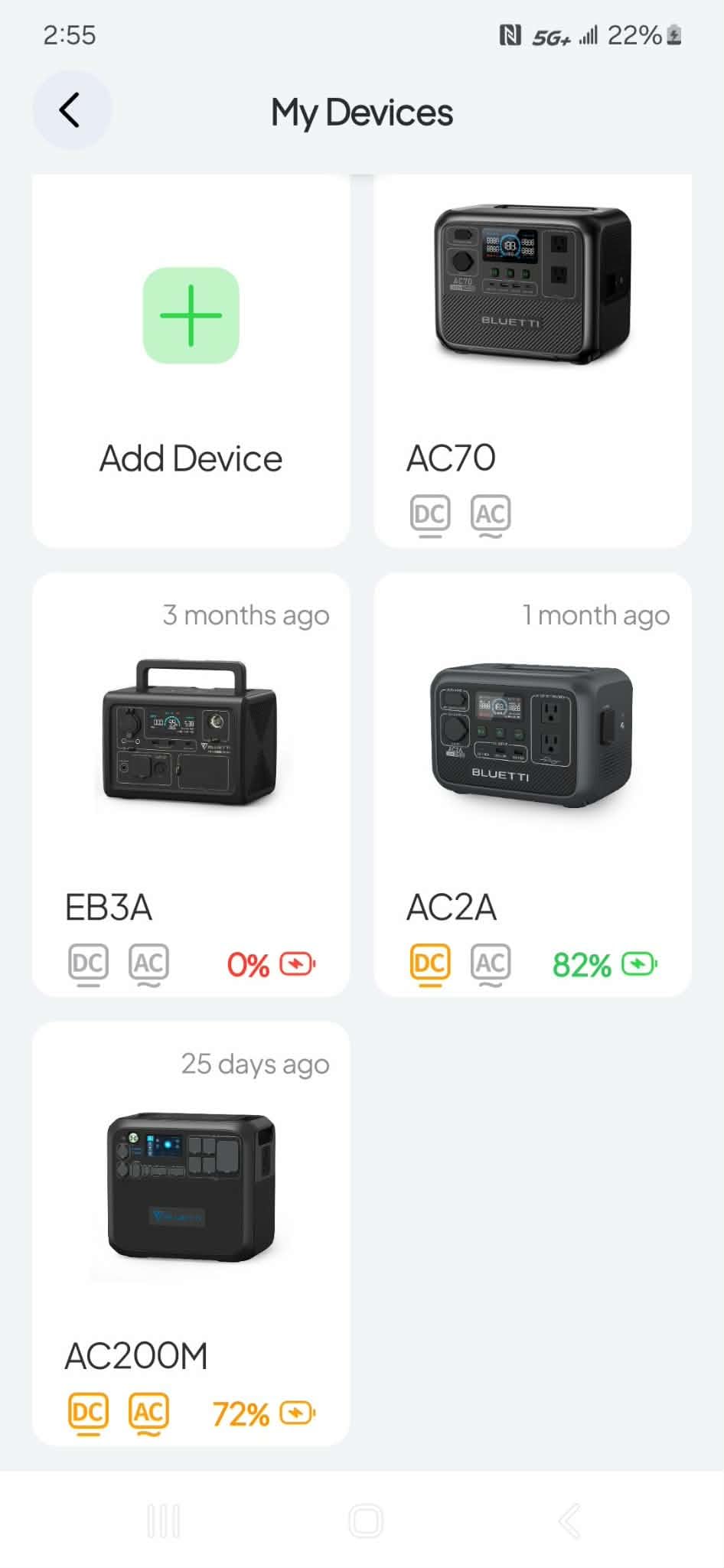
Charging is flexible: 0 to 80% in four hours on solar, a full charge in seven, and a 70-minute full recharge from 1,200W of AC or up to 1,000W of solar input. The BLUETTI app adds WiFi and Bluetooth monitoring with over-the-air updates, so you can check state of charge from a phone across the yard.
At 25 pounds this is the heaviest unit in the guide, and that weight is the reason it stays in the shed rather than the truck bed. Everything else, from the bright screen to the solid XT-60 connectors, reads as a well-built unit intended to sit still and do work.
Loads It Handles Comfortably
With eleven ports this is the pick if your shed doubles as an office or a small shop. A laptop, two monitors, a router, a printer and a lamp are all simultaneous loads that the 1,800W ceiling absorbs without strain, and USB-C charging keeps phones off the AC inverter.
A 32-quart portable fridge or a CPAP machine falls well inside the envelope. Energy use, not wattage, is what runs the battery down, so continuous low-draw appliances are the best use of this capacity.
What to Watch Out For?
There is no high-amperage DC output for RV or tiny-home distribution panels, so anyone wiring this into a structure with 12V circuits needs a separate path. The display also omits granular amp and voltage readings, which annoys people doing their own troubleshooting.
Plan for two deliveries. The power station and the 200W panel arrive separately, and the panel is a standard 200W unit rather than a folding portable, so it needs a real mount. If your roof is metal, our [metal shed guide](https://bansocialism.com/best-metal-sheds/) covers the standoff brackets that make this safe.
We earn a commission, at no additional cost to you. CERTAIN CONTENT THAT APPEARS ON THIS SITE COMES FROM AMAZON. THIS CONTENT IS PROVIDED 'AS IS' AND IS SUBJECT TO CHANGE OR REMOVAL AT ANY TIME.
4. Renogy 200W 12V Monocrystalline Kit – Best Value Expansion Path
Renogy 200W 12V Monocrystalline Solar Panel Kit + 30A PWM Charge Controller
★★★★★★★★★★200W panel
30A PWM controller
1000Wh per day
4-stage charging
- Complete install-ready package with cables and Z-brackets
- 1000Wh per day expected yield for the class
- Reverse polarity
- overcharge
- overload and short-circuit protection
- Expands to 400W
- PWM controller is less efficient than MPPT
- Listing weight and dimension data appear to describe packaging
- Connector listed as barrel rather than MC4
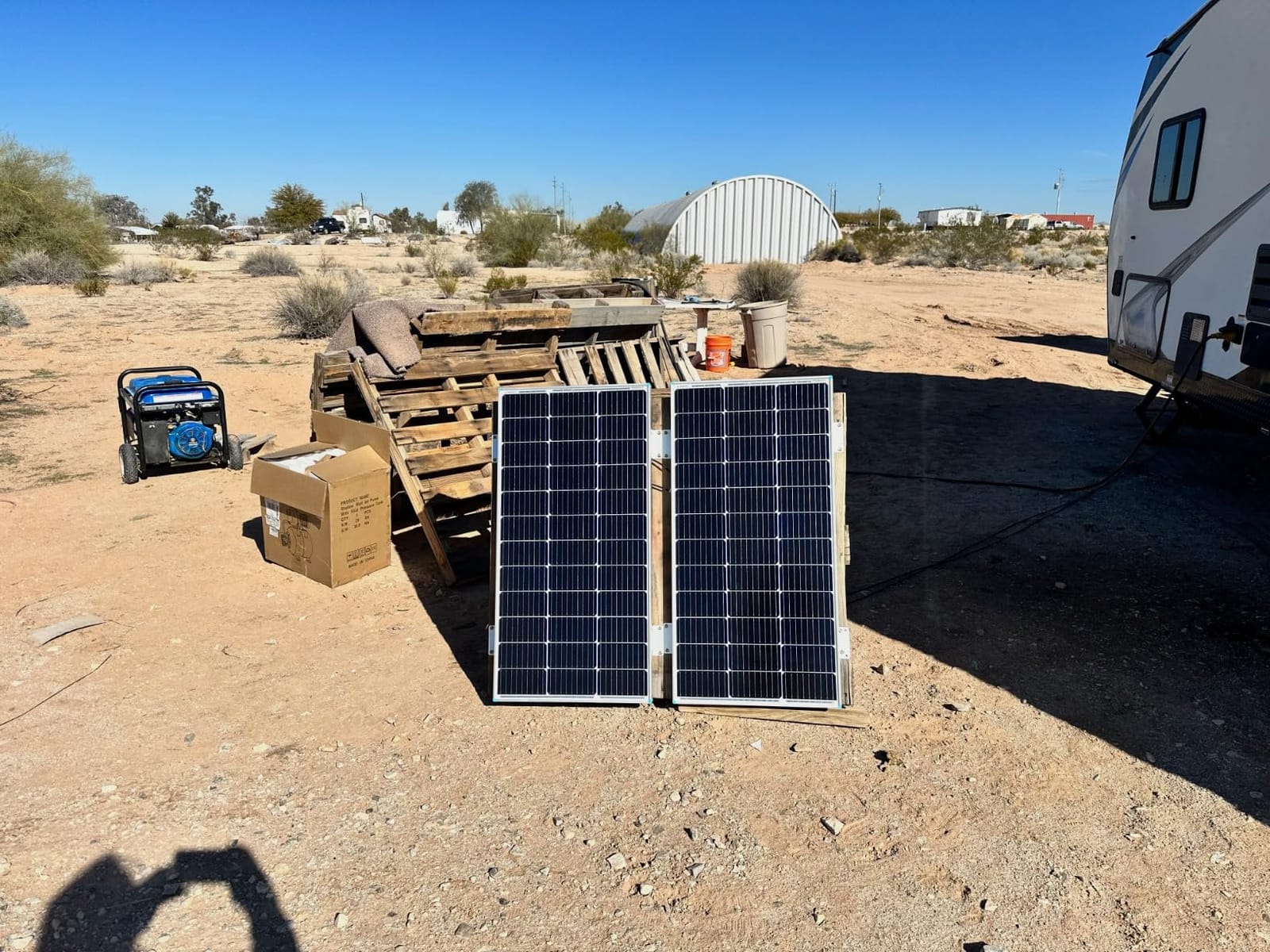
This is the version to buy when lighting alone feels like a waste of a panel. At 200W the Renogy produces about 1,000Wh per day under five hours of direct sun, double the 100W kit, and it costs less per watt. Buyers with 1,542 reviews at 4.6 stars describe it as producing more usable power than they expected.
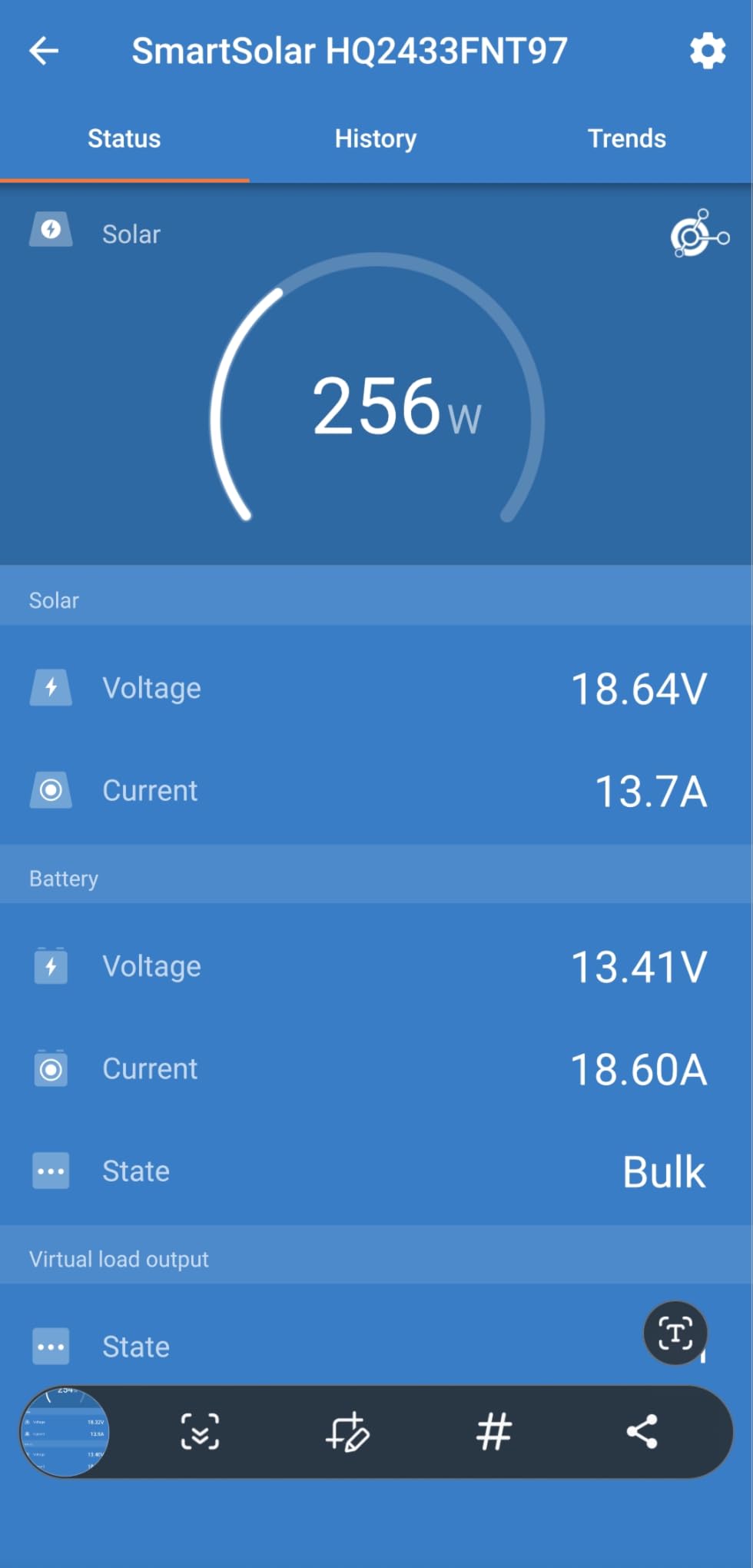
The Wanderer controller runs four-stage charging across bulk, boost, float and equalisation, and includes reverse polarity, overcharge, overload and short-circuit protection. That protection list is longer than most kits at this level, and it matters when the panel lives outside through winter.
Bypass diodes help in mottled conditions, and a TPT backsheet dissipates excess heat so the panel tolerates a hot dark roof better than cheaper laminates. Everything needed to mount and wire is in the box, with pre-drilled holes and Z-brackets.
One thing to know before you order: the listed dimensions and weight describe the packaging rather than the bare panel, so plan your roof space from the physical panel rather than the listing figures. The barrel connector is also less universal than MC4, which limits mixing with other panels later.
Who This Kit Suits Best?
A shed that needs lighting, a laptop, a small fan and tool battery charging across a normal weekend. 1,000Wh per day is comfortable for a single person working alone, and it holds a charge through an overcast day that would flatten a 100W setup.
It is also the more natural first step for anyone who will eventually want 400W, because the expansion path is built in. Starting here and adding a second panel later is cheaper than replacing everything.
Why Not Just Buy MPPT Instead?
Because PWM is cheaper and the gap narrows at low array voltage. At 12V with one or two panels the difference is modest. If you intend to grow to 400W or more, or if your panels sit in partial shade, an MPPT controller recovers meaningfully more energy and pays for itself.
Our 400W MPPT recommendation further down covers that case directly. If you are still unsure, remember the buyer-side consensus from solar forums is simply to start with what you will actually use, and less is more until proven otherwise.
We earn a commission, at no additional cost to you. CERTAIN CONTENT THAT APPEARS ON THIS SITE COMES FROM AMAZON. THIS CONTENT IS PROVIDED 'AS IS' AND IS SUBJECT TO CHANGE OR REMOVAL AT ANY TIME.
5. ECO-WORTHY 200W 12V/24V Kit with Two 100W Panels – Best for 24V Builds
ECO-WORTHY 200 Watts 12 Volt/24 Volt Solar Panel Kit with High Efficiency Monocrystalline Solar Panel and 30A PWM Charge Controller for RV, Camper, Vehicle, Caravan and Other Off Grid Applications
★★★★★★★★★★Two 100W mono panels
30A PWM controller
800Wh per day
Series or parallel
- Panels
- brackets
- controller and cables in one box
- MC4 connectors allow series for 24V or parallel for 12V
- Corrosion-resistant frame rated 2400Pa wind and 5400Pa snow
- IP65 junction box
- 31.6 pound shipping weight makes this a two-person install
- 800Wh figure assumes only four hours of full sun
- PWM rather than MPPT controller
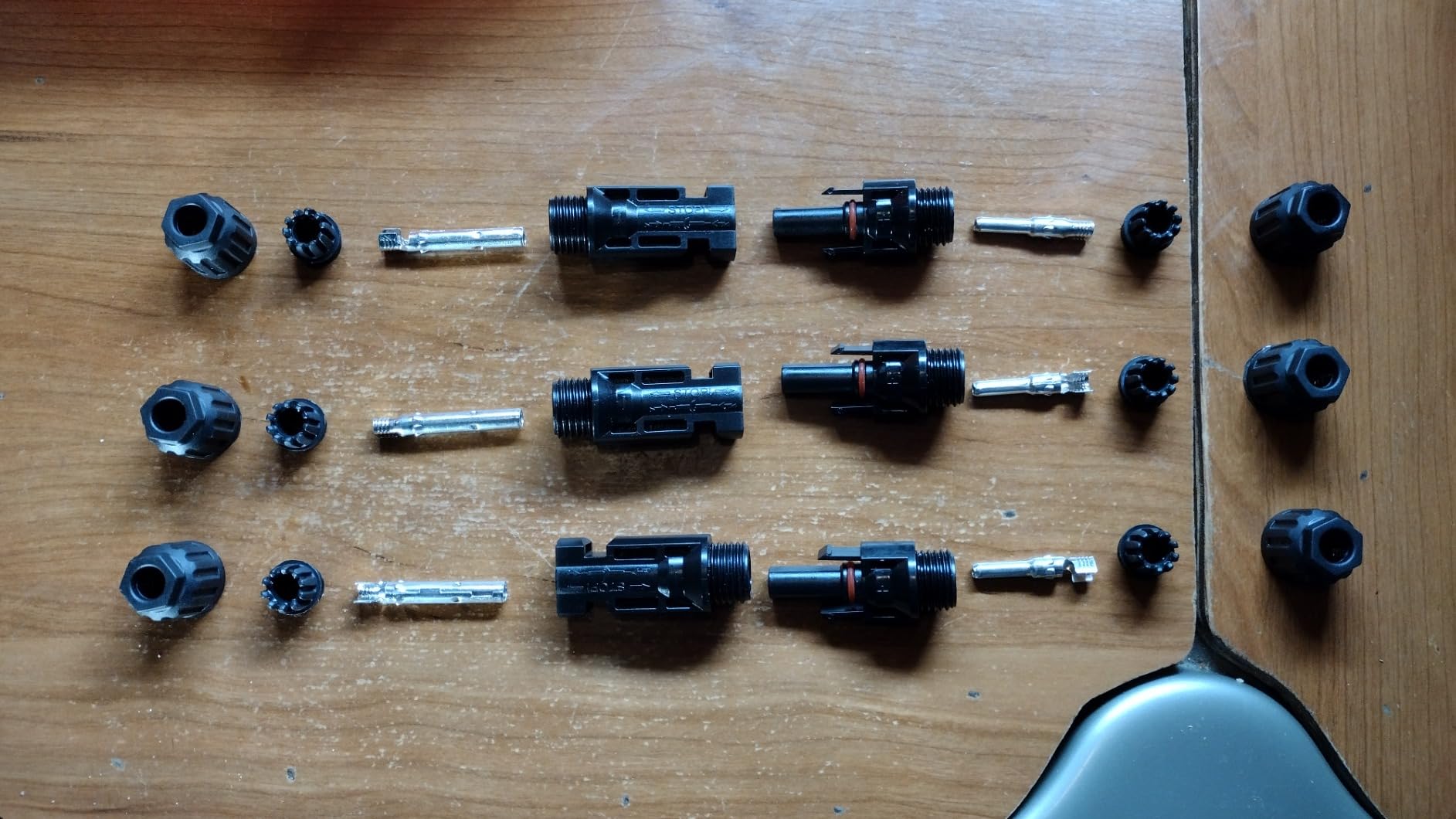
Two panels instead of one is the whole idea here. Each is a 100W monocrystalline unit at up to 21.5% cell efficiency, and the MC4 connectors let you wire them in series for a 24V system or in parallel for 12V. That flexibility is unusual at this level and it lets you start 12V then move to 24V as loads grow.
Rated output is 800Wh per day under four hours of full sun, a slightly more conservative claim than most competitors print, which is a point in its favour. Listing figures that understate tend to survive contact with a real roof.
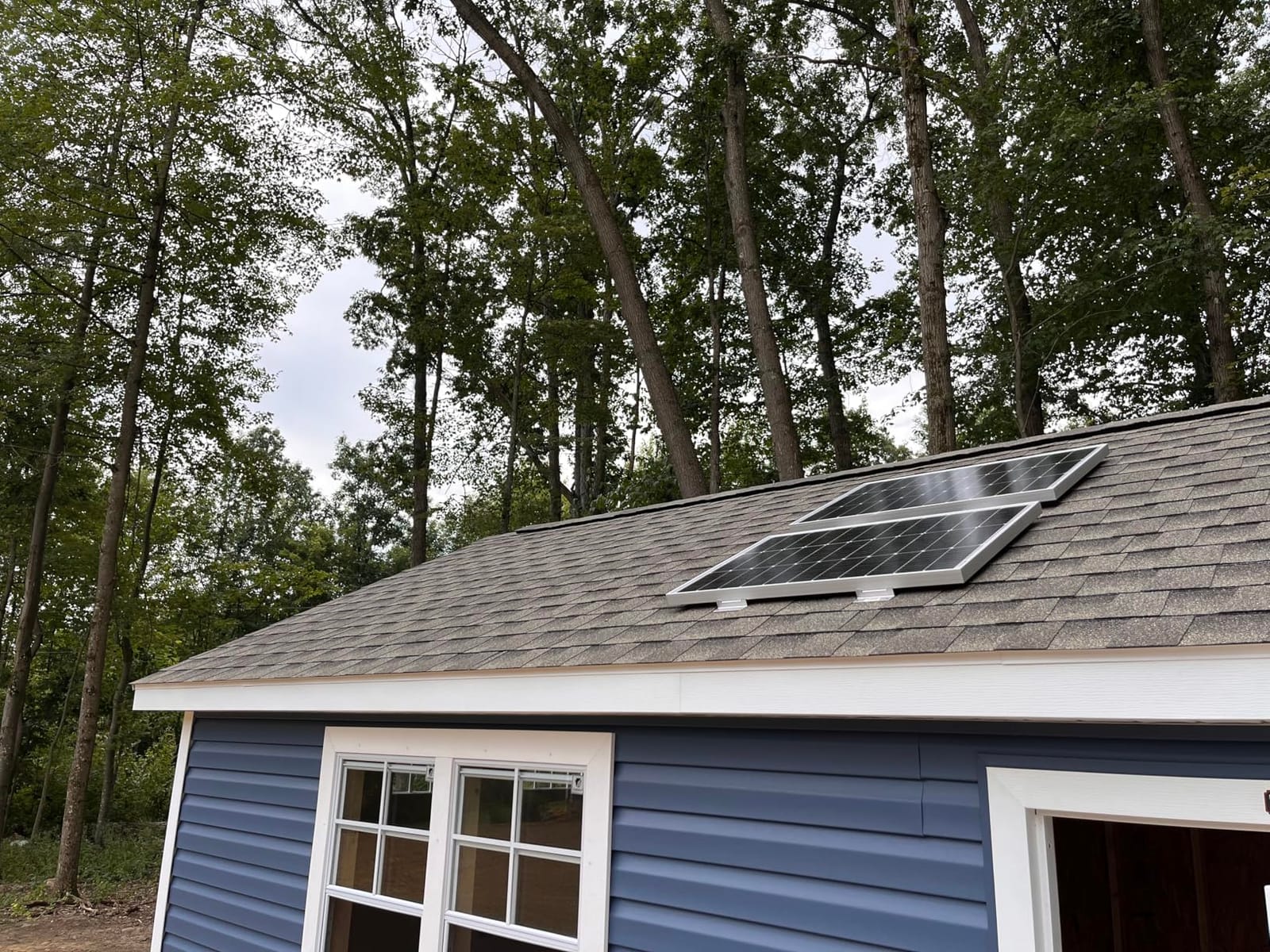
Durability is well specified. The aluminium alloy frame is corrosion resistant, the junction box is IP65, and the panels carry 2400Pa wind and 5400Pa snow load ratings. A maximum voltage of 27.4 volts on each panel keeps the pair comfortably inside the controller’s window in either configuration.
What arrives in the box is unusually complete: two panels, two sets of Z brackets, the 30A controller, 16.4 feet of 10 AWG solar cable, 2-in-1 connectors and a 4.92 foot tray cable. Warranty coverage is one year with 24/7 technical support, which is the shortest in this lineup.
One Panel or Two – The Real Tradeoff
Forum builders debate this constantly, and the consensus is that two smaller panels win on handling while one larger panel wins on cost per watt. Two 100W units are far easier to carry up a ladder, easier to shade and easier to replace individually if one cracks.
The counterargument is that every panel adds a connection, and connections are where failures happen. If you are comfortable with a single rigid panel and have a second pair of hands, one larger unit is simpler.
Watch Out For the Weight and the Warranty
At 31.6 pounds shipped, this is a two-person install and the main reason it trails the single-panel kits on ease of use. Budget an afternoon and a second set of hands rather than a quick lunch-break job.
The one-year warranty is the other concern on a panel expected to last decades. That is why we would add a plan of your own and keep panels covered in snow rather than bare, since warranty terms on long-life panels often depend on correct installation.
We earn a commission, at no additional cost to you. CERTAIN CONTENT THAT APPEARS ON THIS SITE COMES FROM AMAZON. THIS CONTENT IS PROVIDED 'AS IS' AND IS SUBJECT TO CHANGE OR REMOVAL AT ANY TIME.
6. Voltset 100W Kit with 20A Smart Charge Controller – Most Versatile
Voltset 100W 12V Solar Panel Kit with 20A Smart Charge Controller
★★★★★★★★★★100W mono panel
20A controller with LCD
USB and Type-C ports
IP67 frame
- LCD controller shows status in real time
- Built-in USB and Type-C charging outputs
- Works with LiFePO4
- AGM
- Gel
- Flooded and lithium ion
- Pre-drilled holes with all mounting hardware included
- 100W output is modest for a workshop load
- Button-press interface for reading current is not intuitive
- Listed weight of 7.8 kg seems high for a 100W kit
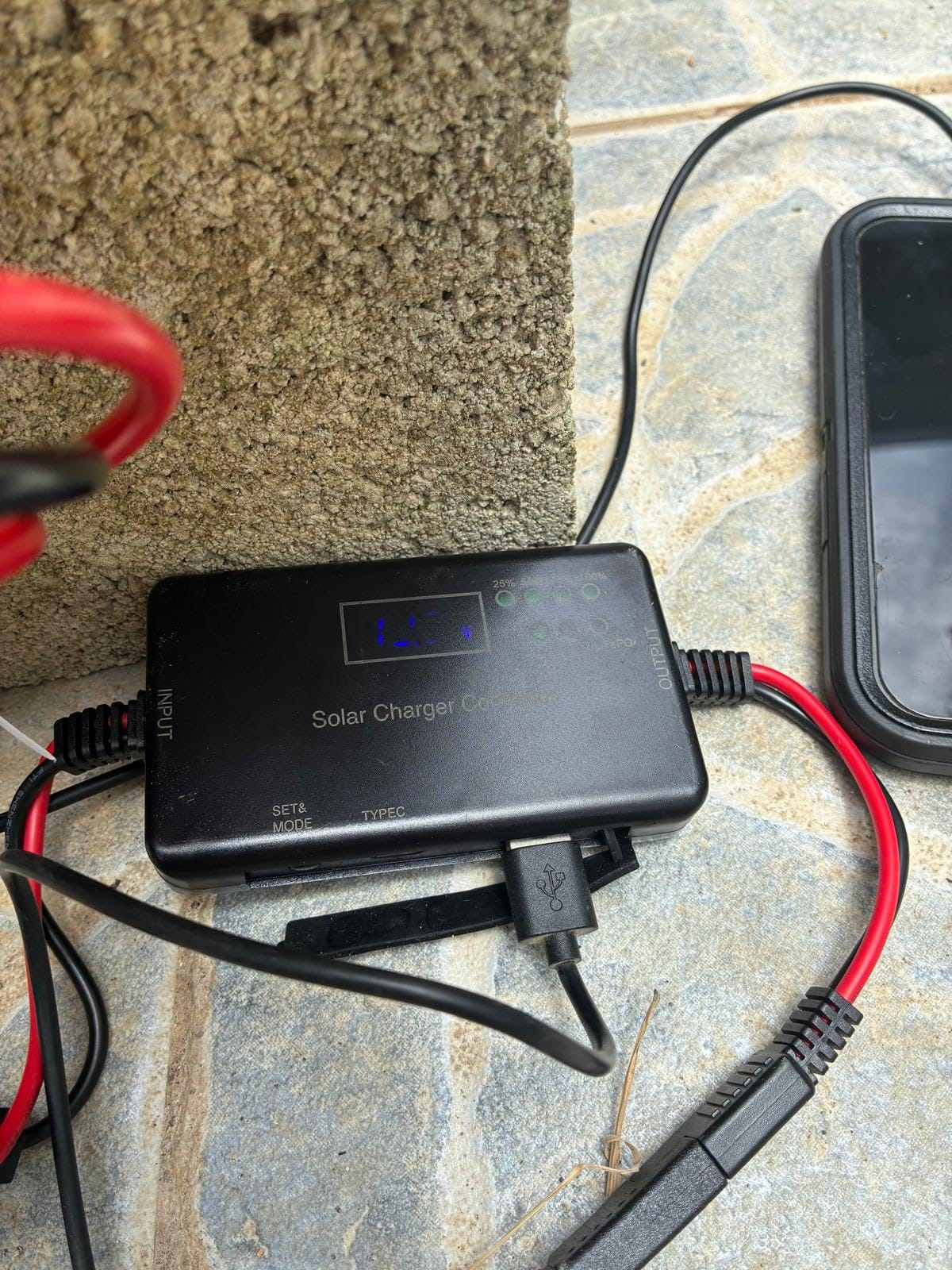
The Voltset differentiates on the controller, and that turns out to matter. A 20A smart controller with an LCD readout plus built-in USB and Type-C ports means you can charge a phone straight from the controller while the panel feeds the battery. For a shed light-and-charging use case, that removes a power bank from the shopping list.
Roughly 500Wh per day from the 100W monocrystalline panel, with high-transparency glass chosen for better light capture. Protection circuits cover overcharge, overvoltage, overcurrent, short circuit, reverse polarity and overheating, which is the broadest safety list we saw at this wattage.
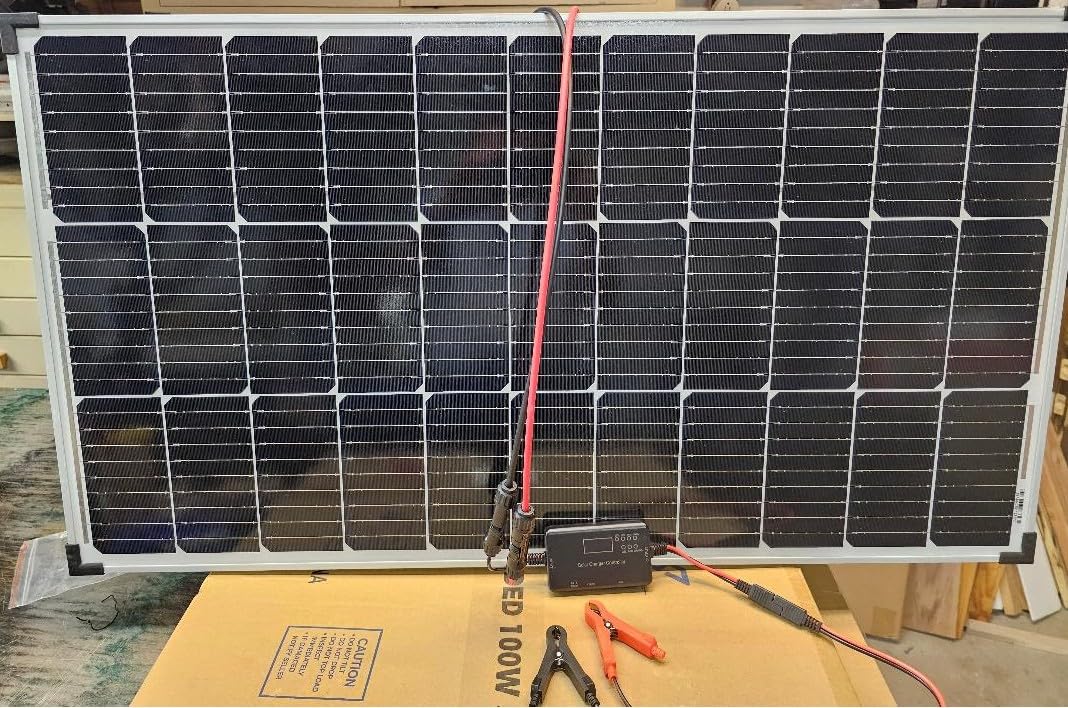
The frame is the quiet strength. IP67 waterproof, rustproof, dustproof and wind resistant, with a claimed service life of up to 25 years, so it can sit on an exposed wall or a roof edge without a sheltered housing.
Everything needed is included: panel, controller, an alligator clip cable and four Z brackets, with pre-drilled holes for a genuinely tool-light installation. Battery chemistry is broad, covering LiFePO4, AGM, Gel, Flooded and lithium ion.
Best Fit for a Lighting-Only Shed
A garden store, a bike shed, a pool house or a chicken coop. This is where a 100W panel and a controller with USB outputs is genuinely sufficient, and where paying for MPPT or a bigger array would be wasted.
It also works well as a second gathering point: one controller feeding lights in the shed, another feeding a battery bank in the workshop, both on the same 12V bus.
Where the Budget Shows?
Reading live current means pressing buttons to cycle the display, which sounds trivial until you are doing it in the dark at the back of a shed. The 100W ceiling is also the reason this is a budget pick and not a workshop pick.
Check the listed weight before planning a ladder job. At 7.8 kg the figure is higher than comparable 100W kits, and if the installation is above head height it is worth confirming the actual panel weight with the manufacturer.
We earn a commission, at no additional cost to you. CERTAIN CONTENT THAT APPEARS ON THIS SITE COMES FROM AMAZON. THIS CONTENT IS PROVIDED 'AS IS' AND IS SUBJECT TO CHANGE OR REMOVAL AT ANY TIME.
7. SOLPERK 20W 12V Maintainer Kit – Best for Battery Maintenance
SOLPERK Solar Panel Kit 20W 12V Solar Battery Charger Maintainer+Controller
★★★★★★★★★★20W mono panel
8A three-stage controller
360-degree bracket
12V battery maintainer
- Proven with 3785 reviews at 4.5 stars
- Two indicator lights show charge status clearly
- 360-degree bracket holds the best angle without drilling
- Reliable in overcast conditions
- Cables are long enough for most installs
- 20W maintains rather than meaningfully recharges a battery
- Included cable can be short for roof mounting
- Cannot recover a deeply discharged battery in one day
This is not a power kit and we will not pretend otherwise. Twenty watts exists to hold a 12V battery at full charge through weeks of sitting, which is a genuinely useful job for lawn equipment, a boat, a mower, an electric fence or a camper stored between trips.
What earns it a place in this guide is the evidence base. At 3,785 reviews and 4.5 stars it is one of the most proven items here, and reviewers report dependable cloudy-day charging over years of service, which is exactly the durability a maintainer needs.
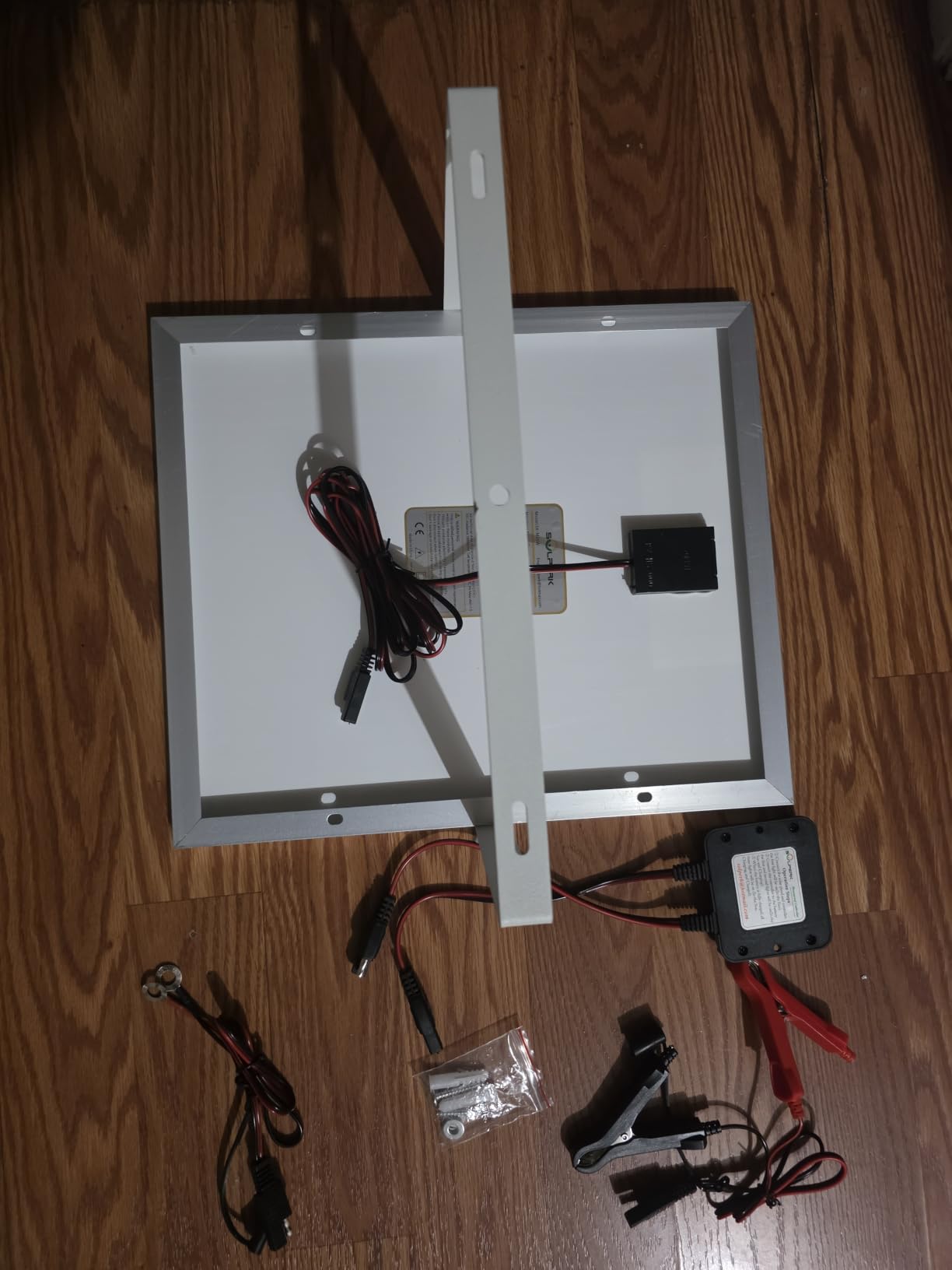
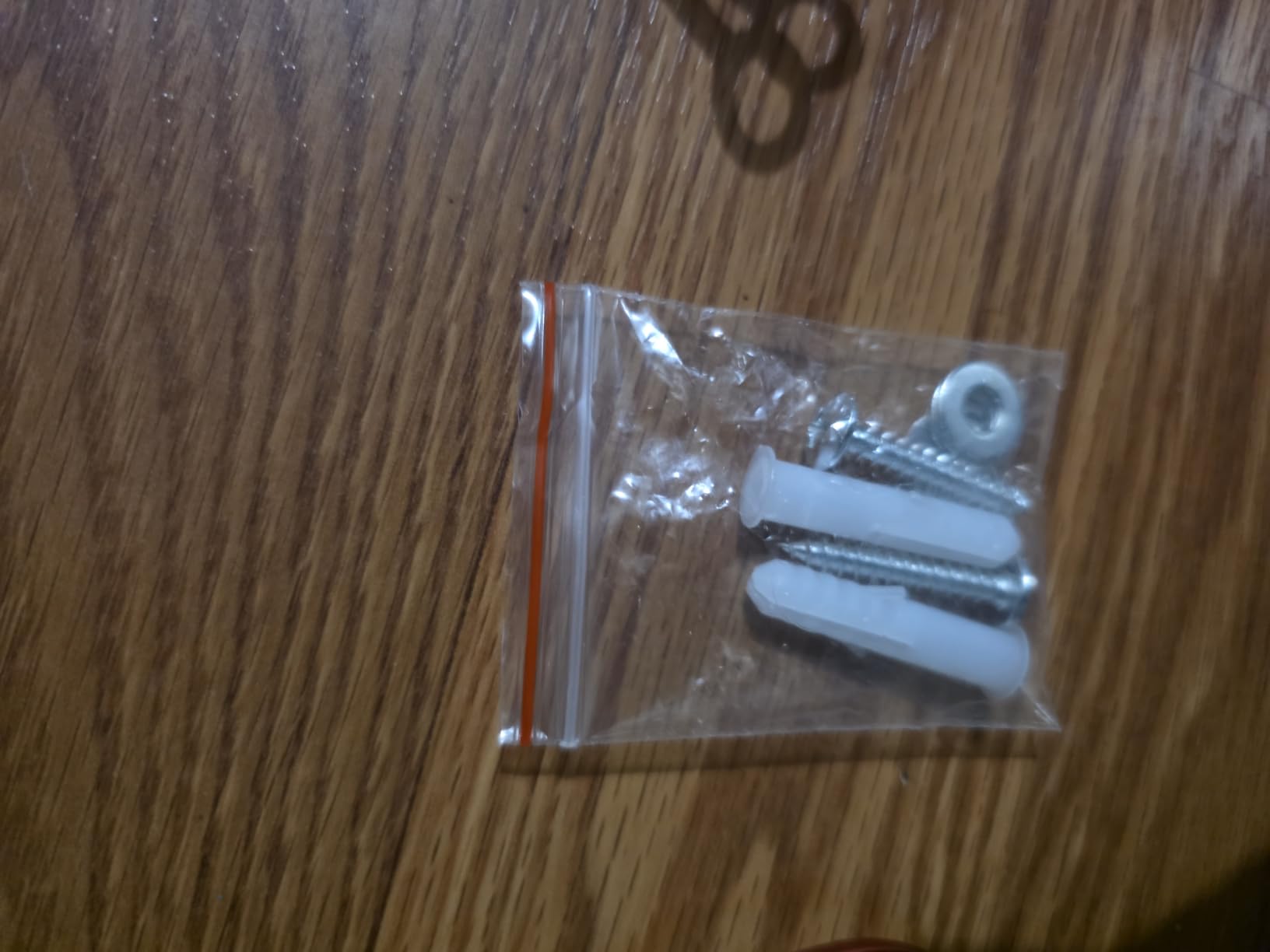
The 8A controller uses three-stage charging and claims 20 to 30% higher charging efficiency than comparable controllers. The cells are monocrystalline A grade at 21 to 30% conversion efficiency, behind low-iron tempered glass in a corrosion-resistant aluminium frame.
Weathering is well handled: rated for 2400Pa wind pressure and 5400Pa snow load, waterproof and rustproof. That rating matters more than it sounds, because a maintainer is by definition mounted somewhere exposed all year.
What It Is Genuinely Good At?
Topping off a battery that is already near full, and offsetting parasitic drain on a stored vehicle or RV. Overcast reliability is the practical strength, since a maintainer that only works in July is not a maintainer.
It also suits a small trailer or a solar-powered fence unit where the load is a few watts and the duty cycle is intermittent. The 360-degree adjustable bracket with pre-drilled holes makes placement fast.
What It Cannot Do?
Recover a depleted battery. At 20W you are looking at roughly 100Wh per day in good sun, so bringing a flat 50Ah battery back to life takes weeks rather than days. Reviewers who expected a trickle charger for a deeply discharged battery are the ones who return it.
Also check cable length against your mounting point. Some installs need more than the included lead reaches, and running a thin extension to a roof is exactly the situation where power drops away.
We earn a commission, at no additional cost to you. CERTAIN CONTENT THAT APPEARS ON THIS SITE COMES FROM AMAZON. THIS CONTENT IS PROVIDED 'AS IS' AND IS SUBJECT TO CHANGE OR REMOVAL AT ANY TIME.
8. Jackery Solar Generator 1000 v2 with 200W Panel – Best for Mobile Setups
Jackery Solar Generator 1000 v2 and 200W Solar Panel,1070Wh,1500W AC
★★★★★★★★★★1500W output,3000W surge
1070Wh LiFePO4
Three pure sine wave AC ports
23.8 pounds
- Ran a full-size fridge for 9 hours on a single charge
- Quiet with no fumes and light enough for one person
- Panel and station charge while powering a load
- Well built with no loose ports
- 5 year coverage with responsive support
- 200W foldable panel sags and needs propping
- Short included panel-to-station cable limits placement
- Panel needs frequent repositioning to follow the sun
Jackery built this for people who carry power around, and that shows. At 23.8 pounds with a foldable handle it is the most portable full-size unit here, and the 1,070Wh LiFePO4 battery with 1,500W of pure sine wave AC output covers the loads a tradesperson actually carries between jobs.
Real-world runtime figures from owners are the strongest endorsement: a full-size fridge for nine hours, a 32-quart portable fridge for three days, plus trailer lights, a microwave and a television. That is a working day away from a wall.
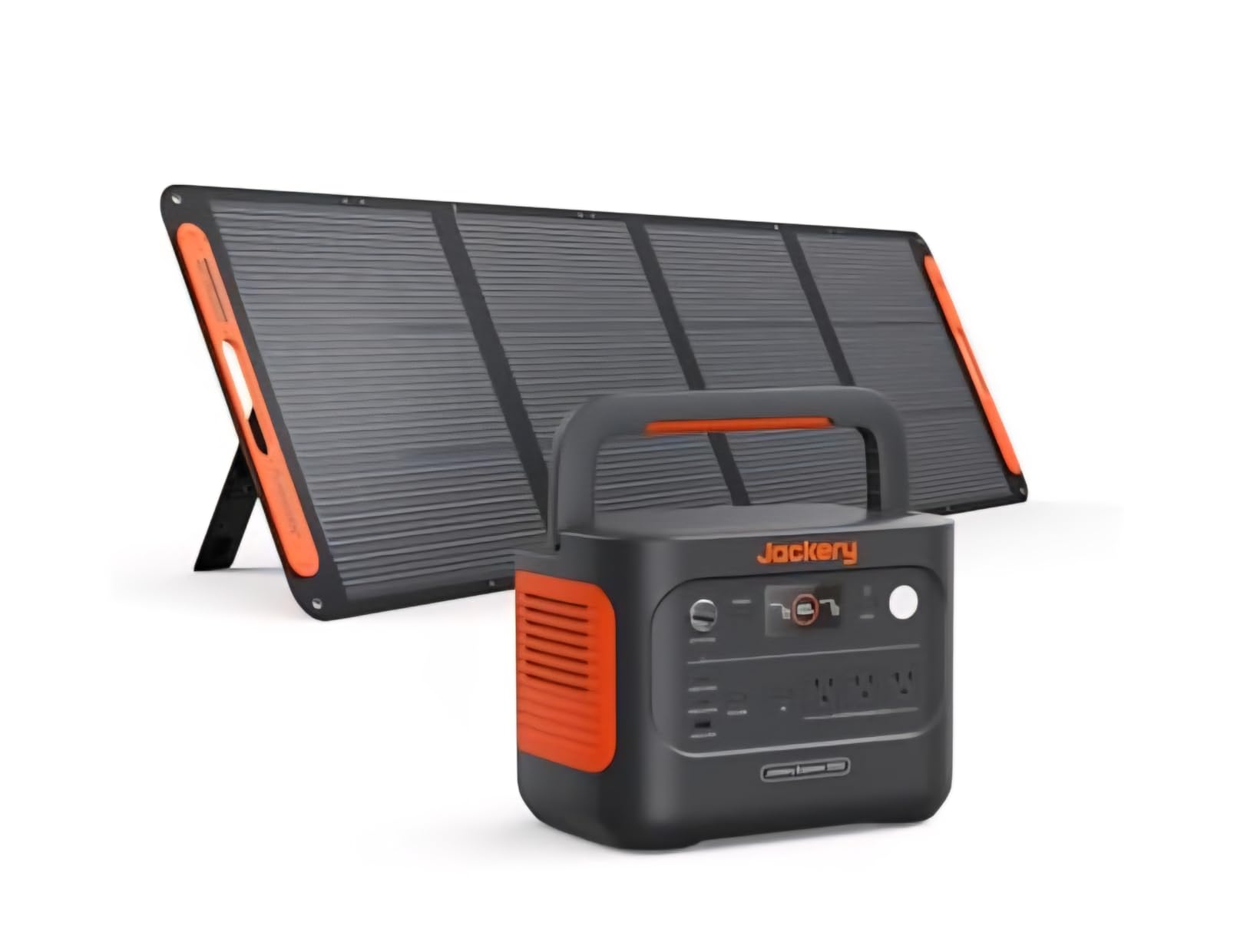
Three pure sine wave AC outlets matter here. Modified sine wave output causes humming, heat and unreliable starts in sensitive motors and some tool chargers, so a true sine wave inverter removes an entire category of workshop frustration.
Charging is flexible: 0 to 100% in one hour with emergency charging enabled, 1.7 hours by default to protect battery health, a three-hour full charge from a 600W alternator, or 80% in six hours from the bundled 200W panel. A 30dB quiet mode handles overnight charging indoors.
Why It Suits a Mobile Workshop?
The panel and the station can charge at the same time while a load runs, so the unit can top itself up during a lunch break rather than sitting idle. That single feature changes how you plan a day when the van is your workshop.
For a fixed shed this panel is not the right choice, since a foldable panel cannot be permanently roof-mounted. As a temporary top-up for a battery already installed, though, it is efficient.
The Panel Is the Weak Link
Owners repeatedly describe the foldable panel as floppy, sags in the middle and blows over unless propped. It also needs re-aiming through the day, and the included station cable is short, which constrains where you can put the two pieces.
The advertised one-hour charge requires turning on emergency charging in the app, and that setting reduces long-term battery life. Leave it off unless you genuinely need the speed.
We earn a commission, at no additional cost to you. CERTAIN CONTENT THAT APPEARS ON THIS SITE COMES FROM AMAZON. THIS CONTENT IS PROVIDED 'AS IS' AND IS SUBJECT TO CHANGE OR REMOVAL AT ANY TIME.
9. Renogy 400W Premium Kit with 40A MPPT Controller – Best for Maximum Harvest
Renogy 400Watt Premium Solar Kit with 40A MPPT Charge Controller
★★★★★★★★★★400W across four 100W panels
40A MPPT Rover controller
Bluetooth module included
- MPPT harvests noticeably more power in changing light
- 400W gives real headroom for workshop loads
- Bluetooth module and Z-brackets included so the kit is complete
- Phone monitoring makes remote status checks easy
- Maximum battery voltage of 32V
- 56.4 pounds makes mounting a two-person job
- Costs well above the smaller Renogy kits
- Roof mounting hardware may need buying separately
This is the array to buy if you already know you need serious power. Four 100W monocrystalline panels give 400W total, and the 40A MPPT Rover controller harvests meaningfully more of it than a PWM unit, particularly when light shifts through the day or part of the array sits in shade.
The controller also accepts up to 32V on the battery side, which means this kit can sit on a 24V bank. That is the most direct route in the guide to a higher-voltage system without changing every component you already own.
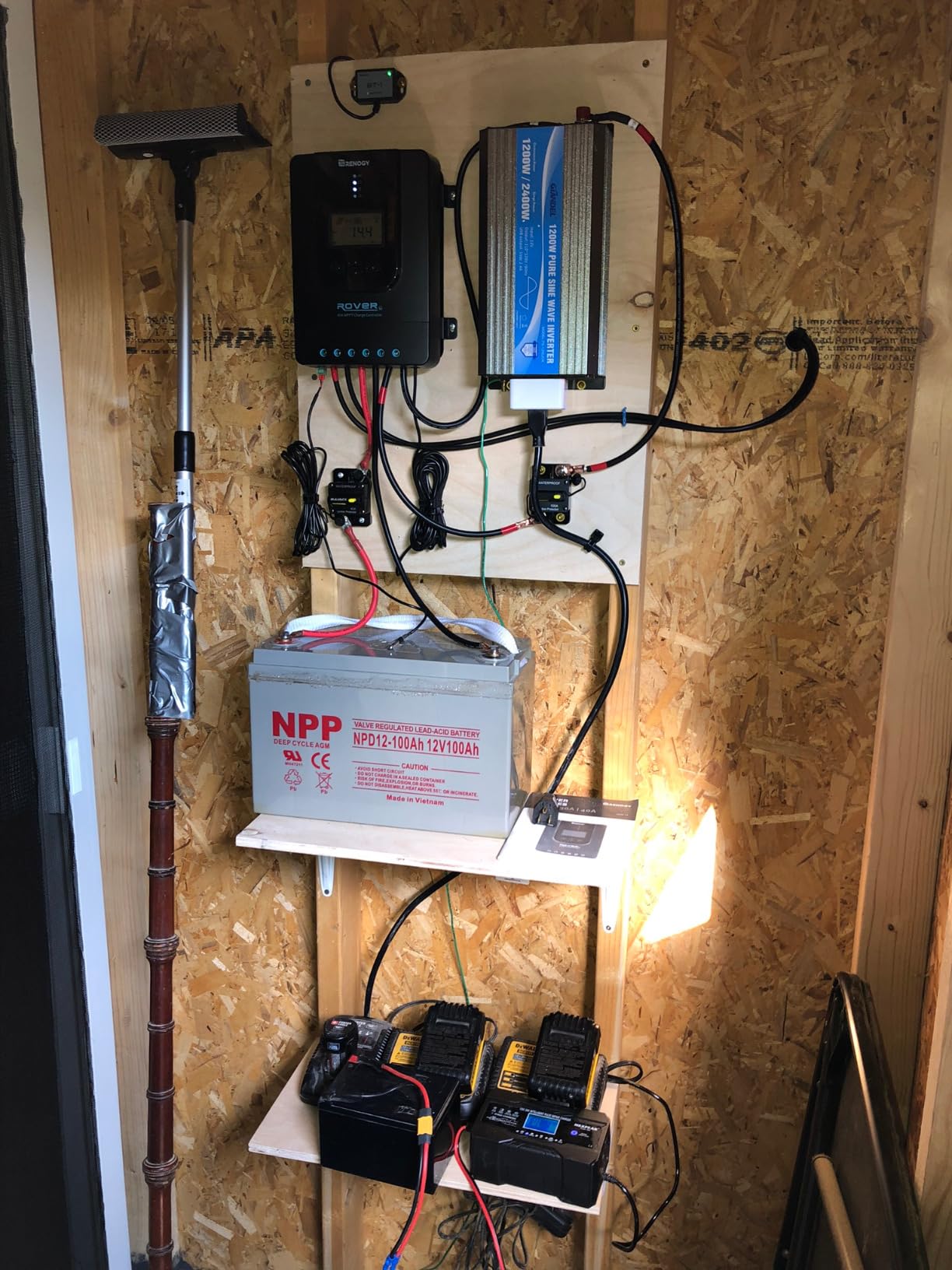
Everything needed to finish the install is included, which is rare at this size: Z-brackets, an adaptor kit, tray cable and a Bluetooth module for phone-based monitoring and adjustment. The module is a genuine differentiator because most kits make it an upsell.
With 577 reviews at 4.5 stars, owners consistently single out the MPPT efficiency and the included monitoring. The repeated complaint is not the electronics but the physical work of lifting and mounting four rigid panels.
What 400W Changes in Practice?
Roughly 1,600 to 2,500Wh per day depending on sun and angle, which is enough to keep a battery bank topped up while charging tool batteries, running a laptop and powering a small compressor on a schedule. Panel wattage becomes the constraint rather than battery capacity.
Four panels also give options. Two on a shed roof and two on a nearby wall is more realistic than cramming all of them onto a small roof, and a partly shaded string is exactly the case where MPPT earns its cost.
Before You Commit to This One
At 56.4 pounds, mounting is a two-person job and probably needs roof-safe access equipment. If your structure cannot take four panels with standoff, a 200W kit plus a power station is the more sensible purchase.
Also budget the missing electrical parts. This kit has no battery, no inverter and no breakers, so the actual cost of a working system is meaningfully higher than the panel price suggests.
We earn a commission, at no additional cost to you. CERTAIN CONTENT THAT APPEARS ON THIS SITE COMES FROM AMAZON. THIS CONTENT IS PROVIDED 'AS IS' AND IS SUBJECT TO CHANGE OR REMOVAL AT ANY TIME.
10. GVSHINE 30W Kit with 115Wh Battery and LED Bulbs – Best for Shed Lighting Only
30W Solar Panel Kit 115WH Backup Battery with Phone Charger and AC to DC
★★★★★★★★★★30W flexible panel
115Wh battery pack
Four LED bulbs
5V 2A USB output
- Very bright bulbs that light a whole shed or barn
- Long cords with inline switches make bulb placement easy
- Multiple USB ports charge several phones at once
- Panel recharges the pack in about three hours of good sun
- Metal frame and battery case feel durable
- Short warranty and USB ports failing within about a year
- Inline switches sit at the battery box rather than the bulb
- No master cut-off so the pack self-discharges in storage
- Panel sections must be disassembled to store
Some sheds do not need power, they need a light. This is the simplest answer in the guide: a 30W flexible panel, a 115Wh backup battery, four LED bulbs and phone charging, with no wiring to run and no controller to configure.
Run times are the useful spec here. Two 2W bulbs run 13 to 14 hours, two 3W bulbs run 10 to 12, and all four together run 8 to 9. For a typical evening in a shed that is more than enough.
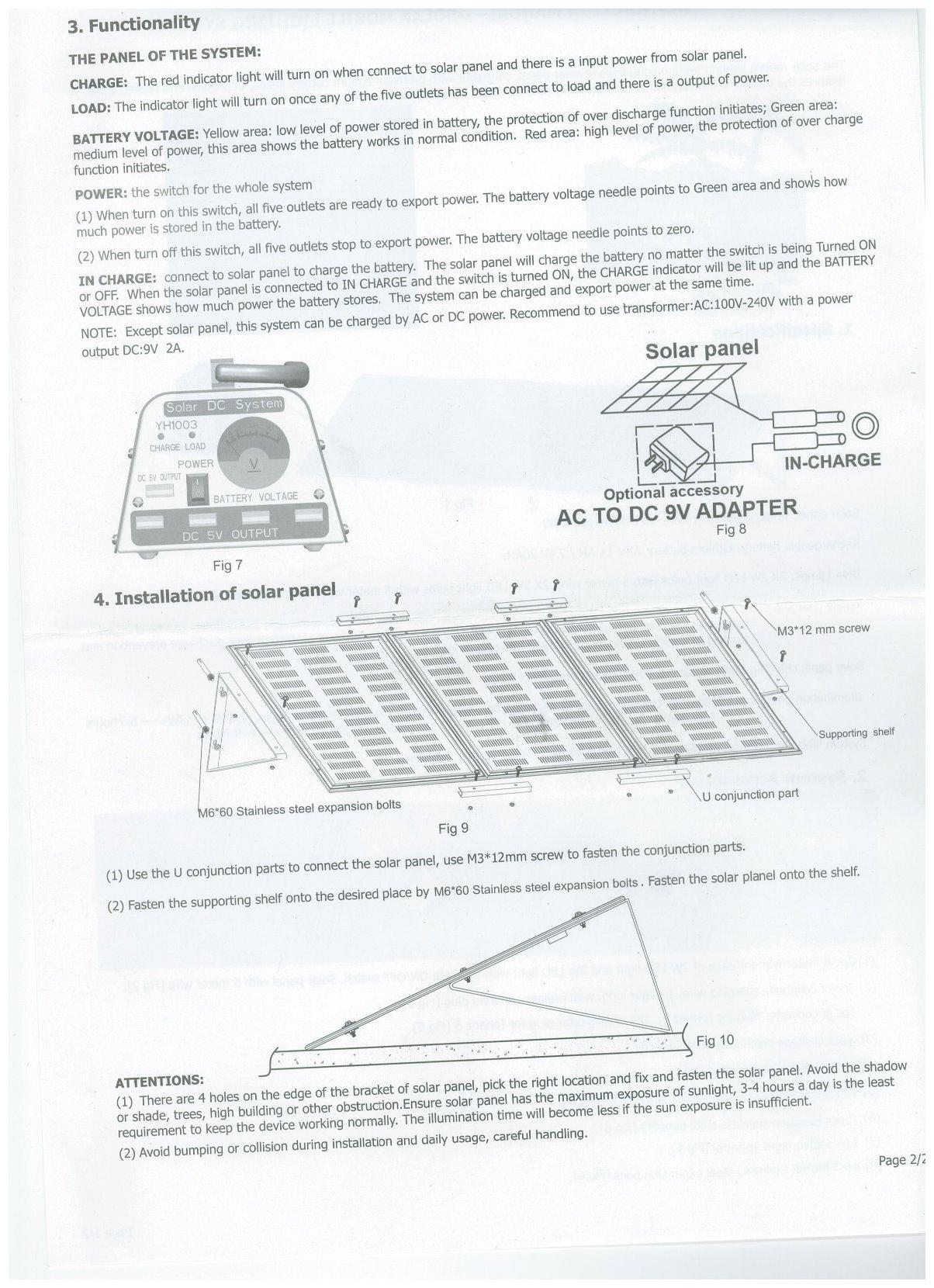
The flexible panel is the reason it works so many places. It conforms to curved roofs, RVs, trailers, vans, trucks, boats, cabins and tents, so a metal or plastic building with an awkward surface is not a problem. Adhesive mounting takes minutes.
The kit also includes 2W and 3W LED bulbs, iPhone 8 and Android Lightning adapters, and three cords with inline on/off switches. Owners with years of daily use report lighting sheds, barns and cabins and keeping phones topped up.
When This Is Exactly the Right Kit?
A garden shed with no power, a market stall, a campsite, a boat or a cabin where lighting is the only load. Installing a 100W panel and wiring a controller would be over-engineering for the job, and this gets the space lit the same day it arrives.
The 5V 2A universal output also charges power banks and small fans, which extends its usefulness well beyond lighting for very little extra effort.
Where It Falls Short?
The recurring weakness is component durability. Multiple reviews describe USB ports and the battery pack failing after six to eighteen months of regular use, and the warranty is short enough that those failures land on you.
Two smaller annoyances add up: the inline switches sit at the battery box rather than at each bulb, and there is no master cut-off, so the pack slowly drains in storage. The panel is also rigid sections rather than genuinely foldable, so plan the storage space before the first winter.
We earn a commission, at no additional cost to you. CERTAIN CONTENT THAT APPEARS ON THIS SITE COMES FROM AMAZON. THIS CONTENT IS PROVIDED 'AS IS' AND IS SUBJECT TO CHANGE OR REMOVAL AT ANY TIME.
11. MARBERO 237Wh Solar Generator with 60W Panel – Best for Light Duty Backup
MARBERO 237Wh Solar Generator with Solar Panel Included Portable Power Station 300W Pure Sine Wave with Foldable Solar Panel 60W Set for Camping Outdoor Hiking Fishing Emergency
★★★★★★★★★★237Wh battery
300W pure sine wave,375W peak
60W foldable panel
USB-C PD output
- Complete set with a panel included at the low end of the range
- Pure sine wave output is cleaner than most budget alternatives
- Good port selection including USB-C PD and 12V DC
- Built-in flashlight with strobe and SOS modes
- Weighs 9 pounds and carries easily
- Lowest star rating here at 4.1 with 12 percent one-star reviews
- 237Wh and 300W are too small for workshop loads
- 60W panel recharges very slowly
- Runtimes near an hour at full draw
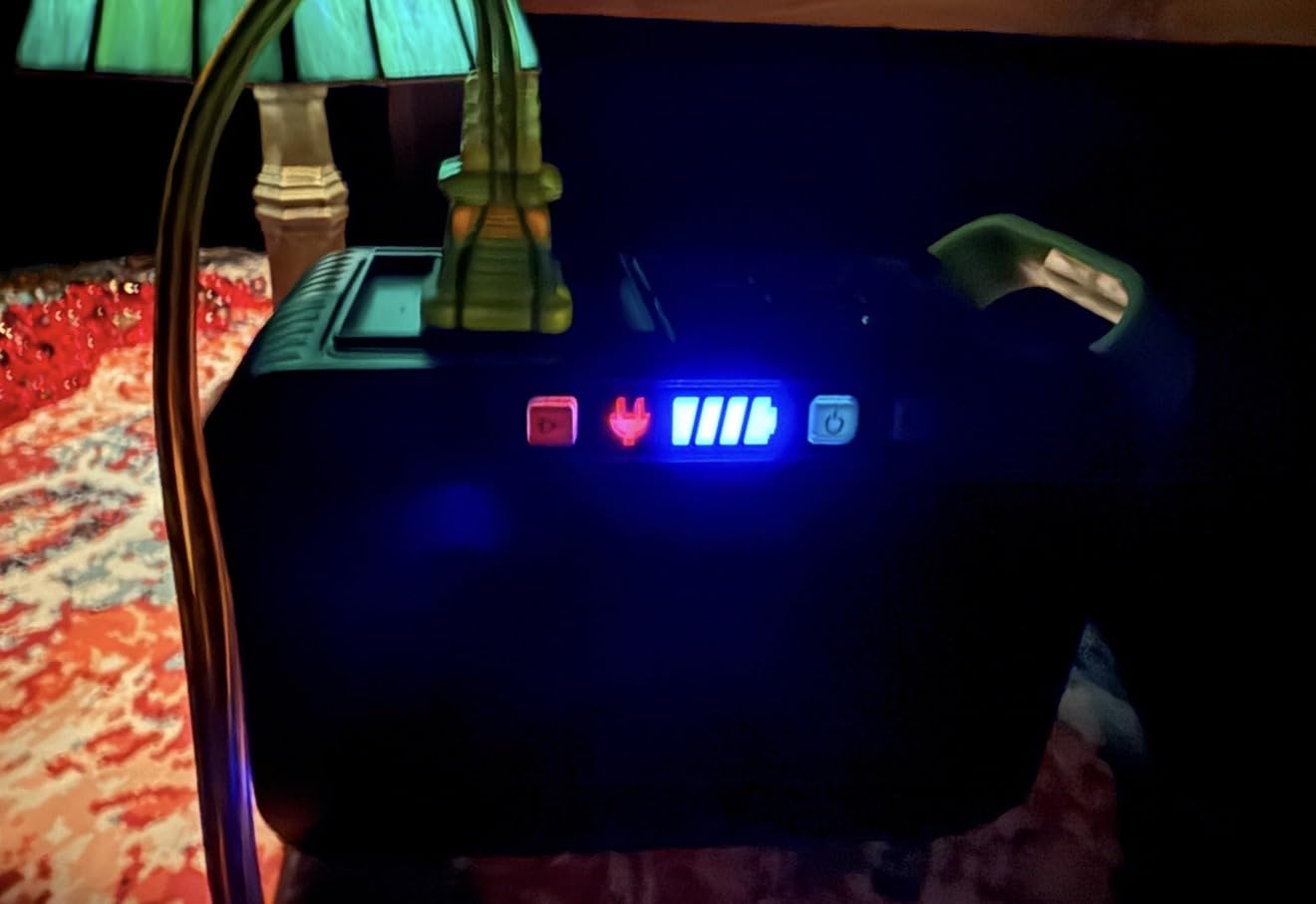
With 9,250 reviews this is the most examined product in the guide, and at 4.1 stars it is also the most polarised. Buyers love the completeness of the package, the pure sine wave outlets and the flashlight, while a 12 percent share of one-star reviews reflects frustration with capacity and charging speed.
The specification is 237Wh, or 64,000mAh, with 300W of pure sine wave AC output and a 375W peak. Two AC outlets cover both two-prong and three-prong plugs, which is more than most units this size manage.
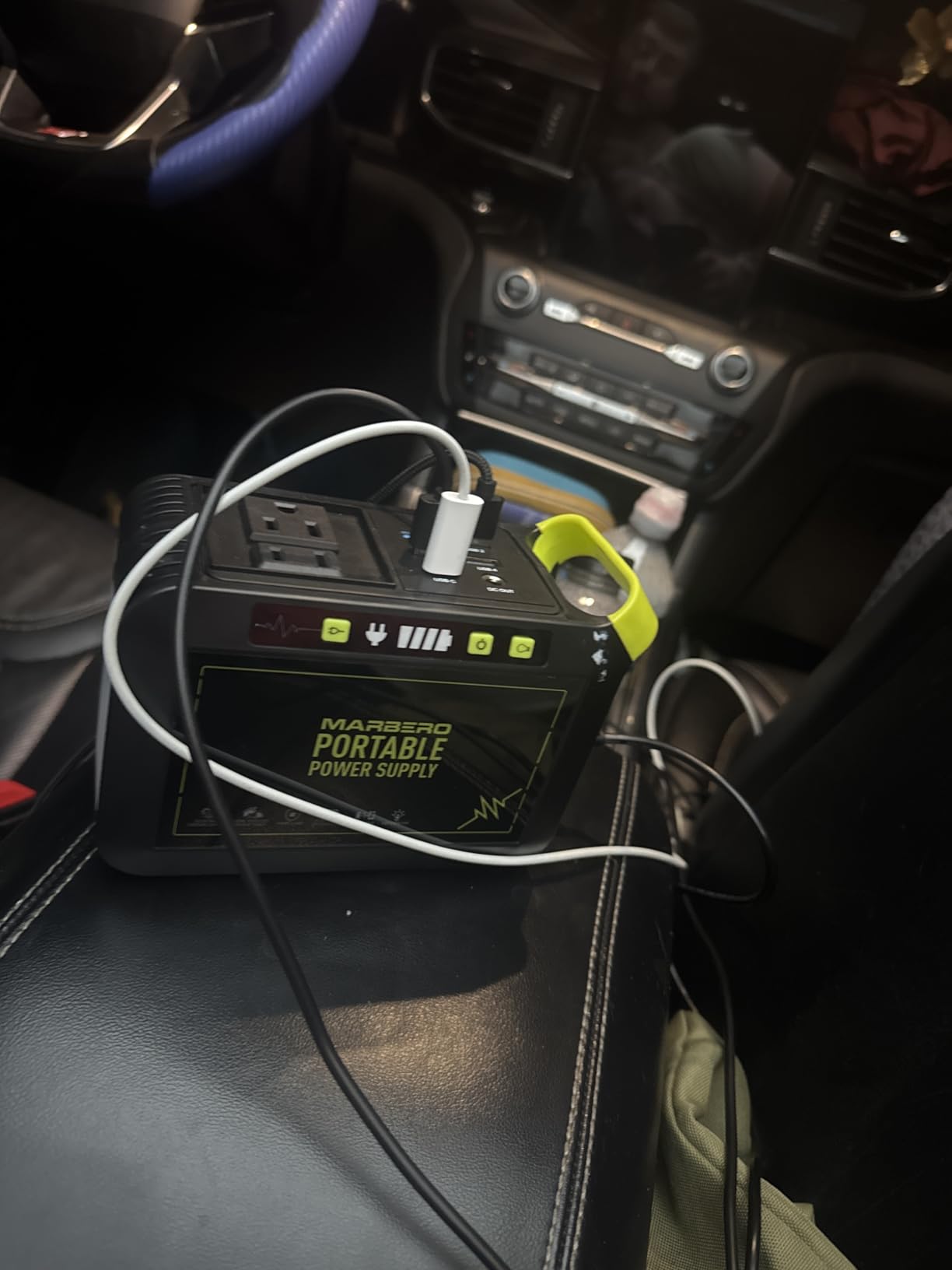
Port selection is genuinely generous for the class: two USB-A QC3.0 ports, two further USB-A, one USB-C PD and a 12 to 16.8V DC output rated to 10A. The LED flashlight with strobe and SOS modes is a small thing that earns its place in an emergency kit.
At 9 pounds it is the most portable unit here by a wide margin, and the 12-month warranty with round-the-clock customer service is at least stated clearly. Our [portable solar kit guide](https://bansocialism.com/best-rv-solar-kits/) covers comparable small units in more depth.
What 237Wh Actually Covers?
Phones, cameras, laptops, a radio, a small fan and lights. Runtime at full draw is around an hour, so treat it as emergency and weekend power rather than a workshop supply. A 32-quart portable fridge is well outside its comfort zone.
The 60W foldable panel charges at 21.5 to 23.5% conversion efficiency with a smart charging chip, but recovering 237Wh from a 60W panel takes the best part of a full day. It is a trickle refill, not a fast recharge.
Why the Rating Is Lowest Here?
Most one-star reviews describe the same thing: expectations set by the port count rather than by the battery size. A unit that offers eleven ways to plug in reads as bigger than it is, and the gap between expectation and runtime is where the returns come from.
If you need a genuine off-grid workshop supply, spend up to a unit with more than three times the capacity. If you need a grab-and-go emergency pack that fits in a backpack, this is the one to buy.
We earn a commission, at no additional cost to you. CERTAIN CONTENT THAT APPEARS ON THIS SITE COMES FROM AMAZON. THIS CONTENT IS PROVIDED 'AS IS' AND IS SUBJECT TO CHANGE OR REMOVAL AT ANY TIME.
12. Anker SOLIX C300 with 60W Solar Panel – Best for Quiet Indoor Workshop Use
Anker SOLIX C300 Portable Power Station with 60W Solar Panel, 288Wh, 300W
★★★★★★★★★★288Wh LiFePO4
300W output,600W surge
Eight ports
25dB operation
- Compact 288Wh and 300W unit with eight ports
- Very quiet at 25dB which suits an indoor workshop
- Reaches 80 percent in 50 minutes from a wall outlet
- LiFePO4 rated for 3000 cycles with a 5 year warranty
- One of the smallest 300W-class power stations
- 288Wh capacity gives short runtime on higher-draw tools
- Not compatible with Anker PS30
- PS200 or PS400 panels
- 60W panel is a trickle refill rather than a recharge
- Carry strap sold separately
The C300 is the smallest 300W-class unit in the guide, at 6.45 by 6.34 by 9.49 inches and 15.5 pounds. That footprint is the reason it wins here: it fits on a bench in a garden office or a shed without dominating the space.
Output is 300W continuous with 600W surge from a 288Wh LiFePO4 pack rated for 3,000 cycles, covered by a five year warranty. Eight ports include three AC outlets, a 12V car socket, two 140W two-way USB-C ports, a 15W USB-C and a USB-A.
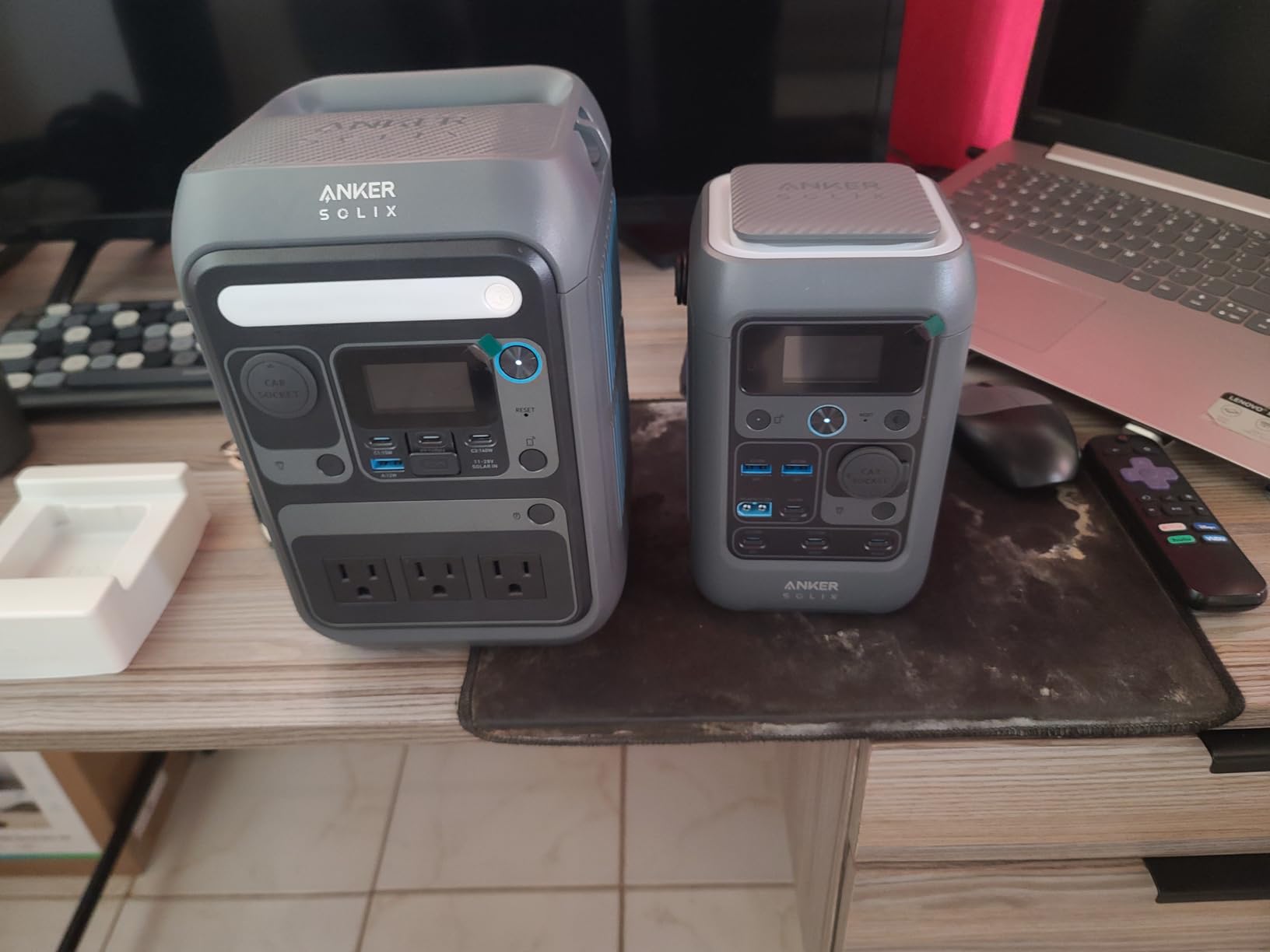
Noise is the underrated spec. At 25dB measured at 3.3 feet, with smart temperature control on the cells, it is quiet enough to sit in a room you work in rather than a corner of a garage. A lot of 300W-class units are not.
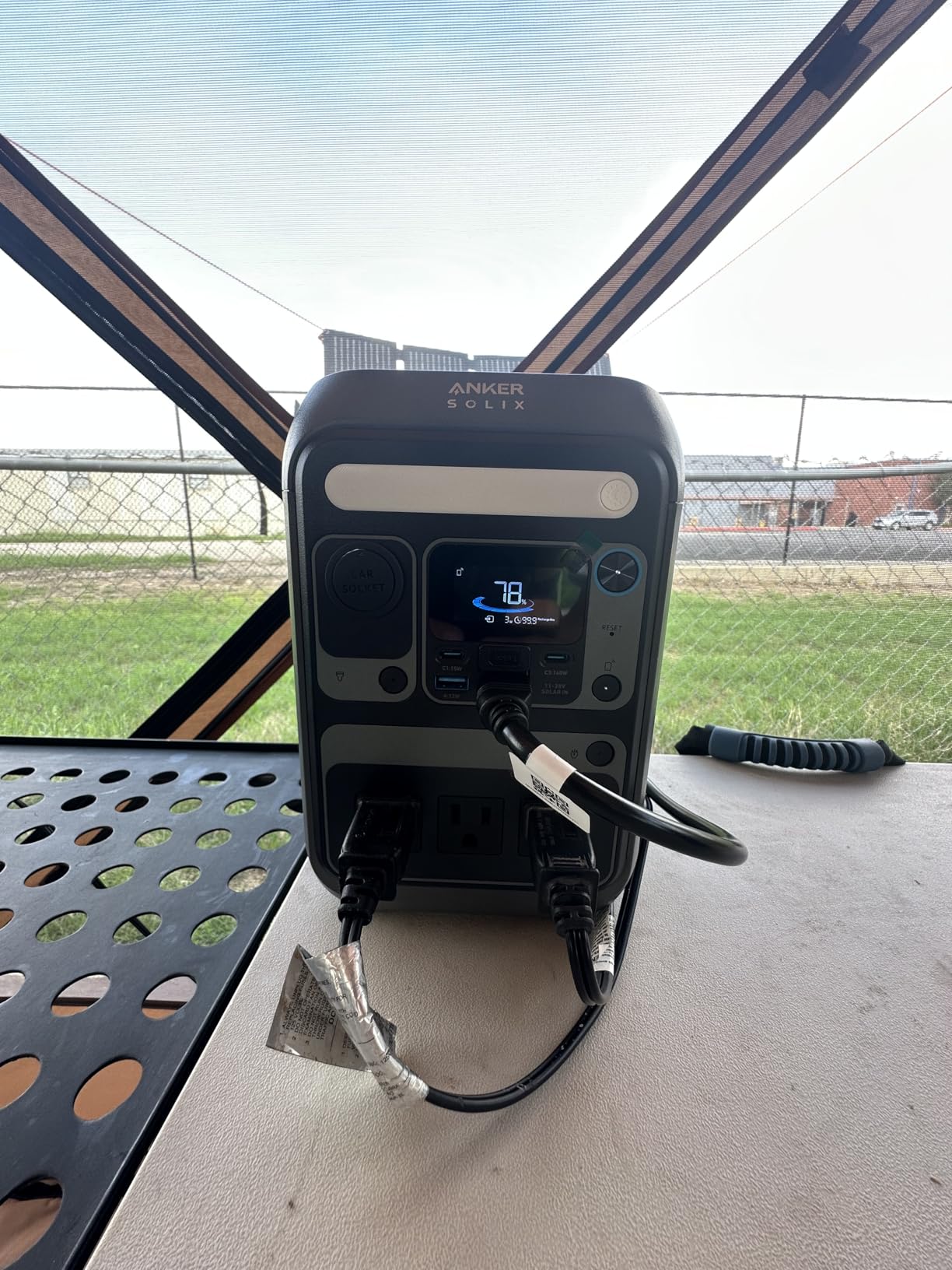
Charging from a wall reaches 80 percent in 50 minutes, and the full battery takes 68 minutes. Solar, car and PD 3.1 USB-C inputs are all supported, and the unit is 15 percent smaller than comparable designs.
Where This One Fits Best?
A home office in a backyard shed. A laptop, two monitors, a router and a lamp draw well under 300W combined, and 288Wh covers a full working day of that profile comfortably. Quiet operation matters in a room you sit in for hours.
It also works as a bench supply for chargers, small fans, soldering irons and battery chargers, where 300W is plenty and silence is appreciated.
Limitations Worth Knowing
288Wh is the ceiling. Run a 200W load and you have about an hour and a half before the battery is spent, so it is a supplement to grid power rather than a replacement. Higher-draw tools are simply outside the design point.
Two compatibility issues catch people out. The bundled 60W panel is not compatible with Anker SOLIX PS30, PS200 or PS400 panels, and the carry strap is sold separately. The station and panel also arrive in separate boxes.
We earn a commission, at no additional cost to you. CERTAIN CONTENT THAT APPEARS ON THIS SITE COMES FROM AMAZON. THIS CONTENT IS PROVIDED 'AS IS' AND IS SUBJECT TO CHANGE OR REMOVAL AT ANY TIME.
How to Size a Solar Kit for Your Shed?
Start from the loads, not the panel wattage. This is the single biggest mistake we see, and it is also the advice that dominates the r/SolarDIY consensus: figure out what you will actually use the electricity for, and start smaller than you think. Electric heat, air conditioning and coffee equipment are the first items to delete from any list.
Work through it in three steps. List every load and its wattage. Decide how many hours per day each one runs. Multiply to get daily watt-hours, then divide by the peak sun hours your site receives to get panel watts.
The table below maps common shed loads to the kit class that handles them. Surge figures matter for anything with a motor, because compressors and saws draw a spike at startup that is several times their running draw.
LED strip or shop light: 10 to 40W running, no surge. A 100W kit covers a full evening comfortably. Ceiling light and phone charging: 15 to 25W combined. A 20W to 30W maintainer-style kit is genuinely enough. Laptop and router: 45 to 65W for a few hours, roughly 150 to 200Wh per day. A 100W panel sustains this indefinitely. Cordless tool charger: 60 to 120W while charging, about 60W for a single battery. One charge a day is realistic on a 200W kit. Mini fridge or 32-quart portable fridge: 40 to 60W running with compressor surge well above that, drawing 200 to 400Wh per day. This needs at least 1,000Wh of battery and a pure sine wave inverter. Table saw or circular saw: 1,200 to 1,800W running with surge above 2,000W, pulling 500 to 900Wh per hour of use. Only a 1,500W to 2,000W inverter handles this, and only intermittently. Air compressor: 1,000 to 2,000W running with substantial startup surge, pulling 700 to 1,600Wh per hour. Same inverter class as the saw, and you need surge headroom. Space heater or air conditioning: 1,500W and up, running continuously. Solar is the wrong answer.
Expectations matter as much as the numbers. A 200W monocrystalline panel yields roughly 600 to 1,000Wh per day, a 400W panel roughly 1,600 to 2,500Wh, and results fall with cloud, angle and season. In a northern winter with short days, plan on a fraction of summer output and size the battery, not the panel, to carry you through.
If you are still working out where the system goes, the roof pitch and orientation of your building decide how many panels fit at all. Our [plastic shed guide](https://bansocialism.com/best-plastic-sheds/) covers the flat and sloped roof options where panels mount most easily.
PWM vs MPPT: Which Charge Controller You Actually Need?
MPPT controllers recover 20 to 40 percent more energy than PWM controllers in many real installations, but the benefit shrinks as array voltage drops and grows in cold, cloudy or partially shaded conditions. That is the whole decision in two sentences.
PWM simply chops the panel output to the battery voltage. Energy above the battery threshold is discarded as heat, so a 30V panel feeding a 12V battery loses a large fraction of its output. MPPT runs the panel at its true maximum power point and converts efficiently, so more of the same sunlight reaches the battery.
Practical guidance: stay with PWM for a single 100W or 200W panel on clear roof with no shade, where the cost difference is not recovered. Move to MPPT for 400W arrays, for anything in partial shade, for winter use in cold climates, and for any build where you will add panels later. Three of the kits in this guide use PWM, one uses MPPT, and the power stations have the converter built in.
12V, 24V or 48V: Choosing a System Voltage
Higher system voltage means lower current for the same power, which means thinner cable and smaller components. It is the difference between a comfortable install and an awkward one at 400W and above.
At 12V a 400W array pushes over 30 amps, so you need heavy gauge cable throughout. At 24V the same array runs about 15 amps, and at 48V around 8 amps. Cable cost falls sharply as current drops, and many charge controllers are simply specified for 12V systems only.
For shed lighting, phone charging and tool charging, 12V is correct and simplest. For a workshop running multiple power tools, 24V is the sweet spot. Push to 48V only when you are building something close to a small house, because the inverter, charge controller and battery all have to agree on the voltage and the parts get more expensive quickly.
The ECO-WORTHY two-panel kit in this guide is the one exception that bridges the two, because its MC4 connectors let you wire the pair in series for 24V or parallel for 12V, and the Renogy 400W MPPT accepts up to 32V on the battery side.
What to Buy Separately From the Kit?
Most complete kits in this category are not complete. The parts below are the ones buyers most often discover are missing after delivery, and they are all inexpensive relative to the frustration of not having them.
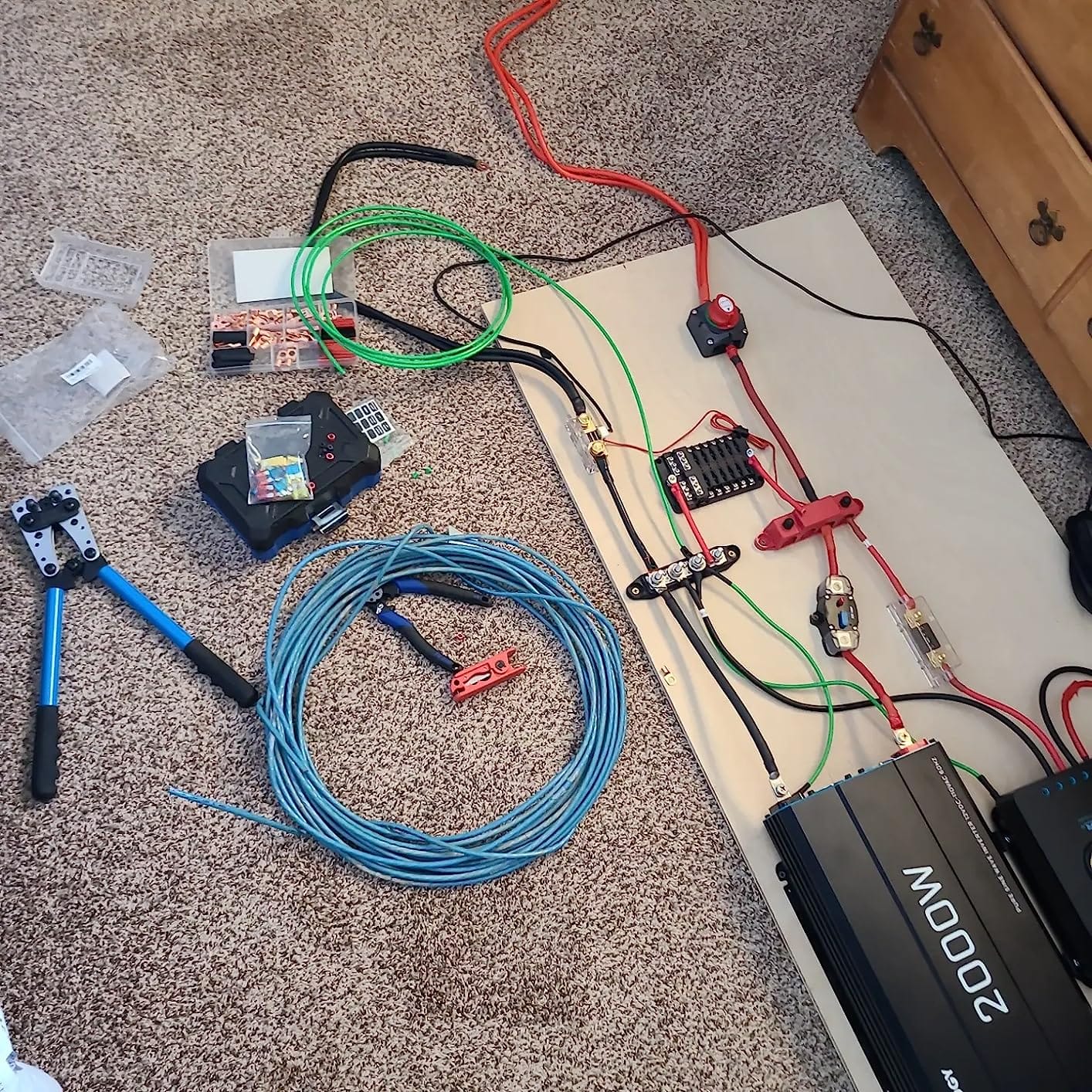
A fuse block and holder for the battery lead, plus appropriately rated fuses, protects both the battery and the wiring if a controller fails short. A disconnect switch between the battery and everything else lets you work on the system safely, and it is close to mandatory practice. A proper circuit breaker on the AC output side protects your tools and the inverter. Voltage-rated cable for any run longer than about 10 feet, because the thin wire included with many kits is not adequate for distance. Ring terminals and a crimping tool for clean battery connections. And weatherproof enclosures or a rated junction box for any controller mounted outside.
Also budget a battery if the kit does not include one. The panel-and-controller kits in this guide, including the 400W MPPT, all require you to source a bank separately, sized in amp-hours to your daily load and your expected cloudy stretch.
Mounting Panels on a Shed Roof, Tilt and Orientation
Panel orientation matters more than almost any other variable. South-facing is best in the northern hemisphere, and within that, tilt should roughly match your latitude to balance winter and summer output. A roof pitch near 30 to 40 degrees is close to ideal for most of the northern US and UK; a flat roof needs a tilt frame.
On a shed roof, use the pre-drilled holes and the Z-brackets supplied with the kit, with a standoff that lets air circulate behind the panel. Panels sitting flat against a roof or wall lose output to heat, and that loss grows sharply in summer. Never lay a panel flat on shingles or an unventilated surface.
Where you cannot get a good angle, an adjustable ground or wall mount is better than a bad roof mount. The 360-degree bracket in the SOLPERK maintainer kit is the cheapest example of that idea, and purpose-built tilt frames exist for 100W to 400W arrays.
Finally, keep the wiring run short between panel and controller, and keep the controller itself out of direct sun and rain where the housing rating allows. A controller in direct sun on a hot roof can run well above its comfortable temperature, and forum reports of hot-running controllers are common for exactly this reason.
Frequently Asked Questions
How many solar panels do I need to run a shed?
For lighting, phone charging and a laptop, one 100W to 200W panel is enough, producing roughly 500 to 1,000Wh per day. Running a mini fridge or tool chargers needs at least one 400W panel plus a battery of at least 1,000Wh. Anything drawing over 1,200W continuously, such as a table saw or air compressor, needs a 1,500W to 2,000W inverter and a battery bank rather than a larger panel alone.
What is the best solar system for a shed?
For most sheds, the Renogy 100W 12V Starter Kit is the best fit, because it is the smallest complete system that reliably runs LED lighting, phone charging and small devices over a weekend. If you want 120V outlets and plan to run tools, an all-in-one power station such as the Anker SOLIX C1000 Gen 2 with its 200W panel is the better starting point, since panel-only kits have no inverter.
What is the 33% rule in solar panels?
The 33% rule says a solar panel loses about 33 percent of its rated output before your electricity reaches the battery. Losses come from heat, dust, shading, wiring resistance, the conversion from DC to AC in the inverter and the charge controller itself. It is why a 200W panel rarely delivers a full 200W to a device, and why oversizing slightly is common practice.
Which solar panel brand is the most reliable?
Reliability is best judged by review count and warranty length rather than brand name. In this category Renogy leads on proven panel longevity with 10-year material and 25-year output warranties on some models, while the LiFePO4 power stations from Bluetti, Anker and Jackery all carry multi-year coverage on the battery. UL 61730 certification on the panel and UL 1741 on the inverter are meaningful markers of third-party testing.
Is a 200W solar panel enough?
A 200W panel is enough for lighting, device charging, a laptop and occasional cordless tool charging, producing roughly 600 to 1,000Wh per day. It is not enough for a mini fridge, a table saw or an air compressor. The panel fills the battery, so what you really need for bigger loads is a larger battery bank and a pure sine wave inverter, not simply more panel.
How long will a 400W solar panel take to charge a 200Ah battery?
A 200Ah 12V battery holds about 2,400Wh. With a 400W panel producing roughly 1,600 to 2,500Wh per day, a full charge takes about one to two hours of peak sun in theory, but in practice three to five hours of good sun is realistic once controller and conversion losses are counted. Charging below the absorption stage takes considerably longer, and winter output shortens the window further.
Will a 400W solar panel run a fridge?
A 400W panel can keep a small fridge running, but the panel alone cannot. A fridge draws 40 to 60W while running, with compressor surge well above that, and it needs power around the clock rather than only during daylight hours. You need at least 1,000Wh of battery storage, a pure sine wave inverter, and enough panel to refill that battery each day after overnight drain.
Final Verdict: Best Solar Panel Kits by Scenario in 2026
For the majority of sheds, the best solar panel kits for sheds and workshops start at the small end. The Renogy 100W 12V Starter Kit wins for lighting, charging and security devices because it is proven, complete and cheap to run. If you want AC outlets and power tools, the Anker SOLIX C1000 Gen 2 with its 200W panel is the strongest all-round tool kit, and the BLUETTI Elite 100 V2 is the better choice when loads are mixed or more numerous.
Move up to the Renogy 400W MPPT kit when you have confirmed you need serious daytime harvest, and choose the ECO-WORTHY two-panel kit if you want the option of a 24V build. For lighting alone, the GVSHINE 30W kit and the SOLPERK 20W maintainer remain the simplest answers, and the Anker SOLIX C300 is the quietest unit for a shed that doubles as an office.
Whatever you choose, budget for the breakers, disconnects and cable that most kits omit, and size the battery for your cloudiest winter week rather than your sunniest summer day. That single piece of advice is the difference between a system you enjoy and one you stop trusting.